Hopes and Dreams: What the top-tier Positive Psychology Researchers wish for 2016

One day before New Year’s Eve, I sent an e-mail to some of the foremost researchers and experts in Positive Psychology and adjacent. I asked them to answer one of the following questions.

  • What do you hope for Positive Psychology in 2016?

  • What are your expectations of Positive Psychology in 2016?

  • What would be a breakthrough for Positive Psychology in 2016?

Positive Psychology Researchers - Mappalicious

While there obviously is a lot of variation in their answers, one common topic is the notion that Positive Psychology needs to shift its attention from individual wellbeing to a broader perspective: systemic or holistic wellbeing, so to say. The answers are displayed below in alphabetical order.

Shawn Achor, CEO of GoodThink Inc. and author of The Happiness Advantage:

I hope positive psychology continues to attract top talent inside and outside of academia, while re-embracing concepts like “happiness” which appeal to the non-academic population rather than going for jargon. I expect that positive psychology will take firmer hold inside of companies as more research comes out. We need a top company or celebrity to credit “positive psychology” (rather than individual interventions) for their success. I’d like to see a celebrity say positive psychology is so important they are donating money to spark the movement.

Robert Biswas-Diener, “Indiana Jones of Positive Psychology” and co-author of Upside of Your Dark Side:

What trends do I expect? 1) An increasing push to brand “positive” with different specialties (positive education, positive real estate, positive boxing, etc.). I think positive education has the greatest momentum so we will see more and more of this. 2) An increasingly “life hack” approach to disseminating positive psychology. For example, many bloggers, etc. will harp on single published studies or offer simplistic advice as a sort of low-cost cheat with big payoffs. I see this as akin to promoting effective communication by saying “use 3 hand gestures every minute.” Artificial, simplistic, dubious. I think this is a by-product of market forces on positive psychology. I think the real action– the important action– will happen in research (see below).

What I hope for: 1) This will take time but there are at least two labs that are undertaking very sophisticated intervention studies. Using careful methods, longitudinal sampling, careful controls, and consulting with academics such as clinical trial researchers to improve the quality of this research. 2) I think we will see an expansion in topics covered. Grit, resilience and happiness, to name three, have been popular, but I think we will start seeing more topics integrated: interest, friendship, hospitality, intelligence, attention, etc. 

Kim Cameron, professor at University of Michigan and co-founder of the Center for Positive Organizations:

My expectation is that the international membership* will double, and that in 18 months we will have as many non-USA members as we do members from The United States.

* This reply somewhat confused me. I conjecture that Professor Cameron is referring to the International Positive Psychology Association (IPPA).

Angela Duckworth, professor at University of Pennsylvania and author of Grit:

My hope for Positive Psychology in 2016 is that there continues to be the scientific rigor that elevates this endeavor to something other than feel-good self-help!

Jane Dutton, professor at University of Michigan and co-author of How to be a Positive Leader:

I have one big wish: I hope for more serious research and consideration of how work and organizational contexts matter in limiting or facilitating human flourishing. My expectation (and deep hope) is that there will be an explosion of research in positive organizational psychology and that it will be used to foster humility and carefulness in how to apply positive psychology in work settings.  

Adam Grant, Wharton professor and author of Originals:

I hope for a shift in focus from the mind to behavior. Positive psychologists have paid a great deal of attention to cognitions and emotions, strengths and virtues, but far less to the actions that make our lives better.

Tim Kasser, professor at Knox College and author of The High Price of Materialism:

I hope that Positive Psychology will become less focused on trying to increase peoples’ personal happiness and instead recognize that a good life also includes living one’s life in ways that promote the well-being of other people and the ecological sustainability of the planet.

Scott Barry Kaufman, scientific director of the Imagination Institute, researcher and lecturer at Penn, and author of Wired to Create:

I’d like to see more research on Positive Communities, and deepen our understanding of their development and benefits. There’s so much of a focus on individual flourishing measured through self-report questionnaires. I’d like to see much more research on meaning as measured by the functioning of larger systems of people and community structures.

Dacher Keltner, professor at Berkeley and co-director of the Greater Good Science Center:

I hope that positive psychology will use its wisdom to tackle the costs of inequality and poverty.

Sonja Lyubomirsky, professor at University of California, Riverside and author of The How of Happiness:

I hope for the label “positive psychology” to be retired. We don’t need it anymore!

Ryan Niemiec, Education Director of the VIA Institute on Character and author of Positive Psychology at the Movies:

I expect there to be an array of important published and forthcoming studies on positive psychology interventions with problems (e.g., conflicts, disorders, stressors, dark side).

Martin Seligman, co-founder and spiritus rector of Positive Psychology:

I hope that more exoplanets suitable to life will be discovered* and that David Mitchell will publish another novel.

* I guess Marty has answered my question in a more comprehensive way. Always dreaming big, I daresay.

Amy Wrzesniewski, professor at Yale and one of the world´s foremost experts on meaning at/in work:

I hope that we see more top tier peer-reviewed research that sheds helpful light on the antecedents and outcomes of people finding a sense of meaning in their lives! Am doing my best to help!
22 Positive Psychology-infused Articles every (HR) Leader should know

Positive Organizational ScholarshipPositive Psychology has a lot to offer for leaders, especially those people taking on a leadership role in human resources and people management. In this post, I´ve gathered 22 research articles infused by Positive Psychology (more specifically: Positive Organizational Scholarship) that, in my opinion, have tremendous value for aspiring as well as established managers and entrepreneurs.

The topics comprise desirable attributes and personality variables such as grit, character strengths, and core self-evaluations, how to create positive relationships at work, how employee motivation is created and sustained, how to find meaning and purpose in work, and several review articles, e.g., on the connection of positive emotions and job performance. Enjoy!

P.S.
This is my 300. post since I’ve started Mappalicious about two years ago. Giving myself a slight pat on the back right now…

There´s a Negativity Bias in your News. But not, if you follow these People on Twitter

A couple of weeks ago, I pusblished a list of 77 Positive Psychology People and Institutions to follow on Twitter which has grown by now to more than 90 accounts and was also picked by the friendly folks at Fulfillment Daily.

Today, I thought it would be a good idea to check my blog stats to see who profited the most from this. All in all, the post resulted in +4,500 klicks on people´s Twitter accounts. Here´s the Top-10 (excluding the Twitter list I created to follow all of those people):

Positive Psychologists on Twitter

So congratulations to Robert Biswas-Diener, Sonja Lyubomirsky, Paul Bloom, Dan Gilbert, Amy Cuddy, Robert Emmons, David Cooperrider, Jane Dutton, Emilia “Queen of Sisu” Lahti, and Jon Haidt. I hope those clicks converted to a lot of new followers for you!

Being your Best on the Job: The Case of Thriving at Work

A couple of days ago, I shared some videos where Kim Cameron elaborates on his ideas about organizational energy. Yesterday, I stumbled upon an adjacent concept that I find equally interesting: Thriving (at work). It was first described by a group of researchers comprising – among others – Gretchen Spreitzer and MAPP lecturers Jane Dutton and Adam Grant.

Striving is a seen as a two-dimensional construct. In short, we experience ourselves as striving when we feel a sense of a) vitality and b) learning. More precisely, vitality represents a sense that one is energized and has a zest for work. Learning, in turn, is signified by the acquisition and application of knowledge and skills to build capability and confidence.Together, these dimensions capture both the affective (vitality) and cognitive (learning) essence of the psychological experience of personal growth (Porath, Spreitzer, Gibson & Garnett, 2011).

There is some preliminary evidence that the experience of thriving as depicted above is significantly linked to favorable outcomes such as job satisfaction, organizational commitment, and even performance. In this paper, a questionnaire for the measurement of thriving is described. If you´re interested, please watch this short video of Gretchen Spreitzer describing the concept. Enjoy!

The Rise of Positive Psychology: Linking the Movement to the 6th Kondratieff Cycle

One very interesting question about Positive Psychology is: Why now? Meaning: Why is it booming at this point in time, why is it gaining so much momentum, why is it turning into a – sort of – movement, attracting the attention of thousands of researchers (plus: institutions that fund research) and practitioners in business, education, healthcare – and elsewhere?

An easy answer could be: Because Marty Seligman chose it as the central topic of his tenure as president of the APA in 1998. Apart from being a brilliant researcher, Marty has proven to be a very good “salesman” and is also highly skilled at securing grants and other third-party funds. But I guess this response is too simple.

The core ideas of Positive Psychology (first and foremost: looking at the “positive” side of the continuum that comprises human behavior and development) have been around for a while, starting with some of the Greek philosophers – and leading all the way up to 20th century humanistic psychologists such as Viktor Frankl, Erich Fromm, and Abraham Maslow. They all do have their well-deserved spot in the psychology hall of fame – and they are widely respected for their (theoretical) contributions. But they did not really manage to turn their ideas into a widely-accepted and especially well-researched “field”, a broad and comprehensive sub-domain of the academic community.

All the forces in the world are not so powerful as an idea whose time has come. (Victor Hugo)

Turns out it may not be their fault after all. There is a good chance that they were simply introducing their ideas to the world…too early. Positive Psychology may be booming during this era of economic development (and human development in general) because it could be the decisive force to spur growth and well-being over the next 50 years (or so…).

Positive Psychology and the sixth Kondratieff Wave

Enter Nikolai Kondratieff (1892-1938). Kondratieff devised an economic theory that today is known as Kondratieff Cycles (often called „theory of the long waves“). They are a concept in macro-economics that describes the development (expansion, stagnation, recession) of entire economies. Yet in contrast to most modern economic theories, Kondratieff did not focus on cycles that last for a few years. He tried to describe waves that last approximately 50-60 years.

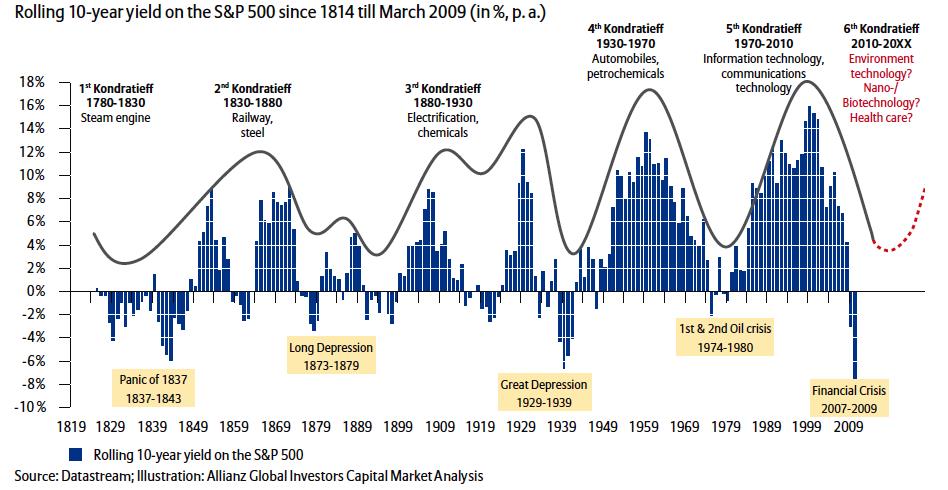
A core concept of the theory is the notion of “basic innovations”: Kondratieff posited that a wave arises from the clustering of technical innovations that consecutively serve to launch technological revolutions that in turn create leading industrial or commercial sectors (please see the following graph taken from a research report created by German insurance giant Allianz for a basic overview of the first five cycles – and a projection for the upcoming sixth cycle):

Kobdratieff Waves

As you can see our economy is depicted as entering the sixth wave since the first industrial revolution. What you can also see is a list of candidates for the basic innovations that are projected to drive economic growth during the upcoming cycle (e.g. nanotechnology, biotechology, green-tech).

But there´s another important candidate on the list that is also elaborated on in the Allianz whitepaper – but was introduced to the public a lot earlier through the book The Sixth Kondratieff by Leo Nefiodow (which has recently been reissued in a 6th edition): Holistic health. This encompasses all those products and (medical) services that cater to the needs of an aging society. But it also decidedly incorporates all the services that cater to the psycho-social wellbeing of the workforces in our organizations.

This is where Positive Psychology as a growth driver may tie in. Phenomena such as the burnout syndrome have been on the rise for at least the past 15 years – resulting in billions and billions lost for corporations and society as a whole as a result of absence from work and medical costs (…and I´m not even trying to incorporate the “psychological costs”; and the “social costs” for families, friends, communities). And according to Gallup, the U.S. economy loses some 450-550 billion Dollar per year due to a disengaged workforce (for Germany, the number is depicted at around 130 billion Euro).

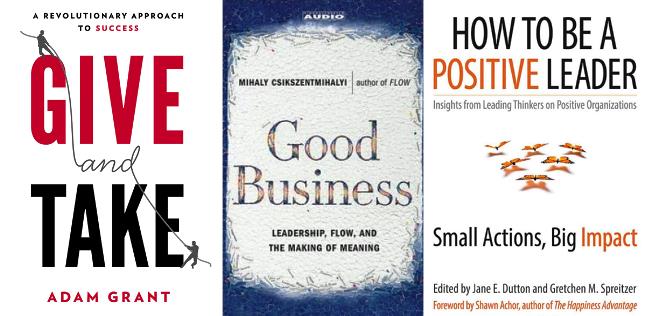
Positive Psychology (especially positive organizational scholarship) offers well-researched and at the same time practical solutions for (a lot of) these problems, at the individual and organizational level. For an overview, you might want to check the recently published book How to Be a Positive Leader: Small Actions, Big Impact by editors Jane Dutton and Gretchen Spreitzer. Other valuable books can be found on this list.

To sum up: I propose Positive Psychology may be the decisive basic innovation of the 6th Kondratieff wave.

What do you think of this?

Positive Psychology at Work: A Book List for the Layman [updated]

Here, I´ve compiled a list of books that apply Positive Psychology to the realm of “the organization”, leadership, management etc. As always, I see the list as work in progress and will be happy to include your suggestions. When making suggestions, please stick to books that have a clear link to Positive Psychology and are (by and large) backed by research.

Positive Leadership Books

Being a better Leader by managing organizational Energy [Video]

A couple of days ago, I wrote a post about Positive Organizational Capital as introduced to the Positive Psychology community by Fred Luthans. Today, I´d like to point you to another concept based on Positive Organizational Scholarship (POS), precisely: (Positive) Energy. I´ve already touched upon that topic quite a while ago – when introducing some of the work of the marvelous Jane Dutton.

Below, you´ll find a 3-minute video of Kim Cameron, one of the founding fathers of POS. He talks about the concept of (Positive) Energy, and how to assess and manage it – and why it´s crucial when being in a leadership role.

And it´s not that complicated after all. We should ask ourselves:

  • Is it an uplifting experience when working with colleague XYZ?
  • Do I feel elevated when being around this person?
  • Is this relationship live-giving?

The goal is too have as many people “on board” where you can answer those questions with “yes”. You can read more about the concept of energy in Jane Dutton´s book Energize Your Workplace. And please also check out the work of Esa Saarinen on Systems Intelligence.

My Mind´s MAP(P): The 4-minute Ivy League Diploma in Positive Psychology

MAPP 9 Superhero MedalFor one of our MAPP final papers, we were asked to come up with a list of bits and pieces of insight, those “eureka moments of comprehension” we´ve had over the two semesters at Penn. I´d like to share those with you as a kind of “MAPP in a nutshell”. As I like to tie knowledge to those teachers that are “responsible” for my comprehension, I will present them to you in that way. Therefore, I´ve created a list of (to my knowledge) all the persons that have taught in MAPP 9 at one point or the other, and will name those that have provided me with an especially memorable insight. Those perceptions do encompass theoretical insights from positive psychology, its real-world application (or its contribution to real-world application of other psychological concepts), or style of (teaching) delivery…

Roy Baumeister: Bad is stronger than good (precisely: bad events and emotions create a stronger and longer-lasting impact on our brains). Therefore, we need to purposefully create more positive events and emotions in our lives to counterbalance this one-sidedness (with a tip to the hat to John Gottman…).

Dan Bowling: Everything that can be done can also be done with style. It makes the world a brighter place.

Art Carey: Has shown me how important the process of writing is for my own life – and that part of my future career should consist of getting paid for being a “wielder of words”.

David Cooperrider: Words create worlds. Accordingly, positive words will create (mostly) positive worlds – whereas negative words will create (mostly) negative worlds. So use your words wisely, especially your questions – as they tend to create the worlds within other people´s minds.

Angela Duckworth/Peggy Kern: Woohoo! Learning (and teaching…) statistics can be fun. Go figure…

Jane Dutton: High-Quality Connections (HQC) are the high-octane fuel of every organization. Suspend your judgment and try to walk a mile in your fellow men´s shoes before coming to any conclusion. Build trust via giving open, positive feedback – if possible, on a daily basis.

Chris Feudtner: Keeping an open heart while working in dark places (e.g. palliative care units for children) can grant you an enormous “aura” and tangible “clarity of the mind”. When there´s nothing left, there can still be hope. What do we hope for – when there´s no other option left but hope?

Barbara Fredrickson: Positive emotions are not a trifle. They are essential building blocks for our well-being and should be fostered actively.

Adam Grant: It is more blessed smarter to give than to receive. Being altruistic does not turn you into a doormat. It can lead to success, even in competitive corporate environments.

Jonathan Haidt: 1) There are no good reasons (at least not good enough) to be pessimistic about the fate of mankind. Judged by most empirical indicators, it´s not foolish to say that we are on an “upwards trajectory”: things are bound to get better. On that note, I would also like to thank my classmate David Nevill for giving me the sentence “We never have enough data to be pessimistic.” It continues to inspire me, even on a sort of metaphysical level. 2) Look to the extreme ends of the (positive) emotional continuum, e.g., to emotions such as awe and elevation. They may be powerful change catalysts.

Emilia Lahti: You have tons of soul mates somewhere out there. They may live at the other end of the world. But eventually, some of them will find you (especially if you start a blog, that is…)

Ellen Langer: Everything that can be done is worth being done mindful. It leads to better results and more satisfaction. Plus: Don´t fear getting old.

Daniel Lerner: Everything that can be done can also be done with “an eye for excellence”. It pushes the boundaries of human achievement.

Chris Major: A man with a true purpose is (almost) unstoppable.

Ryan Niemiec: 1) Strengths matter more than frailties. They are the key to our “true self” and the building blocks on our road to (work and life) satisfaction. 2) A movie is never “just a movie”. It´s a lesson on character strengths.

Off the Beat: Singing is life!

Ken Pargament: Even atheists value the “sacred moments” in their lives. Find them, cultivate them, and cherish them. They are valuable.

James Pawelski: 1) Trust the process. 2) It´s always valuable not to be the smartest person in the room. 3) Know which giants´ shoulders you are standing on. 4) There is nothing more practical than a good theory (and a proper definition). 5) Know the limits of your knowledge. 6) Positive psychology is grounded in meliorism (the belief that people/things can improve/be better than they are today). 7) You can be a proper scientist and nevertheless enjoy Tony Robbins.

Isaac Prilleltensky: Fairness on the community and societal level influences our individual well-being. Countries with developed democracies, a high degree of personal freedom, generous social security systems and relatively small gaps between top earners and “normal” workers are the happiest (on average)

John Ratey/Tom Rath: Move your ASS! Your brain will appreciate it.

Ann Roepke: Our life is a narrative and as such, we do have tremendous power over it by actively re-writing or pre-writing the storylines.

Esa Saarinen: Don´t hold back. Create systems of generosity. Err on the giving side. Embrace your inner (and outer!) “weird”.

Barry Schwartz: 1) Most times, “good” is “good enough”. 2) Purposefully limit the choices you have to make in life. E.g., choose not to choose by setting defaults and creating habits.

Martin Seligman: Think and dream big.

Daniel Tomasulo: Everything that can be done can also be done with a twinkle in the eye. Makes hard work feel “easy”.

Amy Wrzesniewski: Purpose and meaning (at work) are the result of finding work that integrates your strengths, passions, and values. The calling comes from within. Other people matter (at work, too).

I am deeply thankful to all of you!


P.S. Thanks to my classmate Linda Rufer for designing those MAPP 9 superhero medals. The backside says I was voted “most mappalicious” person in our cohort. Whatever that means at the end of the day… 🙂

Positive Psychology and MAPP at Penn: Doing that Namedropping Thing

Actually, I should be busy writing on my MAPP final papers right now. But then, taking short breaks is supposed to help your mind stay fresh, right?

By now, a lot of people that have read my blog also contacted me to ask about my MAPP experience. Obviously, it´s not that easy to tell a story of 10 months in a few sentences. Hey, that´s why I started this blog in the first place…* There´s also been some questions about the tuition – and to be honest, it´s not exactly a bargain. I could have not taken part without some generous support from my employer (or rather: my boss). But hey – Penn belongs to the Ivy League and that comes with a price tag.

If you´d like to know why I am convinced that it was worth each and every penny (and much more…), please read my blog front to back. Otherwise, you might be convinced by the sheer (work-)force of people that you’ll  have the pleasure and honor to learn from. So here is the name-dropping list. Please note that the guest lecturers and assistant instructors will vary from year to year (C = core faculty; G = guest lecturer; A = assistant instructor that has taught part of a class at some point):

That´s value for money…

*And to become super-duper famous, of course…

“You´re doing just fine.” On the Power of Trust and day-to-day Positive Feedback

Blind SymbolAs I´ve already told you in this post on the significance of empathy, one guest lecturer at MAPP 13/14 onsite has been Jane Dutton who is known best for her research and teaching on high-quality connections (at work).

Jane stopped her lecture once in a while to lead us through some practical exercises on that topic. On one occasion, half of the group was blindfolded and then led through the hallways of Penn´s Huntsman Hall by the other people for several minutes. Now, I´ve done this sort of thing a couple of times before in coaching seminars – but I´ve never had such a powerful realization as I had this time:

I was feeling pretty save and comfortable in the beginning. My partner guided me with her hands and simple verbal cues, telling me to go left and right whenever needed. At one point, we were walking straight along a stretched-out hallway.* All I had to do was walk straight-on – so my partner stopped giving verbal feedback.

Somewhere half-way down that hallway, there was an ever so small bump in the floor, I guess a spot where a cable lay beneath it. But it was enough to catch me off-guard and lessen my trust considerably. Upon understanding that, my partner started to behave very differently. Instead od telling me only about necessary changes, she started to give me constant feedback, mostly along the lines of:

You´re doing just fine. The way is free. Just keep on going!

What a tremendous change that was! A genuine difference that makes a difference! And a powerful metaphor for everyday (business) life…

Because, on a closer look, we´re running around blindfolded all the time. We hear, see, and know so little compared to the sheer endless amount of information that is out there and could be of value for us. What a difference it makes to just hear “You´re on the right track” from somebody who just happens to know a little bit more than you do.

So if you´re a boss, a parent, or just somebody who happens to care about other people: How about telling them that they´re doing fine at least once every day? Not because they did something special. Just because they need and deserve it…


*I still wonder what all those suited-up Wharton MBAs thought of our crazy group of people playing children´s games in their sacred halls…