7 more essential Books on Positive Psychology for 2015/16

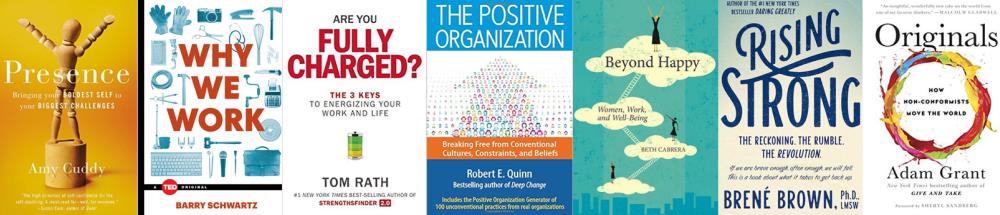
After publishing a list of 5 essential upcoming books on Positive Psychology a couple of days ago, several friendly people approached me (Thank you!) to point me towards further noteworthy books that have just been published or are already appearing on the publishing horizon (a.k.a. on Amazon for pre-order). So, if you´re looking for further entertainment, enlightenment, or just plain Positive Psychology science, here you go. There´s books on women´s careers, rising strong after setbacks, good work and great organizations, world-changing individuals, and much more (click to enlarge the image). Enjoy – and share the good news!
Positive Psychology Books 2015 & 2016

Positive Psychology books that have already been published

Brené Brown: Rising Strong. Brené Brown is a professor at the University of Houston Graduate College of Social Work and author of the No. 1 New York Times bestseller “The Gifts of Imperfection”. About the book:

“It is the rise from falling that Brown takes as her subject in Rising Strong. As a grounded theory researcher, Brown has listened as a range of people — from leaders in Fortune 500 companies and the military to artists, couples in long-term relationships, teachers, and parents — shared their stories of being brave, falling, and getting back up. She asked herself, What do these people with strong and loving relationships, leaders nurturing creativity, artists pushing innovation, and clergy walking with people through faith and mystery have in common? The answer was clear: They recognize the power of emotion and they’re not afraid to lean in to discomfort.” 

Beth Cabrera: Beyond happy: Women, Work, and Well-Being. Beth Cabrera is a senior scholar at the Center for the Advancement of Well-Being at George Mason University and works with companies to help them create positive work environments. About the book:

“Over the course of a decade, Beth Cabrera has surveyed and interviewed more than a thousand women to gather insight into how to effectively balance career and family responsibilities. Beyond Happy: Women, Work, and Well-Being gathers essential findings and offers women proven strategies for living more authentic, meaningful lives. Through the lens of shared experience, Cabrera thoughtfully examines the challenges women face and presents a simple yet powerful model for enhancing well-being that can both improve and transform lives.”

Tom Rath: Are you fully charged? Tom Rath is a Penn MAPP alum, now a regular guest lecturer in that program, and otherwise, regularly to be found at No. 1 spots on the New York Times bestseller lists with his heavily Positive Psychology-infused masterpieces. About the book:

The book “reveals the three keys that matter most for our daily well-being, as well as our engagement in our work. Drawing on the latest and most practical research from business, psychology, and economics, this book focuses on changes we can make to create better days for ourselves and others. Are You Fully Charged? will challenge you to stop pursuing happiness and start creating meaning instead, lead you to rethink your daily interactions with the people who matter most, and show you how to put your own health first in order to be your best every day.”

Barry Schwartz: Why we work. Barry Schwartz is a professor at Swarthmore College, author of the highly-acclaimed The Paradox of Choice and a regular New York Times contributor, and a regular guest lecturer in the Penn MAPP program. About the book:

“We’ve long been taught that the reason we work is primarily for a paycheck. In fact, we’ve shaped much of the infrastructure of our society to accommodate this belief. Then why are so many people dissatisfied with their work, despite healthy compensation? And why do so many people find immense fulfillment and satisfaction through “menial” jobs? Schwartz explores why so many believe that the goal for working should be to earn money, how we arrived to believe that paying workers more leads to better work, and why this has made our society confused, unhappy, and has established a dangerously misguided system.”

Robert E. Quinn: The Positive Organization: Breaking Free from Conventional Cultures, Constraints, and Beliefs. Robert E. Quinn is a professor at University of Michigan´s School of Business and author of “Deep Change”. About the book:

“Beholden to accepted assumptions about people and organizations, too many enterprises waste human potential. Robert Quinn shows how to defy convention and create organizations where people feel fully engaged and continually rewarded, where both individually and collectively they flourish and exceed expectations.”

Upcoming books on Positive Psychology

Amy CuddyPresence: Bringing Your Boldest Self to Your Biggest Challenges. Amy Cuddy is a professor at Harvard and best known for her research on body language and “power-posing” (watch her TED Talk here). About the book:

The book “shows us we need to stop worrying about the impression we’re making on others, and instead change the impression we’re making on ourselves. Cutting-edge science reveals that if we adopt behaviors reflecting power and strength, we liberate ourselves from the fears and doubts that obstruct us. By redirecting our thoughts, actions, and even physiology, we free ourselves to be our best.”

Adam M. Grant: Originals: How Non-Conformists Move the World. Adam Grant is a professor at Wharton Business School, author of the immensely successful book Give and Take, and regular guest lecturer in the Penn MAPP program. About the book:

“Using surprising studies and stories spanning business, politics, sports, and entertainment, Grant explores how to recognize a good idea, speak up without getting silenced, build a coalition of allies, choose the right time to act, and manage fear and doubt; how parents and teachers can nurture originality in children; and how leaders can fight groupthink to build cultures that welcome dissent.”

5 essential brand-new & upcoming Books on Positive Psychology

Are you eager to get some fresh perspectives on Positive Psychology? Here you go…

Recently published books on Positive Psychology

Michelle Gielan: Broadcasting Happiness: The Science of Igniting and Sustaining Positive Change. Michelle is a former CBS News anchor and is a Penn MAPP alum. About the book:

“In Broadcasting Happiness, Gielan shows us how our words can move people from fearbased mindsets, where they see obstacles as insurmountable, to positive mindsets, where they see that change is possible and take action. Using scientifically proven communication strategies, we have the ability to increase others’ happiness and success at work, as well as our own, instantly making us more effective leaders.”

Shannon Polly & Kathryn Britton (Eds.): Character Strengths Matter: How to Live a Full Life. Shannon and Kathryn are also Penn MAPP graduates working at the intersection of research and consulting. About the book:

The book brings Peterson´s and Seligman´s character strengths “to life with stories involving children, teenagers, adults, and elders and occurring in family life and business settings, in the present and in the distant past, in locations from China to the United States to the Middle East. Research shows that using character strengths in new ways for a week makes people happier up to six months later. This book includes many ideas for using your character strengths in new ways.”

J. Harold Ellens, Theo D. McCall & David Bryce Yaden (Eds.): Being Called: Scientific, Secular, and Sacred Perspectives. David was an assistant instructor in during my stay in the Penn MAPP program and has his own Mappsterview. About the book:

“This unique book is an essential resource for interdisciplinary research and scholarship on the phenomenon of feeling called to a life path or vocation at the interface of science and religion.”

Positive Psychology Books coming up in 2016

Emma Seppälä: The Happiness Track: How to Apply the Science of Happiness to Accelerate Your Success. Emma is the Science Director of Stanford’s Center for Compassion and Altruism Research and Education and founder of Fulfillment Daily. About the book:

“Drawing on the latest findings from the fields of cognitive psychology and neuroscience—research on happiness, resilience, willpower, compassion, positive stress, creativity, mindfulness—Seppälä shows that finding happiness and fulfillment may, in fact, be the most productive thing we can do to thrive professionally.”

Angela Duckworth: Grit: The Power of Passion and Perseverance. If you are remotely interested in Positive Psychology, it is not necessary to introduce Angela, but for the sake of consistency in this article, she´s a professor at Penn´s Positive Psychology Center and a close colleague of Martin Seligman. About the book:

“Why do some people succeed and others fail? Sharing new insights from her landmark research on grit, MacArthur “genius” Angela Duckworth explains why talent is hardly a guarantor of success. Rather, other factors can be even more crucial such as identifying our passions and following through on our commitments.”

New Positive Psychology Books

7 wonderful TED Talks related to Positive Psychology (Self-Motivation, Body Language, Positive Stress… and more)

Here, I present to you seven (more or less…) recent TED talks related to Positive Psychology. Enjoy!

Here´s an older list of 20 TED talks based on Positive Psychology. And by the way: I firmly believe that my own TEDx talk needs to have a least one million views. That´s just 996.783 to go. Are you going to help me out? 🙂

The 7 Habits of Highly Obnoxious Self-Help Articles

Double Face-PalmIn the light of recent events, here´s my list of the seven habits of highly obnoxious self-help articles:

1) Know-what: They tell you what to do instead of how to achieve it.

That’s basically useless. People typically know what´s “good and right”.

2) Scienciness: They tell you that “science says ” (or “research says”) XYZ without further explanation or linking to the original sources.

I mean, seriously? Go and do your homework!

3) Sloppiness: They use vacuous stock photos.

That´s not a crime, but as a matter of fact, inconsiderate. If I see one more article on Positive Psychology adorned with a smiley, I´ll go bonkers (…yet I plead guilty to having done that in the past).

4) One-track mind: They claim to make you “successful” – equating success with money.

Life is complex and colorful – and success comes in all shapes and sizes. Cash is only a small part of the equation.

5) Lectio interruptus: They tell you part of the story but then require you to download/buy XYZ to get the whole picture.

Hey, if you mojo is really worth it, I´m more than happy to buy your book. But don´t force me to.

6) Megalomania: They tell you that “after reading this all your problems (in the area of XYZ…) are solved forever”.

Duh…

7) Simpleness: They tell you that whatever they propose is “easy”.

Adding two and two is easy. But life mostly is not, at least not those things in life that are worth striving for. Get used to it…

The ROI of Happiness: Spreading the News across Germany

Dr. Nico Rose - Handelsblatt CFO KongressI am super-happy today. Just came back from back-to-back talks on Positive Psychology / Positive Organizational Scholarship in Frankfurt and Munich. On Tuesday evening in Frankfurt, I spoke to a group of about 50 CFOs at a convention hosted by Handelsblatt, one of Germany´s premier financial news outlets. I was a bit nervous since, a) it was a dinner speech and I am not that experienced in giving speeches without a PowerPoint presentation; and b)  I am obviously not a CFO myself – all participants were much older and more advanced in their careers than I am right now. Nevertheless, people were listening attentively and I received a lot of positive feedback. These were my ten main points to convince the financial leaders that investing in their employees´ happiness will bring them a solid financial return:

  1. Compensation: Happy employees are more intrinsically motivated and therefore need less extrinsic motivation. In turn, a happy workforce helps to keep personnel costs at a reasonable level over time.
  2. Health: Happy employees are sick less often, and if they are, return to work after fewer days. This helps to keep healthcare costs in check.
  3. Retention: Happy employees stay with companies for a longer time and create positive word-of-mouth. This helps to keep save costs concerning the functions of employer branding, recruiting, and training.
  4. Cooperation: Happy employees typically display more positive self-regard and therefore are better at handling conflict and situations that entail negotiation.Dr. Nico Rose - Handelsblatt CFO Forum
  5. Engagement: Happy employees display more organizational citizenship behavior (OCB) and therefore are willing to take on responsibility over and beyond their role descriptions and department boundaries.
  6. Innovation: Happy employees are more creative on average. This may foster innovation processes.
  7. Problem-solving: Additionally, they will find solutions to existing problems faster and more frequently.
  8. Meaning: Happy employees experience more meaning at work – which is one of the strongest drivers of motivation and engagement.
  9. Contagion: Happy employees will make other employees happy (at least: happier) by way of emotional contagion, potentially creating an upward-spiral of emotional well-being in the workplace.
  10. Customer Satisfaction: Happy employees will make your customers happy – via their motivation, exceptional engagement, and emotional contagion as well.

Since I was talking to CFOs, I closed my speech by referring to an article from the Journal of Financial Economics. In a paper titled “Does the stock market fully value intangibles? Employee satisfaction and equity prices”, Wharton´s Alex Edmans was able to show that a fictional stock portfolio build out of the “100 Best Companies to Work For in America’’ (as a proxy for companies whose employees are highly satisfied) has significantly outperformed carefully selected benchmarks on a yearly basis between 1984 and 2009. Ain´t that nice? They day after in Munich in a very stylish old movie theater, I spoke about Positive Psychology in general to 160 people working for the German branch of the Bonnier Group, a Scandinavian publishing house. Hopefully, this gave them tons of ideas for new books on Positive Psychology here in Germany. 🙂 Since this was my wife´s birthday and I couldn´t be home that day until dinner, I asked my audience to sing “Happy Birthday” for her – and they did. Thank you, kind people at Bonnier…

Foto credits: Euroforum / Handelsblatt

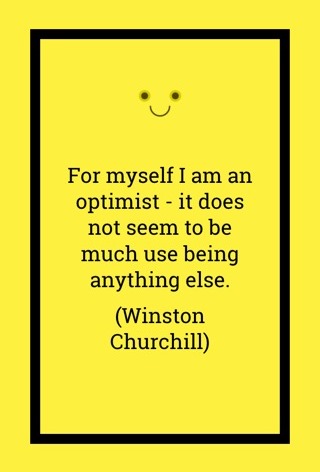
For myself I am an optimist. It does not seem to be much use being anything else

Winston Churchill most likely was an alcoholic, and he certainly had to fight bouts of severe depression for most of his life. He called this his Black Dog. Nevertheless, this quote shows that he remained a die-hard optimist. Maybe this was the secret to his incredible success as a military and political leader?

Churchill - Optimist

It is easier to build strong children than to repair broken men.

I stumbled upon this quote yesterday and it struck me as very powerful. It beautifully conveys one of the central tenets of Positive Psychology (strengths-orientation and looking at “what´s right”) – and at the same time it could be a sort of “battle cry” for the Positive Education movement.

Strong_Children

The 10 most Valuable Positive Psychology Resources on Mappalicious

Ever since the beginning of Mappalicious about 20 months ago, I´ve not only shared my own take on Positive Psychology with you – I´ve also tried to compile valuable resources that help to spread research (and knowledge in general) on all things Positive Psychology. Based on feedback, such as shares via social media, these 10 resources have been the most useful pieces of information so far:

Please share this if you like…

Positive Psychology Resources on Mappalicious

A unified Hashtag for all Things Positive Psychology: #PosPsy

By now, a whole lot of people are writing and blogging about Positive Psychology. There´s also a pretty active Twitter community (please read the post 7 Positive Psychology People and Institutions to follow on Twitter). But as far as I know, people have not (intuitively) agreed on a single Twitter hash tag for the topic. Some use #PositivePsychology (which is quite long), some #PosPsychology (still long and rather unusual), some use #PosPsych – and others do not use hash tags at all when sharing their content. Following my fellow German #PosPsy evangelist Michael Tomoff, I propose to use the hash tag #PosPsy (or #pospsy) from now on whenever talking about this magnificent topic. Using a single unified hash tag as a community has a couple of advantages:

  • Content in general becomes more visible. Tweets with (more or less) popular tags profit from a higher interaction rate. Additionally, as people get accustomed to the expression, it´ll become the general search term for the topic – helping people to find all the good stuff that is out there on Twitter.
  • For the same reason, it will help your content to become more visible.
  • Ultimately, using #PosPsy as the unified hash tag will create a sense of community – just as e.g., all the tweets supporting a certain football team will display the same tag.

Of course, we should still use our more individualized tags like #Gratitude or #Happiness, but using #PosPsy in addition will create the additional attention our topics deserve. So, if you think that having a unified hash tag for all things Positive Psychology is a great idea, please share this post or the following picture! Would be cool to make it a trending topic on Twitter… 🙂

Hashtag_PosPsy

Update

Dear all,
I´ve received a lot of comments and feedback on this topic, via mail, Twitter, or here in the comments section – thanks a lot for your input. I´d like to make three points here:
  1. Yes, I´ve done some research. If PP hashtags were a market, I´d say it´s “absolutely not consolidated”. On some days, one tag is used more often than others, and on other days, it´s something else. In general, when comparing “our” tags to really popular ones, the result would be: they´re all insignificant. That´s why it´s a really good idea in the first place to start using a single one as a community – whatever it may be at the end of the day.
  2. My learning is: with hashtags, it´s all about brevity. You´d want a “minimum understandable solution” that is not occupied by another topic – that´s why I propose #PosPsy.
  3. I´m not sure if hash tags are really important in terms of “resonance”. People resonate with content, not with hash tags. The thing is: in most cases when there´s no predefined tag given out by a source with a considerable outreach, it´s a sort of “winner takes it all” dynamic (you can monitor that e.g. with large sports events). The one that is used most in the beginning (and/or is supported by someone with a large audience) tends to win. First, due to “social pressure”, and second due to the Twitter algorithm that magnifies this effect by suggesting the one that is mostly used anyway.
Therefore: whatever we agree on as a group (and then use systematically…) will be the winner over time. 🙂
Warm wishes,
Nico

Update No. 2

The Positive Psychology Center at UPenn twittered that they support #PosPsy. That´s not like the Pope supporting us, but it´s not too far away either… 🙂