How can the Apple Watch be a true Piece of Positive Technology?

The internet is going mad about the soon-to-come launch of the Apple Watch. After checking out what it actually can do. some people think it´s a useless marketing fad, other feel it´s the best thing since sliced bread. Via Twitter, Wall Street Journal writer Geoffrey Fowler asked:

For me, the true challenge would be turning it into a piece of positive technology. Here are my three ideas:

  1. As far as I know, the Apple Watch can check my pulse. Then a fine-tuned app could very well detect irregular patterns or longer breaks to a pretty high degree of certainty. As such, it could possibly detect symptoms of an impending cardiac arrest – and then send a emergency SMS using GPS data.
  2. As far as I know, the Apple Watch can record my speech (the iPhone can). As such, it could be used to prevent depression. There is some evidence that usage of certain words, but also certain speech characteristics (e.g., prosody) are predictive of depressive symptoms. If a person is prone to this kind of disorder, a speech recorder could automatically capture sound bites at random intervals over the day. If the elements of “depressive speech” increase over several days based on appropriate algorithms, the Apple Watch could notify the owner – or his/her doctor.
  3. As far as I know, the Apple Watch can mow my lawn. Oh wait, it can´t? Well…

What are your ideas?

A unified Hashtag for all Things Positive Psychology: #PosPsy

By now, a whole lot of people are writing and blogging about Positive Psychology. There´s also a pretty active Twitter community (please read the post 7 Positive Psychology People and Institutions to follow on Twitter). But as far as I know, people have not (intuitively) agreed on a single Twitter hash tag for the topic. Some use #PositivePsychology (which is quite long), some #PosPsychology (still long and rather unusual), some use #PosPsych – and others do not use hash tags at all when sharing their content. Following my fellow German #PosPsy evangelist Michael Tomoff, I propose to use the hash tag #PosPsy (or #pospsy) from now on whenever talking about this magnificent topic. Using a single unified hash tag as a community has a couple of advantages:

  • Content in general becomes more visible. Tweets with (more or less) popular tags profit from a higher interaction rate. Additionally, as people get accustomed to the expression, it´ll become the general search term for the topic – helping people to find all the good stuff that is out there on Twitter.
  • For the same reason, it will help your content to become more visible.
  • Ultimately, using #PosPsy as the unified hash tag will create a sense of community – just as e.g., all the tweets supporting a certain football team will display the same tag.

Of course, we should still use our more individualized tags like #Gratitude or #Happiness, but using #PosPsy in addition will create the additional attention our topics deserve. So, if you think that having a unified hash tag for all things Positive Psychology is a great idea, please share this post or the following picture! Would be cool to make it a trending topic on Twitter… 🙂

Hashtag_PosPsy

Update

Dear all,
I´ve received a lot of comments and feedback on this topic, via mail, Twitter, or here in the comments section – thanks a lot for your input. I´d like to make three points here:
  1. Yes, I´ve done some research. If PP hashtags were a market, I´d say it´s “absolutely not consolidated”. On some days, one tag is used more often than others, and on other days, it´s something else. In general, when comparing “our” tags to really popular ones, the result would be: they´re all insignificant. That´s why it´s a really good idea in the first place to start using a single one as a community – whatever it may be at the end of the day.
  2. My learning is: with hashtags, it´s all about brevity. You´d want a “minimum understandable solution” that is not occupied by another topic – that´s why I propose #PosPsy.
  3. I´m not sure if hash tags are really important in terms of “resonance”. People resonate with content, not with hash tags. The thing is: in most cases when there´s no predefined tag given out by a source with a considerable outreach, it´s a sort of “winner takes it all” dynamic (you can monitor that e.g. with large sports events). The one that is used most in the beginning (and/or is supported by someone with a large audience) tends to win. First, due to “social pressure”, and second due to the Twitter algorithm that magnifies this effect by suggesting the one that is mostly used anyway.
Therefore: whatever we agree on as a group (and then use systematically…) will be the winner over time. 🙂
Warm wishes,
Nico

Update No. 2

The Positive Psychology Center at UPenn twittered that they support #PosPsy. That´s not like the Pope supporting us, but it´s not too far away either… 🙂

CEO, want your Bonus? Then make your Employees happy!

Tui - Employee Satisfaction - BonusA couple of days ago, I introduced the term Return on Flourishing (ROFL) as a key financial performance indicator for future-minded leaders. My post described how programs that are designed to foster employee wellbeing can be assessed pertaining to their financial returns.

To that effect, today I was delighted to learn that German tourism giant TUI Group plans to base a part of their top executives´ bonus salaries on employee satisfaction in the near future. Yes, you´ve read correctly: employee satisfaction, not customer satisfaction.

That´s really good news in light of the old managerial adage:

What gets measured gets done.

Besides being a progressive and bold move in terms of leadership culture, it´s also a clever campaign in terms of profitability – as studies have shown time and time again there´s a strong link between employee satisfaction, customer satisfaction and profitability.

Here, you can read a German article about it in Die Welt, one of Germany´s premier daily newspapers. And here´s an English press release. Enjoy!

A KPI for the Leaders of the Future: Return On Flourishing (ROFL)

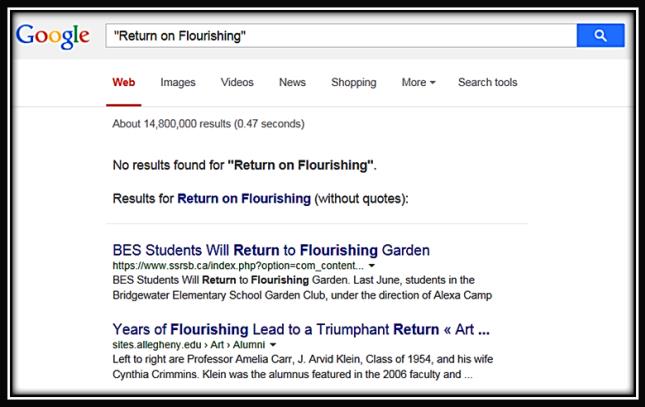
First, I have to admit it feels really good to think something (or at least: say it “in the digital public”) for the very first time. At least with regard to Google hits, I´ve created a new expression:

Return on Flourishing - Dr. Nico Rose

Return On Flourishing (ROFL – pun somewhat intended)

In my main occupation, I work as a human resources director. In most business organizations, Key Performance Indicators (KPIs) are of paramount importance. One of the most important KPIs in every organization is Return on Investment (ROI). In its simplest form, ROI is the return of some activity divided by the cost of that same activity. For instance, if a marketing campaign costs $10,000 and (identifiably) leads to $20,000 in additional sales in a certain period of time, the ROI of that project is 200%.

To this effect, it would also be possible to calculate a Return on Flourishing – which I propose to be the additional (financial) return that is generated by investing in measures designed to foster flourishing of the company´s workforce; minus the cost of those measures. By now, there´s an abundant body of research that is able to demonstrate that companies which invest in employee wellbeing do indeed fare better economically – which may ultimately even be detectable in stock prices (please check out the following paper: Does the stock market fully value intangibles? Employee satisfaction and equity prices).

By way of example, employee well-being could lead to a better quality of products or services; or a more engaged salesforce, leading to better sales figures. On the other hand, higher levels of flourishing may lead to cost reductions, e.g., by decreasing levels of absenteeism and healthcare costs; or lower levels of employee turnover which in turn helps to minimize recruiting costs. Therefore, it is reasonable to expect that investing in employee flourishing will lead to an increase in financial returns. In order to make this effect visible and clearly identifiable from the inside perspective, first, we would have to establish a baseline of overall flourishing in the workforce. Based on Seligman´s PERMA framework, we could rather easily measure the following:

Alternatively, there are existing “one-stop” questionnaires to measure flourishing, e.g., the PERMA Profiler (please check out my MAPP Capstone thesis for its items; this could be adapted so as to better fit to a working context).

Second, one or more activities to foster workforce flourishing would have to be implemented. For instance, there could be company-wide workshops on job crafting. Or rather, first we would have to implement that project with a part of the workforce (treatment group; e.g., a product line) in order to later compare those employees with another group that will receive the workshops at another point in time (control group; another product line). If, after implementation, the treatment group shows significantly higher levels of flourishing compared to the control group (manipulation check), we could move on to the final step.

Ultimately, the financial success of the different business units would have to be calculated for several ensuing periods. If the treatment group fares significantly better than the control group (e.g., a significant increase in sales), this difference could be attributed to the increase in employee flourishing. Of course, it is always tricky to make this kind of causal inference, but there are lots of steps one can take to rule out or control for other effects. Now, if the increase in financial returns surpasses the cost of the measures to increase flourishing (over time), we would assume a positive Return on Flourishing (ROFL).

Return on Flourishing (ROFL): the wider Perspective

Of course, this is still a rather limited point of view. Studies were able to show that an increase in well-being at work leads to higher levels of general well-being. To that effect, we can assume there could a be a wider ROFL – where higher employee well-being leads to an increased level of well-being with regard to the company´s community and stakeholder groups via a kind of ripple effect.

What are your thoughts on this?

Psychology is still ruled by the Disease Model. But Positivity and Strength-Orientation are gaining Ground

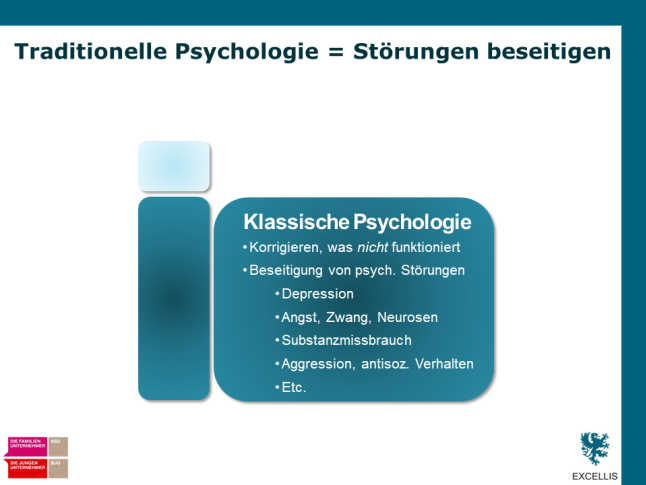
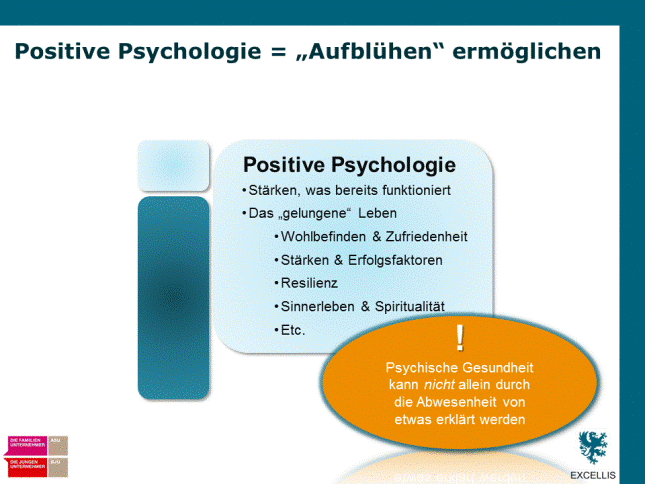
When I talk about Positive Psychology in Germany, I also talk about the necessity for this rather recent branch of research and practice (see the slides below), referring to the fact that most psychological research is centered around a disease model, thereby concentrating on mental illness, its antecedents, and cures – just as Martin Seligman and Mihály Csíkszentmihályi propose in their seminal article Positive Psychology: an Introduction.

Today, I wanted to check if this is really true – and if the onset of Positive Psychology at this millennium has does anything to change that conjectured imbalance. Therefore, I went to Google Scholar and searched for articles which titles` contain either the words depression, anxiety, happiness, or life satisfaction. For a first round, I limited the search to articles that were published between 1900 and 1999. For a second round, I counted all the articles that have been published afterwards. Here´s what I´ve found:

Depression Happiness Graph

A first stunning finding* is the fact that, in the last 15 years, more papers were published than in the previous 100, no matter on what subject. Whether that is a desirable development with regard to quality and impact remains to be seen.

But more importantly, the imbalance between research focusing on desirable vs. undesirable states is clearly visible in the chart. In the 20th century, papers focusing on depression outnumber those focusing on happiness by a factor of 13. For anxiety and life satisfaction, it´s factor 10.9.

Now what has changed over the last 15 years? The answer is: Positive Psychology has made quite an impact: an increasing publication rate in this branch of psychology results in a (at least slightly) more balanced ratio. Depression outnumbers happiness by “only” 5.7, anxiety outnumbers life satisfaction by “only” 5.8.

I´ve put the world “only” in parentheses since that still is very far away from a sort of equilibrium. But progress has been achieved. And there will be more…

Traditional Psychology  Positive Psychology - Dr. Nico Rose


* Of course, the overall number of publications is much higher. But I suppose that counting papers containing a specific word in the title is a pretty decent proxy for the general writing activity in a sub-branch of research.

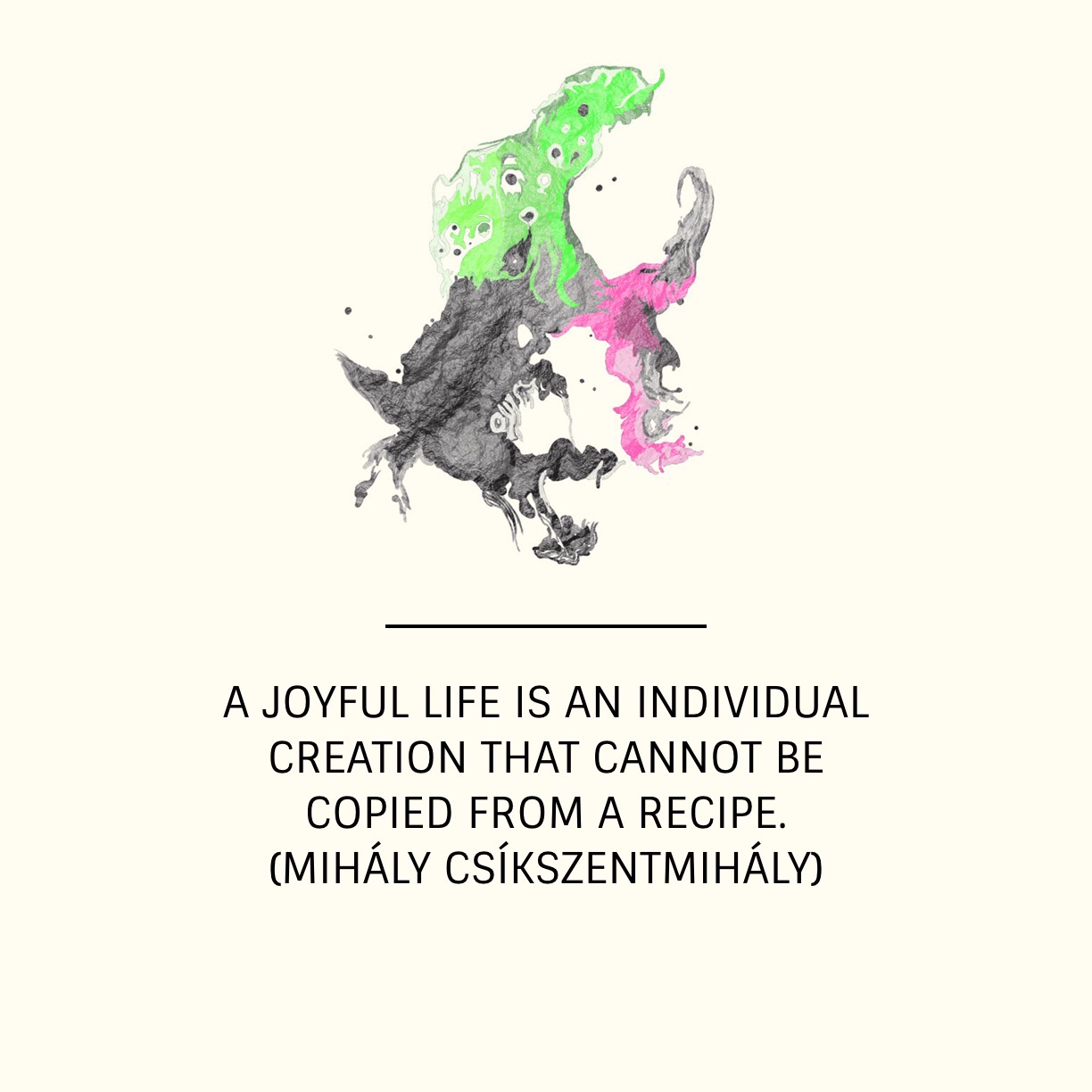
A joyful Life is an individual Creation that cannot be copied from a Recipe.

This powerful quote by Mihaly Csikszentmihalyi reminds us that we should approach conventional self-help “wisdom” (but also Positive Psychology interventions) with a certain amount of caution.

There will always be gurus who claim to know the way, and Facebook/Twitter are full of posts such as “These are the 7 things successful/rich/happy people do before breakfast”. These people greatly underestimate human individuality – and the power of context and timing.

Positive Psychology researchers also suggests doing certain things (such as being grateful frequently) but, in general, are very cautious when making claims about efficacy. Additionally, there’s a growing body of research investigating so-called fit models, showing that people may profit greatly from some Positive Psychology interventions, but may not do so with regard to other exercises, e.g., due to individual preferences. If you would like to find out more, I suggest checking out this research article: To each his own well-being boosting intervention: using preference to guide selection.

The Art of Coaching: Making a Leap of Faith

I´ve just moved into a new home – and that means I also had to renovate my coaching office. The new office is slightly larger than my old one – so I had a little more wall space to fill. In a local gallery, I´ve found the picture you can see below. I knew I wanted to buy it right away. Though being rather calm and monotonous, I feel it conveys optimism, confidence, and exuberant strength.

A successful coaching process often involves making a leap of faith, seeing things in a new way, leaving something old behind – sometimes, without knowing exactly what will appear instead. Believing in one´s own strength and resources in crucial when pursuing this trajectory.

I hope the picture will inspire this kind of self-efficacy my clients…

Nico Rose - Positive Psychology

A new fantastic Resource: thepositivepsychologypeople.com

Positive Psychology PeopleFor all of you that just cannot get enough of first-class Positive Psychology content – here’s something brand new for you:

http://thepositivepsychologypeople.com

The site was launched yesterday (UN´s International Happiness Day). All content will be supplied by a truly international team of outstanding researchers and practitioners, among them Lesley Lyle, Sandip Roy (who is a part of Happiness India Project), and Seph Fontane Pennock (who also runs PositivePsychologyProgram).

I wish you best of luck and millions of studious readers!