Here, I present to you seven (more or less…) recent TED talks related to Positive Psychology. Enjoy!
Here´s an older list of 20 TED talks based on Positive Psychology. And by the way: I firmly believe that my own TEDx talk needs to have a least one million views. That´s just 996.783 to go. Are you going to help me out? 🙂
Ever since the beginning of Mappalicious about 20 months ago, I´ve not only shared my own take on Positive Psychology with you – I´ve also tried to compile valuable resources that help to spread research (and knowledge in general) on all things Positive Psychology. Based on feedback, such as shares via social media, these 10 resources have been the most useful pieces of information so far:
Emilia Lahti, a fellow Penn MAPPster, and Queen of Sisu (as I like to call her) has finally given a TEDx talk. Sisu can be defined as fortitude, perseverance and indomitable determination in the face of extreme adversity. It´s part of the Finnish culture but obviously is not limited to Finns – everybody can display (and profit from) Sisu at times. Here you go…
This week, I had the chance to do something remarkable (at least in my book): I controlled a computer with my mind. I attended a talk given by Sven Gabor Janszky who is one of Germany´s eminent futurologists. During his presentation, I volunteered for an experiment: he put a device (a kind of headset) on my head (see photo below) that serves to detect my brainwaves (electroencephalography; EEG). The data is then fed into a laptop that is able to identify individual patterns of brain activity. Basically, an algorithm learns what your brain does when you think a specific thought.
First, the algorithm needs a baseline. For about 20 seconds, it registers what you do when you don´t think of anything at all (what neuroscientists now call the default network). Then, you´re given a task. For example, you see a cube on the screen and the goal is to move that shape from the center to the left of the screen. So, there are two trials of just 8 seconds. In that time, the algorithm learns what your brain does when you think/imagine “Cube, please move to the left!”. After that, you´re able to move the cube just with mind – as long as you are pretty consistent with regard to your mode of thinking while trying to move the shape.
In a second experiment, my goal was to make the cube disappear – which is harder because basically our brain is not made to think about things that are not there. But I also managed to that after just two trial runs. It was really easy. You can have a look at the exact same procedure via this TED talk by Tan Le:
There are a couple of really good news in this story: First, I do have a brain. I could watch it on the screen and see it do its magic. Hey, I mean you can never be sure until you see it. Second, making that cube move around was really easy. The whole procedure only took about three minutes. And finally, the technology behind it all isn’t that expensive any more.
So for me, the question is: will this be a piece of positive technology in the near future? We´ll see. I´m very sure the military are all over it already, trying to fly jets or tanks that way. I mean, if you can move an image on a screen, you can also move a vehicle. Which brings us back to the post´s title. Maybe, in the near future, we will be able to operate the vacuum cleaner sitting in an armchair watching reruns of the X Files.
But then, there might be use cases that are far more beneficial. If there´s a distinct brain pattern for “Cube, please move left!” – then there could also be a distinct brain pattern for, e.g., “I feel like my life has a meaning”, or “I feel grateful and at peace with myself and others”. And if that were the case (and the technique became so cheap as to make it a mass-market product) then it could become a powerful tool to prevent people from slipping into depression or other psychological disorders.
If you are a regular visitor of Mappalicious, you know by now that I´m a big fan of Self-Determination Theory and adjacent frameworks such as Self-Concordance Theory. These concepts have been developed roughly at the same time as central tenets of Positive Psychology – without necessarily being regarded as “part of” Positive Psychology (don´t ask me why, I guess it´s just a consequence of different research agendas/”brand building”).
Recently, I stumbled upon a TEDx talk given by Edward Deci where he explains the foundations of SDT. In addition, there´s a nice intro to the framework by Richard Ryan given at a SDT conference. Listening to the two SDT co-founders will give you a great and lively overview of the core concepts and some of its applications. Enjoy!
Yesterday, I told you that I would be going to give a TEDx talk at Bergen/Norway today. And that´s already history by now. I had a great time and would like to congratulate the TEDxBergen team for the great job that they´ve done (the event is entirely run by students!). Thanks for inviting me…
Since it´s probably going to take a couple of days until there´s a video available, let me give you a bit of advance information. My topic was: “How to be the architect of your own fortune”. I talked about how some People be seem to be luckier than others by sort of inviting luck into their lives.
Just a short info: right now, I’m on my way to Bergen in Norway. Tomorrow, I’ll be a speaker at TEDxBergen. I was invited to give this talk just five days ago – because another speaker had to cancel. Lucky me.
That’s why I decided to give a talk on luck and serendipity – and how we can be the architects of our own luck. I’ll share it here once it is available online…
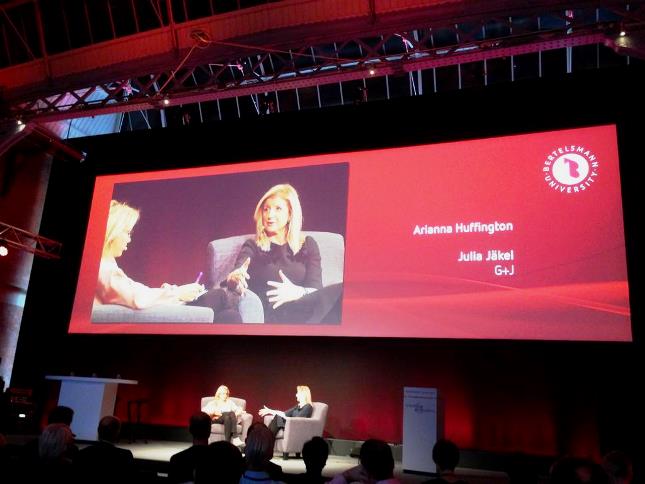
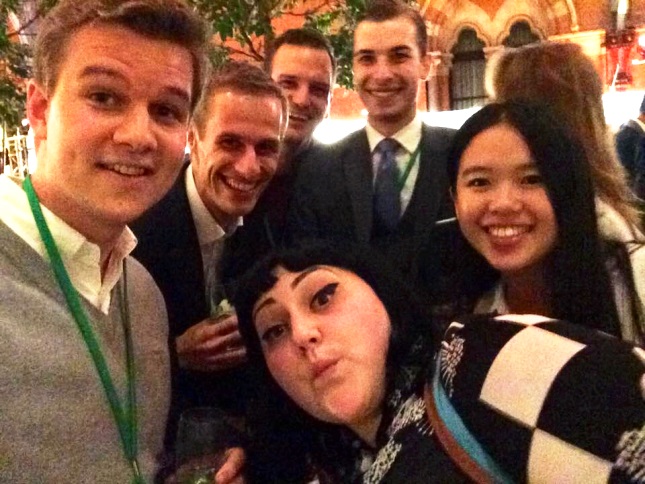
From last week’s Wednesday to Friday I stayed at London’s beautiful St. Pancras Renaissance Hotel (where the Spice Girls’ “Wannabe” video was shot) to attend a conference that my employer Bertelsmann held for about 200 top executives. The overarching motto for the conference was creativity – since, as a media company, our biggest asset is creative output in all of its forms. Among the many guest speakers were people such as Ed Catmull, CEO of Pixar, Simon Cowell, Arianna Huffington, E.L. James (author of “50 Shades”), will.i.am, and Beth Ditto.
Here, I´d like to share three things (or rather: people) that impressed me the most – and whose topics also have a distinct connection to Positive Psychology.
First in line is Arianna Huffington who said a lot of smart things about mindfulness, meditation, getting enough sleep etc. – while gracefully marketing her book “Thrive”. Here´s the one sentence that really lingered in my mind:
Your eulogy will not be resumé.
Second, I was deeply impressed by poet David Whyte – who taught me about the power of words, allowing for repetition, long pauses – and speaking without PowerPoint. It is really hard to recount his talk without sounding corny – so instead you might want to watch his TED talk:
And finally, I tremendously enjoyed the talk of conductor Itay Talgam, who illustrated different leadership styles by showing video footage of some of the greatest conductors of the past and present. He also has a TED talk out there. So enjoy!
Even though the idea of compassion lies at the heart of virtually each and every religious and spiritual movement (with Buddhism and the Dalai Lama problably being the frontrunner), psychological science has ignored this important feature of our human nature for quite a long time, describing it as a subtype of other, more primary emotions. Starting with research on meditation, such as carried out by pioneers such as Jon Kabat-Zinn, the topic has slowly but surely entered the “regular” academic discourse. Nowadays, the science of compassion is a full-blown discipline, being researched, e.g., at Stanford´s Center for Compassion and Altruism Research and Education (CCARE) or Berkeley´s Greater Good Science Center (GGSC).
In 2010, researchers Jennifer L. Goetz, Dacher Keltner, and Emiliana Simon-Thomas authored a review article that sought to make a case for the idea that compassion is a truly distinctive feature on the continuum of human behavior and emotion. Here´s what they have to say in their conclusion:
Our review reveals compassion to arise out of distinct appraisal processes, to have distinct display behaviors, distinct experiences, and an approach-related physiological response. The state like experience of compassion, and the trait like tendency to feel compassion, fall under the purview of three evolutionary arguments: that compassion evolved as part of a caregiving response to vulnerable offspring, that compassionate individuals were preferred in mate selection processes, and that compassion emerged as a desirable trait in cooperative relations between non-kin.
If you want to hear the full story, please read the aforementioned article. You may also want to watch this TEDx talk by Dacher Keltner (who´s the director of the aforementioned GGSC). Enjoy!



 Mappalicious