I´m in the ninth cohort of the Master of Applied Positive Program at Penn. Consequently, there are tons of brilliant MAPP Alumni out there that have very fascinating stories to tell: about their experience with the program, about Positive Psychology in general – and about themselves of course. I really want to hear those stories. That´s why I started to do Mappsterviews* with my predecessors.
In Mappsterview No. 3, you´re going to get to know David Yaden who was in MAPP 8 and is now an assistant instructor in the current program. David is a very special person because he always gives me good grades …well: just read for yourself!

Please introduce yourself briefly:
I study self-transcendent experiences (which are basically peak or spiritual experiences), meaning and purpose in life, and death. Currently, I work as a researcher at the University of Pennsylvania at the Positive Psychology Center and in collaboration with UPenn’s Center for Cognitive Neuroscience. I also work as a consultant and public health educator with Lourdes Health System and I serve as a Humanist Chaplain for Rutgers University. I primarily study the psychology and neuroscience of self-transcendent experiences, but I am also interested in end-of-life issues.
What did you do before MAPP?
I was more of an entrepreneur. After undergrad, I started a health and wellness practice (Integrative Mind-Body Health) to teach people about relaxation techniques, wellness, and well-being. My practice has been sub-contracted by Lourdes Health System for several years. I also started a healthcare consulting practice (Psychosocial Consulting), which initially served medical practices but the work has moved into more technical healthcare business consulting, my primary account is now a medical imaging engineering firm.
My main reason for applying to MAPP was to determine whether I was more of an entrepreneur, a clinician, or an academic researcher. It turns out that of these three I’m best suited for academic research. Ideas light my mind on fire – they move me on an emotional level – so working in this area excites me on a daily basis. My research feels like a real calling.
What got you interested in Positive Psychology?
My journey to positive psychology began with a spontaneous “mystical” experience of self-transcendence. In one instant, my life seemed to go from mild despair and meaninglessness to absolutely overflowing with a joyful and loving sense of meaning and purpose. Much of my adolescent angst was resolved in one overwhelming moment. I’m not alone in this – experiences like mine, which William James describes in The Varieties of Religious Experience, are surprisingly common. Research suggests that today about 33% of cross-cultural samples report something like them. This means that about 1 out of every 3 of your readers will be nodding their heads in recognition when they read this. One scale, the “Mystical Experience Questionnaire” gives a sense of the experience through its items:
- “Experience of the insight that ‘all is One.’”
- “Awareness of the life or living presence in all things.”
- “Feeling that it would be difficult to communicate your own experience to others who have not had similar experiences.”
My attempts to understand this experience led me through academic studies and “real world” experiences that I would not have had otherwise. My studies include comparative religion, philosophy, psychology, and cognitive neuroscience. Experientially, I graduated Marine Corps. Boot Camp and participated in Zen meditation retreats to study rites of passage. I have also traveled and taken psychedelic drugs (legally) to learn more about how certain triggers and circumstances can facilitate self-transcendent states of mind. While these experiences never re-captured my initial experience, many came close. I now believe that many group rituals and contemplative practices have tremendous value. I still meditate and go on retreats, for example. I also promote the on-going psychopharmacology research on psilocybin (a psychedelic substance) at John Hopkins and NYU, and I believe that we will see a return of immersive interventions similar to rites of passage in psychology’s near future.
I should also say that I see my research through a purely psychological lens, and I work hard to keep from engaging in metaphysical speculation. While I was raised religious – and still feel generally positive about religion – I became an atheist at a young age. After my mystical experience, however, I became very spiritual – after all, “seeing is believing”, right? Well no, actually… As Dr. Jon Haidt once said to me, “seeing is perceiving.” After studying philosophy and neuroscience, I realized that I can’t know the true nature of existence or consciousness. This humbled me tremendously. Coming to terms with the fact that we lack certainty about these issues was, and is, a difficult but very valuable process. Now I consider myself an agnostic – this keeps me living in wonder at the mystery that surrounds us. This view also allows me to understand the perspective of religious, spiritual, and secular people alike, which has been particularly important while volunteering with Hospice and doing chaplaincy work. In these areas, the main focus is on helping people rather than getting caught up in debates about belief systems.
My research eventually led me to the work of Dr. Andrew Newberg, who studies the neuroscience of mystical experiences. He is best known for putting long-term meditators and nuns into neuroimaging scanners (like SPECT and fMRI) to see what is going on in their brains while they experience self-transcendent states of unity. He seemed to understand the subjective side of these experiences, was conducting useful and fascinating research on the topic, and wasn’t trying to prove any points based on a particular belief system. Rather than having a metaphysical axe to grind, he frames his work as a strictly scientific endeavor that has the potential to help people. In fact, his respectful and open-minded way of presenting his research often leads people of both extremes of belief to use his research as “proof” that their particular worldview is right.
Atheists say, “See! These experiences are only in the brain” and believers say, “See! These experiences are even in the brain!”
Of course, the data does nothing to prove either of these metaphysical positions correct, but it does advance our scientific understanding of the actual experiences tremendously.
At some point in this process, I saw that Dr. Seligman was on the board of advisors for Dr. Newberg’s lab. I recognized Dr. Seligman’s name from psychology textbooks during my undergrad training. After I learned about his positive psychology initiative, I began to hear about it everywhere. The director of the psychology lab I worked in at the time referred to his work, my Zen teacher brought up positive psychology in his talks (called “teishos” in the Zen tradition), and I remembered that my undergrad study group “Jedi Mind Tricks,” had briefly covered this topic. Once I started reading more of Seligman’s work, I couldn’t learn enough. For a few months I became a hermit in order to read books and articles by him and the other usual suspects in positive psychology (Barbara Fredrickson, Jonathan Haidt, Paul Bloom, Jane Gillham, etc…). After hearing James Pawelski discuss the Masters of Applied Positive Psychology program at an info session, I knew I was hooked. I applied that fall.
As stated above, one of your research areas is the experience of self-transcendence. Can you please elaborate on that?
“Getting out of your head” is one way that I’ve been thinking about self-transcendence lately. Self-transcendent experiences (STE’s) are temporary states of unity with something beyond the self. They range from the routine, like getting lost in a piece of music, to the transformative, such as the mystical experience that I had. Other experiences fall in-between these extremes, like states of mind experienced during meditation or while making love, for instance.
I am working with a dream team of researchers to formalize the definition and spectrum on which STE’s occur – something we call “the unitary continuum.” We are applying for a Templeton grant to study how often these experiences occur, what kind of people experience them and under what circumstances, how people describe them, what biological processes are associated with them, and how they relate to outcomes like well-being and altruistic behavior. To learn more about how these experiences work on the neurological level, we are currently utilizing non-invasive brain stimulation techniques to try to elicit self-transcendent experiences at UPenn’s Center for Cognitive Neuroscience.
Evidence suggests that unlike many interventions in psychology that have small effect sizes and are relatively short-lived, the more intense varieties of self-transcendent experiences can be positively transformative. Some studies show that certain beneficial effects of mystical experiences of self-transcendence, like increased well-being and altruistic behavior, can last years, decades, or even a lifetime. Many people rate these experiences among the most meaningful of their entire lives – alongside events like marriage and childbirth.
If I wanted to foster the presence of self-transcendence in my life: where, or with what should I start?
There are two broad paths to more self-transcendence that have the most evidence behind them, contemplative practices and group connection. In terms of contemplative practices, meditation, prayer, yoga, or even simple relaxation techniques are a great place to start. For group connection, attending church, going to a concert, or participating in anything that involves group cooperation can elicit a sense of self-transcendence.
I would also point you to the research on self-transcendent positive emotions by Barbara Fredrickson, Awe by Dacher Keltner and Jonathan Haidt, Flow by Mihayli Csizkszentmihalyi, Mindfulness by Richard Davidson and Britta Holzel, Peak Experiences by Abraham Maslow, and Mystical Experiences by Ralph Hood and Andrew Newberg. We are calling these “The Varieties of Self-Transcendent Experience” in an obvious nod to William James.
You´re also interested in end-of-life healthcare. How is that a “positive” topic?
Death is scary, dying is difficult, and in our society we don’t do a particularly good job of handling either particularly well (see Atul Gawande’s brilliant article “Letting Go”). Attempts to improve the dying process typically do so by reducing suffering, and I am a great proponent of these efforts. Hospice is one of the very few examples of truly cross-disciplinary, holistic health-care. Palliative care (or “comfort care”) has even recently become a specialty that physicians can study. We have made great collective strides in reducing the pain and suffering of those who are actively dying.
At the same time, I believe that we can do more than reducing pain alone. Hospice care provides art and music therapists, compassionate presence from volunteers, and visits from chaplains. Soaringwords is an organization run by fellow MAPPster Lisa Buksbaum that is also doing wonderful work in this area. These are just a few examples of an amazing start, and I think we can build on these beginnings. Well-being is important for people, period. The fact that someone is actively dying should not exclude them from positive interventions. The dying process is still part of life, and this experience could be improved by making options available that promote well-being. I suspect elements of well-being like meaning and relationships will be shown to be particularly valuable.
Research on mindfulness practices and psychedelic sessions at end-of-life have shown that remarkable improvements in well-being and reductions in anxiety and depression are now possible. Based on this research, I predict that within ten years, when one is pronounced terminally ill (about six months to live) they will have the option of undergoing a psychedelic session. I am very surprised to be saying this, but the evidence of positive benefit is so strong that I think policy makers will eventually be morally obligated to permit research and application in this domain. Physicians and patients will demand access to these substances, especially as research reaches a tipping point of demonstrating their potential to relieve suffering.
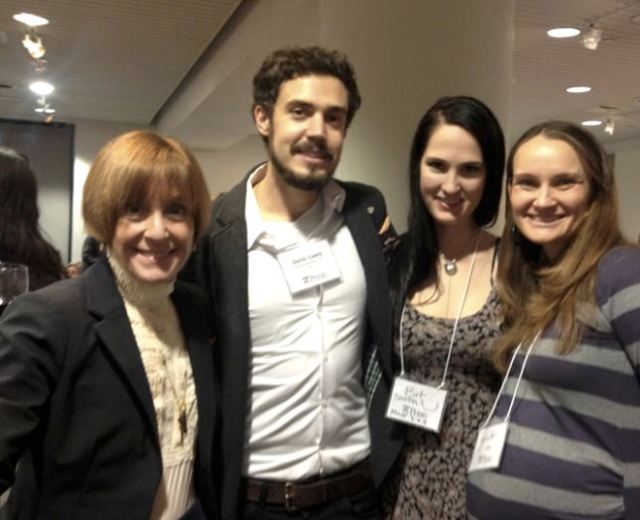
David Yaden with fellow Mappsters
Thanks a lot, David, for this Mappsterview!
* If you are a MAPP alumnus and would like to have your story featured here – please go ahead and shoot me an e-mail!




 Mappalicious