Footage from Aalto Systems Forum 2014 feat. Peter Senge and Esa Saarinen

On November 20, 2014, the University of Aalto, Finland hosted a conference by the name of “Being Better in the World of Systems” in order to celebrate the 30th anniversary of Systems Analysis Laboratory. The keynote speaker was internationally acclaimed management “guru” Peter Senge (author of The Fifth Discipline: The Art & Practice of The Learning Organization). His one-hour-long lecture is now available online:

Additionally, you can watch a lecturer by Esa Saarinen by the name of “Systems Intelligence as Life Philosophy”.

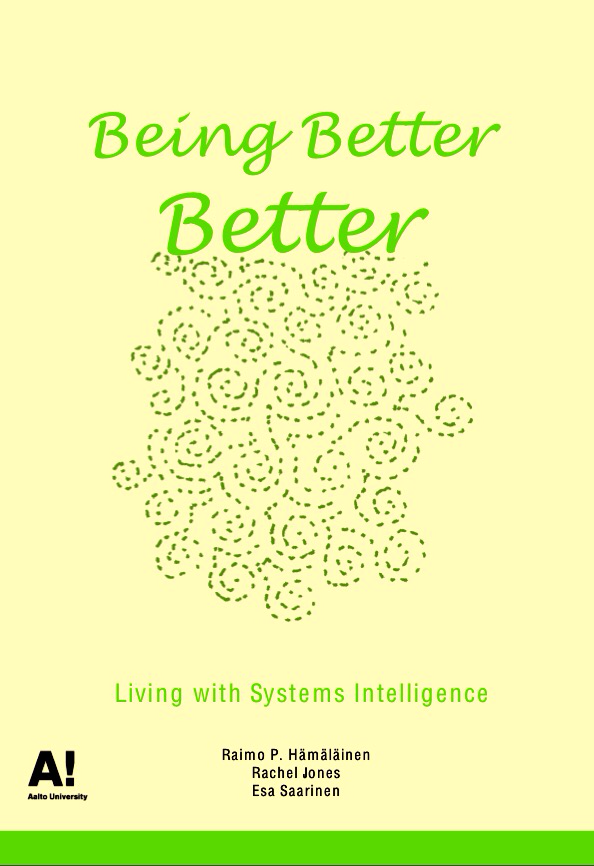
All the other lectures of that day are available on Youtube as well. Additionally, I advise downloading and reading the book Being better better – with Systems Intelligence.


Top 10 Articles for 2014 on Mappalicious – Positive Psychology

Top 10I´ve written 157 posts on Mappalicious in 2014. My learning: Content curation (when it´s well done…) really draws large audiences. Posts No. 1, 2, 4, 6, and, to a lesser degree, 10 are lists of Positive Psychology articles, books, and videos.

Then, video content obviously works: No. 7 & 9 are beautiful video clips on Positive Psychology topics.

Additionally, there´s a lot of “Finn-Power” in this list. No. 5 is my first Mappsterview featuring the “Queen of Sisu”, Emilia Lahti, who´s recently given her first TEDx talk (must-watch). No. 8 is a fun article based on the marvelous work of Finnish super-hero philosopher Esa Saarinen.

Last not least, I´m happy to see that a very personal, slightly off-topic, post has made No. 3.

  1. Positive Psychology Articles
  2. Positive Psychology Constructs
  3. SCHLAAAAAND! How the Soccer World-Cup helps to Build a Likeable Version of the “German Nation”
  4. Positive Psychology at Work: A Book List for the Layman
  5. Mappsterview No. 1: Emilia Lahti, the Queen of Sisu
  6. My Top 20 TED(x) Talks on Happiness, Well-Being, Meaning & Co.
  7. Positive Psychology in a Nutshell: Watch this beautiful 5-minute Instructional Video
  8. The James Bond Philosophy of Life – in 007 Chapters
  9. A little Kindness goes a long Way: heart-warming Short Film about the Power of being a Giver
  10. My Mind´s MAP(P): The 4-minute Ivy League Diploma in Positive Psychology


Thanks a lot to all friends, frequent as well as less frequent visitors, and all those who “stumbled upon” Mappalicious by chance. See you in 2015!


Source for Top 10 graphic

Sisu – Transforming Barriers into Frontiers [TEDx]

Emilia Lahti, a fellow Penn MAPPster, and Queen of Sisu (as I like to call her) has finally given a TEDx talk. Sisu can be defined as fortitude, perseverance and indomitable determination in the face of extreme adversity. It´s part of the Finnish culture but obviously is not limited to Finns – everybody can display (and profit from) Sisu at times. Here you go…

With ordinary People to extraordinary Returns

Nico Rose - Handelsblatt Jahrestagung Private EquityA couple of weeks ago, I was invited to give a dinner speech at a private equity convention that was hosted by Handelsblatt, one of the most eminent (business) newspapers in Germany. I was a little surprised since – to be honest – I don’t know sh.t about private equity, mergers & acquisitions, etc.

So instead, I decided to talk about some subjects I do know, e.g., Positive Psychology, Self-Determination, and alternative forms of leadership.

Subsequent to my talk, I was invited to put into writing what I said that evening. The result is a feature that spans topics such as burnout, employee engagement, managing organizational energy, and the theory of the Kondratieff waves. My tagline was:

Extraordinary returns will be realized where ordinary people are empowered to achieve extraordinary results.

An English version of the piece is available available here. Enjoy!

Nico_Rose_FYB

Being better better – with Systems Intelligence

IMG_4016-0I’m a big fan of the idea of Systems Intelligence, a concept by Finnish philosopher Esa Saarinen and his collaborators that I’ve explored Systems Intelligence here on Mappalicious.

Recently, together with some colleagues from Aalto University, he has published a new book by the name of “Being better better” that explores Systems Intelligence in a way that addresses the layman. You can download a free PDF of the book here. I highly suggest reading it. Enjoy!

Listen to the Founders of Self-Determination Theory, Edward Deci & Richard Ryan

If you are a regular visitor of Mappalicious, you know by now that I´m a big fan of Self-Determination Theory and adjacent frameworks such as Self-Concordance Theory. These concepts have been developed roughly at the same time as central tenets of Positive Psychology – without necessarily being regarded as “part of” Positive Psychology (don´t ask me why, I guess it´s just a consequence of different research agendas/”brand building”).

Recently, I stumbled upon a TEDx talk given by Edward Deci where he explains the foundations of SDT. In addition, there´s a nice intro to the framework by Richard Ryan given at a SDT conference. Listening to the two SDT co-founders will give you a great and lively overview of the core concepts and some of its applications. Enjoy!

#NotJustSad: Why we desperately need Positive Reinforcement and Flow to be Happy

Over the last couple of days, the hashtag #NotJustSad has been a trending topic on the German Twitter feed. It was created by a journalist in order to raise awareness for depression and was quickly picked up by mainstream media. The goal was to counter the popular notion that people with depression just need to “get their act together” in order to be “normal” again.

Quite obviously, there are different types of depression – or rather, different ways for depression to “arise”. Some types are clearly endogenous, a sickness of the body, e.g., as a by-product of a strong and continuous imbalance with regard to certain neurotransmitters, such as serotonin.

Yet, over the last days, I was also strikingly reminded of how our everyday behavior may either promote or act as a buffer against bouts of (minor) depressive episodes. Today, I was in a very bad mood all day long. I suffered from what typically is called cabin fever. For the last seven days, I had to stay at home because of “hand, foot and mouth disease”, a pretty harmless but highly contagious and annoying children´s malady I acquired from the Little Guru. When it hits you hard, you´re basically unable to walk for a couple of days, and in addition, you´re mostly incapable of using your hands thanks to painful blisters. As a consequence, I ended up watching TV for most of the time, I managed to get through three seasons of “The Walking Dead” and some other enthralling stuff.

So you could say I was pretty amused most of the time. But still my mood declined from day to day, culminating in today´s bout of huffishness. So I finally went out for a coffee and thought about my situation. Seen through the lens of Positive Psychology, I guess this is what happened: over the last days, I suffered from…

For me, this is a strong reminder of how “intentional activity” is crucially important for our (psychological) well-being. Watching TV can generate a feeling of flow, but it is a fake kind of flow. Yes, I was excited and had fun. Yes, I (sort of) met new people (and a lot of zombies…). I might have learned a bit, and I even accomplished something (getting to the end of season three…). But beware – none of that is the real deal.

As I´ve also mentioned in my recent TEDx talk, we have to go out and meet other people. We need to get stuff done in the real world, and the real world has to provide us with feedback. This is not to say that all of us can fight off any kind of depressive episode at all times. But we should all be aware that a stitch in time saves nine…

 

Nico Rose - Flow

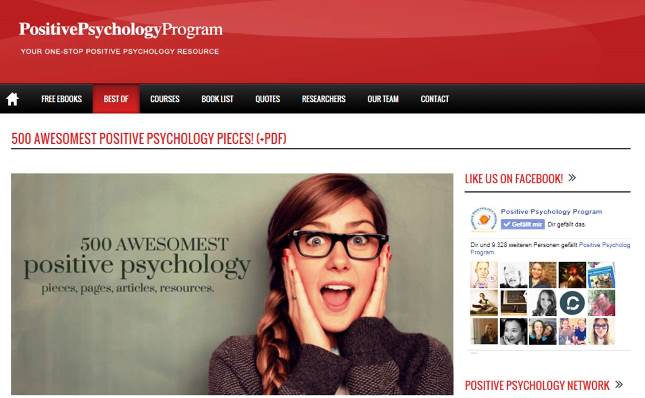
Outstanding Resource for Positive Psychology Articles and Blogs

I´ve already mentioned Seph Fontane Pennock´s awesome website in the past, precisely when he created a very useful overview of institutions that offer academic Positive Psychology courses.

Obviously, he´s been very busy these days – because in the meantime, he´s created a database containing links to 500(!) of his favorite Positive Psychology articles (journals articles as well as blogs posts). He´s probably going to be at 5.000 once you´re done with those… 🙂

Enjoy!

500 Positive Psychology Pieces

What keeps Marriages healthy? [Presentation]

Mainly for German speakers…

Yesterday, I a gave a talk on the science of healthy (and failing…) marriages at a local business club. I drew upon the outstanding work on marriages of John Gottman, tied in some of Marty Seligman´s classics (e.g., his theory on attributional styles), and finished with some hints from Transactional Anaylsis along the lines of Eric Berne. If you are interested – here are the Charts (in German):


If you´d like to know more on the work of John Gottman – he´s got tons of stuff on Youtube, e.g. this:

Here´s how Organizations create a Culture of extraordinary Creativity

For a long time, people have been interested in creativity, especially “creative geniuses” such as Mozart, Edison, or van Gogh. We´ve tried to find out what is “special” about these persons: was there something extraordinary about their intellect, their personality, even their brains?

While these are very interesting questions, there is another angle on creativity that may be somewhat more relevant to our everyday lives. Creativity and, in turn, innovation, are key facets of enduring success for most organizations on this planet. Most of this creative output will be “everyday creativity”, not some big mind-blowing leap into another dimension: small, incremental changes that lead to a competitive advantage at least for a while. So while it is surely helpful to ask “How can I get exceptionally creative people on board?” – an even more important question could be:

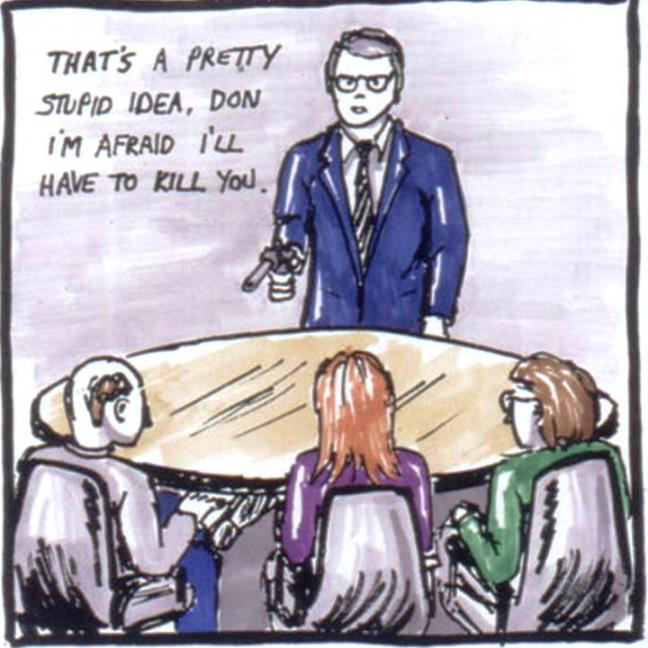
Killing CreativityHow can we create organizational cultures that foster creativity in each and every person?

As noted in the beginning, research on this special topic is more scarce than then the investigation of individual creativity – but it has been done. Researcher Laird D. McLean has published an article that reviews studies on the connection of organizational culture and creativity, roughly from the 1960s to 2000, incorporating findings from experts such as Harvard´s Theresa M. Amabile and Rosabeth M. Kanter.

Here are the key factors that separate highly creative organizations from the rest:

  • Organic design: influence is based on expertise instead of position, decision-making authority is decentralized.
  • Organizational encouragement: risk-taking is valued and evaluated supportively; collaborative idea flow and participative decision-making is fostered.
  • Supervisory encouragement: managers clarify team goals and support team’s creative work, support open interaction.
  • Work group encouragement: organization actively fosters/leverages diversity, integrating creative personalities into “organizational mainstream”.
  • Freedom and autonomy: organization grants sovereignty to employees with regard to determining the means by which to achieve goals.
  • Resources: finding the „golden mean“ with regard to time and money: scarcity produces fear, distrust, and burnout, excess decreases creative performance.

No rocket science, huh…? If you are a manager, now go out and do that… 🙂


Picture source