A Celebration in 12 Tweets: 10 Years of Master of Applied Positive Psychology (MAPP) at Penn

What a wonderful day! I haven´t been to Philadelphia ever since my graduation from Penn in August 2014. But now I´m back. This weekend, Martin Seligman´s Positive Psychology Center hosts the annual MAPP Summit. On this occasion, the current MAPP cohort gets to meet their predecessors. How? It´s a top-notch Positive Psychology conference combined with an alumni meeting of the previous MAPP cohorts.

The alumni gathering, the so-called MAPP Fete, had a special reason to celebrate. 2015 marks the year of the 10th anniversary of the MAPP program at Penn (and cohort 11 is well on it´s way). While Martin Seligman himself addressed us during the lunch hour, the greater part of the day was reserved for “Ignite Presentations”, 5-minute “Pecha Kucha”-style talks given by 17 of our distinguished alumni. Several of us tweeted using the hash tag #10YearsofMAPP. Here´s my little Twitter round-up of that beautiful day:

https://twitter.com/DrNicoRose/status/655031332603580416

https://twitter.com/DrNicoRose/status/655031646576648192

https://twitter.com/DrNicoRose/status/655035269725442048

https://twitter.com/ShannonPolly/status/655048874680303616

https://twitter.com/DrNicoRose/status/655060394797568000

https://twitter.com/DrNicoRose/status/655075881921191936

https://twitter.com/DrNicoRose/status/655090344992886785

https://twitter.com/DrNicoRose/status/655095785479151616

https://twitter.com/DrNicoRose/status/655128308758261760

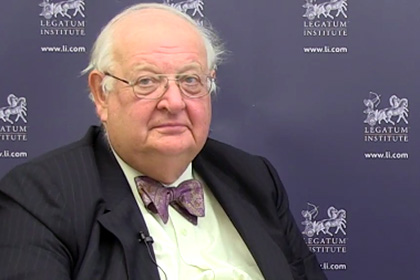
Recent Nobel Laureate Angus Deaton talks about Happiness [Video]

Yesterday, I wrote a post introducing the fact that recent Nobel Laureate in economics, Angus Deaton, has also accumulated a considerable body of research in the area of subjective wellbeing. If you´d like to have him explain his research to you in person – here you go:

Angus Deaton, the Nobel Prize, and Positive Psychology

Angus DeatonYesterday, the 2015 Nobel Prize for economics was awarded to British-American researcher Angus Deaton. While he received that honor for “for his analysis of consumption, poverty, and welfare” – Deaton also conducted a lot of research (mostly later in his career) that is heavily related to Positive Psychology.

By way of example, he was involved in research on the relationship of:

Congratulations!

Should you really “Follow your Passion“? Yes, but…

StinkefingerOne of the most common pieces of self-help advice is to “follow your passion”. Countless authors propagate this is the surefire way to lasting success and happiness at work (please also read Following your Bliss vs. following your Blisters).

Research suggests that, on the one hand, this may be good advice, but that things are not as simple as they seem, on the other hand. According to Robert J. Vallerand and his colleagues, there is a distinction between what they call harmonious vs. obsessive passion. In general, they define passion as

a strong inclination toward an activity that people like, that they find important, and in which they invest time and energy. Thus, for an activity to represent a passion for people, it has to be significant in their lives, something that they like, and something at which they spend time on a regular basis.

They further propose that

there are two types of passion, obsessive and harmonious, that can be distinguished in terms of how the passionate activity is internalized into one’s core self or identity.

In detail:

Harmonious passion results from an autonomous internalization of the activity into the person’s identity. An autonomous internalization occurs when individuals have freely accepted the activity as important for them without any contingencies attached to it. This type of internalization produces a motivational force to engage in the activity willingly and engenders a sense of volition and personal endorsement about pursuing the activity. Individuals are not compelled to do the activity but rather they freely choose to do so. With this type of passion, the activity occupies a significant but not overpowering space in the person’s identity and is in harmony with other aspects of the person’s life.

Whereas:

Obsessive passion results from a controlled internalization of the activity into one’s identity. Such an internalization originates from intrapersonal and/or interpersonal pressure either because certain contingencies are attached to the activity such as feelings of social acceptance or self-esteem, or because the sense of excitement derived from activity engagement becomes uncontrollable. Thus, although individuals like the activity, they feel compelled to engage in it because of these internal contingencies that come to control them. They cannot help but to engage in the passionate activity. The passion must run its course as it controls the person. Because activity engagement is out of the person’s control, it eventually takes disproportionate space in the person’s identity and causes conflict with other activities in the person’s life.

Vallerand as his coworkers have developed a scale to assess whether a certain aspect in our lives is a harmonious or an obsessive passion, e.g., for harmonious passion:

  • This activity allows me to live memorable experiences.
  • This activity reflects the qualities I like about myself.

And for obsessive passion:

  • I have difficulty imagining my life without this activity.
  • I am emotionally dependent on this activity.

After having developed and validated the scale, they evaluated some of the consequences of having harmonious vs. obsessive passion in our lives. Here’s their synopsis:

Harmonious passion was positively related to positive affective and cognitive (concentration and flow) experiences and to the absence of negative affect during and after activity engagement. In addition, harmonious passion was unrelated to negative affect and cognition when people were prevented from participating in the passionate activity. Conversely, obsessive passion was unrelated to positive affect and cognition during task engagement but positively associated with negative affect during and after activity engagement, as well as when prevented from engaging in the passionate activity.

Additionally, there were able to show that

the positive affect experienced during task engagement seems to spill over onto how the person feels in general in his or her life. More specifically, it appears that harmonious for the activity leads to increases in general positive affect over time even when the person is not directly engaged in the activity.

So, in the future you might want to be a little more careful when giving someone the advice to follow their passion. Only those that are intrinsically motivated and really fit it with the “overall system” of that person will lead to growing satisfaction and a fulfilled live.

Master of Applied Positive Psychology at Penn: This is what you´ll get

In my LinkedIn Profile, I call myself a Penn MAPPster ever since getting the OK on my final assignment, the so-called Capstone Project in August 2014 – but my official certificate took about a year to cross the Atlantic Ocean. This is what it looks like:

Penn MAPP - Nico Rose

If you are thinking about obtaining a degree in Positive Psychology, here you can find a great list of educational opportunities for different wallets, time frames, and levels of aspiration. I can only tell you about the MAPP program at Penn. I think these 10 articles best sum up my deep dive into Positive Psychology in Philadelphia. Enjoy! 

  1. Pennsylvania, here I come
  2. Another Day in Positive Psychology Paradise
  3. Welcome to Hogwarts
  4. 2051: Positive Psychology, Optimism, and the Florentine Moment in Time
  5. Positive Psychology and MAPP at Penn: Doing that Namedropping Thing
  6. My Year in MAPP: A 5-Step Course in the fine Art of Being Un-German
  7. Godspeed to MAPP 9! I Love Myself so Much More Because of You
  8. How to rock your Ivy League Master in Positive Psychology: a 10-Point Action Plan
  9. “All in on Love” and other beautiful Stories
  10. Positive Psychology has Changed the Way I Live, Lead, and Love

Research: Linking “Positive Practices” to Organizational Effectiveness

Stones - GrowthThere are tons of books out there explaining how to use Positive Psychology for boosting the performance of organizations. But the truth is: from a scientific point of view, we really do not know very much about this link. There’s abundant research on the connection of positivity and individual performance – but it remains by and large unclear if this influence on the micro-level yields any outcomes on the macro-level. Of course, it seems to make a lot of sense to infer this relationship – but where’s the research?

A very worthwhile attempt is offered via an article named Effects of positive practices on organizational effectiveness by Kim Cameron and his colleagues. Based on prior research, they developed an inventory of what they call “positives practices”. According to the authors, these can be described as

behaviors, techniques, routines […] that represent positively deviant (i.e., unusual) practices, practices with an affirmative bias, and practices that connote virtuousness and eudemonism in organizations.

In order to do so, they administered a large number of questionnaire items to diverse groups of people. Afterwards, they clustered the answers in order to find common themes and pattern in the data. They found that all positives practices could be categorized into six distinct subgroups:

Caring

People care for, are interested in, and maintain responsibility for one another as friends.

Compassionate Support

People provide support for one another including kindness and compassion when others are struggling.

Forgiveness

People avoid blame and forgive mistakes.

Inspiration

People inspire one another at work.

Meaning

The meaningfulness of the work is emphasized, and people are elevated and renewed by the work.

Respect, Integrity, and Gratitude

People treat one another with respect and express appreciation for one another. They trust one another and maintain integrity.

Having found that structure, they gathered data from several divisions of a financial services company and one operating in the healthcare industry. They asked employees to assess their respective business unit (= the organization as a whole, not individuals) with regard to being a place that possesses the aforementioned attributes. Additionally, they obtained data on several objective and subjective key performance indicators of those business units – and finally looked at the connection of the presence of positive practices and organizational effectiveness measures. Here´s what they´ve Cameron and his colleagues found (in their own words):

In Study 1, positive practices in financial service business units were significantly associated with financial performance, work climate, turnover, and senior executive evaluations of effectiveness. In an industry in which positive practices might be assumed to carry little importance, organizational performance was substantially affected by the implementation of positive practices.

In Study 2, improvement in positive practices over a two year period in health care units predicted improvements in turnover, patient satisfaction, organizational climate, employee participation in the organization, quality of care, managerial support, and resource adequacy.

 In the course of arguing why positive practices should have a performance-boosting effect, the authors conclude that

cognitively, emotionally, behaviorally, physiologically, and socially, evidence suggests that human systems naturally prefer exposure to the positive, so it is expected that organizational performance would be enhanced by positive practices.

Of course, Cameron et al. urge us to be careful not to make strong inferences from their results:

The results of these two investigations, of course, are suggestive and not conclusive.

Still, their work is one of the first and still very rare pieces of research that links positive organizational behavior to organizational effectiveness. I am very much looking forward to scholars who pick up on these findings and expand our knowledge on the positivity-performance link.
The 4 Types of Fun – Infographic

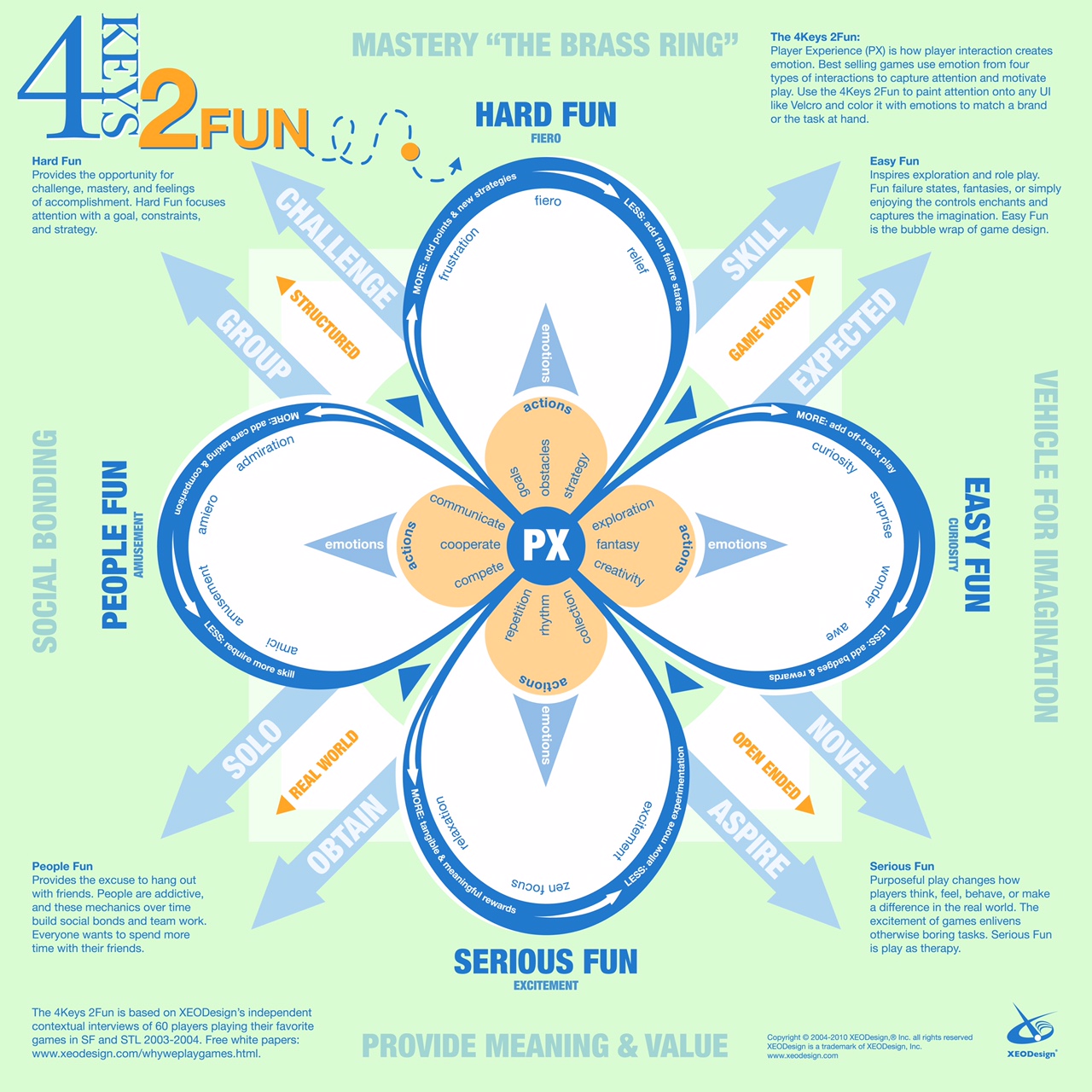
Yesterday, I stumbled upon this fascinating info graphic (click to enlarge):

Four Keys to Fun

It was created by game experience designer Nicole Lazzaro and shows the different kinds of positive emotions that gamers can experience while playing a well-crafted game. The underlying data was obtained from in-depth interviews and thorough observations of 60 gamers.

I am not a gamer myself (or rather, I stopped being one at age 14…) but I like the chart and the underlying concept for its striking similarity to some frameworks from Positive Psychology. It seems pretty easy to map the four types of fun to Seligman´s PERMA framework:

  • “Easy Fun” and Imagination can be found in Positive Emotions.
  • “Hard Fun” and Mastery can be found in Engagement and Achievement.
  • “People Fun” and Bonding can be found in Relationships.
  • “Serious Fun” and Value can be found in Meaning and also Achievement.

I´m always fascinated when different thinkers come to similar conclusions starting at totally different angles of a certain subject. Lazzaro has a presentation on Slideshare where she explores her framework in more depth. Have (maybe four types…) of fun with it!

Richard Branson: “I am successful, wealthy and connected BECAUSE I am happy.”

Book - Dear StrangerSir Richard Branson seems to be an endless source of formidable quotes (I´ve used one in my TEDx Talk). Today I stumbled upon another one that I find particularly striking – as it promotes one of the central tenets in Positive Psychology: Namely, that (financial) success in life may be a consequence of positive emotions, and not so much a prerequisite. This quote s art of a longer “letter to a stranger”, where Branson shares his core ideas on how to live a life that is worthwhile living.

I know I’m fortunate to live an extraordinary life, and that most people would assume my business success, and the wealth that comes with it, have brought me happiness. But they haven’t; in fact it’s the reverse. I am successful, wealthy and connected because I am happy.

This letter, in turn, is part of a new book that consists of more “letters to strangers” on the same subject, among them Lord Richard Layard and Arianna Huffington. I´m pretty sure this will be on my reading list soon.

Branson - Happiness

22 Positive Psychology-infused Articles every (HR) Leader should know

Positive Organizational ScholarshipPositive Psychology has a lot to offer for leaders, especially those people taking on a leadership role in human resources and people management. In this post, I´ve gathered 22 research articles infused by Positive Psychology (more specifically: Positive Organizational Scholarship) that, in my opinion, have tremendous value for aspiring as well as established managers and entrepreneurs.

The topics comprise desirable attributes and personality variables such as grit, character strengths, and core self-evaluations, how to create positive relationships at work, how employee motivation is created and sustained, how to find meaning and purpose in work, and several review articles, e.g., on the connection of positive emotions and job performance. Enjoy!

P.S.
This is my 300. post since I’ve started Mappalicious about two years ago. Giving myself a slight pat on the back right now…

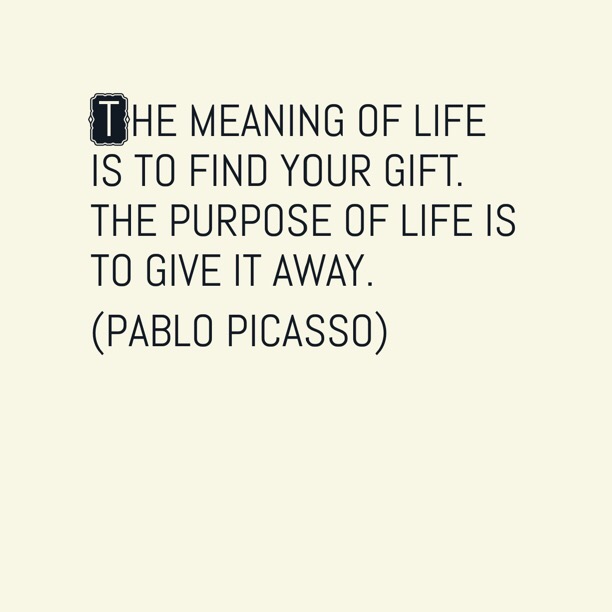
The Meaning of Life is to find your Gift. The Purpose of Life is to give it away

I sometimes struggle with the difference of the terms “meaning” and “purpose” – especially, as the German language doesn’t really provide distinct translations. The definition of Picasso really helped me to get a grasp on the distinction.