- Blah.
- Blah blah.
- Well.
- Maybe.
- Really?
- I mean, really?
- Of course.
- Of course not.
- Nah.
- Duh.
- C’mon.
- WTF?
- Nevermind.
- I don’t care.
- Get a life.
- Um?
- Stop falling for clickbait headlines.
- Yada yada yada.
- Oh my.
- Irrelevant.
- Yeah, right.
- Nope.

Want to lead a happier life in 2016 (and beyond)?
This list includes valuable tips, exercises and “hacks” to be happier and lead a more meaningful life. All of these recommendations are backed by psychological science. In case you are interested to learn more, I´ve included links to some research articles that have examined the corresponding topic. No. 12 – 22 can be found here, No. 23 – 33 ½ will be published shortly. The pieces of advice are ordered (roughly) by difficulty/level of effort etc. Share and enjoy!
Conventional wisdom holds that people tend to smile because they are happy. And while that is certainly true, it turns out that the other way around makes sense as well. We get happier because we smile. This is called facial feedback hypothesis and it has been shown to hold true over many studies. Accordingly, one way to better our mood is to make ourselves smile – even if we don´t feel like it in that particular moment. A popular method in order to achieve this is to hold a pencil between your teeth for a minute or so.
Facial feedback hypotheses: Evidence, implications, and directions
Consuming moderate amounts of chocolate, especially the darker, less sugary type, has been shown to improve peoples´ mood. Whether this is just a consequence of the pleasurable eating experience, or caused by specific psycho-active ingredients in the cocoa, is still under debate. It works, anyway. But don´t overdo it. You know what I mean…
Listening to happy and/or you favorite music is associated with elevated mood. It seems that there´s music that has a general happiness-inducing quality (e.g., Happy by Pharrell Williams) but otherwise, it´s more important that you really, really like what you´re listening to. By way of example, I´m really into heavy metal – a type of music that was once seen as fostering aggression and antisocial behavior. In the meantime, it became clear, that the emotional consequences of listening to music should be attributed to the fit between music and listener.
 4) Catch the Sun
Low levels of Vitamin D seem to be associated with depressive disorders, especially S.A.D. (seasonal affective disorder a.k.a. winter blues) – and it´s comparably difficult to generate enough intake just from food. Our body is able generate this vitamin, but we need exposure to sunlight in order to pull off that stunt. That´s why we need to go out regularly, even when the weather is not all that great. You don’t need to take an actual sunbath – just being outside is enough (even when it´s cloudy), especially around noon-time. Sitting in the sunlight inside of the house does not help. What´s more, sunscreen seems to inhibit the process that generates the vitamin. For more advice, please see this article on Psychology Today.
Paying heed to No. 4 will additionally help you with this one: the so-called biophilia hypothesis states (among other things) that spending time in green environments (parks, forests etc.) helps to fight off stress and boosts our mood. Basically, the equation goes: the greener, the better, so you´ll profit more from a stroll in a nearby forest than a walk in the park. Long-term studies have found that moving from an inner-city area (lots of concrete, few greens spots) to a more rural area is greatly beneficial for several aspects of our psychological and physiological health.
Now, I´m perfectly aware of the fact that dancing may not be the most favorite subject among lots of my fellow men. Actually, psychologists have described a specific facet of our personality by the name of dance confidence – and that tends to be a bit lower with the not-so-fair sex. Nevertheless, regular dancing – even when you do it on your own in your living room – has tons of positive side effects, e.g., lifting your mood, boosting your immune system, and fighting stress by decreasing the concentration of cortisol in your blood.
It is known that people need different amounts of sleep, and that the need for sleep changes over our lifetime (generally becoming less the older we get). And yes, there are people out there that claim to get along with just four hours of sleep per night. But the truth is: those folks are probably killing themselves very slowly. Most “normal” adults need at least seven to eight hours of good rest per night. Anything below that level for prolonged periods of time will very likely lead to performance problems (e.g., concentration disorders) – and yes: bad moods.
 8) Move your Ass
Most people start exercise regimens at the onset of a new year to lose some pounds in order to look better in their Speedos once summer comes along. As less known fact: regular physical activity, especially endurance exercises like jogging, swimming etc. at medium intensity might just be one of the strongest anti-depressants out there.
Now, I certainly don´t belong to the type of people that engage in simple-minded smartphone (and social media) bashing – but: there are more and more studies that show detrimental effects of too much smartphone use. Especially among heavy users, there seem to be several adverse effects such as concentrations disorders – and also, a kind of separation anxiety when not having access to one´s favorite toy, e.g. due to low battery. Bottom line: the tool is fine, but don’t get attached to it.
Research shows the more meaningful conversations you have (as opposed to small talk and gossip), the happier you will be. Additionally, certain types of expressions on social media, such as swearing and verbalizing aggression, seem to be associated with bad moods and even adverse health conditions, e.g., a higher risk rate for cardio-vascular diseases. So, watch your language, young ladies and gentlemen.
Cultivating gratitude seems to be the Swiss Army knife of Positive Psychology. It´s one of the most thoroughly researched positive interventions. Mostly, it comes in the form of keeping a gratitude (or: www for “what went well”) journal; please see this post on Greater Good Science Center´s website for more detail). The power of gratitude lies in its ability to counter the effect of what psychologist like to call the hedonic treadmill. We get used to almost all circumstances and things in our lives, whether they be desirable or undesirable. That´s why it´s helpful to actively focus our attention on all the good things in our lives once in a while. Also, it doesn’t cost thing.
Please note
Science shows that you do not have to practice all of these things (at once) to be happier. Rather, you should find out which of these activities best fit your personality and current way of life – so you´ll find it easy to sustain them. Please refer to: To each his own well-being boosting intervention: using preference to guide selection.
Dear Mappalicious Visitor!
In the past, I ran a Mappalicious Facebook page where I basically re-posted all the articles that I’ve published on this blog.
Recently, I’ve decided to abandon this site. The reason is that I also publish regularly on other outlets, sometimes on topics that are not directly related to Positive Psychology.
In order to have “everything in one place” in the future, I’ve created a new Facebook page that is directly associated with my name:  Therefore, if would like to be notified about new Positive Psychology content via Facebook regularly, I kindly ask you to “like” this new page.
You can find it here.
Thank you!
Dr. Nico Rose
 I knew it! I kneeeeew it!!! If millions and millions of people do something, there must be a good reason. Even if those people don’t know exactly why they are doing it.
Do you fancy watching cat content on the Internet? I do. Well, I have two real cats myself, but still Iindulge in a feline YouTube spree at least once a week. Makes me smile, makes me happy. Love it…
Researchers at Indiana University now surveyed some 7.000 people on their behavior of watching cat content online. Here’s what they found (excerpts taken from the study report on the University’s homepage):
That’s it! Cat content = happiness. For those that now go “Duh…” because they already knew: At least, now we have science on our side…
Please share this if you like…

By now, a whole lot of people are writing and blogging about Positive Psychology. There´s also a pretty active Twitter community (please read the post 7 Positive Psychology People and Institutions to follow on Twitter). But as far as I know, people have not (intuitively) agreed on a single Twitter hash tag for the topic. Some use #PositivePsychology (which is quite long), some #PosPsychology (still long and rather unusual), some use #PosPsych – and others do not use hash tags at all when sharing their content. Following my fellow German #PosPsy evangelist Michael Tomoff, I propose to use the hash tag #PosPsy (or #pospsy) from now on whenever talking about this magnificent topic. Using a single unified hash tag as a community has a couple of advantages:
Of course, we should still use our more individualized tags like #Gratitude or #Happiness, but using #PosPsy in addition will create the additional attention our topics deserve. So, if you think that having a unified hash tag for all things Positive Psychology is a great idea, please share this post or the following picture! Would be cool to make it a trending topic on Twitter… 🙂

The Positive Psychology Center at UPenn twittered that they support #PosPsy. That´s not like the Pope supporting us, but it´s not too far away either… 🙂
 Luckily, the field of Positive Psychology is growing fast. Yet sometimes, it can be hard to stay up-to-date with all the latest studies coming out, books being published, articles and blog posts being written – and all the other exciting PP stuff that happens around the globe 24/7.
Below, you’ll find 10 social networking and news groups that you might want to join to be part of the ongoing conversation on all things Positive Psychology.
Please note that some of the groups might have a restricted access and/or posting policy. Anyway, I would like to encourage you to read the corresponding FAQs and “house rules” (e.g., on advertizing) before actively participating. See you there…
 Update 2: If you´d like to follow all of the accounts mentioned below, you can do so by following this Twitter list I´ve created this morning.
Update 1: Thanks a lot for all the positive feedback to this post. Within just 12 hours, it has become one of the most-read on Mappalicious. Via your suggestions, the list is now at 90 Twitter accounts. Therefore, I´ve decided to copy/paste this post to the (permanent) Positive Psychology Resources section. Further suggestions to the list will be added there, not here.
Over the last four years, Twitter tweets could not be found via Google. Now, both companies announced a new partnership which makes sure tweets will be part of the search results again. This means Twitter will become (even) more important in the future. So I guess that’s a good reason to see what Twitter has to offer with regard to Positive Psychology. Below, you’ll find 77 Twitter accounts of researchers, consultants, coaches, writers, bloggers, instititions, associations, news outlets, and software tools. As always, this is meant to be work in progress. So if you feel you know somebody (or an institution etc.) that belongs on this list, please leave a comment below this article. If you want to make a suggestion, please stick to people that either are in research, or otherwise display an in-depth knowledge of Positive Psychology (visible through e.g., a corresponding university degree).
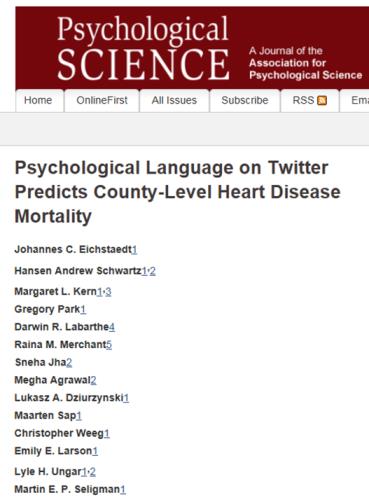 There are lots of anecdotes that portray how a careless social media post has destroyed a reputation, a career, or a romantic relationship. But can tweeting actually kill you?
Probably not. But your Twitter account may at least have a say on your risk for developing heart disease. In a study published in the renowned journal “Psychological Science”, researchers from the University of Pennsylvania (among them MAPP alum Johannes Eichstaedt, MAPP lecturer Peggy Kern, and Martin Seligman himself) have shown that Twitter can serve as a dashboard indicator of a community’s psychological well-being and can predict rates of heart disease.
They found that frequent expressions of negative emotions such as anger, stress and fatigue in a county’s tweets were associated with higher heart disease risk. On the other hand, positive emotions like excitement and optimism were associated with lower risk. Having seen correlations between language and emotional states in previous study using Facebook posts, the researchers now examined if they could detect connections between those emotional states and physical outcomes rooted in them.
Drawing on a set of public tweets made between 2009 and 2010, they used established emotional dictionaries to analyze a random sample of tweets from individuals who had made their locations available. There were enough tweets and health data from about 1,300 counties, which contain 88 percent of the USA´s population.
Eichstaedt et al. found that negative emotional language and topics, such as words like “hate” remained strongly correlated with heart disease mortality, even after variables like income and education were taken into account. Positive emotional language showed the opposite correlation, suggesting that optimism and positive experiences, words like “wonderful” or “friends,” may be protective against heart disease. In the future, this data could be used to marshal evidence of the effectiveness of public-health interventions on the community level, or serve as valuable input in the process of planning locations for new medical facilities.
While the study does not make any claims about the heart disease risk of individuals, I still suggest monitoring your Twitter timeline from time to time for prophylactic reasons. E.g., you can use the website www.tweetstats.com to obtain a free and easy overview of your tweeting behavior, for instance, a word cloud displaying your most frequently used words and hash tags.
This post kindly uses some passages from the Penn News service.
I know that about half of my pageviews come from Germany – so I´d like to share with you a presentation I just uploaded on Slideshare. It´s about Generation Y and the future of leadership – but there´s a strong link to positive psychology, especially on the subject of meaning in life.*
 Mappalicious