Your Strengths, as seen by Others: The Reflected Best Self™ Exercise

If you’re a bit like me, you do have a hard time talking about your strengths. As a German, I tend to be not that good at this – it basically is not really something that you do in our culture. I could tell you a long story about each and everyone of my flaws, but you probably don’t want to hear that.

Maybe you don’t even know what your strength are. So how are you going to find out? Obviously, there’s lots of tests and questionnaires out there. By way of example, you could take the Gallup StrengthFinder, or the VIA Questionnaire which will display your personal order of 24 character strengths according to a framework by Positive Psychology researchers Christopher Peterson and Marty Seligman.

But then, you might feel uncomfortable with regard to being assessed by an algorithm. Those tests are very reliable but on the other hand, they will only show you results depending on a fixed framework. What others really think of you or perceive as being your strengths could be a lot more nuanced than what those tests will be able to show you.

Granted, it might feel a little awkward asking other people to name your strength. The good thing is: there is a structured framework to achieve just that: the Best Reflected Self™ exercise. It was developed at University of Michigan´s Center for Positive Organizations and you can purchase the official exercise book there in case you want to use the that tool with your students or clients.

But basically, it involves just a couple of easy steps:

1) You ask a group of people that know you (friends, relatives, coworkers, clients etc.) to provide you with feedback. They should tell you what your strengths are from their point of view and ideally provide examples to back up their opinion. Instead of asking people in person, yesterday, I reached out to my network on Facebook to do just that:

Best_Reflected_Self

2) You gather all the responses and try to identify common themes. Here, I tried to detect all the words that alluded to a strength, turned them into nouns, and then harmonized those terms that represent very similar concepts. Finally, I took the result and inserted it into http://www.wordle.net. Here´s what came out of it (it´s German, but I guess you´ll understand most of it anyway):
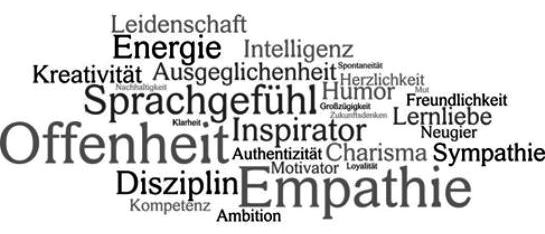
Best Reflected Self - Nico Rose

3) Now, write up a paragraph, summarizing your findings, describing what you are really, really good at: this is your personal strengths profile.

4) Finally, you should reflect on your current life roles with regard to this profile. E.g., does your current job give you frequent opportunities to play on your strengths? And if the answer is “no”: what could you do to adapt your role so it better reflects your best self (–> Job Crafting)?

I have to admit it was really touching to get all this positive feedback. Typically, when you work in an organization, you tend to get feedback (if things go well…) based on what you do well, but mostly on your potential (a.k.a.: where you need to improve).

Explicitly asking people to look on your bright side exclusively yields a special kind of learning experience – it´s like a mirror that somehow manages to make you look really, really good. I definitely know that it´s an idealized picture that I don’t live up to each and every day – but I know that I have it in me. And I can rely on it when life requires me to shine…
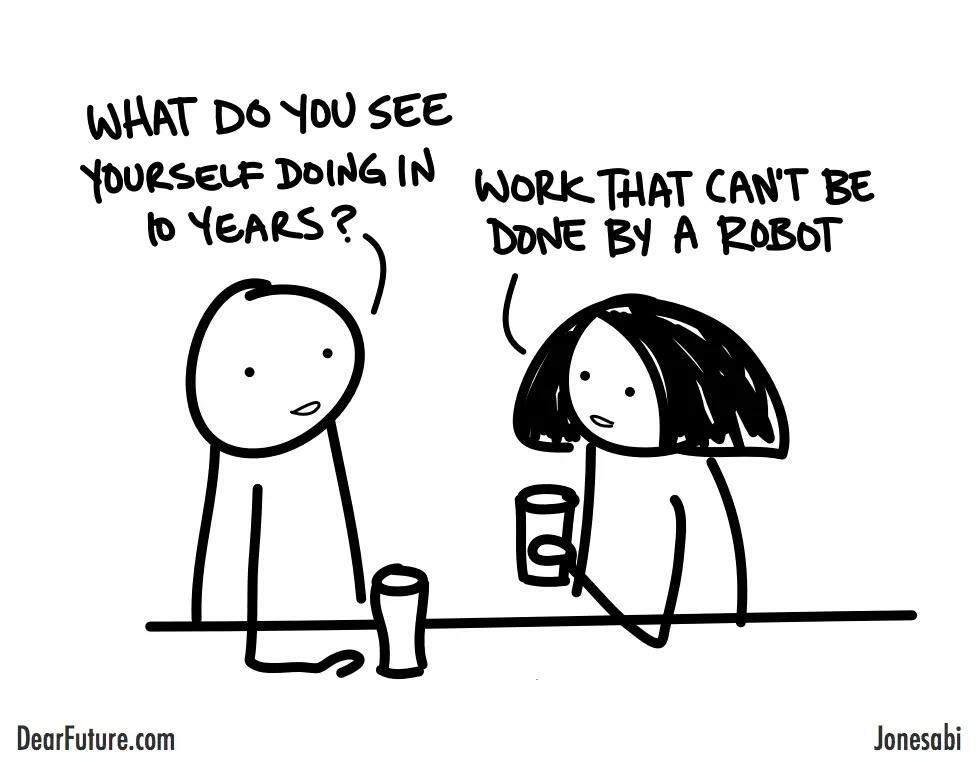
A Robot will probably take your Job soon. Here’s why we should be Happy about it

RobotThis is off-topic, but then, it might not be that off at the end of the day…

In June, I attended INSEAD, France’s premier MBA School, for a week of executive education. Basically, we were taught change management, strategy, and finance. At one point, we were discussing the consequences of artificial intelligence and advanced robotics. Over the last couple of years, a lot of articles and books have been published on this subject. Quite a lot of those take on a distinctly pessimistic perspective, claiming that squillions of jobs will be lost in the process. And indeed, a Chinese firm has announced that it plans to build the first robot-only factory site. Additionally, if you want to know the likelihood of being replaced by a computer in the medium run, please check this article on Fortune.com.

Now the fascinating question is: Is this a good or a bad development? The answer may, in fact, depend on the timeframe we´re looking at – and on the scope we´re considering. Have a look at this “arithmetic” problem that was given to us by INSEAD profesor Kevin Kaiser:

If a farmer with a tractor can do the work of 100 farmers without a tractor in the same amount of time: What´s the value of the tractor? The answer is: 99 farmers that are able to do something else.

This is basically what has happened over the last 1000 years or so. In the middle-ages, only a tiny fraction of the population was not working in farming. Even though, mankind could barely produce enough food to sustain itself. Today, only one percent of the U.S. population is working in that profession. The output per farmer has multiplied twelvefold – and that only covers the timeframe between 1950 and today. Just try to imagine the magnitude of the difference between a medieval and a modern farmer.

Now what has happened to those several hundred millions of people that aren’t farmers any more? Did they all become “unemployed farmers” and starved to death? The answer is no, of course. Over time, lots of them became craftsmen or merchants, later on, factory workers, service agents, psychologists, game designers, bloggers …,  [fill in whatever you like]. In short: they did something else – at least in the long run!

The idea that technological advancements will lead to large-scale unemployment is known as luddite fallacy, named after early 19th century textile workers in England, who protested against the implementation of mechanical stocking frames, culminating in riots and the destruction of factory equipment. It´s called “fallacy” because the machine breakers turned out to be wrong. They (mostly) did not starve: they did something else instead.

The fallacy is based on the assumption that there´s a limited amount of work in this world – so when a part of that whole is automated, it is “lost” to humans. This assumption is most likely wrong. We´re constantly developing new jobs (mostly services) that fulfill certain needs arising with the arrival of new technologies. By example, this article lists ten jobs that did not exist ten years ago. My question is: Why should this development suddenly come to an end?

Yes, it is true. Millions of people will lose their job to a computer or robot over the next 20 to 30 years. And from the vantage point of the individual, there will be tragedies. Some people clearly will not be able to cope. But: In the long run, people will do something else. They will not sit around and wait until they starve. They will do something else.

And again, it is true. For a lot of us, it is not clear as of now what this “something else” might be like. But I am a die-hard optimist. I am firmly convinced that whatever remains (or arises) will be more fulfilling than those jobs that are going extinct. Let´s be honest: Those jobs in that robot factory in China: how satisfying would they have been for human workers? And even if, somewhere in the near future, algorithms will be able to write news articles that are comparable in quality to those of human journalists, those journalists will find more creative work that cannot be matched by a computer program.

Recently, the German “new work guru” and former IBM executive Prof. Gunther Dueck said in a keynote:

“The simple part of work will disappear – for all of us. What remains is the challenging (or: sophisticated) part – for all of us.

Let´s all find out what the sophisticated part of our work is – the one that is truly creative and fulfilling: the one that cannot be matched by a silicone chip.

P.S.

If you want to know more, please read this article by Forbes contributor and new work expert Steve Denning: The ‘Jobless Future’ Is A Myth. Another angle on that story is provided by Pulitzer Prize-winning journalist John Markoff. In an intriguing long-read for Edge.org titled The Next Wave, he makes the point that we´re probably overestimating what artificial intelligence will be able to achieve in the near future. By way of example, he showcases results from a recent robotics contest, where most machines weren’t even able to properly used a door handle (“If you’re worried about the Terminator, just keep your door closed”).

No, the Chief Happiness Officer is not the Pizza Guy!

Smiling PizzaAs Positive Psychology has been entering mainstream media outlets over the past years, there have been people advocating for the implementation of ”Chief Happiness Officer” (CHO) role (sometimes also: Chief Wellbeing Officer) in organizations, typically as part of the wider HR/People Operations department. And while I fully endorse the idea in general (as there is a very distinct connection between employee happiness/wellbeing and organizational success, please see this article for an overview) I get really frustrated when reading what this role supposedly is all about. Here´s a selection of what I´ve read in several news outlets and blogs over the past weeks:

  • ordering pizza, ice-cream, massages and the like;
  • organizing office parties;
  • organizing trainings;
  • helping with relocation;
  • helping to individualize workplace furniture and design;

Excuse me – but are you f…..g kidding me? This is the description of a team or human resources assistant. We don´t need a CHO to achieve these things…

The Chief Happiness Officer is not the Pizza Guy!

A CHO that really deserves the C in her title would be a strategic role out and out, someone who reports directly to an organization´s CHRO or even CEO, as employee wellbeing has been shown to impact the bottom line in a pretty direct way. A CHO, the way I see it, should have a least 10 to 15 years of experience in different HR functions (e.g., leadership instruments, employer branding, payroll etc.) and should also have gained some experience in more operational roles to know about the “pain points” of the employees she´s responsible for. She would have (at least) a master´s degree in a field like organizational/occupational/positive psychology, or even an MBA with a specialization in one of those areas – and several years of experience in a leadership role. Increasingly, expertise in predictive data modelling could also be helpful, but I guess this could be delegated to a specialist. The role should be responsible for or at least significantly involved in the following processes and functions:

  1. strategy and mission development;
  2. leadership culture, development and instruments;
  3. training initiatives, especially on leadership;
  4. development of career tracks and work-time models,
  5. performance management including compensation & benefits;
  6. employee surveys, predictive analytics and other (big) data initiatives;
  7. employer branding, recruiting, and retention management;
  8. corporate health initiatives;
  9. workplace design;
  10. internal communications.

Only, if the CHO role is able to significantly influence all these tasks and processes in a concerted approach and is part of (or has regular access to) the company´s top management, it would be possible to leverage the valuable insights that Positive Psychology and especially Positive Organizational Scholarship (POS) have generated over the last 20 years. Image Source

With ordinary People to extraordinary Returns

Nico Rose - Handelsblatt Jahrestagung Private EquityA couple of weeks ago, I was invited to give a dinner speech at a private equity convention that was hosted by Handelsblatt, one of the most eminent (business) newspapers in Germany. I was a little surprised since – to be honest – I don’t know sh.t about private equity, mergers & acquisitions, etc.

So instead, I decided to talk about some subjects I do know, e.g., Positive Psychology, Self-Determination, and alternative forms of leadership.

Subsequent to my talk, I was invited to put into writing what I said that evening. The result is a feature that spans topics such as burnout, employee engagement, managing organizational energy, and the theory of the Kondratieff waves. My tagline was:

Extraordinary returns will be realized where ordinary people are empowered to achieve extraordinary results.

An English version of the piece is available available here. Enjoy!

Nico_Rose_FYB

Ready to push the Button? Instant Feedback for a Positive Work Culture

Today, I stumbled upon an article in The Wall Street Journal (Are You Happy at Work? Bosses Push Weekly Polls) that explains how some firms have adopted short weekly employee surveys/polls to measure workforce well-being, engagement, but also other work-related attitudes such as preferences for communication tools and software usage, among other things.

I find this highly interesting as receiving regular feedback, but also being able to provide feedback to bosses and the company as a whole seems to be a driver of well-being at work, and as a consequence, performance (especially among the younger part of our workforces). So basically everything that enables or facilities giving or receiving feedback could be a worthwhile investment.

This then reminded me of a photo that I took a the airport in Bergen/Norway when flying home from my TEDx talk in October.

Feedback Button - Bergen, Norway

It displays an easy-to-use feedback system that is installed right after the security controls. While walking by you can simply press one of the buttons to convey your opinion with regard to the quality of the control procedure. No pencil-and-paper, no log-in, just a short movement with your hands. You can even do that while carrying several bags.

How about having one of these gadgets at your office´s main entrance? It could be used to receive day-to-day feedback on your employee´s satisfaction, or based on the prompt, e.g. organizational energy. Quite obviously, a system like this will not tell you why a certain measure may go up or down, but this can be tackled using more sophisticated (and less frequent) feedback systems.

Are you ready to push the button?

New Article in Professional Magazine: Workplace Happiness and Job Crafting

Mach Dich zufriedenFor my German-speaking readers…

In the October issue of managerSeminare, Germany´s premier professional magazine for coaching and training, the lead article is concerned with workplace happiness and job satisfaction. I´ve been interviewed for that piece and was able to contribute some notions on job-crafting as theorized by MAPP lecturer Amy Wrzesniewski.

The print article lies behind a paywall but I might be able obtain a PDF to share in some weeks. In the meantime, you might want to listen to a podcast based on that article. This is available for free. Enjoy!

By the way: an article from spring 2014 in that same Magazine, which deals with a more general introduction to Positive Psychology, can be obtained for free here.


Being your Best on the Job: The Case of Thriving at Work

A couple of days ago, I shared some videos where Kim Cameron elaborates on his ideas about organizational energy. Yesterday, I stumbled upon an adjacent concept that I find equally interesting: Thriving (at work). It was first described by a group of researchers comprising – among others – Gretchen Spreitzer and MAPP lecturers Jane Dutton and Adam Grant.

Striving is a seen as a two-dimensional construct. In short, we experience ourselves as striving when we feel a sense of a) vitality and b) learning. More precisely, vitality represents a sense that one is energized and has a zest for work. Learning, in turn, is signified by the acquisition and application of knowledge and skills to build capability and confidence.Together, these dimensions capture both the affective (vitality) and cognitive (learning) essence of the psychological experience of personal growth (Porath, Spreitzer, Gibson & Garnett, 2011).

There is some preliminary evidence that the experience of thriving as depicted above is significantly linked to favorable outcomes such as job satisfaction, organizational commitment, and even performance. In this paper, a questionnaire for the measurement of thriving is described. If you´re interested, please watch this short video of Gretchen Spreitzer describing the concept. Enjoy!

Mappsterview No. 5: Margaret Greenberg on how Companies can Profit from the Positive

I was in the ninth cohort of the Master of Applied Positive Program at Penn. Consequently, there are tons of brilliant MAPP Alumni out there that have very fascinating stories to tell: about their experience with the program, about Positive Psychology in general – and about themselves of course. I really want to hear those stories. That´s why I started to do Mappsterviews with my predecessors.

Today, you are going to meet Margaret Greenberg from MAPP 1, the very first group of Mappsters to be taught at Penn. She co-authored a very successful book that I also included in my Positive Psychology at Work Book List.  

Profit from the PositivePlease introduce yourself briefly:

Like all of us, I wear many hats. I’m a wife to my sweet husband Neal of 30 years. I’m a mother to our two bright and beautiful twenty-something daughters. I’m an entrepreneur, having started my consulting/coaching practice, The Greenberg Group, in 1997 after spending the first 15 years of my career in corporate HR/Learning & Development. I’m a certified executive coach, speaker, and co-author of Profit from the Positive: Proven Leadership Strategies to Boost Productivity and Transform Your Business with fellow MAPPster Senia Maymin, and positive business columnist for Live Happy Magazine. I also do fundraising for the American Foundation for Suicide Prevention in honor of both my mother and mother-in-law. Finally, I enjoy being outside in nature, as well as inside baking, as you can probably tell from all the photos I post on Facebook!

What did you do before MAPP?

I’m doing after MAPP the same thing I did before MAPP – coaching business leaders and their teams to achieve more than they ever thought possible. The only difference is that I now have more research and resources to draw upon, and I’m writing a heck of a lot more. We all entered MAPP with our own set of experiences and education. To prevent positive psychology from becoming just another fad (I don’t even like to use the term “movement”) I believe it’s prudent for us practitioners to view positive psychology as just one more body of knowledge that we bring to our professions and lives.

What got you interested in Positive Psychology in the first place?

I had been in practice for 8 years as an executive coach when I learned of MAPP. What was missing from my coaching certification was the science behind what we do as coaches. I’ll never forget the day an email popped up in my inbox about this new graduate program in positive psychology. I ran, yes ran, outside to share my excitement with my husband who was gardening. “Go for it,” he said. “Yeah, but what if I get in, then what?” The rest is history as they say.

I´ve noticed that you´ve written your MAPP thesis on optimistic managers. Shouldn´t managers be more the critical, discerning type of person?

Most certainly managers need to think critically to come up with innovative solutions to business challenges. The trouble arises when managers apply this same critical thinking to the people they lead. Case in point: If all I do is look for things you are not doing right, and skip over the things you’re doing well, that can be pretty discouraging. In our book  we offer several practical tools to combat this tendency. We call them “Capitalize on What’s Right”, “Find Solutions Not Faults”, and “Obsess Over Strengths, but Don’t Ignore Weaknesses”.

The title of your book is “Profit from the Positive”. Please tell us a bit more about that!

Writing PFTP with a fellow MAPPster has been one of the most rewarding experiences. Senia and I each brought different strengths to the virtual table (Senia is on the west coast of the US and I’m on the east). We really wanted to bring what we were learning from applying positive psychology with our coaching clients to a much broader audience. The book is written for business leaders, HR professionals, and coaches in particular, but we have had readers tell us they found one or more of our 31 tools helpful in their own personal life. I’m happy to report that it will be translated into Chinese next month, and Korean and Japanese early next year. People can see what we’re up to by visiting our website, Facebook page, or connect with us on our LinkedIn Pulse blogs or @profitbook on Twitter.

OK, in my day job, I´m a manager myself. Which three things should I (personally) start doing right away?

First, recognize what we call the “Achoo! Effect”. Our emotions are contagious. Be sure you are spreading cheer, not fear at work (or at home). Second, if you do performance reviews at your company, be sure to preview, don’t just review Performance. Finally, I’d also recommend that you give FRE, which stands for frequent recognition and encouragement, to your employees, peers, and even your Boss. This was one of the key research findings from my Capstone that I collaborated on with another MAPPster, Dana Arakawa. Chris Peterson was our advisor and I will be forever be grateful for his guidance on this study, which is available on the University of Pennsylvania’s Scholarly Commons, and has been downloaded over 7,000 times.

And what kind of initiatives would you recommend on the organizational level?

I think there are lots of opportunities to be what Senia and I call a “positive deviant”. We’ve worked with companies large and small at the individual, team and organizational levels. Here are a few practical applications of positive psychology at the org level. To improve:

  • Strategy and Planning: Use the S.O.A.R. analysis (Strengths, Opportunities, Aspirations, and Results) rather than the traditional S.P.O.T. analysis (Strengths, Problems, Opportunities, and Threats).
  • Recruiting: Revamp hiring practices to include “Hiring for What’s Not on the Resume” to get at the more intangible social and emotional intelligence skills that are most predictive of success and higher Retention. In fact, there are many HR practices that need to be revamped to focus more on what’s going right, such as performance reviews that I mentioned earlier.
  • Meetings: Start and end meetings on a positive note.
  • Leadership and Talent Development Programs: That’s a topic for a whole other interview!

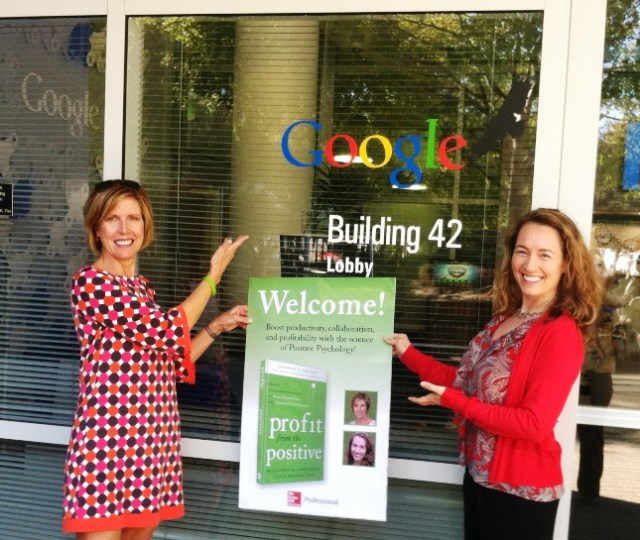
Margaret Greenberg and Senja Maymin

Thanks a lot, Margaret (on the left), for this Mappsterview!

Positive Psychology at Work: A Book List for the Layman [updated]

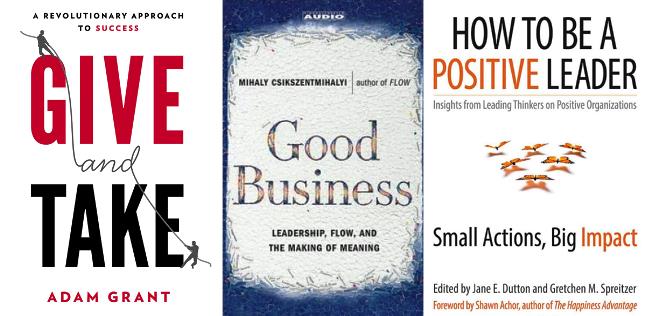
Here, I´ve compiled a list of books that apply Positive Psychology to the realm of “the organization”, leadership, management etc. As always, I see the list as work in progress and will be happy to include your suggestions. When making suggestions, please stick to books that have a clear link to Positive Psychology and are (by and large) backed by research.

Positive Leadership Books