The Little Guru wishes you a HAPPY Day!

The P in Marty Seligman´s PERMA framework of Positive Psychology stands for Positive Emotions. According to Barbara Fredrickson´s Broaden-and-Build theory of positive emotions, regularly experiencing sentiments such as happiness, joy, and anticipation is a sign of psychological well-being, and potentially even a pathway to creativity, success across different areas of life, and overall health.

So here´s a friendly reminder from my son, the Little Guru, to stay HAPPY! Have a great day!

Mappy Birthday! The most Mappalicious Blog on Positive Psychology is 1 Year old today…

Happy Birthday365 days ago, I started Mappalicious as a kind of diary while being in the 2013/14 Master of Positive Psychology (MAPP) cohort at the University of Pennsylvania. By now, the program is over – and there are 181 blog entries which means that I blogged something roughly every other day. I´m a little bit proud of myself for being so diligent.

And I´ve decided to go on with the blog as a valuable resource for people that are interested in Positive Psychology (and my personal take on the field…). For today, here are the 10 most-read articles of the first 365 days:

  1. History in the making: Epic Harvard Study on what keeps Men healthy and happy
  2. SCHLAAAAAND! How the Soccer World-Cup helps to Build a Likeable Version of the “German Nation” *
  3. Monkey (Porn) Business keeps up with the Kardashians **
  4. Mappsterview No. 1: Emilia Lahti, the Queen of Sisu
  5. The James Bond Philosophy of Life – in 007 Chapters
  6. A little Kindness goes a long Way: heart-warming Short Film about the Power of being a Giver
  7. My Top 20 TED(x) Talks on Happiness, Well-Being, Meaning & Co.
  8. The Upsides of Suffering: On Post-Traumatic Growth (PTG) and the Wounded Healer Archetype
  9. 7 common Misconceptions about Positive Psychology
  10. My Mind´s MAP(P): The 4-minute Ivy League Diploma in Positive Psychology

My blog also consists of 12 permanent pages by now. Apart from the “Home” section, my list of seminal Positive Psychology articles has the most views by far.

*This one is especially sought-after since it was published only about four weeks ago. **Guess which article gets the most traffic via search engines – and why…


Picture Source

Other People Matter: 2 Videos featuring the late Christopher Peterson

Unfortunately, I never had a chance to meet Prof. Christopher Peterson, who died before I really discovered the field of Positive Psychology and applied for the MAPP program at Penn. But all the people (I know) that had the privilege to be taught be by him speak most highly of “Chris”.

Therefore, I was glad to discover these two short video yesterday where he elaborates on his personal take on Positive Psychology. Enjoy!

If you like what you´ve seen, you might also enjoy The Good Life, a Positive Psychology blog that Chris used to write for Psychology Today.

Are you a H.E.R.O.? Positive Psychological Capital (PsyCap) explained

Positive Psychological CapitalSince it´s “formulation” at the onset of the new millennium, researchers have tried to apply Positive Psychology to organizational settings. E.g., Adam Grant promotes pro-social behavior in business settings, Amy Wrzesniewski looks at how employees can foster (perceived) meaning via job-crafting, and Jane Dutton investigates the impact of high-quality connections.

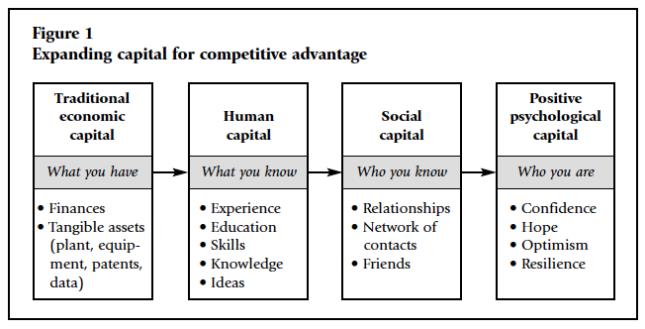
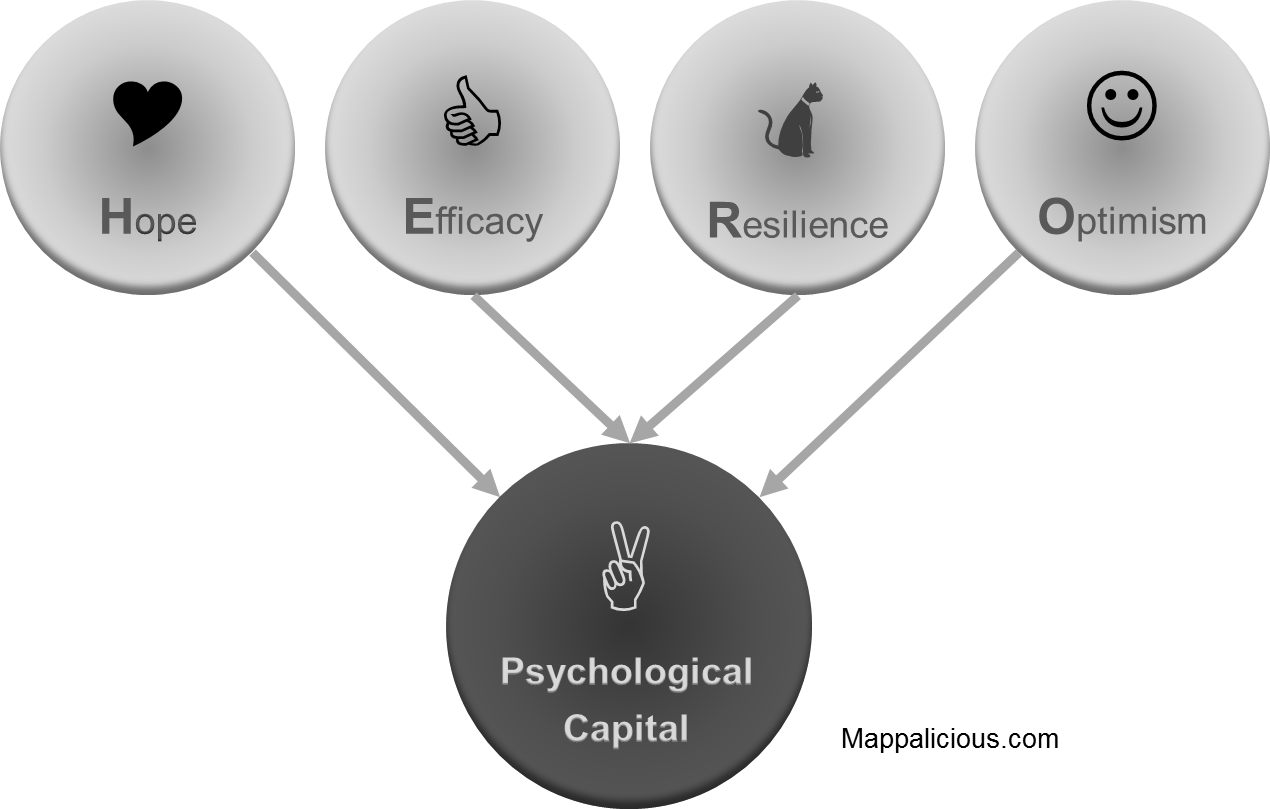
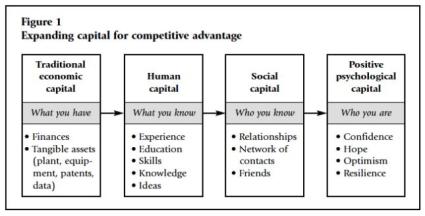
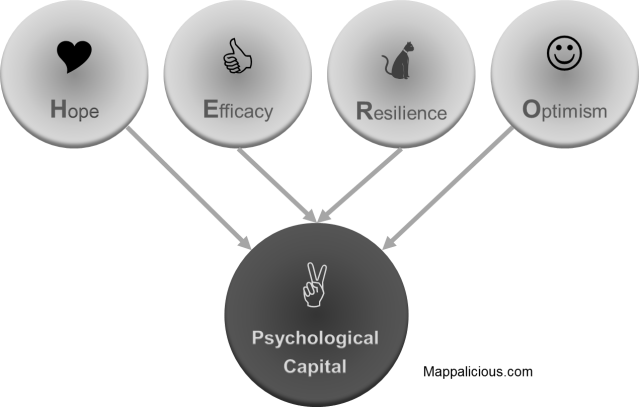
Another interesting framework is offered by Fred Luthans and his colleagues. They have developed the idea of Positive Psychological Capital (PsyCap) which is seen as a valuable extension to the concepts of economic, human, and social capital (see table above; taken from Luthans et al., 2004). PsyCap is theorized as a higher-order construct that is “composed” of four underlying constructs, precisely Self-Efficacy (also called Confidence), Hope, Optimism, and Resiliency. It´s called higher-order because PsyCap is not just “made of” the underlying constructs, but taken together, they form something new, an entity that is more than the sum of its parts. Please see diagram at the bottom, based on Luthans & Youssef (2004). This shows the whole framework, precisely: the H.E.R.O. formation by which the constructs is sometimes known to the general public. What are the building blocks all about – as defined in Positive Psychology?

  • Hope is as a positive state where our feelings of agency (goal oriented determination) and pathways (proactively planning to achieve those goals) interact.
  • Self-efficacy is depicted as confidence in our ability to achieve a specific goal in a specific situation.
  • Optimism is theorized as a realistically-positive view of what can or cannot do.
  • Resilience is defined as successfully coping with adversity or stress. In organizational settings, it is characterized as the ability to “bounce back” from high workload, conflict, failure, and ongoing organizational change.

Why were these four concepts chosen? In the words of Luthans et al. (2004):

The four psychological capacities of confidence, hope, optimism, and resilience are measurable, open to development, and can be managed for more effective work performance.

Why is this important? Because it means that – unlike trait-like concepts such as general intelligence – PsyCap can be developed by deliberate practice. Just the other three forms of capital, it can be built and enhanced – in a rather short amount of time, by the way (see this paper for more info). As such, it can be a very valuable tool in organizational and personnel development.

Why should you care (especially if you are a CEO or HR Director)?

Well, you should care if you are interested in having a healthy, engaged, and high-performing workforce. A meta-analysis (a type of study that aggregates the results of prior studies) based on 51 empirical investigations found a wide array of positive consequences for workers displaying high (vs. low) PsyCap. From the study abstract:

The results indicated the expected significant positive relationships between PsyCap and […] job satisfaction, organizational commitment, psychological well-being, desirable employee behaviors (citizenship), and […] measures of performance (self, supervisor evaluations, and objective). There was also a significant negative relationship between PsyCap and undesirable employee attitudes (cynicism, turnover intentions, job stress, and anxiety) and undesirable employee behaviors (deviance).

Are you curious now?
PsyCap Structure

Positive Psychology in a Nutshell: Watch this beautiful 5-minute Instructional Video

Today, while fixing something with my own, rather puerile Introduction to Positive Psychology on Youtube, I stumbled on this absolute gem of an instructional video. It´s a concise first-rate 5-minute introduction to Positive Psychology (as outlined in Marty Seligman´s recent book “Flourish”).

Why does it only have some 100K views? If cute cat videos (I mean, this is reeaaaaaly cute…) can get +50 million views, this one should have 100 million at least. So if you care about Positive Psychology, please share the hell heaven out of this thing…

The MAPP Capstone Folder at Penn´s Scholarly Commons Directory: Cutting-Edge Positive Psychology Knowledge for free

It´s almost over. What started out as a dream about 11 months ago, is now reality. I´m about one mouse-click away from becoming a full-blown Mappster. Mid-May, I had finished all my regular course requirements – and celebrated that intensely. By now, I`ve finished writing my so-called capstone project, an paper that can take on the form of a typical research paper, a book proposal, or even an outline for training concept etc. – as long as it´s backed by scientific research. I´ve decided to write a theoretical paper on the concept of self-permission which will be available online very soon. Over the last two hours, I´ve turned that paper into a conference poster and will send that over to Philly once I´m done with writing this post. When that is approved, I´m officially Dr. rer. pol. Dipl.-Psych. Nico Rose, MAPP. 🙂

By the way, if you are interested in novel ways of applying Positive Psychology to different domains of the “real life” (and also some cutting-edge research), you should definitely check out the MAPP folder of Penn´s Scholarly Commons directory. There, you´ll find +30 MAPP capstones from previous years – and it´ll grow as my fellow classmates and future Mappsters will upload their work over the upcoming weeks and years. My paper by the name of “Introducing Self-Permission: Theoretical Framework and Proposed Assessment” is already uploaded and will be available for download within the next days. Enjoy!

Penn - MAPP - Capstone Projects

Reaching our Life Goals: What gets in our Way?

I´d really like to have your reactions to this case:

  • What name would you give to “what happened” to Gregory?
  • What psychological theories can explain what happened to him?
  • What could have helped him?
  • Any other reactions?

Gregory is about to finish high school. He desperately wants to pursue a life as a professional classical pianist. He loves music more than anything else, commands sufficient talent, and is equally willing to engage in the necessary practice hours – as he has done all through his childhood. On that note, he has already successfully applied for a renowned conservatory to finish his musical education. Yet, his father, grandfather, and great-grandfather all have sought successful and very rewarding careers as medical doctors. His father has at times conveyed that – while valuing Gregory’s musical talent and ambition – he would very much like to see him stick with the “family tradition” and become a doctor as well. After several rather emotional discussions with his parents, Gregory decides to dismiss his father’s appeal and enrolls at the academy of music.

After doing well for a couple of months, he begins to feel more and more stressed. He starts to skip practice sessions, delivers flawed performances on important rehearsals, and gradually loses much of his enjoyment in performing the music he once loved. About two years later, he’s admonished to leave the conservatorium, due to diminishing prospects of success. Inconsolable, Gregory moves in with his parents again to sort out what to do with the rest of his life. He looks at the homepages of some pre-medical schools, but cannot make up his mind to enroll. Currently, he makes some money by giving piano lessons to children in the neighborhood and is considerably happy doing that – but deep inside, he feels like some part of him has died.   


On “Liebe und Arbeit” (Love and Work)

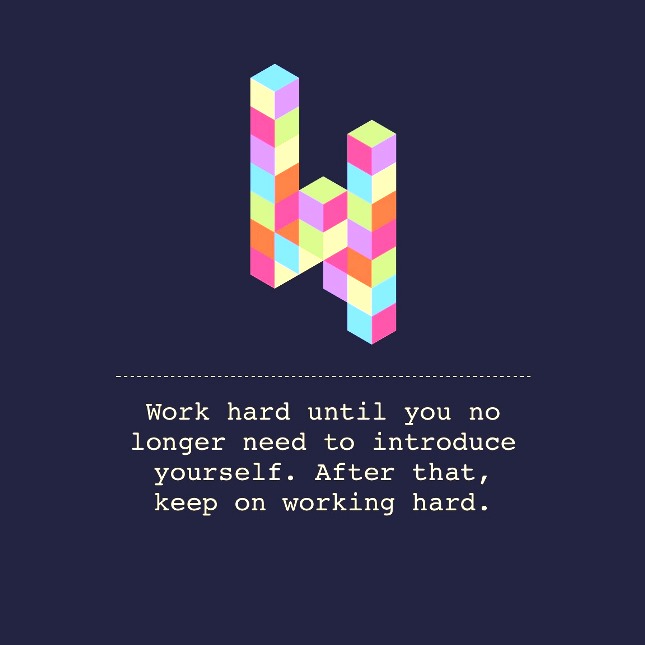
Two days ago, I stumbled upon this (anonymous…?) quote on the net:

Work until you no longer nedd to introduce yourself

Or rather, the quote consisted only of the first sentence – and I found it necessary to add the second. Sigmund Freud once wrote that “Love and work are the cornerstones of our humanness.” Freud has written a lot of nonsense in his lifetime – but I think here, he´s right on the spot. Obviously, this is not to say that other aspects of life are not important (such as play and recreation). But a lot of people these days spend a least half of their waking hours at work, which also means that we spend most of our time (because that includes our free time) in the presence of other people. That´s why the late Christopher Peterson used to say Other People Matter when asked for a short definition of Positive Psychology. It´s pretty straightforward. I guess most people would agree that our loved ones and friends are one of the most important sources of happiness in our lives – we don´t need Positive Psychology for this insight (even though they can also be an important source of grieve).

But what about work? Isn´t work a constant source of stress and discomfort for most of us? After all, surveys such as the Gallup Engagement Index regularly show that the greater part of the workforce are not really engaged in their current job. While this finding most likely is based on different causations, I propose that a very important one is a lack of fit between the person and the attributes of a job. That´s why I felt a need to add a second sentence to the above-mentioned quote. While I like the general idea, “becoming (more or less) famous” is a prime example of an extrinsic goal – and pursuing these has been shown to be detrimental to our well-being.

We all need to find something that we like to do irrespective of the (external) consequences. This is the most important learning from Self-Determination Theory and adjacent theories like the Self-Concordance Model. We have to find work that we would do even without being paid. I know that this a “moonshot goal” for most people as things are today – but it´ll be the key to lasting productivity and (workplace) happiness in the future.

My 15+15 Minutes of Positive Psychology Fame in Lincoln, Nebraska…

What do you do when you´re – more or less out of the blue – invited to be interviewed about your take on Positive Psychology by a radio talk host in Lincoln, Nebraska? Obviously, you say yes and turn on Skype. That´s what I did when Nick Hernandez contacted me via Facebook this Monday. It wasn´t completely out of the blue as I know Nick from his regular contributions on the Positive Psychology group on Facebook. But I did not know that he regularly hosts a 30-minutes show by the name of Community Matters on KZUM.org – now I do.

Mostly, we talked about my take on belief systems, a topic that I also explore in my book License for Satisfaction. If you´d like to hear the show – I´ve uploaded it here.

Community Matters - KZUM