The modern age of Positive Psychology started with Marty Seligman being elected APA´s president in 1998. But as the biblical saying goes, “there´s nothing new under the sun”. In very different ways, Positive Psychology is standing on the shoulders of giants – it draws upon a rich history of sages, philosophers, psychologists, and other lucid thinkers. For a short overview, please read this article: Positive Psychology: Standing on which Giants` Shoulders?
To make that point, I´ve created a visual Positive Psychology ancestral gallery (click on the image to enlarge) for a recent talk I´ve given for HR professionals. What do you think of it? And even more important – from your point of view: Who should be on there that is not right now?*
to bring together teachers, parents, academics, students, schools, colleges, universities, charities, companies and governments to promote positive education. Our goals are to support collaboration, change education practice and reform government policy.
On the question “Why Positive Education?” the website states:
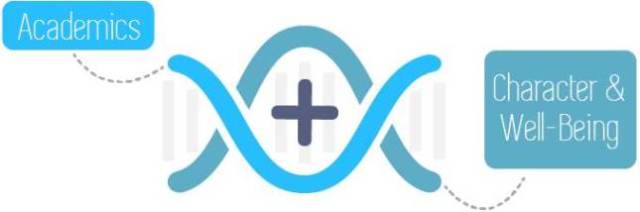
Positive education challenges the current paradigm of education, which values academic attainment above all other goals. Drawing on classical ideals, we believe that the DNA of education is a double helix with intertwined strands of equal importance:
The fulfillment of intellectual potential through the learning of the best that has been thought and known.
The development of character strengths and well-being, which are intrinsically valuable and contribute to a variety of positive life outcomes.
For quite a long time, Geelong Grammar School in Australia has been the hallmark of applied Positive Education. But more schools shall follow soon. Even in Germany – which typically does not pick up Positive Psychology topics that fast – has seen some Positive Education initiatives as early as 2007. We have a movement called Schulfach Glück (“School Subject Happiness”) which is backed by the “Fritz-Schubert-Institute”. They bring a positive curriculum especially to primary schools, helping teachers to teach topics to their classes such as joy and motivation, curiosity and courage, and mindfulness and respect.
By now, Fritz Schubert has authored three books on this initiative. The effectiveness of the program was recently evaluated in a study comparing classes who completed the curriculum to control groups. The treatment groups displayed higher subjective well-being and self-esteem at the end of the school year. The research article is written in German, but there´s an English abstract:
Applying a quasi-experimental pre-posttest design, we examined the effectiveness of a new teaching unit called school subject happiness. The investigation took place at two vocational schools that had established this subject in the school year 2010/11. Effects of one school year of instruction in the school subject happiness on students´ well-being, self-esteem, and self-efficacy are reported. In addition, a moderation effect of the personality traits emotional stability and extraversion was investigated. A total of 106 vocational school students who belonged either to the treatment or the control group participated in the study. At the beginning and at the end of the school year 2010/11, all students completed questionnaires. Beneficial effects were found for affective components of subjective well-being and self-esteem. Furthermore, the effects on self-esteem and cognitive components of well-being were moderated by emotional stability. Students who reported higher emotional stability benefited more from the new teaching unit. For self-efficacy no effect was found. The results are interpreted as partial effectiveness of the program.
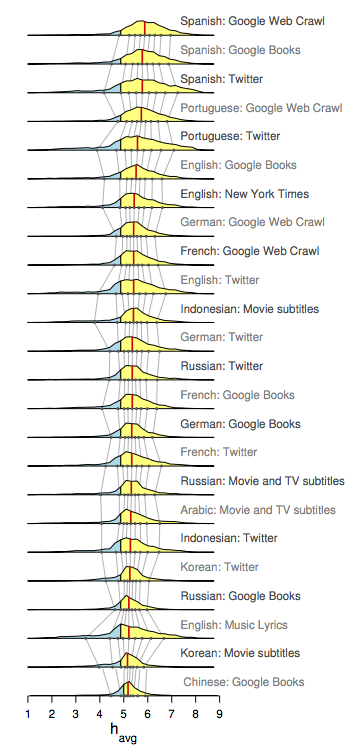
A couple of weeks ago, I was musing about the notion that the German language may just not be the perfect vehicle for Positive Psychology – as I feel my mother tongue may lack specific positive words, or at least displays a certain lack of breadth and differentiation at the positive end of the “language scale”. While this “lost in translation” effect was based on my intuition and personal experience, recent research supports my notion at least to some extent. As part of a large-scale study, researchers collected the most frequently used words in all of the major languages of the world – and then had them rated for positivity/negativity by natives speakers.
Finding No. 1: Positivity
Each and every language is positively skewed. Means: across languages, positive words are used more often than negative words.
No. 2: Distribution
Some languages are heavily inclined to the positive side (e.g, Spanish), while others are more balanced (e.g., Chinese). German is located in the lower middle part, so we use positive words less often than a lot of other languages (including English).
I think this study is able to shed some light on why someone might feel the aforementioned “lost in translation” effect when trying to bring Positive Psychology to a culture other than the “typical” Anglo-Saxon context. It just might be a (slight) case of an emotional mismatch.
Luckily, the field of Positive Psychology is growing fast. Yet sometimes, it can be hard to stay up-to-date with all the latest studies coming out, books being published, articles and blog posts being written – and all the other exciting PP stuff that happens around the globe 24/7.
Below, you’ll find 10 social networking and news groups that you might want to join to be part of the ongoing conversation on all things Positive Psychology.
Please note that some of the groups might have a restricted access and/or posting policy. Anyway, I would like to encourage you to read the corresponding FAQs and “house rules” (e.g., on advertizing) before actively participating. See you there…
Update 2: If you´d like to follow all of the accounts mentioned below, you can do so by following this Twitter list I´ve created this morning.
Update 1: Thanks a lot for all the positive feedback to this post. Within just 12 hours, it has become one of the most-read on Mappalicious. Via your suggestions, the list is now at 90 Twitter accounts. Therefore, I´ve decided to copy/paste this post to the (permanent) Positive Psychology Resources section. Further suggestions to the list will be added there, not here.
Over the last four years, Twitter tweets could not be found via Google. Now, both companies announced a new partnership which makes sure tweets will be part of the search results again. This means Twitter will become (even) more important in the future. So I guess that’s a good reason to see what Twitter has to offer with regard to Positive Psychology. Below, you’ll find 77 Twitter accounts of researchers, consultants, coaches, writers, bloggers, instititions, associations, news outlets, and software tools. As always, this is meant to be work in progress. So if you feel you know somebody (or an institution etc.) that belongs on this list, please leave a comment below this article. If you want to make a suggestion, please stick to people that either are in research, or otherwise display an in-depth knowledge of Positive Psychology (visible through e.g., a corresponding university degree).
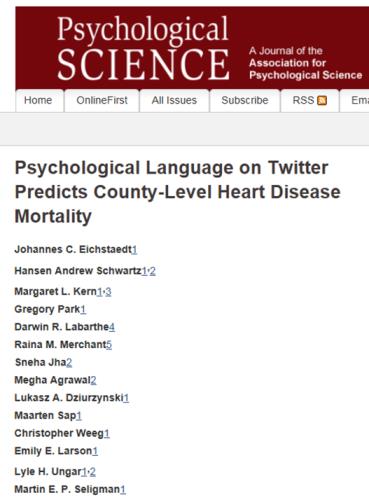
There are lots of anecdotes that portray how a careless social media post has destroyed a reputation, a career, or a romantic relationship. But can tweeting actually kill you?
They found that frequent expressions of negative emotions such as anger, stress and fatigue in a county’s tweets were associated with higher heart disease risk. On the other hand, positive emotions like excitement and optimism were associated with lower risk. Having seen correlations between language and emotional states in previous study using Facebook posts, the researchers now examined if they could detect connections between those emotional states and physical outcomes rooted in them.
Drawing on a set of public tweets made between 2009 and 2010, they used established emotional dictionaries to analyze a random sample of tweets from individuals who had made their locations available. There were enough tweets and health data from about 1,300 counties, which contain 88 percent of the USA´s population.
Eichstaedt et al. found that negative emotional language and topics, such as words like “hate” remained strongly correlated with heart disease mortality, even after variables like income and education were taken into account. Positive emotional language showed the opposite correlation, suggesting that optimism and positive experiences, words like “wonderful” or “friends,” may be protective against heart disease. In the future, this data could be used to marshal evidence of the effectiveness of public-health interventions on the community level, or serve as valuable input in the process of planning locations for new medical facilities.
While the study does not make any claims about the heart disease risk of individuals, I still suggest monitoring your Twitter timeline from time to time for prophylactic reasons. E.g., you can use the website www.tweetstats.com to obtain a free and easy overview of your tweeting behavior, for instance, a word cloud displaying your most frequently used words and hash tags.
By now, there are hundreds (or probably thousands…) of books on Positive Psychology. Most of them are general introductions to the subject or books focusing on the use of Positive Psychology in organizations (please see the general and organizational book lists on Mappalicious).
So today, I compiled a list of recent publications that looks a little different. All the books look at Positive Psychology from a very distinct and special angle. Enjoy!
Todd Kashdan and Robert Biswas-Diener look at the positive value of our negative emotions, thereby challenging the assumption that Positive Psychology is all about seeing the world through rose-colored glasses.
Kate Hefferon sheds light on the role of the body in Positive Psychology, thereby filling a gap in the extant literature that mostly focuses on the psychological side of things.
Rafael Calvo and Dorian Peters show us the (near) future of technology, where smartphones and wearables, together with the appropriate applications, will help to foster and sustain human well-being.
Michael Bishop aims at integrating philosophical and psychological theories of well-being and proposes a new theory for understanding flourishing.
Finally, Stephen Joseph takes on one of my most favorite subjects: post-traumatic growth. He explains how we can navigate (traumatic) change and adversity to find new meaning and direction in life.
Is a scientist (morally) responsible for his scientific discoveries? In a way yes, I would guess. If you help to develop the atomic bomb (knowing what kind of destruction it´ll cause…) and put it in the hand of the military, you´re at least partly responsible in case it is actually used. But what if somebody else (unknowingly…) takes your scientific discovery – and uses it in a way that is fundamentally the opposite of what you intended it to be?
Because this is what happened to the co-founder of Positive Psychology, Martin Seligman. Over the last couple of weeks, Marty was mentioned in several articles covering the “CIA torture report”, e.g., here in the New York Magazine. Supposedly, two psychologists that helped the CIA to develop “more efficient” torture methods said they were “inspired” to do so by research on the subject of learned helplessness, a framework that was first described by Marty in the late 1960s (this was his breakthrough as an internationally acclaimed researcher; here´s one of the first articles on the subject from 1967), and that was subsequently used to develop effective treatment methods for depression.
Some articles even (falsely!) claimed that Marty was directly involved in the development of torture methods. For instance, this so happened in the “Spiegel” (“Mirror”), Germany´s leading weekly magazine on politics and culture. Luckily, I was able to help Marty to some extent with my knowledge of the German media system. At the end of the day, an intervention led to a significant reformulation of central aspects of the article. The newspaper even apologized to him for having made those false claims.
If you are interested in the development of the concept of learned helplessness and its (alleged) role in torture methods (and Marty´s thoughts and feelings on this unfortunate issue): there´s a superb article on this topic by Maria Konnikova in the New Yorker.
A couple of times in the past, I´ve written about how immersing yourself in Positive Psychology is somewhat hard when you´re German – because it seems to be a slightly “Un-German” topic. Today, I´d like to explore this topic from a slightly different angle – that of language. Oscar Wilde supposedly said “Life is too short to learn German.” And he may have been right. It´s pretty complicated and therefore awfully hard to learn as a foreign tongue. Yet, it is the language of Goethe, Schiller, and Rammstein – that´s something to explore.
Speaking of the metal band Rammstein: there´s this thing about German pronunciation that makes just about everything sound like a declaration of war – even if you say something like “I love you”. There´s a funny video about this on Youtube. The guys overdo it a little, but then, this may just be what it feels like to a non-German ear:
But I digress. What I really want to talk about: I feel there´s a lack of positive words in the German language. Positive Psychology was (sort of…) invented in the U.S. – and most research papers and books are written in English. When I came to Penn, obviously I had to study the subject in English, too. But now that I´m back in Germany, I try to “sell” the topic over here, which has to be done in German of course. And that´s where the problems begin.
There´s this myth that the Inuit have an unusually high number of words to describe snow. We have “50 Shades of Grey”, they supposedly have 50 shades of snow. Actually, this is not true. But the idea behind the myth seems highly intriguing to me. In short it says: when something is valued very highly in a specific culture this tends to influence the use of language. Specifically, people pay more attention to the subject because of its importance, thereby learning to make more subtle distinctions, that ultimately are reflected in the amount of different words that can be used to talk about the subject.
To a certain degree, this idea mirrors one of Wittgenstein´s most famous dictums:
The limits of my language means the limits of my world.
When I do not have a word for something, that makes it hard to think about that subject, because it cannot be “grasped”. And it makes it even harder to speak about “that something” to other people. That idea is (probably) embodied in another Wittgenstein quote: “Whereof one cannot speak, thereof one must be silent.”
Which brings us back to my problem of “selling” Positive Psychology in German:
Where there are no words, you can´t “spread the word”.
When I first tried to talk and write about Positive Psychology in German, oftentimes I felt a lack of the “right” words. For example, the German language has the same word (ergo: a lack of distinction…) for the subjects of “Happiness” and “Luck”. Both are signified by the noun “Glück”. So whenever I talk about happiness and positive emotions in the context Positive Psychology, I have to use an awful lot of extra words to get across the intended meaning.
But it´s not only a lack of distinction. Sometimes, I even feel there are no words. For instance, the brilliant Jonathan Haidt gave a lecture on the subject of “awe” in one of our MAPP classes. This moved me very much and I wanted to talk about my experience with friends back in Germany. The problem is: obviously, there is no adequate translation for “awe”. If you type “awe” into a translation machine, you’ll get the German equivalents of “veneration” or “reverence”, “rapture” or “entrancement”. All the suggestions entail a very religious or, at least, old-fashioned connotation. They are not part of a modern, non-religious German “language game”. Therefore, talking about “awe” in German in a scientific (or just everyday) context seems awfully hard.
This bears some interesting implications. Whenever I fill in a questionnaire on happiness or life satisfaction (e.g., here on Marty Seligman´s website), there´s an interesting phenomenon when I look at the results. These will be displayed in the context of different normed groups. E.g., your scores will be compared to other people of your age, your educational background, but also your ZIP code (when provided). Now here´s the thing: Comparing my results to other people from my ZIP code (ergo: other Germans) will always put me in a higher percentile. This means: based on the same raw scores, the algorithm will display that I´m quite happy when comparing myself to other men in general, or other Ph.Ds, but that I´m extremely(!) happy when comparing myself to other Germans.
Now, there´s a couple of different explanations for this phenomenon. The easiest one would be: on average, the German respondents in that data base are not all that happy – and that´s why I score (relatively) higher vis-à-vis that group. But it may also be a phenomenon of language. What if Germans were just as happy on average as, let´s say, U.S. citizens, but were reluctant to use positive self-descriptions in an extreme specification – just because it´s not part of our “happiness language game”? Maybe, via studying Positive Psychology in English in the U.S., I became a little less German, thereby being able to mitigate the dissonance of describing my life in a very positive light?
I guess Positive Psychology has to integrate cultural perspectives more and more in order to be equally “useful” for all the people on this planet. Recently, the Scientific American published a piece by the name of “Not Everyone Wants to Be Happy” citing different studies that were able to show that the concept and meaning of happiness can vary significantly between different cultures (notably, between more Western and more Eastern cultures) – but has also evolved over time. Very though-provoking.
Which brings me to the final question for today:
Could Germany be a better place if somebody invented new positive words?
“The German” per se (as a stereotype”) is depicted as a sober-minded person. We´re perceived as being diligent, orderly, industrious, and a lot of other helpful attributes. But we´re also depicted as being rather anxious, risk-averse, and just not that open-minded (think “German Angst”). This is not just an academic discussion. The German economy has been doing comparably well over the last couple of years – but how long will this last? We´re really not that good at building and financially supporting start-ups. Forbes regularly updates a large list of all those startups that are valued at more than one billion $ in terms of private equity funding. Only one of those is based in Germany.
What if all this were (at least to some extent) a consequence of a lack of the right positive words? Would we become more optimistic, less risk-averse, and more open-minded if we were able to enhance our language, if we were able to broaden the (far) positive side of our verbal aptitude? I think it´d be worth a try. In 1999, a German publisher of dictionaries (together with ice-tea brand Lipton) hosted a contest for the invention of a new word. We have a German word for the state of being “full” (= not hungry any more) – but there´s no positively framed expression for being “not thirsty any more”. As far as I know, the winning word has not made it into our regular language use, but I guess it was worth the effort.
So why shouldn’t we – for starters – find a more awesome translation for “awe”? I´m eager to hear your suggestions…
If you want to learn the basics of Positive Psychology directly from one of the most eminent researchers in the field, 2015 is your time. Barbara Fredrickson is offering a massive open online course (MOOC) via the platform Coursera for free. The course is scheduled from February 9 to March 27. You´ll have to put in roughly 2-4 hours of work. This is the course´s syllabus:
Week 1: Positive Emotions: The Tiny Engines of Positive Psychology. Look “under the hood” to discover the powerful drivers of growth, well-being, and health.
Week 2: The Mindscapes and Outcomes of Positivity. Discover the roots of flexibility, creativity, and resilience.
Week 3: The Delicate Art of Pursuing Happiness. Discover the ratios and priorities that best promote flourishing and learn common pitfalls to avoid.
Week 4: Positivity Resonance and Loving-Kindness. Unveil the force of co-experienced positive emotions and practice this lab-tested meditation honed over millennia.
Week 5: The Fruits of Positivity Resonance. Learn to spot the health benefits that loving-kindness uniquely nourishes.
Week 6: The Ripples of Positivity Resonance. Far beyond you and your happiness, positive psychology radiates out to benefit your relationships and community.





 Mappalicious