What’s your “Ikigai”? On Purpose, Meaning, and making a Living

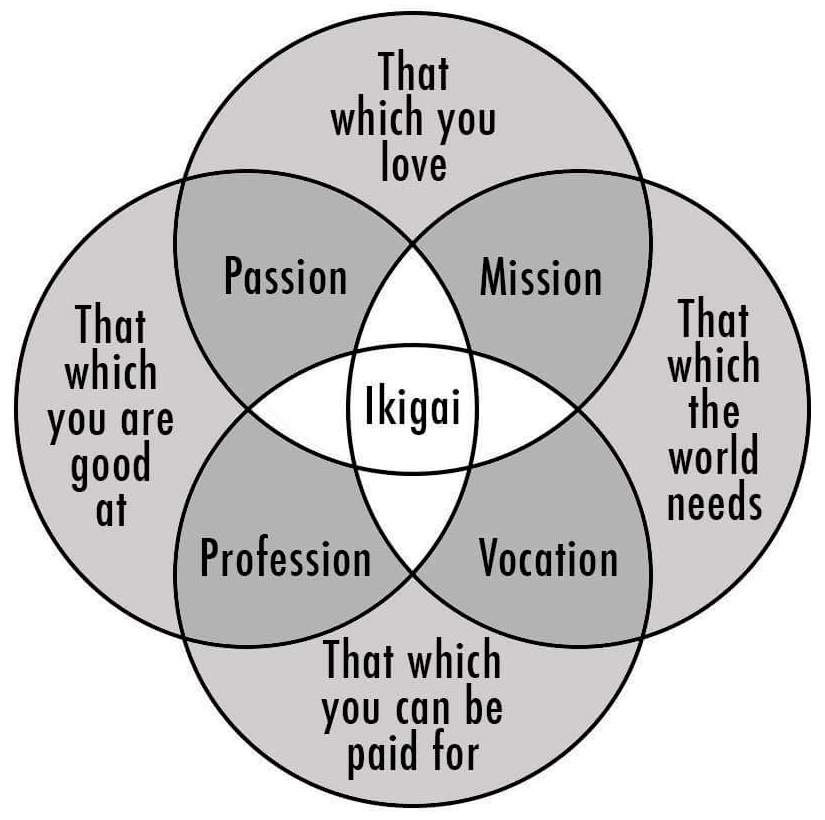
There’s a very popular infographic on the net. It’s been around for a couple of years in several different versions.*

The graphic is supposed to help us find our life purpose by showing the different elements it consists of. It displays several overlapping Venn diagrams, thereby distinguishing the elements of mission, vocation, profession, and passion.

Ikigai - Purpose - Meaning
In later versions, at the center of those four circles, you’ll see the Japanese word Ikigai. Just in case you are wondering: Ikigai is composed of two separate Japanese terms: iki (life), and kai, which roughly means the realisation of what one expects and hopes for.

In more specific terms, ikigai is a) used to indicate the things that make one’s life worthwhile, and b) to refer to mental and spiritual circumstances under which individuals feel that their lives are valuable.

Having found (and living according to) one’s personal ikigai seems to be associated with greater health and longevity. At least this was a finding from a large-scale study among Japanese citizens. From the summary:

In this population-based prospective cohort study in Japan, those who did not find a sense of ikigai were significantly associated with an increased risk of all-cause mortality. The increase in mortality risk was attributed to an increase in the mortality from CVD (mainly stroke) and external causes […]. 

In our study subjects, those who did not find a sense of ikigai were likely to have a poorer socioeconomic status and poorer objective health status. However, the mortality risk in those who did not find a sense of ikigai was consistently increased, irrespective of socioeconomic factors, other psychological factors, physical function, lifestyle habits, and a history of illness.

*The infographic can be found in numerous versions on a ton of websites. In case you know who created it originally, please leave a comment so I can give proper credit.

The Paying it Forward Paradox | TEDxUoM

What if the toughest barrier between us and our needs is that we don’t ask for help fulfilling them? Sociologist Wayne Baker offers insight into the concept of generalized reciprocity or “paying it forward.”

Wayne Baker is Robert P. Thome Professor of Business Administration and Professor of Management & Organizations at the Ross School of Business. He is also Professor of Sociology at the University of Michigan and Faculty Associate at the Institute for Social Research. His work focuses on social networks, generosity, and values. His books include “United America: The Surprising Truth about American Values, American Identity, and the 10 Beliefs that a Large Majority of Americans Hold Dear” and “Achieving Success through Social Capital: Tapping the Hidden Resources in Your Personal and Business Networks”. He blogs five days a week at http://www.ourvalues.org, an online experiment in civil dialog.

Pioneers in Positive Psychology — from the 1950s

Jahoda_Positive_HealthWhen thinking about (modern) Positive Psychology, people usually associated its onset with Martin Seligman’s term as president of the the American Psychological Association (APA) and his seminal paper in American Psychologist (2000, co-authored with Mihály Csíkszentmihályi).

But the first modern (research-based) sources are almost 50 years older than that. Abraham Maslow was (very likely) the first person to use the term Positive Psychology in a scientific essay. As early as 1954, he wrote about how and why psychology had gone wrong by focusing only on negative behaviors and avoiding the question of what the human experience could be:

If one is preoccupied with the insane, the neurotic, the psychopath, the criminal, the delinquent, the feeble-minded, one’s hopes for the human species become perforce more and more modest, more and more realistic, more and more scaled down. One expects less and less from people. From dreams of peace, affection, and brotherhood, we retreat.

In 1958, Marie Jahoda wrote the book Current Concepts of Positive Mental Health, a book considered to be the first on positive mental health. From the introduction:

Knowledge about deviations, illness, and malfunctioning far exceeds knowledge of healthy functioning. […] Science requires that the previous concentration on the study of inappropriate functioning be corrected by greater emphasis on appropriate functioning, if for no other reason than to test such assumptions as that health and illness are different only in degree.

It´s always good to know on which giant´s shoulders we´re standing on today…

Surprising Finding | Mental Illness vs. Mental Health: Continuum or Matrix?

A few days ago, I shared some research by Carol Ryff and Corey Keyes on the structure of psychological well-being. Today, I’d like to highlight more of Keyes’  work.

When we think about psychological health, we typically have a kind of continuum in mind. On the one end, there are states such as satisfaction and happiness, on the other end there’s (severe) mental illness, e.g., depression and anxiety disorders. And we’re also sure all people can be located on this single dimension at any given point in time. Additionally, the absence of one state is mostly equated to the presence of the other. Accordingly, an individual is perceived as being psychological healthy when there are no signs of mental illness.

Turns out this perspective may be flawed, or rather: incomplete. Using large-scale samples, Corey Keyes is able to show that we should probably see mental health and mental illness as two interrelated, yet clearly separable dimensions. The first one is about the presence or absence of mental health, the other about the presence or absence of mental illness (please take a look at his paper Mental Illness and/or Mental Health? Investigating Axioms of the Complete State Model of Health)

Keyes_Mental_Health_Matrix

When creating a matrix that is composed of these two continua, we’re able to understand psychological states on a much more nuanced level. By way of example, in his data, Keyes finds there are people who portray distinct signs of mental illness (e.g., depressive symptoms) while at the same time displaying a moderately high level of psychological health (e.g., perception of meaning in life). Conversely, there are quite a few people who are clearly neither mentally ill nor particularly healthy, a state that Keyes calls languishing. In the words of the researcher:

The current study confirms empirically that mental health and mental illness are not opposite ends of a single continuum; rather, they constitute distinct but correlated axes that suggest that mental health should be viewed as a complete state. Thus, the absence of mental illness does not equal the presence of mental health.

[…]

The diagnosis and measurement of mental health […] has provided some invaluable information. First, relatively few adults (i.e., about 2 in 10) who were free of any of the four 12-month mental disorders could be classified as flourishing or completely mentally healthy. Almost as many adults were mentally unhealthy (i.e., languishing) as were mentally healthy (i.e., flourishing), and most adults were moderately mentally healthy. Second, diagnoses less than flourishing were associated with greater levels of dysfunctions in terms of work reductions, health limitations, and psychosocial functioning. Moreover, pure languishing was as dysfunctional (sometimes more) than pure mental illness.

Especially the last sentence should give some food for thought to public health officials and corporate health executives alike. For decades, their focus has been on understanding, assessing, and mitigating mental illness. And while this certainly is an important endeavor, Keyes´ esearch clearly shows that it might be and equally pressing mission to help people find pathways from a state of low mental health (languishing) to high mental health (flourishing).

Enter Positive Psychology

Breathing Happiness: New TEDx Talk by Emma Seppälä

Emma Seppälä believes we already possess the tools we need to control our own happiness. She explores the science behind harnessing your state of mind and how it can ultimately lead to success.

Turns out, happiness is not as elusive as it once seemed. Using findings from cognitive psychology and neuroscience, Seppälä simplifies happiness so that anyone can enjoy it. She’s a frequent contributor to Harvard Business Review, Psychology Today and Scientific American Mind. She’s the founder and editor-in-chief of Fulfillment Daily, a news site dedicated to the science of happiness.

The Structure of Psychological Well-Being — before PERMA

Torbogen_Kirche_kleinWhen talking about the “grand design” of psychological wellbeing these days, most people (at least implicitly) refer to Seligman’s PERMA framework, comprised of the building blocks: positive emotions, engagement, relationships, meaning, and achievement. You might also find people who add another letter for vitality, resulting in PERMA-V.

Of course, Seligman’s outline wasn’t the first attempt at developing a “theory of everything” with regard to psychological well-being.

Between 15 to 20 years before the introduction of the PERMA framework, researchers Carol Ryff and Corey Keyes presented a data-driven model that is comprised of 6 dimensions (here’s the link to one of the original papers: The structure of psychological well-being revisited): self-acceptance, positive relations with others, autonomy, environmental mastery, purpose in life, and personal growth.

Quite obviously, there’s a lot of overlap between the two frameworks, but also subtle differences.

To me, one very interesting feature of the Ryff/Keyes model is the idea that well-being is a higher-order entity. They were able to show statistically there’s a kind of “the whole is greater than the sum of its parts”-effect in the data. The idea is that psychological well-being exists as a single factor on the meta-level, where the whole has more meaning than the parts – kind of like looking at a house creates more meaning than looking at bricks, a door, and windows separately.

Here are the six factors of the Ryff/Keyes model in the original words of the researchers:

Self-Acceptance

High scorer: possesses a positive attitude toward the self; acknowledges and accepts multiple aspects ofself, including good and bad qualities; feels positive about past life.

Low scorer: feels dissatisfied with self, is disappointed with what has occurred in past life, is troubled about certain personal qualities, wishes to be different than what he or she is.

Positive Relations With Others

High scorer: has warm, satisfying, trusting relationships with others; is concerned about the welfare of others; capable of strong empathy, affection, and intimacy; understands give and take of human relationships.

Low scorer: has few close, trusting relationships with others; finds it difficult to be warm, open, and concerned about others; is isolated and frustrated in interpersonal relationships; not willing to make compromises to sustain important ties with others. 

Autonomy

High scorer: is self-determining and independent, able to resist social pressures to think and act in certain ways, regulates behavior from within, evaluates self by personal standards.

Low scorer: is concerned about the expectations and evaluations of others, relies on judgments of others to make important decisions, conforms to social pressures to think and act in certain ways.

Environmental Mastery

High scorer: has a sense of mastery and competence in managing the environment, controls complex array of external activities, makes effective use of surrounding opportunities, able to choose or create contexts suitable to personal needs and values.

Low scorer, has difficulty managing everyday affairs, feels unable to change or improve surrounding context, is unaware of surrounding opportunities, lacks sense of control over external world.

Purpose in Life

High scorer: has goals in life and a sense of directedness, feels there is meaning to present and past life, holds beliefs that give life purpose, has aims and objectives for living.

Low scorer: lacks a sense of meaning in life; has few goals or aims, lacks sense of direction; does not see purpose in past life; has no outlooks or beliefs that give life meaning.

Personal Growth

High scorer: has a feeling of continued development, sees self as growing and expanding, is open to new experiences, has sense of realizing his or her potential, sees improvement in self and behavior over time, is changing in ways that reflect more self-knowledge and effectiveness.

Low scorer: has a sense of personal stagnation, lacks sense of improvement or expansion over time, feels bored and uninterested with life, feels unable to develop new attitudes or behaviors.
10 fantastic Quotes by William James that preview Positive Psychology

Philosopher William James is often portrayed as being the founding father of modern (American) psychology. Here, I collected ten of his quotes that show he’s also been an influence for many theories and practices that are among the cornerstones of Positive Psychology.

On self-efficacy and solution-focused thinking

Action may not always bring happiness, but there is no happiness without action.

On creating habits

To change one’s life:
1. Start immediately.
2. Do it flamboyantly.
3. No exceptions.

On optimism, pessimism, and rumination

If you believe that feeling bad or worrying long enough will change a past or future event, then you are residing on another planet with a different reality system.

On the value of attention and mindfulness

Each of us literally chooses, by his way of attending to things, what sort of universe he shall appear to himself to inhabit.

On belief systems and disputation of negative thoughts

To perceive the world differently, we must be willing to change our belief system, let the past slip away, expand our sense of now, and dissolve the fear in our minds.

On perseverance, grit, and sisu

In exceptional cases we may find, beyond the very extremity of fatigue distress, amounts of ease and power that we never dreamed ourselves to own, sources of strength habitually not taxed at all, because habitually we never push through the obstruction, never pass those early critical points.

On finding purpose and vitality

Seek out that particular mental attribute which makes you feel most deeply and vitally alive, along with which comes the inner voice which says, ‘This is the real me,’ and when you have found that attitude, follow it.

On meaning, altruism, and the greater good

The great use of life is to spend it for something that will outlast it.

On the value of positive relationships

Wherever you are, it is your friends who make your world.

On hope, best future selves, and callings

Your hopes, dreams and aspirations are legitimate. They are trying to take you airborne, above the clouds, above the storms, if you only let them.
 William  James 

The Most Important Part of the Good Life | Jamie Gruman 

The good life. We all want it. We all want to know the secret formula for attaining it. But the simplistic, often misleading prescriptions for the good life that are tossed around in the popular media, books, and online, can push the good life further out of our reach. Psychologist, and Founding Chair of the Canadian Positive Psychology Association, Jamie Gruman, explains how a balanced viewpoint helps us properly understand the good life and make it a reality.

In his TEDx talk, Gruman describes the good life as a result of leading a balanced life, specifically, four different kinds of balance: Balance as a) mid-range, b) synthesis, c) tempered view, and d) sensitivity to context.

Share and enjoy!

Hacking your brain for happiness | James Doty | TEDx

James Doty explains the neurological benefits of compassion.

“Project Compassion” has now turned into a leading research and educational institution and the only institution solely focused on the study of Compassion, Altruism and Empathy. Compassion improves the world; yet the world around us seems ever in need of greater feats of compassion.

How, then, can we create more compassion and inspire compassionate acts? And how is it that the brain and the heart work together to create compassion in the first place?
James Robert Doty, M.D., tackles these tough questions, examining the neural, mental, and social bases of compassion. He serves as Professor of Neurosurgery at Stanford University School of Medicine and Founder and Director of Stanford University’s Center for Compassion and Altruism Research and Education (CCARE) – of which the Dalai Lama is the founding benefactor.

He serves as Chairman of the Dalai Lama Foundation and as a member of the International Advisory Board of the Council of the Parliament of the World’s Religion.