Want to be the Boss? Be Happy, Science says, and you´ll be a Good Leader

Happy BossFor a moment, think about a leadership person (a.k.a. boss) in your life that you really liked working for. How could that person be described, what kind of personality did he/she convey? Was he/she more the grumpy moaner – or rather an upbeat “Sunday´s child”?

Turns out that this question is not only about likeability but also about leadership effectiveness. In a recent meta-analysis* published in The Leadership Quarterly titled Is a happy leader a good leader? A meta-analytic investigation of leader trait affect and leadership, Dana L. Joseph and her colleagues found that – broadly speaking – happier leaders also tend to be more effective leaders. In the words of Joseph and her colleagues:

Our analyses show that leader trait affectivity, particularly leader trait positive affect, plays a significant role in predicting leadership criteria.

A happy boss is a good boss.

They also find that the relationship between leader happiness and effectiveness may not be a direct one. Rather, it seems that happy bosses predominantly engage in a special leadership style that has been coined transformational leadership. As opposed to more traditional leadership styles (telling people what to do and controlling them; management by objectives etc.), transformational leadership, according to Joseph et al., consists of the following dimensions:

  • idealized influence, or the extent to which a leader displays conviction and behaves in a way that causes followers to identify with him/her;
  • inspirational motivation, which involves communicating optimism and challenging followers to meet high standards;
  • intellectual stimulation, or the extent to which a leader takes risks, challenges assumptions, and encourages follower creativity;
  • and individualized consideration, which is characterized by follower mentoring, attending to follower needs, and listening to follower concerns.

Now, does that sound like the behavior of a boss we´d all like to work for? My answer is a clear yes. And it predominantly starts with that person´s happiness.

* A special type of study that statistically aggregates previous study results to provide an overview of a specific branch of research.

Want to stay on top of Positive Psychology in Organizations? Here are 3 Reviews for you (PDF)

Happy ManagersBeing a manager in my day job, I am foremost interested in the application of Positive Psychology in organizations – and the science exploring these issues, Positive Organizational Scholarship. While there are a couple of good trade books on the subject, I also like to read original research papers which is always a great source for new ideas to blog about. As there are so many articles out there, the question is: Where should we start?

The (or at least my) answer is: Always start with review articles, and, if there are any, meta-analyses. Both are tremendously valuable in order to get an overview of a discipline in the shortest amount of time – as the authors first scan the extant data-bases for relevant articles, and then organize and summarize the current body of research. It´s a lot of hard work which is usually rewarded by receiving frequent citations over time. So, thanks to all those diligent, hard-working review writers out there!

Here´s a list of three reviews on Positive Psychology in organizations for you – the links will lead you to the respective PDFs. Enjoy!

Do you want to find more Meaning in your Work? Here´s where you should look for it – according to Science

Feeling that your work has a deeper meaning or purpose has many positive consequences, for yourself as well as your organization: For instance, higher levels of engagement, job satisfaction, and (individual) performance. Therefore, researchers as well as practitioners have tried to find the antecedents of meaning in work for quite some time. Yet, it turns out that it´s a pretty complicated issue. A job that yields a lot of meaning for one person might feel totally meaningless for another individual.

Where should we look for the source of meaning in work? Is it something that can be found within ourselves? Does it depend on the type of job? Or is it determined by some characteristics of the organization? The answer is: very likely, all of those factors do play their role – and in part, meaning depends on the interaction between the characteristics of the person and those of the job.

In an empirical study published in the Journal of Positive Psychology, Tatjana Schnell and her colleagues surveyed some 200 people from different occupational backgrounds. In short, here´s what they´ve found:

When looking at all factors in a single model…

  • the strongest predictor of meaning in work is job significance (= the perceived implications one’s deeds have on an organizational, societal or even global level);
  • the runner-up is the organization´s socio-moral climate (= a culture that fosters a) open confrontation with social conflicts and problems; b) reliable appreciation, care, and support; and  c) participative collaboration);
  • third place goes to the organizations´s self-transcendent orientation (= commitment to a higher purpose, combined with a concern for ethics and integrity);
  • and the last (but not least) impact comes in the form of work-role fit (= a perceived match between personal identity and actual job activities).

All in all, those attributes are able to predict almost 50% of the variance pertaining to participants´ level of perceived in meaning in work (that´s quite a lot in the context of psychological research). To put in everyday language:

We find meaning in our work when we frequently have the opportunity to perceive the (positive) outcome of our individual contribution, when our organization promotes a culture of fairness, trust, support – and authentically commits to some “greater good”, and when we feel that our job provides us with lots of opportunities to use our unique talents and matches our personal values.

In another fascinating article, Brent D. Rosso et al. try to provide an integrative model that compasses (more or less) all known factors that influence perceived meaning in work. Personally, I think it´s a very insightful (and: beautiful…) piece of research – and I will reread it frequently. I think, it is pretty self-explanatory, so I´ll leave it up to you to make the most of it.


Ready to push the Button? Instant Feedback for a Positive Work Culture

Today, I stumbled upon an article in The Wall Street Journal (Are You Happy at Work? Bosses Push Weekly Polls) that explains how some firms have adopted short weekly employee surveys/polls to measure workforce well-being, engagement, but also other work-related attitudes such as preferences for communication tools and software usage, among other things.

I find this highly interesting as receiving regular feedback, but also being able to provide feedback to bosses and the company as a whole seems to be a driver of well-being at work, and as a consequence, performance (especially among the younger part of our workforces). So basically everything that enables or facilities giving or receiving feedback could be a worthwhile investment.

This then reminded me of a photo that I took a the airport in Bergen/Norway when flying home from my TEDx talk in October.

Feedback Button - Bergen, Norway

It displays an easy-to-use feedback system that is installed right after the security controls. While walking by you can simply press one of the buttons to convey your opinion with regard to the quality of the control procedure. No pencil-and-paper, no log-in, just a short movement with your hands. You can even do that while carrying several bags.

How about having one of these gadgets at your office´s main entrance? It could be used to receive day-to-day feedback on your employee´s satisfaction, or based on the prompt, e.g. organizational energy. Quite obviously, a system like this will not tell you why a certain measure may go up or down, but this can be tackled using more sophisticated (and less frequent) feedback systems.

Are you ready to push the button?

Here´s how Organizations create a Culture of extraordinary Creativity

For a long time, people have been interested in creativity, especially “creative geniuses” such as Mozart, Edison, or van Gogh. We´ve tried to find out what is “special” about these persons: was there something extraordinary about their intellect, their personality, even their brains?

While these are very interesting questions, there is another angle on creativity that may be somewhat more relevant to our everyday lives. Creativity and, in turn, innovation, are key facets of enduring success for most organizations on this planet. Most of this creative output will be “everyday creativity”, not some big mind-blowing leap into another dimension: small, incremental changes that lead to a competitive advantage at least for a while. So while it is surely helpful to ask “How can I get exceptionally creative people on board?” – an even more important question could be:

Killing CreativityHow can we create organizational cultures that foster creativity in each and every person?

As noted in the beginning, research on this special topic is more scarce than then the investigation of individual creativity – but it has been done. Researcher Laird D. McLean has published an article that reviews studies on the connection of organizational culture and creativity, roughly from the 1960s to 2000, incorporating findings from experts such as Harvard´s Theresa M. Amabile and Rosabeth M. Kanter.

Here are the key factors that separate highly creative organizations from the rest:

  • Organic design: influence is based on expertise instead of position, decision-making authority is decentralized.
  • Organizational encouragement: risk-taking is valued and evaluated supportively; collaborative idea flow and participative decision-making is fostered.
  • Supervisory encouragement: managers clarify team goals and support team’s creative work, support open interaction.
  • Work group encouragement: organization actively fosters/leverages diversity, integrating creative personalities into “organizational mainstream”.
  • Freedom and autonomy: organization grants sovereignty to employees with regard to determining the means by which to achieve goals.
  • Resources: finding the „golden mean“ with regard to time and money: scarcity produces fear, distrust, and burnout, excess decreases creative performance.

No rocket science, huh…? If you are a manager, now go out and do that… 🙂


Picture source

New Article in Professional Magazine: Workplace Happiness and Job Crafting

Mach Dich zufriedenFor my German-speaking readers…

In the October issue of managerSeminare, Germany´s premier professional magazine for coaching and training, the lead article is concerned with workplace happiness and job satisfaction. I´ve been interviewed for that piece and was able to contribute some notions on job-crafting as theorized by MAPP lecturer Amy Wrzesniewski.

The print article lies behind a paywall but I might be able obtain a PDF to share in some weeks. In the meantime, you might want to listen to a podcast based on that article. This is available for free. Enjoy!

By the way: an article from spring 2014 in that same Magazine, which deals with a more general introduction to Positive Psychology, can be obtained for free here.


Being your Best on the Job: The Case of Thriving at Work

A couple of days ago, I shared some videos where Kim Cameron elaborates on his ideas about organizational energy. Yesterday, I stumbled upon an adjacent concept that I find equally interesting: Thriving (at work). It was first described by a group of researchers comprising – among others – Gretchen Spreitzer and MAPP lecturers Jane Dutton and Adam Grant.

Striving is a seen as a two-dimensional construct. In short, we experience ourselves as striving when we feel a sense of a) vitality and b) learning. More precisely, vitality represents a sense that one is energized and has a zest for work. Learning, in turn, is signified by the acquisition and application of knowledge and skills to build capability and confidence.Together, these dimensions capture both the affective (vitality) and cognitive (learning) essence of the psychological experience of personal growth (Porath, Spreitzer, Gibson & Garnett, 2011).

There is some preliminary evidence that the experience of thriving as depicted above is significantly linked to favorable outcomes such as job satisfaction, organizational commitment, and even performance. In this paper, a questionnaire for the measurement of thriving is described. If you´re interested, please watch this short video of Gretchen Spreitzer describing the concept. Enjoy!

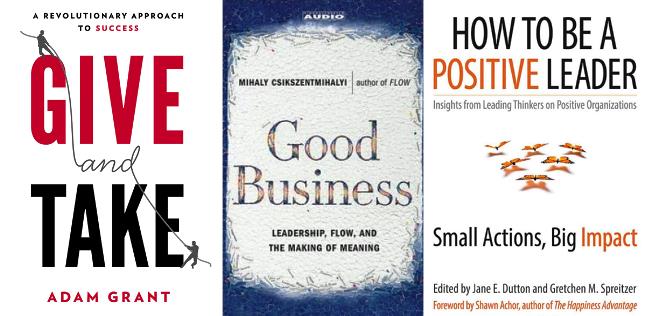
Positive Psychology at Work: A Book List for the Layman [updated]

Here, I´ve compiled a list of books that apply Positive Psychology to the realm of “the organization”, leadership, management etc. As always, I see the list as work in progress and will be happy to include your suggestions. When making suggestions, please stick to books that have a clear link to Positive Psychology and are (by and large) backed by research.

Positive Leadership Books

Being a better Leader by managing organizational Energy [Video]

A couple of days ago, I wrote a post about Positive Organizational Capital as introduced to the Positive Psychology community by Fred Luthans. Today, I´d like to point you to another concept based on Positive Organizational Scholarship (POS), precisely: (Positive) Energy. I´ve already touched upon that topic quite a while ago – when introducing some of the work of the marvelous Jane Dutton.

Below, you´ll find a 3-minute video of Kim Cameron, one of the founding fathers of POS. He talks about the concept of (Positive) Energy, and how to assess and manage it – and why it´s crucial when being in a leadership role.

And it´s not that complicated after all. We should ask ourselves:

  • Is it an uplifting experience when working with colleague XYZ?
  • Do I feel elevated when being around this person?
  • Is this relationship live-giving?

The goal is too have as many people “on board” where you can answer those questions with “yes”. You can read more about the concept of energy in Jane Dutton´s book Energize Your Workplace. And please also check out the work of Esa Saarinen on Systems Intelligence.

Are you a H.E.R.O.? Positive Psychological Capital (PsyCap) explained

Positive Psychological CapitalSince it´s “formulation” at the onset of the new millennium, researchers have tried to apply Positive Psychology to organizational settings. E.g., Adam Grant promotes pro-social behavior in business settings, Amy Wrzesniewski looks at how employees can foster (perceived) meaning via job-crafting, and Jane Dutton investigates the impact of high-quality connections.

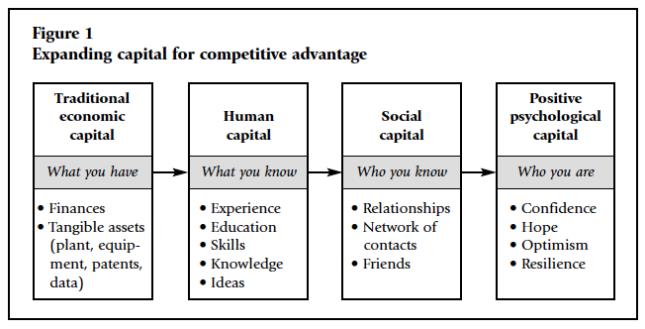
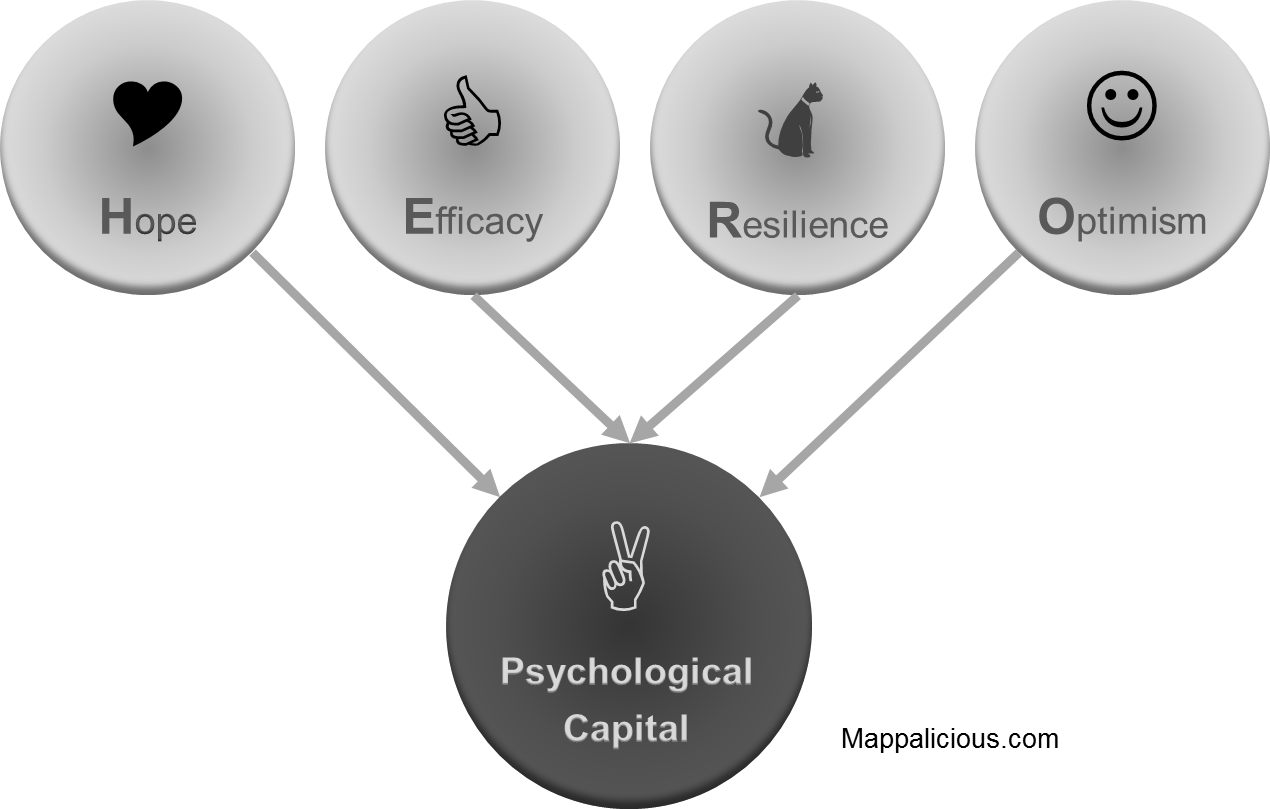
Another interesting framework is offered by Fred Luthans and his colleagues. They have developed the idea of Positive Psychological Capital (PsyCap) which is seen as a valuable extension to the concepts of economic, human, and social capital (see table above; taken from Luthans et al., 2004). PsyCap is theorized as a higher-order construct that is “composed” of four underlying constructs, precisely Self-Efficacy (also called Confidence), Hope, Optimism, and Resiliency. It´s called higher-order because PsyCap is not just “made of” the underlying constructs, but taken together, they form something new, an entity that is more than the sum of its parts. Please see diagram at the bottom, based on Luthans & Youssef (2004). This shows the whole framework, precisely: the H.E.R.O. formation by which the constructs is sometimes known to the general public. What are the building blocks all about – as defined in Positive Psychology?

  • Hope is as a positive state where our feelings of agency (goal oriented determination) and pathways (proactively planning to achieve those goals) interact.
  • Self-efficacy is depicted as confidence in our ability to achieve a specific goal in a specific situation.
  • Optimism is theorized as a realistically-positive view of what can or cannot do.
  • Resilience is defined as successfully coping with adversity or stress. In organizational settings, it is characterized as the ability to “bounce back” from high workload, conflict, failure, and ongoing organizational change.

Why were these four concepts chosen? In the words of Luthans et al. (2004):

The four psychological capacities of confidence, hope, optimism, and resilience are measurable, open to development, and can be managed for more effective work performance.

Why is this important? Because it means that – unlike trait-like concepts such as general intelligence – PsyCap can be developed by deliberate practice. Just the other three forms of capital, it can be built and enhanced – in a rather short amount of time, by the way (see this paper for more info). As such, it can be a very valuable tool in organizational and personnel development.

Why should you care (especially if you are a CEO or HR Director)?

Well, you should care if you are interested in having a healthy, engaged, and high-performing workforce. A meta-analysis (a type of study that aggregates the results of prior studies) based on 51 empirical investigations found a wide array of positive consequences for workers displaying high (vs. low) PsyCap. From the study abstract:

The results indicated the expected significant positive relationships between PsyCap and […] job satisfaction, organizational commitment, psychological well-being, desirable employee behaviors (citizenship), and […] measures of performance (self, supervisor evaluations, and objective). There was also a significant negative relationship between PsyCap and undesirable employee attitudes (cynicism, turnover intentions, job stress, and anxiety) and undesirable employee behaviors (deviance).

Are you curious now?

PsyCap Structure