Being your Best on the Job: The Case of Thriving at Work

A couple of days ago, I shared some videos where Kim Cameron elaborates on his ideas about organizational energy. Yesterday, I stumbled upon an adjacent concept that I find equally interesting: Thriving (at work). It was first described by a group of researchers comprising – among others – Gretchen Spreitzer and MAPP lecturers Jane Dutton and Adam Grant.

Striving is a seen as a two-dimensional construct. In short, we experience ourselves as striving when we feel a sense of a) vitality and b) learning. More precisely, vitality represents a sense that one is energized and has a zest for work. Learning, in turn, is signified by the acquisition and application of knowledge and skills to build capability and confidence.Together, these dimensions capture both the affective (vitality) and cognitive (learning) essence of the psychological experience of personal growth (Porath, Spreitzer, Gibson & Garnett, 2011).

There is some preliminary evidence that the experience of thriving as depicted above is significantly linked to favorable outcomes such as job satisfaction, organizational commitment, and even performance. In this paper, a questionnaire for the measurement of thriving is described. If you´re interested, please watch this short video of Gretchen Spreitzer describing the concept. Enjoy!

The Rise of Positive Psychology: Linking the Movement to the 6th Kondratieff Cycle

One very interesting question about Positive Psychology is: Why now? Meaning: Why is it booming at this point in time, why is it gaining so much momentum, why is it turning into a – sort of – movement, attracting the attention of thousands of researchers (plus: institutions that fund research) and practitioners in business, education, healthcare – and elsewhere?

An easy answer could be: Because Marty Seligman chose it as the central topic of his tenure as president of the APA in 1998. Apart from being a brilliant researcher, Marty has proven to be a very good “salesman” and is also highly skilled at securing grants and other third-party funds. But I guess this response is too simple.

The core ideas of Positive Psychology (first and foremost: looking at the “positive” side of the continuum that comprises human behavior and development) have been around for a while, starting with some of the Greek philosophers – and leading all the way up to 20th century humanistic psychologists such as Viktor Frankl, Erich Fromm, and Abraham Maslow. They all do have their well-deserved spot in the psychology hall of fame – and they are widely respected for their (theoretical) contributions. But they did not really manage to turn their ideas into a widely-accepted and especially well-researched “field”, a broad and comprehensive sub-domain of the academic community.

All the forces in the world are not so powerful as an idea whose time has come. (Victor Hugo)

Turns out it may not be their fault after all. There is a good chance that they were simply introducing their ideas to the world…too early. Positive Psychology may be booming during this era of economic development (and human development in general) because it could be the decisive force to spur growth and well-being over the next 50 years (or so…).

Positive Psychology and the sixth Kondratieff Wave

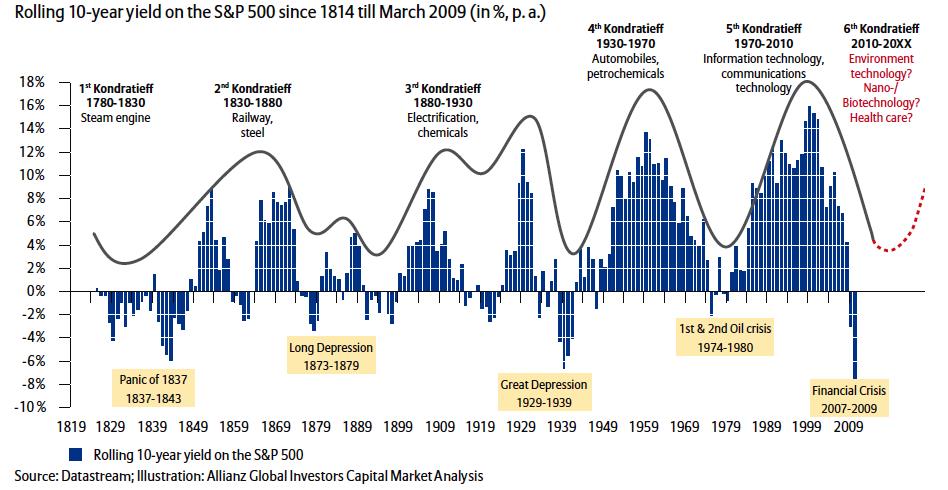
Enter Nikolai Kondratieff (1892-1938). Kondratieff devised an economic theory that today is known as Kondratieff Cycles (often called „theory of the long waves“). They are a concept in macro-economics that describes the development (expansion, stagnation, recession) of entire economies. Yet in contrast to most modern economic theories, Kondratieff did not focus on cycles that last for a few years. He tried to describe waves that last approximately 50-60 years.

A core concept of the theory is the notion of “basic innovations”: Kondratieff posited that a wave arises from the clustering of technical innovations that consecutively serve to launch technological revolutions that in turn create leading industrial or commercial sectors (please see the following graph taken from a research report created by German insurance giant Allianz for a basic overview of the first five cycles – and a projection for the upcoming sixth cycle):

Kobdratieff Waves

As you can see our economy is depicted as entering the sixth wave since the first industrial revolution. What you can also see is a list of candidates for the basic innovations that are projected to drive economic growth during the upcoming cycle (e.g. nanotechnology, biotechology, green-tech).

But there´s another important candidate on the list that is also elaborated on in the Allianz whitepaper – but was introduced to the public a lot earlier through the book The Sixth Kondratieff by Leo Nefiodow (which has recently been reissued in a 6th edition): Holistic health. This encompasses all those products and (medical) services that cater to the needs of an aging society. But it also decidedly incorporates all the services that cater to the psycho-social wellbeing of the workforces in our organizations.

This is where Positive Psychology as a growth driver may tie in. Phenomena such as the burnout syndrome have been on the rise for at least the past 15 years – resulting in billions and billions lost for corporations and society as a whole as a result of absence from work and medical costs (…and I´m not even trying to incorporate the “psychological costs”; and the “social costs” for families, friends, communities). And according to Gallup, the U.S. economy loses some 450-550 billion Dollar per year due to a disengaged workforce (for Germany, the number is depicted at around 130 billion Euro).

Positive Psychology (especially positive organizational scholarship) offers well-researched and at the same time practical solutions for (a lot of) these problems, at the individual and organizational level. For an overview, you might want to check the recently published book How to Be a Positive Leader: Small Actions, Big Impact by editors Jane Dutton and Gretchen Spreitzer. Other valuable books can be found on this list.

To sum up: I propose Positive Psychology may be the decisive basic innovation of the 6th Kondratieff wave.

What do you think of this?

Mappsterview No. 5: Margaret Greenberg on how Companies can Profit from the Positive

I was in the ninth cohort of the Master of Applied Positive Program at Penn. Consequently, there are tons of brilliant MAPP Alumni out there that have very fascinating stories to tell: about their experience with the program, about Positive Psychology in general – and about themselves of course. I really want to hear those stories. That´s why I started to do Mappsterviews with my predecessors.

Today, you are going to meet Margaret Greenberg from MAPP 1, the very first group of Mappsters to be taught at Penn. She co-authored a very successful book that I also included in my Positive Psychology at Work Book List.  

Profit from the PositivePlease introduce yourself briefly:

Like all of us, I wear many hats. I’m a wife to my sweet husband Neal of 30 years. I’m a mother to our two bright and beautiful twenty-something daughters. I’m an entrepreneur, having started my consulting/coaching practice, The Greenberg Group, in 1997 after spending the first 15 years of my career in corporate HR/Learning & Development. I’m a certified executive coach, speaker, and co-author of Profit from the Positive: Proven Leadership Strategies to Boost Productivity and Transform Your Business with fellow MAPPster Senia Maymin, and positive business columnist for Live Happy Magazine. I also do fundraising for the American Foundation for Suicide Prevention in honor of both my mother and mother-in-law. Finally, I enjoy being outside in nature, as well as inside baking, as you can probably tell from all the photos I post on Facebook!

What did you do before MAPP?

I’m doing after MAPP the same thing I did before MAPP – coaching business leaders and their teams to achieve more than they ever thought possible. The only difference is that I now have more research and resources to draw upon, and I’m writing a heck of a lot more. We all entered MAPP with our own set of experiences and education. To prevent positive psychology from becoming just another fad (I don’t even like to use the term “movement”) I believe it’s prudent for us practitioners to view positive psychology as just one more body of knowledge that we bring to our professions and lives.

What got you interested in Positive Psychology in the first place?

I had been in practice for 8 years as an executive coach when I learned of MAPP. What was missing from my coaching certification was the science behind what we do as coaches. I’ll never forget the day an email popped up in my inbox about this new graduate program in positive psychology. I ran, yes ran, outside to share my excitement with my husband who was gardening. “Go for it,” he said. “Yeah, but what if I get in, then what?” The rest is history as they say.

I´ve noticed that you´ve written your MAPP thesis on optimistic managers. Shouldn´t managers be more the critical, discerning type of person?

Most certainly managers need to think critically to come up with innovative solutions to business challenges. The trouble arises when managers apply this same critical thinking to the people they lead. Case in point: If all I do is look for things you are not doing right, and skip over the things you’re doing well, that can be pretty discouraging. In our book  we offer several practical tools to combat this tendency. We call them “Capitalize on What’s Right”, “Find Solutions Not Faults”, and “Obsess Over Strengths, but Don’t Ignore Weaknesses”.

The title of your book is “Profit from the Positive”. Please tell us a bit more about that!

Writing PFTP with a fellow MAPPster has been one of the most rewarding experiences. Senia and I each brought different strengths to the virtual table (Senia is on the west coast of the US and I’m on the east). We really wanted to bring what we were learning from applying positive psychology with our coaching clients to a much broader audience. The book is written for business leaders, HR professionals, and coaches in particular, but we have had readers tell us they found one or more of our 31 tools helpful in their own personal life. I’m happy to report that it will be translated into Chinese next month, and Korean and Japanese early next year. People can see what we’re up to by visiting our website, Facebook page, or connect with us on our LinkedIn Pulse blogs or @profitbook on Twitter.

OK, in my day job, I´m a manager myself. Which three things should I (personally) start doing right away?

First, recognize what we call the “Achoo! Effect”. Our emotions are contagious. Be sure you are spreading cheer, not fear at work (or at home). Second, if you do performance reviews at your company, be sure to preview, don’t just review Performance. Finally, I’d also recommend that you give FRE, which stands for frequent recognition and encouragement, to your employees, peers, and even your Boss. This was one of the key research findings from my Capstone that I collaborated on with another MAPPster, Dana Arakawa. Chris Peterson was our advisor and I will be forever be grateful for his guidance on this study, which is available on the University of Pennsylvania’s Scholarly Commons, and has been downloaded over 7,000 times.

And what kind of initiatives would you recommend on the organizational level?

I think there are lots of opportunities to be what Senia and I call a “positive deviant”. We’ve worked with companies large and small at the individual, team and organizational levels. Here are a few practical applications of positive psychology at the org level. To improve:

  • Strategy and Planning: Use the S.O.A.R. analysis (Strengths, Opportunities, Aspirations, and Results) rather than the traditional S.P.O.T. analysis (Strengths, Problems, Opportunities, and Threats).
  • Recruiting: Revamp hiring practices to include “Hiring for What’s Not on the Resume” to get at the more intangible social and emotional intelligence skills that are most predictive of success and higher Retention. In fact, there are many HR practices that need to be revamped to focus more on what’s going right, such as performance reviews that I mentioned earlier.
  • Meetings: Start and end meetings on a positive note.
  • Leadership and Talent Development Programs: That’s a topic for a whole other interview!
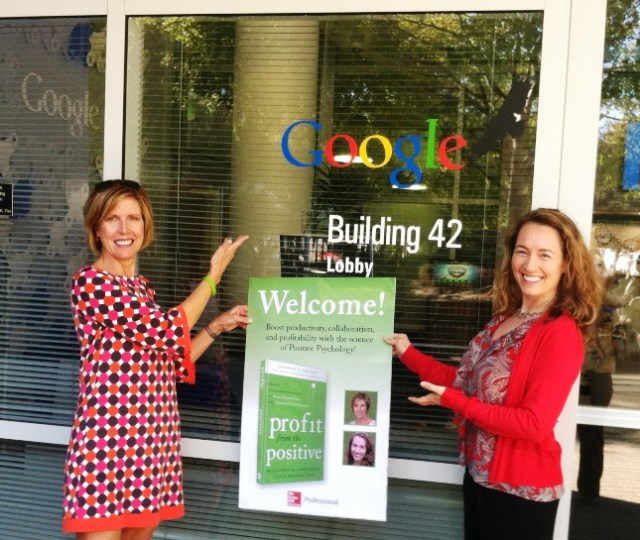
Margaret Greenberg and Senja Maymin

Thanks a lot, Margaret (on the left), for this Mappsterview!
Being a better Leader by managing organizational Energy [Video]

A couple of days ago, I wrote a post about Positive Organizational Capital as introduced to the Positive Psychology community by Fred Luthans. Today, I´d like to point you to another concept based on Positive Organizational Scholarship (POS), precisely: (Positive) Energy. I´ve already touched upon that topic quite a while ago – when introducing some of the work of the marvelous Jane Dutton.

Below, you´ll find a 3-minute video of Kim Cameron, one of the founding fathers of POS. He talks about the concept of (Positive) Energy, and how to assess and manage it – and why it´s crucial when being in a leadership role.

And it´s not that complicated after all. We should ask ourselves:

  • Is it an uplifting experience when working with colleague XYZ?
  • Do I feel elevated when being around this person?
  • Is this relationship live-giving?

The goal is too have as many people “on board” where you can answer those questions with “yes”. You can read more about the concept of energy in Jane Dutton´s book Energize Your Workplace. And please also check out the work of Esa Saarinen on Systems Intelligence.

Are you a H.E.R.O.? Positive Psychological Capital (PsyCap) explained

Positive Psychological CapitalSince it´s “formulation” at the onset of the new millennium, researchers have tried to apply Positive Psychology to organizational settings. E.g., Adam Grant promotes pro-social behavior in business settings, Amy Wrzesniewski looks at how employees can foster (perceived) meaning via job-crafting, and Jane Dutton investigates the impact of high-quality connections.

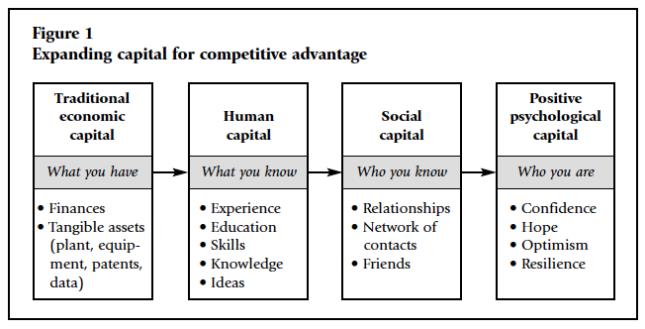
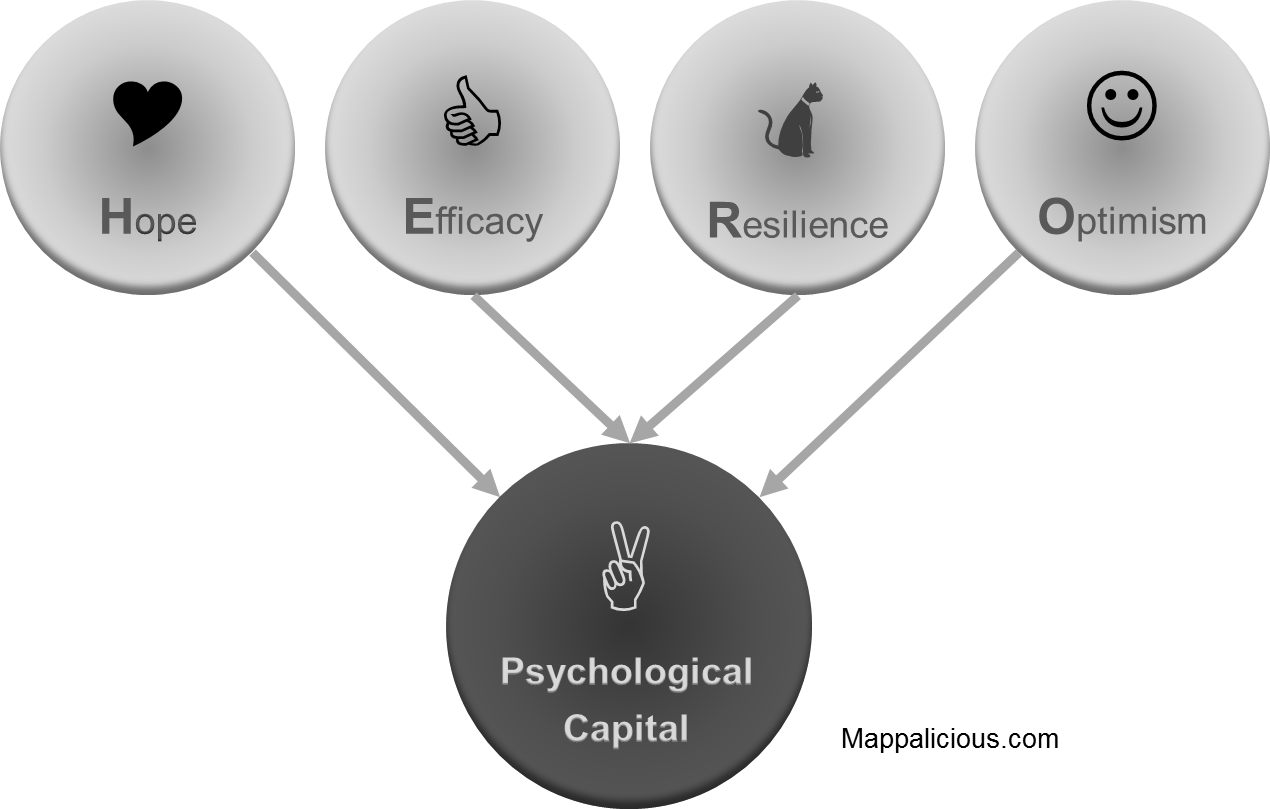
Another interesting framework is offered by Fred Luthans and his colleagues. They have developed the idea of Positive Psychological Capital (PsyCap) which is seen as a valuable extension to the concepts of economic, human, and social capital (see table above; taken from Luthans et al., 2004). PsyCap is theorized as a higher-order construct that is “composed” of four underlying constructs, precisely Self-Efficacy (also called Confidence), Hope, Optimism, and Resiliency. It´s called higher-order because PsyCap is not just “made of” the underlying constructs, but taken together, they form something new, an entity that is more than the sum of its parts. Please see diagram at the bottom, based on Luthans & Youssef (2004). This shows the whole framework, precisely: the H.E.R.O. formation by which the constructs is sometimes known to the general public. What are the building blocks all about – as defined in Positive Psychology?

  • Hope is as a positive state where our feelings of agency (goal oriented determination) and pathways (proactively planning to achieve those goals) interact.
  • Self-efficacy is depicted as confidence in our ability to achieve a specific goal in a specific situation.
  • Optimism is theorized as a realistically-positive view of what can or cannot do.
  • Resilience is defined as successfully coping with adversity or stress. In organizational settings, it is characterized as the ability to “bounce back” from high workload, conflict, failure, and ongoing organizational change.

Why were these four concepts chosen? In the words of Luthans et al. (2004):

The four psychological capacities of confidence, hope, optimism, and resilience are measurable, open to development, and can be managed for more effective work performance.

Why is this important? Because it means that – unlike trait-like concepts such as general intelligence – PsyCap can be developed by deliberate practice. Just the other three forms of capital, it can be built and enhanced – in a rather short amount of time, by the way (see this paper for more info). As such, it can be a very valuable tool in organizational and personnel development.

Why should you care (especially if you are a CEO or HR Director)?

Well, you should care if you are interested in having a healthy, engaged, and high-performing workforce. A meta-analysis (a type of study that aggregates the results of prior studies) based on 51 empirical investigations found a wide array of positive consequences for workers displaying high (vs. low) PsyCap. From the study abstract:

The results indicated the expected significant positive relationships between PsyCap and […] job satisfaction, organizational commitment, psychological well-being, desirable employee behaviors (citizenship), and […] measures of performance (self, supervisor evaluations, and objective). There was also a significant negative relationship between PsyCap and undesirable employee attitudes (cynicism, turnover intentions, job stress, and anxiety) and undesirable employee behaviors (deviance).

Are you curious now?

PsyCap Structure

What “gives Life” to your Organization? Appreciative Inquiry and the Quest for the “Positive Core”

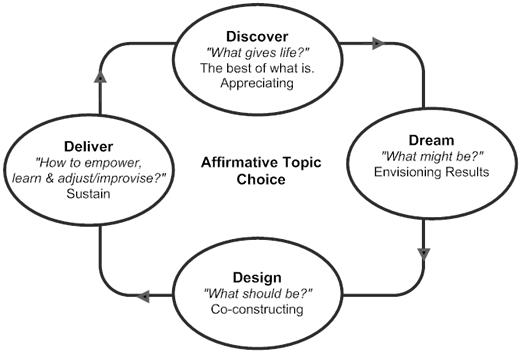
AI_4_DAt the January MAPP onsite, one of our guest speakers was David Cooperrider. He has (co-)developed Appreciative Inquiry (AI), a method of organizational development that is rooted in Positive Organizational Scholarship (POS). It´s a bit hard to explain it in a few words; therefore, I´ll let other people do the talking. The first video below is a short interview with David Cooperrider on the foundations and underlying assumption of AI. The second one is a bit longer and explains the whole AI process in a very graspable way.

Let me just say this much: the word “appreciate” is typically understood in the sense of “highly valued” – but can also mean “increasing something in value”. Therefore, things we appreciate grow in their value precisely because of our appreciation. To make use of a little oversimplification:

Whatever we put most energy into – grows. So if we focus a lot of energy on problems and problem-fixing – there´s a good chance there will be more problems. But if we instead put emphasis on strengths and what is already good – those aspects tend to grow. That´s exactly what AI tries to do – by asking the right questions (that´s where the “inquiry” in AI comes from). Enjoy!

What is AI?