Mappalicious discontinued for the time being…

rawpixel-255076-unsplashDear reader! I´ve decided to discontinue writing on Mappalicious for the time being. I´m currently going through a transition in my professional life, as well as writing on a German book on Posititive Organizational Science. For this reason, my focus and energy is needed elsewhere. This is not to say that Mappalicious as a project is finished – but I will not add any new articles at least until the second half of 2019.

Of course, you can still access all the content (…close to 600 posts…) that was generated ever since starting Mappalicious when I joined the MAPP program at University of Pennylvania in 2013. To give you a headstart in case you´ve found this site rather recently, below you´ll find a top-20 list of articles that were either read the most – or that I personally like the most. Of course, I will continue to share insights from the world of Positive Psychology (in organizations) in the meantime. Accordingly, if you haven´t done so, please follow me on Twitter, Facebook, and LinkedIn.

Reading about Positive Psychology on Mappalicious: Where to start?

  1. Great Infographic on Self-Compassion: How not to be Hard on Yourself
  2. Feel-Good vs. Feel-Purpose: Hedonia and Eudaimonia as separate but connected Pathways to Happiness
  3. “To Thine Own Self Be True”: Self-Concordance and Healthy Goal-Striving
  4. Bad is Stronger than Good! That is why our World desperately needs Positive Psychology
  5. 3 “Original” Questions for Wharton´s Adam Grant
  6. A Definition of Positive Interventions
  7. Are you a H.E.R.O.? Positive Organizational Capital (PsyCap) explained
  8. Lift! On Leading with Purpose
  9. 22 Positive Psychology-infused Articles every (HR) Leader should know
  10. The James Bond Philosophy of Life – in 007 Chapters
  11. What’s your “Ikigai”? On Purpose, Meaning, and making a Living
  12. My Mind´s MAP(P): The 4-minute Ivy League Diploma in Positive Psychology
  13. On the Meaning of Meaning at Work: A Collection of Infographics
  14. Honoring the Forefathers: Viktor Frankl and Men’s Quest for Meaning
  15. My Year in MAPP: A 5-Step Course in the fine Art of Being Un-German
  16. Following your Bliss vs. following your Blisters
  17. Feedback on Optimal Human Functioning: The Reflected Best Self Exercise™
  18. 10 fantastic Quotes by William James that preview Positive Psychology
  19. Heavy. Metal. Heart. Finding Happiness in Angry Music
  20. I´ve got 99 Words for Happiness, but the Germans only have One
Picture: unsplash.com/@rawpixel

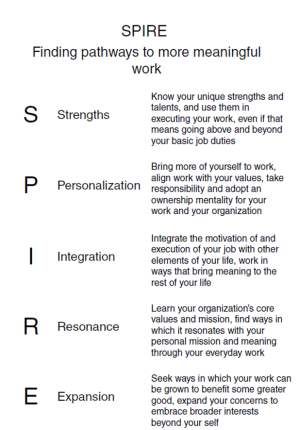
Do you Want to Make your Work more Meaningful? Aim for the S.P.I.R.E.!

SPIRE_StegerI´m a big fan of the work of Professor Michael F. Steger (Colorado State University), one of the world´s foremost scholars on the subject of meaning in life and meaning in work (see his TEDx Talk here).

In fact, he´s not only a top-notch scientist, but at the same time he´s able to turn his research (plus other people´s scholarly work) into actionable insights for business leaders. Accordingly, I was more than thrilled when Michael agreed to work with me on a paper that showcases some research on the question of how leaders can help to make the work of their subordinates more meaningful. While the original paper was written in German, there´s a neat summary of that research (CAARMA leadership) available via Positive Psychology News Daily.

Today, I´d like to introduce you to another framework that has been described by Michael, precisely via this book chapter. Where CAARMA leadership focuses on the role of the leader in creating (more) meaningful work for employees, the acronym S.P.I.R.E. points us towards all those resources and pathways to meaning that employees control unmediatedly. The building blocks of this acronym have been synthesized by Steger based on some 40 years of extant research on meaningful work.

Strengths

In Steger´s words: Know your unique strengths and talents, and use them in executing your work, even if that means going above and beyond your basic job duties.

Now obviously, in order to make this recommendation work, you´ll have to find out what your strengths are in the first place. A good place to start would be taking the VIA survey, a test that was developed based on a framework of 24 character strengths first described by Christopher Peterson and Martin Seligman. Or, you could create your Reflected Best Self™ portrait, a method developed at the Center for Positive Organizations (Ross School of Business). In this LinkedIn article, I explain how you can do that.

Personalization

In Steger´s words: Bring more of yourself to work, align work with your values, take responsibility and adopt an ownership mentality for your work and your organization.

A rewarding pathway to tackling the challenge of (increased) ownership could be practicing what Professor Amy Wrzesniewski (Yale) calls job crafting – which is defined as ‘‘the physical and cognitive changes individuals make in the task or relational boundaries of their work’’. Basically, via job crafting employees progressively turn the job they currently have into the one they really want to be in. Here´s a nice description of fellow Penn MAPPster Paula Davis-Laack via Psychology Today.

Integration

In Steger´s words: Integrate the motivation of and execution of your job with other elements of your life, work in ways that bring meaning to the rest of your life.

Now, that is obviously a task which cannot be executed just like 1…2…3. Finding the right balance (or rather: blend) to me seems to be an ongoing internal exploration and negotiation between the different selves that comprise the “whole person” over the span of a lifetime. Nevertheless, I recently stumbled upon this beautiful article in the Harvard Business Review crafted by Brianna Caza, Lakshmi Ramarajan, Erin Reid, and Stephanie Creary that might point you towards some meaningful pathways: How to Make Room in Your Work Life for the Rest of Your Self.

Resonance

In Steger´s words: Learn your organization’s core values and mission, find ways in which it resonates with your personal mission and meaning through everyday work.

As with the aspect of strengths, this pathway will not come to life without a fair amount of soul-searching and self-discovery. Aligning our personal mission with that of our organization requires discovering (or rather: building and exploring over time?) our life´s mission in the first place. Now personally, I´ve wrangled with the concept of a personal mission for several years, especially when being contrasted to a similar, but somewhat different matter, a personal purpose statement. Even though the following article by Disney Institute´s Bruce Warner covers this topic on the level of the organization, it helped me tremendously to clarify my mission and my purpose (at least in their current versions) – that´s why I´m recommending it to you here: The Difference Between Purpose and Mission.

Expansion

In Steger´s words: Seek ways in which your work can be grown to benefit some greater good, expand your concerns to embrace broader interests beyond your self.

I figure there are countless opportunities to achieve this goal. To start, you might find some inspiration in this New York Times article covering research by Wharton professor Adam Grant (described in his seminal book Give and Take) written by Susan Dominus.

++++++++++

Following these recommendations can help you to propel your work life onto a more meaningful trajectory. Quite naturally, it´s not a good idea to tackle all of these different pathways at the same time. I´d start with those one or two drivers that resonate the most with you for the time being.

Enjoy!

Foto Credit

The Center for Positive Organizations: My Top-10 List of Research Papers

This is some stuff you should definitely check out if you´re in HR, or an (aspiring) leader – or if you want to up your game in general with regard to understanding positive organizations. All links lead you to PDFs of the respective articles.

Cameron, K. S., Bright, D., & Caza, A. (2004). Exploring the relationships between organizational virtuousness and performance. American Behavioral Scientist, 47(6), 766-790.

Cameron, K., Mora, C., Leutscher, T., & Calarco, M. (2011). Effects of positive practices on organizational effectiveness. The Journal of Applied Behavioral Science, 47(3), 266-308.

Dutton, J. E., Worline, M. C., Frost, P. J., & Lilius, J. (2006). Explaining compassion organizing. Administrative Science Quarterly, 51(1), 59-96.

Heaphy, E. D., & Dutton, J. E. (2008). Positive social interactions and the human body at work: Linking organizations and physiology. Academy of Management Review, 33(1), 137-162.

Mayer, D. M., Aquino, K., Greenbaum, R. L., & Kuenzi, M. (2012). Who displays ethical leadership, and why does it matter? An examination of antecedents and consequences of ethical leadership. Academy of Management Journal, 55(1), 151-171.

Owens, B. P., Baker, W. E., Sumpter, D. M., & Cameron, K. S. (2016). Relational energy at work: Implications for job engagement and job performance. Journal of Applied Psychology, 101(1), 35-49.

Roberts, L. M., Dutton, J. E., Spreitzer, G. M., Heaphy, E. D., & Quinn, R. E. (2005). Composing the reflected best-self portrait: Building pathways for becoming extraordinary in work organizations. Academy of Management Review, 30(4), 712-736.

Spreitzer, G. M., Kizilos, M. A., & Nason, S. W. (1997). A dimensional analysis of the relationship between psychological empowerment and effectiveness, satisfaction, and strain. Journal of Management, 23(5), 679-704.

Spreitzer, G., Sutcliffe, K., Dutton, J., Sonenshein, S., & Grant, A. M. (2005). A socially embedded model of thriving at work. Organization Science, 16(5), 537-549.

Wrzesniewski, A., & Dutton, J. E. (2001). Crafting a job: Revisioning employees as active crafters of their work. Academy of Management Review, 26(2), 179-201.

rawpixel-com-250087

Unsplash.com – Creator: rawpixel


The Center for Positive Organizations at University of Michigan: a Book List

Kim Cameron | Nico RoseI´m the luckiest guy in the world. I get to spend the week at University of Michigan in Ann Arbor, more precisely: the Ross of Business. Part of the Ross School is the Center for Positive Organizations – which without exaggeration can be described as the global focal point for research and application(s) of Positive Psychology in business (Positive Organizational Scholarship). It´s home to POS luminaries such as Kim Cameron, Jane Dutton, and Robert Quinn. Additionally, some of the big shots in the field have completed their Ph.D. studies here, among them Adam Grant and Amy Wrzesniewski.

I´m going to provide an overview of what I´ve learned here at a later point in time. For today, I´d like to provide a book list of works that been crafted by faculty of  the Center for Positive Organizations. After is, Christmas is coming up soon – and you might still be looking for something for your loved ones (or yourself)…

Also, watch out for Wayne Bakers upcoming book “Just Ask”…

Positive Psychology News Digest | No. 17/2017

Positive Psychology News Digest

My favorite news and blog articles covering Positive Psychology and adjacent Topics from (roughly) the last seven days.

Fast Company: Your Positive Work Culture Might Be Making Your Team Less Productive by Belle Cooper


New York Times: You’re Too Focused on What You’re Focused On by Erica Boothby


Huffington Post: Civil Actions: Creating A Culture of Kindness at Work by Kimberly Connor


New York Magazine: A New Theory on Why People Who Exercise Lots Are So Damn Happy All the Time by Melissa Dahl


Forbes: ROK (Return On Kindness): It’s More Than Just Being Nice by Roger Dean Duncan


Washington Post: Prioritizing these three things will improve your life — and maybe even save it by Colby Itkowitz


Fast Company: You May Soon Be Able To Take A Drug To Prevent Depression by Adele Peters


New York Magazine: How Should We Talk About Amy Cuddy, Death Threats, and the Replication Crisis? by Jesse Singal


New York Magazine: Become More Resilient by Learning to Take Joy Seriously by Brad Stulberg


Guardian: Google’s Mo Gawdat: ‘Happiness is like keeping fit. You have to work out’ by Ian Tucker


Heleo: What to Do When Bad Things Happen and We Don’t Know How We Should Respond (Interview with Monica Worline), no author

Positive Psychology News Digest | No. 16/2017

My favorite news and blog articles covering Positive Psychology and adjacent Topics from (roughly) the last seven days.

Positive Psychology News Digest

Quartz: The world’s largest assessment of teenage students suggests happiness is crucial to learning by Jenny Anderson


Greater Good Science Center: Confessions of a Bad Meditator by Christine Carter


Quartz: Silicon Valley executives are hiring philosophers to teach them to question everything by Michael Coren


Psychology Today: Are You the Pursuer or the Distancer in Your Relationship? by Lisa Firestone


Washington Post: Introverts tend to be better CEOs — and other surprising traits of top-performing executives by Jena McGregor


Huffington Post: You Don’t Need Good Grades To Get An A+ In Resilience by Bowman Nixon


Psychology Today: Why Speaking Less is the Secret to Powerful Communication by Emma Seppälä


Psychology Today: 7 Must-Read Books to Change Your Life This Summer by Emma Seppälä


Quartz: Our need to feel special is making us lonely by Emma Seppälä & Peter Sims


Quartz: What is the evolutionary purpose of happiness? by Oliver Staley


BBC: Prince William says keeping a stiff upper lip can damage health, no author

Positive Psychology News Digest | No. 10/2017

mappalicious_news_digest_2017

My favorite news and blog articles covering Positive Psychology and adjacent topics from (roughly) the last seven days.

New York Times: I’m Not O.K. Neither Are You. Who Cares? by Henry Alford


New York Magazine: Awe Is the Everyperson’s Spiritual Experience by Drake Baer


Big Think: Is Technology Destroying Happiness? by Derek Beres


Forbes: Organizational Strategies That Promote Well-Being And Reduce Burnout by Paula Davis-Laack


Harvard Business Review: To Motivate Employees, Show Them How They’re Helping Customers by Francesca Gino


BPS Research Digest: Smarter people are happier, says new analysis involving 80,000 participants, but only a bit by Christian Jarrett


Harvard Business Review: Find Purpose in Even Your Most Mundane Tasks at Work by Valerie Keller & Caroline Webb


Forbes: Why Grit Is More Important Than IQ When You’re Trying To Become Successful by Lisa Quast


Harvard Business Review: Why Diverse Teams Are Smarter by David Rock


LA Times: UAE’s minister of happiness insists her job is no laughing matter by Ann Simmons


Psychology Today: The Marshmallow Myth by Nick Tasler


Psychology Today: Compassion Is Better than Empathy by Tara Well


Heleo: A New View of the Self: The Psychology of Connection, no author


My new TEDx talk: “Dare to Foster Compassion in Organizations”

I´m super happy. After my official TEDx premiere at TEDx Bergen/Norway in 2014 (How to be the architect of your own fortune), as of today, my second TEDx talk is available on YouTube. It was filmed at the very first edition of TEDx EBS late in 2016. EBS University (or European Business School Oestrich-Winkel) is one of the premier business schools in Germany and, coincidentally, the place where I obtained my Ph.D.

The talk is named “Dare to Foster Compassion in Organizations”. It draws on research by luminaries such as Jane Dutton, Monica Worline, Adam Galinsky, Laura Little, Jennifer Berdahl, and the late Peter Frost (and even though they are neither mentioned nor referenced on a slide explicitly, Esa Saarinen, Adam Grant, and Robert Quinn).

I hope you will enjoy the talk! And if you do, please consider sharing the news. Thank You!

If you are interested in a (sort of…) transcript of the talk: this was published here a while ago.