Goals: Why SMARTIES are smarter than SMART…

It is the same story each year, isn´t it?

  • I really want to lose weight…
  • I really want to quit smoking…
  • I really want to be physically fit…
  • I really want to have my own business…
  • I really want to meet the wo/man of my dreams…

I guess that´s what the top-5 list of New Year´s resolutions would look like. The problem is: most of these goals have about the same half-life period as that hangover that welcomes a lot of us on New Years´s morning. Yet, per se, goal-setting is not a bad thing – quite the opposite is true. The motivational and performance-enhancing effects of goal-setting are among the most thoroughly researched issues in academic psychology.  If you´d like to know more, please read this article that succinctly summarizes 30 years of goal-setting research.

Besides, there´s lots of help available on the net. When you type in “how to reach goals” on Google you´ll get more than one million hits. Most of these will display smart content. To be more precise: some information on the SMART framework. SMART is an acronym that originally stems from project management theory.* There are lots of slightly different versions on the internet. The most common probably is this one:

Specific: A goal should be stated in a markedly tangible way. The more precise, the easier it will be to take the necessary steps. An example: Instead of “I want to work out more often” it is better state something along the lines of “From now on, I will go jogging twice a week for 45 minutes (on Tuesdays and Thursdays right after work). Additionally, I will do weight training on Saturday afternoons for 45 minutes.” This could be refined even more. As a rule of thumb: the more precise you are able to describe to another person what you intend to do, the better.

Measurable: A goal (as well as the distance between the initial situation and the goal) should be quantifiable. Without measurement, there´s no progress check. Without progress, there´s no lasting motivation. An example: Instead of “I want to lose some weight” it is better to state something along the lines of “I want to weigh 140 pounds and keep that weight as a steady state. In order to achieve this, I will lose 4 pounds on average over the next 6 months – and then keep my weight right there.”

Attainable: A goal should be achievable – but definitely display a certain amount of difficulty. Goals that are completely unrealistic typically destroy our motivation. On the other hand, goals that are reached to easily usually do not yield the success stories we really yearn for. Yet, there´s another connotation to this criterion. We should put our efforts in something that personally attainable – a goal should be in our personal “sphere of influence”. For instance, “Finding the man of my dreams” goes against this criterion. It´s much more helpful to plan concrete actions that are conducive to that overarching goal, e.g., enrolling in a dancing course.

Relevant: A goal should be relevant, in other words: important and meaningful. This may sound self-evident – but it is not at all trivial. Rarely do we question the motivation behind our goals sufficiently. Why do I want what I want? Is this really my goal? And if not: For whom or what am I doing this? Should you realize that a goal is chiefly driven by extrinsic motivation please do exercise some caution. The most beneficial kind of goal is a self-concordant objective – in other words, a goal that is aligned with our deeper values and motives. Following a self-concordant goal is a satisfying process in itself – so no matter if you reach the goal or not: you will profit from trying to do so. From this it follows that one important prerequisite for “good goals” is a sufficient level of self-awareness. One way to attain this is getting to know your (character) strengths. You´ll find a free scientifically validated test here (create a profile, then choose the „VIA Signature Strengths Questionnaire“).

Time-bound: A goal should have a reasonably defined time frame. Without this, there is no rigorous progress review. Additionally, most people are motivated by deadlines – so why not use this extra kick? I guess an example is not needed here.

Ok. So this is the original SMART framework. I assume that most of my readers have been at least somewhat familiar with this. Now the question is: Why do so many personal changes endeavors fail? Is SMART useless? Probably not. But incomplete, most likely. Therefore, here´s my proposal for an extension – based on science and my personal experience as a coach:

SMARTIES

Implementation Intentions: Peter Gollwitzer, a German professor of motivational psychology, has developed a method that tries to bridge the ever-looming implementation gap:  so-called implementation intentions. Because of their structure, they are also called “If-Then-Plans” (Alternatively: “When-Then”).  They function by connecting planned behavior with triggering cues in the proximate environment. Two examples: 1) “Right after I have laid down my briefcase when coming home from work, I will put on my jogging clothes and go for a run. If the weather is really bad, I´ll use the exercise machine instead.” 2) “If I notice a strong urge to smoke, I will put a chewing gum in my mouth immediately.” Once again: the more concrete the plan, the higher the chance for following through.

Exceptions clarified: If you want to create a new habit, making no exceptions at all over the course of the first months is the fastest road to success.  At the same time, it is well-known that the spirit is willing but the flesh is weak. Therefore, it is very helpful to give some thought to the potential occurrence of exceptions and setbacks. For instance: What does smoking one cigarette once in a while mean for somebody who tries to quit? From my experience with coaching clients I know that people tend to frame these exceptions to the new rule as a total failure of the change project – which in turn extinguishes all of their motivation.  In terms of sustainable change, it is therefore helpful to define which exceptions to the new rule will be acceptable – without calling into question the overall endeavor.

Systemic Perspective: Finally, I highly suggest giving some thought to the following issues (this is comparable to a Force-Field Analysis in organizational change management):

How does my goal fit in with the goals and aspirations of important people in my personal context (the external system)? E.g., if you would like to work out from now on for 5 hours per week: Is this time you usually spend with your significant other? And if yes: How do you intend to “compensate” for this?

How does my goal fit into the texture of those goals and intentions that are already in place (the internal system)? It is useful to ask which positive intentions (secondary benefits) are fulfilled by those behavior patterns that you would like to change/eliminate. Your chances of establishing a new behavior pattern are much higher if you manage to transfer these intensions/needs into your new mode of being: By way of example, most smokers do not smoke because they like the taste. Rather, smoking fulfills a calmative function. For some, it´s a means of weight control. Additionally, there is a social aspect to smoking that needs to be considered. So if you want to quit, it is highly advisable to give some thought to the question of how to integrate these requirements into your life as non-smoker.

By the way: it cannot hurt to get some external reference to keep yourself on track. The earlier you manage to turn the envisioned behavior into a habit, the better. In 2014, I use my smartphone, specifically the Good Habit Maker and the app Balanced.


* The original source of the SMART framework is this article (most likely): Doran, G. T. (1981). There’s a S.M.A.R.T. way to write management’s goals and objectives. Management Review, 70(11), 35-36.
 

Picture source

Tired of meaningless rattled-down Introductions? Try “Serious Introductions”

You probably know this thing: it´s the first day of a seminar or the beginning of some business meeting. The host suggests everybody introduce her- or himself to the other attendees (more or less succinct). Following the common social script, most of the times people will now take turns and give an account of their education, job histories, and – on a good day – their personal status. From my own experience I have to admit: I tend to forget most of the information instantaneously – except for the rare occasion when there´s some shared background with another person.

So why not do it a little differently? I have to admit this may not be the best of ideas on each and every occasion – but then I can imagine a lot of place where this feels really appropriate.

A Serious Introduction

A serious introduction consists of telling a meaningful story about a specific moment in our lives. It could be a moment that is just very important to us, or a moment that shows us at our best, thereby displaying our unique blend of character strengths. To quote my lovely MAPP classmate Patricia De La Torre: It’s a fantastic way to learn about somebody else and to instantly connect with them in the non-cheasiest way possible. So here we go…

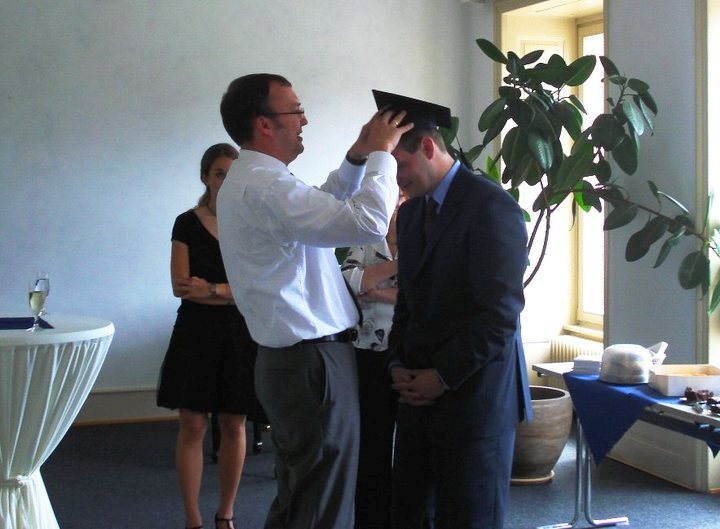
This is September 9, 2010. I have a glass of champagne in my hands and feel a one-of-a-kind combination of exaltation and relief. My dress shirt is soaked with sweat from the room temperature of more than 100 degrees Fahrenheit – and from the 30-minute lecture I have given a couple of minutes ago. The first supervisor of my doctoral thesis at European Business School Oestrich-Winkel, has just pronounced I will be awarded the doctoral degree in business sciences with the best possible grade, “summa cum laude”. Now this evaluation consists of the grade for my thesis, which accounts for 70 percent of the total grade; and the grade for the disputation which has just taken place – which accounts for the remaining 30%. My thesis had been graded in-between the top marks – and in order to receive the overall “summa cum laude”, the disputation would have to be an absolute top-notch performance.

Let´s go back in time for a week…

During that final week before my disputation, I did something very unusual: I practiced. In fact, I practiced my ass off. I am used to lecturing regularly, either at conferences, or at the business school where I teach – which has given me a lot of confidence in that matter over the years. I typically will prepare my PowerPoint slides some days before due date alright – but I never ever really think about what to say in advance, let alone learn something by heart. That often results in entertaining but hopelessly overlong lectures. But for once, it had to be different. There are very strict regulations pertaining to the disputation process. You have exactly 30 minutes to convince the doctoral committee of your research, not one minute more, not one minute less.

So I practiced – and I learned my text by heart.

As usual, I prepared my slides. In the morning seven days before the disputation, I practiced for the first time – and went over 45 minutes. I practiced again in the afternoon, talking a little faster, and still went well over 40 minutes. So I cut out one of the slides, practiced again in the evening and finished at 38 minutes. I practiced again before going to bed and stopped at 37 minutes.

For the upcoming six days, I practiced four times a day, once in the morning, once in the afternoon, once in the evening and once before going to bed. I cut out further slides but never made in less than 33 minutes – until the day of the disputation.

I had thrown out another slide spontaneously in the morning and was a little nervous, but clearly not too nervous. I was wearing a tailor-made suit – and my wife, my parents, my parents-in-law and some of my best friends joined the audience to witness the culmination point of a strenuous 5-year period of my life.

Due to practicing hard (I believe), I was at my best that day. Speaking quite clearly, convincingly, seemingly without much effort, and most of all: according to the rules of this extraordinary occasion. I hit the mark in 30 minutes sharp.

Now all this accounts for the exaltation. But what about the relief?

The truth is: joining that doctoral program was – at least from a certain point of view – one of the worst decisions of my life. I´d had lost interest in my research topic during the first year. I felt out of place and out of tune with myself for most of the time. I knew this doctoral thesis was leading neither me (nor someone else) anyhere. I wanted to quit at least once a year but my parents managed to convince me to go on over and over again.

Now it is over. I made it. And I made it worthwhile.

Nico Rose - Disputation

2014: “Don´t hold back! Animate. Validate. Elevate.”

Esa SaarinenLudwig Wittgenstein said: “The limits of my language mean the limits of my world.” From this it follows that adding new words to one´s vocabulary (or a new connotation for a known word) can broaden one´s mind. Therefore, giving a “proper name” to a phenomenon at hand can fundamentally change and deepen our understanding of that same “thing”.

This is exactly what happened to me on December 7th, 2013. It was the last onsite period of MAPP 13/14´s first semester – and we had the great pleasure of having Esa Saarinen as a guest lecturer. Esa is one of Finland´s most widely acclaimed philosophers. With this post, (among other things) I´d like to give him massive kudos:

  • First, for being a really cordial person.
  • Second, for gracefully sporting a style that makes Lapo Elkann look like an old spinster.
  • Third, and foremost, I´d like to thank him for giving me a new word: “Holding Back”.

Systems Intelligence

But first things first. Together with a colleague, Esa has developed and endorses what he calls Systems Intelligence – an extension of systems thinking. In his own words, Systems Intelligence is…

[…] “intelligent behaviour in the context of complex systems involving interaction and feedback. A subject acting with Systems Intelligence engages successfully and productively with the holistic feedback mechanisms of her environment. She perceives herself as part of a whole, the influence of the whole upon herself as well as her own influence upon the whole. By observing her own interdependence in the feedback intensive environment, she is able to act intelligently.” (Hämäläinen & Saarinen, 2007, p. 4)
“The Systems Intelligence approach stems from a deep belief in the human potential. In its positive overtones and strive towards flourishment, as opposed to avoiding pitfalls or neutralizing negatives, Systems Intelligence runs parallel to Positive Organizational Scholarship and to Positive Psychology.” (Hämäläinen & Saarinen, 2007, p. 7)

Holding Back

Now, a central tenet in Systems Intelligence is the notion of “Holding Back”:

“The concept refers to mutually aggregating spirals which lead people to hold back contributions they could make because others hold back contributions they could make. We believe such systems are fundamental to human interaction – indeed, our conviction is that human interaction has a tendency to slide into systems of holding back unless conscious effort is launched to counter this tendency. A negative dance of holding back will prevail unless it is countered time and again.” (Hämäläinen & Saarinen, 2007, p. 26)
“We speak of ‘Systems of Holding Back’, and of ‘Systems of Holding Back in Return and in Advance’. The subject holds back what would benefit the other because the other first holds back from me what would benefit me. Systems Of Holding Back gain momentum […] because there is a bias in human mental constitution to be more aware of the contributions others fail to make to me than of the contributions I fail to make to others.” (Hämäläinen & Saarinen, 2008, p. 824)

A simple example for the phenomenon of “Holding Back”: a young man wants to say “I love you” to a young woman – but refrains from doing so out of fear that the feeling is not mutually. Unfortunately, it´s exactly the same for her. As a consequence, they break up after some time…

Now obviously, this is not something entirely new to me. I´ve experienced things like this myself – and I see similar occurrences on a regular basis when working as a coach. But the term “Holding Back” has induced an elevated level of understanding, a new kind of clarity – and the desire to explore this phenomenon; particularly: what we can do about it…

I´ve decided to make only one New Year´s resolution: 2014 is going to be my year of “Not Holding Back”. I´m going to monitor my behavior closely – and when I detect “Holding Back”, I´m going to figure out why – and then do something about it. 2014 is going to be my personal “Year of Kindness”. I will try hard to be a more considerate person. And I´m going to do it systematically – turning it into a personal change project. My mantra: “Don´t hold back!. Animate. Validate. Elevate.” Keep your eyes peeled, there´s something coming up…

But for now, I wish you an exceptional New Year´s celebration and a happy and healthy year 2o14! 

Don´t hold back

References

Hämäläinen, R. P., & Saarinen, E.  (2007). Systems intelligent leadership. In R.P. Hämäläinen & E. Saarinen (Eds.), Systems intelligence in leadership and everyday life (pp 3-38). Espoo: Helsinki University of Technology.

Hämäläinen, R. P., & Saarinen, E. (2008). Systems intelligence – the way forward? A note on Ackoff’s’ why few organizations adopt systems thinking’. Systems Research and Behavioral Science, 25(6), 821-825.

It was a very good Year…

Thank You DanceOne of the oldest and therefore thoroughly researched interventions in positive psychology is deliberately focusing one´s attention on being grateful. So why not express gratitude for a whole year? Here were go … *

Thank you to Carl-Christoph Fellinger for being an awesome colleague to talk to, an awesome co-author, and an awesome person in general.

Thank you to Dr. Hays Steilberg, my boss at Bertelsmann. You know why.

Thank you to Bernd Rathjen and his team at Corporate Candy for making me look good as a manager (not easy …).

Thank you to the organizing team of WHU Euromasters 2013 for making me feel like 23 again.

Thank you to Annette Mattgey, Anja Tiedge und Petra Diebold (out of the journalists I´ve worked with over the year).

Thank you to the participants of McKinsey´s CEO of the Future for making me believe the future will be a good one.

Thank you to Russell Ackoff for writing the best business book of all times (most likely …).

Thank you to Arjen Lucassen (Ayreon) for re-introducing me to the art of listening to whole albums – instead of taking in whatever the “shuffle” shuffles…

Thank you to the whole MAPP gang, especially James Pawelski (Master of Ceremony), Esa Saarinen (Master of Elevation), Art Carey (Master of Style), Emilia Lahti (Queen of Sisu), and Patricia De La Torre (Mistress of elevated conversion, good food+wine, and staying up way too late…) for making my stay in the U.S. a one-of-a-kind experience.

Last not least:
Thank you to my wife for letting me be who I am. And to the Little Guru for making me better than I really am.


* Thank you for this inspiration, Christoph…


Clip art source

Micro-Moments of Love: A short Story on Meaning in Life

The MAPP program is a fulltime program – but combines onsite classes with long-distance learning periods. Part of the distance learning comprises a lot of reading (Who would have thought of that…) and writing essays about a wide array of positive psychology topics. I´ve decided to post some of those essays here on Mappalicious. Surely, they´re not the be-all and end-all of academic writing. But then again, it would also be a pity to bury them in the depths of my laptop…

Introduction

Positive psychology stresses the importance of close relationships, be it friendship, romantic love, family, or the support of a larger social entity (Reis & Gable, 2003). When asked to give a definition of positive psychology, the late Christopher Peterson used to say: “Other people matter.” (2006, p. 249). Fredrickson (2013) complements this remark by asserting that love (and its benefits) cannot be a matter of one person, but can only exist in pairs or groups of people. For authors like Vaillant (2008) and Seligman (2011), relationships are of uttermost importance as well. They are embodied by the letter “R” in the acronym PERMA, which represents Seligman´s framework of human flourishing. Additionally, it is hypothesized that close relationships can serve as a major source of meaning in life (Steger, 2009). This should hold true especially if one of the person´s top character strengths (Peterson & Seligman, 2004) is the “capacity to love and to be loved” – which for me is the case. Therefore, this story focuses on love between father and son as an “active ingredient” in the creation of meaning.

Micro-Moments of Love: A short Story on Meaning in Life

On 30th October 2013, my son Mika turned one year old. This year as a young father has been the most transformative experience of my life. It is said that having a child turns the “M” in “Me” upside down, converting it into “We”. By now I know this is absolutely true.

Having a child turns the M in Me upside down.
It is transformed into a We.

When I had to leave Germany for the U.S.A. on 3rd September 2013 to attend the so-called immersion week of the 2013/14 Master of Applied Positive Psychology program at University of Pennsylvania, I was deeply worried. My job as a manager at Bertelsmann, Europe´s largest media company, requires me to travel a lot. But until that day, I had never been away from my boy for more than two nights in a row – and even that could be heartbreaking. Yet, back then I had to leave for a whole week. For whatever reason, one of my greatest fears was that Mika would forget me and “turn cold” in the meantime. Happily, I can say this notion was utter foolishness on my part.

Nico - Mika - FunMika is a wild boy. We have this little ritual: When I return home from work on weekdays, my wife will wait at the door, holding him in her arms. When he spots me, you can see in his eyes that it takes him a little while to realize that his daddy is home. He will look at me with a blank expression. In my head, I start counting the seconds: twenty-one … twenty-two … twenty- … and then his whole face will transmute into the acme of joy. He will squeak with glee and hold up his arms, meaning: Daddy, grab and hug me! He will be really wild in his excitement, hit me on the cheek, kick my belly, and bite my nose. After seven seconds or so, he will beckon me to let him down on the floor again – and he will turn his attention to whatever toy is in reach at that moment.

But when I came home from Philadelphia in the early afternoon of 9th September, it was different. Really different. Mika had just woken up from his afternoon nap. He was standing upright, holding on to the guardrail of his crib, the lights still turned down low. I slowly entered his room and walked to the window, opening up the roller blind just a little bit so the afternoon sun could sneak into the room. Then, I stepped to the side of his bed and looked at him. And Mika looked back with that blank expression on his face. And in my head, I started to count the seconds again: twenty-one … twenty-two … twenty-three … twenty-four … twenty-five – and then I felt he really had forgotten about me.

But at last, he lifted up his arms. Calm. Not smiling. And I picked him up and he hugged me. And he laid down his head on my chest and for the eternity of about thirty seconds it stayed there. He then looked up, gazing at my face. Calm. Not smiling. After about five seconds, he rested his head again for another fleeting eon. Finally, he looked up again. And his whole face transformed into the acme of joy. And he squeaked with glee, and he hit me on the cheek, and he kicked my belly, and bit my nose. And after seven seconds or so, he made me let him down on the floor and went to play. And I cried.

References

Fredrickson, B. L. (2013). Love 2.0: How our supreme emotion affects everything we feel, think, do, and become. New York: Hudson Street Press.
Peterson, C. (2006). A primer in positive psychology. New York: Oxford University Press.
Peterson, C., & Seligman, M. E. P. (2004). Character strengths and virtues: A handbook and classification. Washington, D.C.: American Psychological Association.
Reis, H. T., & Gable, S. L. (2003). Toward a positive psychology of relationships. In C. L. Keyes & J. Haidt (Eds.), Flourishing: The positive person and the good life (pp. 129-159). Washington, DC: American Psychological Association.
Seligman, M. E. (2011). Flourish: A visionary new understanding of happiness and well-being. New York: Free Press.
Steger, M. F. (2009). Meaning in life. In S. J. Lopez (Ed.), Oxford handbook of positive psychology (pp. 679-687). Oxford, UK: Oxford University Press.
Vaillant, G. (2008). Spiritual evolution: How we are wired for faith, hope, and love. New York: Broadway Books.

License for Satisfaction: German Book Trailer with English Subtitles

If you are a regular visitor of Mappalicious you may know by now that I´ve written a German book on positive psychology by the name of Lizenz zur Zufriedenheit (License for Satisfaction). Unfortunately, the book is still not available in English. But yesterday, I took some time to create English subtitles for the book trailer that we shot in 2012. I hope you´ll have as much fun watching it as we had while creating it. If you like the film, please share!

2013 – 8760h: How time flies…really?

Every time a year draws to a close, a lot of people start saying something like “Oh, how time flies…”. Mostly, it is used in a slightly sniveling fashion – as if those people might have missed something. I guess that´s why they show all those year-end retrospectives on TV. But then, they invite all these VIP and VEP (Very Exceptional People) – and at the end of the day, one´s own life might seem insignificant in comparison.

So why not create your own personal year-end retrospective?* Why not have a look at what really happened in those last 365 days?

Merry Christmas and happy new Year!

Nico Rose - Neon - Euromasters

One year consists of 8760 hours! I have…

Big Chunks

Need to Talk

Nico Rose - TEDxKoeln

Working with real People

New Beginnings

  • started to study (surprise, surprise…) positive psychology (and therefore spent 22 days in the U.S.)
  • started the blog Mappalicious (surprise, surprise…again…) and written 62 articles (including this one)
  • published 5 articles as “Digital Leader” via lead-digital.de
  • bought an acoustic guitar, taken 7 lessons and practiced about 10 hours (definitely not enough)

Endings

Not so nice

Very nice

  • been promoted at Bertelsmann

Nico Rose - Birthday

Personal Stuff

  • said “I love you” +365 times (not every day, but several times on some of the days)
  • canoodled with my son approx. one million times
  • read +80 good-night stories (definitely not enough, please refer to kilometers travelled)
  • had approx. 700 cappuccinos and 5 kg chicken tikka
  • been to 5 metal concerts and one opera premier

My New Year´s resolution: having myself cloned!

So, how might your very own year-end retrospective look like?

* Please excuse the fact that a lot links in this article will lead to German sites. I´ve really just started publishing in English this year – so most of my stuff is still in German…