Positive Psychology in a Nutshell: Watch this beautiful 5-minute Instructional Video

Today, while fixing something with my own, rather puerile Introduction to Positive Psychology on Youtube, I stumbled on this absolute gem of an instructional video. It´s a concise first-rate 5-minute introduction to Positive Psychology (as outlined in Marty Seligman´s recent book “Flourish”).

Why does it only have some 100K views? If cute cat videos (I mean, this is reeaaaaaly cute…) can get +50 million views, this one should have 100 million at least. So if you care about Positive Psychology, please share the hell heaven out of this thing…

The MAPP Capstone Folder at Penn´s Scholarly Commons Directory: Cutting-Edge Positive Psychology Knowledge for free

It´s almost over. What started out as a dream about 11 months ago, is now reality. I´m about one mouse-click away from becoming a full-blown Mappster. Mid-May, I had finished all my regular course requirements – and celebrated that intensely. By now, I`ve finished writing my so-called capstone project, an paper that can take on the form of a typical research paper, a book proposal, or even an outline for training concept etc. – as long as it´s backed by scientific research. I´ve decided to write a theoretical paper on the concept of self-permission which will be available online very soon. Over the last two hours, I´ve turned that paper into a conference poster and will send that over to Philly once I´m done with writing this post. When that is approved, I´m officially Dr. rer. pol. Dipl.-Psych. Nico Rose, MAPP. 🙂

By the way, if you are interested in novel ways of applying Positive Psychology to different domains of the “real life” (and also some cutting-edge research), you should definitely check out the MAPP folder of Penn´s Scholarly Commons directory. There, you´ll find +30 MAPP capstones from previous years – and it´ll grow as my fellow classmates and future Mappsters will upload their work over the upcoming weeks and years. My paper by the name of “Introducing Self-Permission: Theoretical Framework and Proposed Assessment” is already uploaded and will be available for download within the next days. Enjoy!

Penn - MAPP - Capstone Projects

Reaching our Life Goals: What gets in our Way?

I´d really like to have your reactions to this case:

  • What name would you give to “what happened” to Gregory?
  • What psychological theories can explain what happened to him?
  • What could have helped him?
  • Any other reactions?

Gregory is about to finish high school. He desperately wants to pursue a life as a professional classical pianist. He loves music more than anything else, commands sufficient talent, and is equally willing to engage in the necessary practice hours – as he has done all through his childhood. On that note, he has already successfully applied for a renowned conservatory to finish his musical education. Yet, his father, grandfather, and great-grandfather all have sought successful and very rewarding careers as medical doctors. His father has at times conveyed that – while valuing Gregory’s musical talent and ambition – he would very much like to see him stick with the “family tradition” and become a doctor as well. After several rather emotional discussions with his parents, Gregory decides to dismiss his father’s appeal and enrolls at the academy of music.

After doing well for a couple of months, he begins to feel more and more stressed. He starts to skip practice sessions, delivers flawed performances on important rehearsals, and gradually loses much of his enjoyment in performing the music he once loved. About two years later, he’s admonished to leave the conservatorium, due to diminishing prospects of success. Inconsolable, Gregory moves in with his parents again to sort out what to do with the rest of his life. He looks at the homepages of some pre-medical schools, but cannot make up his mind to enroll. Currently, he makes some money by giving piano lessons to children in the neighborhood and is considerably happy doing that – but deep inside, he feels like some part of him has died.   


On “Liebe und Arbeit” (Love and Work)

Two days ago, I stumbled upon this (anonymous…?) quote on the net:

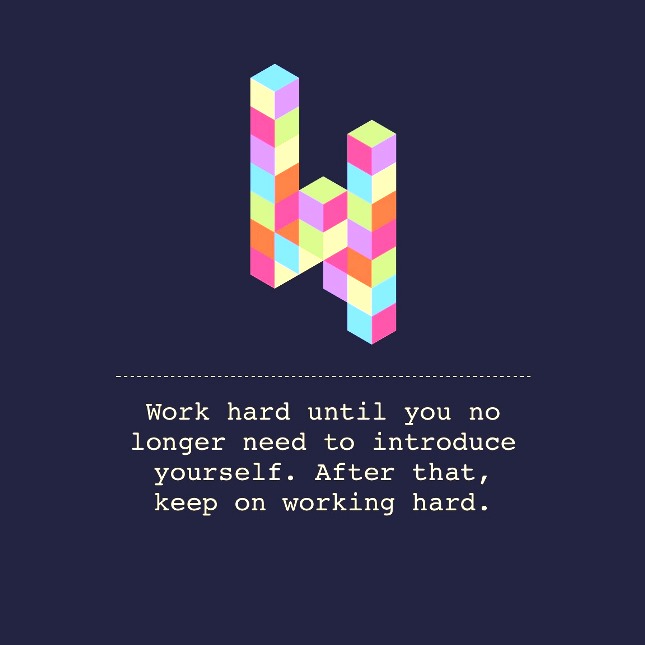
Work until you no longer nedd to introduce yourself

Or rather, the quote consisted only of the first sentence – and I found it necessary to add the second. Sigmund Freud once wrote that “Love and work are the cornerstones of our humanness.” Freud has written a lot of nonsense in his lifetime – but I think here, he´s right on the spot. Obviously, this is not to say that other aspects of life are not important (such as play and recreation). But a lot of people these days spend a least half of their waking hours at work, which also means that we spend most of our time (because that includes our free time) in the presence of other people. That´s why the late Christopher Peterson used to say Other People Matter when asked for a short definition of Positive Psychology. It´s pretty straightforward. I guess most people would agree that our loved ones and friends are one of the most important sources of happiness in our lives – we don´t need Positive Psychology for this insight (even though they can also be an important source of grieve).

But what about work? Isn´t work a constant source of stress and discomfort for most of us? After all, surveys such as the Gallup Engagement Index regularly show that the greater part of the workforce are not really engaged in their current job. While this finding most likely is based on different causations, I propose that a very important one is a lack of fit between the person and the attributes of a job. That´s why I felt a need to add a second sentence to the above-mentioned quote. While I like the general idea, “becoming (more or less) famous” is a prime example of an extrinsic goal – and pursuing these has been shown to be detrimental to our well-being.

We all need to find something that we like to do irrespective of the (external) consequences. This is the most important learning from Self-Determination Theory and adjacent theories like the Self-Concordance Model. We have to find work that we would do even without being paid. I know that this a “moonshot goal” for most people as things are today – but it´ll be the key to lasting productivity and (workplace) happiness in the future.

My 15+15 Minutes of Positive Psychology Fame in Lincoln, Nebraska…

What do you do when you´re – more or less out of the blue – invited to be interviewed about your take on Positive Psychology by a radio talk host in Lincoln, Nebraska? Obviously, you say yes and turn on Skype. That´s what I did when Nick Hernandez contacted me via Facebook this Monday. It wasn´t completely out of the blue as I know Nick from his regular contributions on the Positive Psychology group on Facebook. But I did not know that he regularly hosts a 30-minutes show by the name of Community Matters on KZUM.org – now I do.

Mostly, we talked about my take on belief systems, a topic that I also explore in my book License for Satisfaction. If you´d like to hear the show – I´ve uploaded it here.

Community Matters - KZUM


Who´s the Boss? A Tale of Cops and Cheerleaders…

Cop CostumeOk, whatever you think…the title is not the tag line for some special interest porn flick. It’s about leadership. Precisely, COP and CHEERleader are acronyms that I stumbled upon yesterday in an article by the name of Forty things every Manager should know about Coaching. They define two antagonistic frameworks of leadership, and ultimately, underlying views of the nature of man.

COP stands for “Coerce – Organize – Punish”. Basically, it describes what effective leadership was thought to be for most of the 20th century (and the eons before that…). You can still “smell” a lot of Taylor´s “Scientific Management” in there. What is says between the lines: People are inherently lazy and incapable. That´s why the leader has to motivate his “followers” using external rewards and punishment to get the desired results. And above that, there´s one person that knows which form of organizing the tasks at hand is the best: the leader – and no one else.

On the other end of the spectrum, CHEERleader stands for Challenge – Empower – Encourage – Reinforce. It´s based on the assumption that people are intrinsically motivated (please read my article on Self-Determination Theory for a little background information), capable or organizing themselves (alone as well as in groups), and eager to learn, grow, and achieve – in short: that people are grown-up individuals capable of deciding what´s best for themselves as well as the companies they work for.

What do you think of this?


Picture source


Barack Obama vs. Gordon Brown: Are you “holding back”? And what if you wouldn´t?

If you´re not here for the very first time, you probably know about Esa Saarinen and his theory about Systems of Holding Back. More precisely, they are defined as “mutually aggregating spirals which lead people to hold back contributions they could make” (“because others hold back contributions they could make”). You can read more about this topic here.

Recently, someone pointed my attention to this short footage of Barack Obama visiting former British Prime Minister Gordon Brown. It´s a perfect example of Esa´s theory. Now ask yourself: How many times a day am I Obama – and how often am I Brown?

“To Thine Own Self Be True”: Self-Concordance and Healthy Goal-Striving

Self-Determination TheoryPeople have goals. In fact, that may be the defining element of our human nature. We´ve been called the “Knowing Man” (Homo sapiens), the “Learning Man” (Homo discens) and even the “Story-telling Man” (Homo narrans) – among lots of other things. In one of their latest works, Martin Seligman, spiritus rector of Positive Psychology, and Roy Baumeister posit that we are “Homo prospectus”: the “envisioning man” – precisely due to the fact that we are always “drawn by the future”. We are always “on to something”: places to go, people to meet, things to do. On a closer look, it is strikingly odd trying to imagine a (living and healthy) person that does not have any goals, however small they may be.  To that effect, we are also drawn by our future selves. There is always an upgrade, a “Me 2.0”. It may wait around the next corner or in a distant future – but again: it´s hard to imagine a person that has stopped trying to “become something else” (and most likely: something “better” – whatever that may be).

So, if goals and goal-striving play such an important part in all our lives: Why does it go wrong so often? Why do people lose their motivation while being on their way? Or, even more interesting: Why do they reach their goals and end up being disillusioned and unhappier than they were before? Some very valuable answers to these questions are provided by Self-Determination Theory (Ryan & Deci, 2000), and the Self-Concordance Model of (healthy) goal-striving (Sheldon & Elliot, 1999), an adjacent framework.

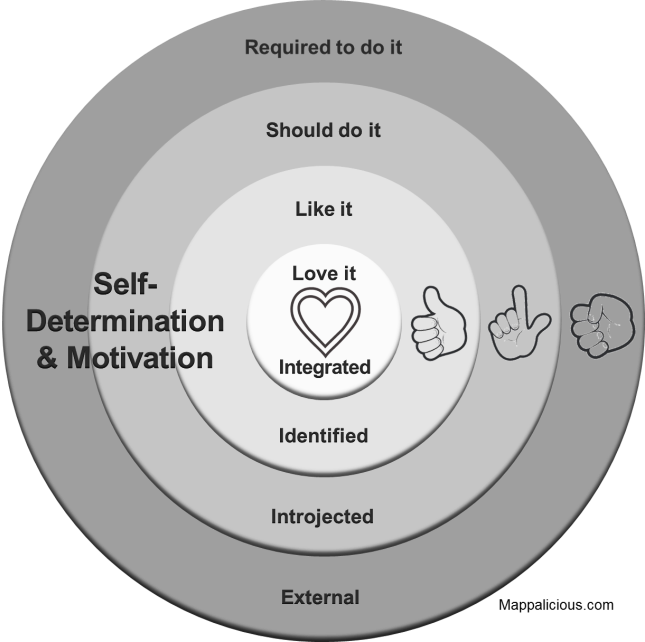
Self-Determination Theory* suggests there are four distinguishable levels of motivation, or more precisely: regulations of behavior: integrated, identified, introjected, and external. The level is determined by the degree of internalization of a specific goal – you might also say: how close it is to our “true selves”; and it´s also a way of describing the path from very little to full autonomy in the process of pursuing a goal.

  • External: When we are forced to do something or carry out an action only because of an external reward (“In it for the money…”).
  • Introjected: When we rely on external goals and standards of evaluation, trying (more or less fruitlessly) to “make them our own”: E.g., doing something in order to raise our own self-esteem.
  • Identified: When we really get to the point of making a once external goal “our own”. This involves willfully appreciating a goal so that it is accepted as personally important.
  • Integrated: When behavioral regulation is entirely assimilated with self and therefore included in a person’s self-evaluations and beliefs about personal needs.

Integrated motivation shares a lot of attributes with intrinsic motivation but is nonetheless classified as extrinsic – because the goal in question is still pursued for reasons extrinsic to the self, rather than the inherent enjoyment of the task.

Self-Concordance and healthy Goal-Striving

The Self-Concordance Model takes the above-mentioned insights one step further. Let´s have a look at the abstract of the first scientific article describing the theory:

The self-concordance of goals (i.e., their consistency with the person’s developing interests and core values) plays a dual role in the model. First, those pursuing self-concordant goals put more sustained effort into achieving those goals and thus are more likely to attain them. Second, those who attain self-concordant goals reap greater well-being benefits from their attainment. Attainment-to-well-being effects are mediated by need satisfaction, i.e., daily activity-based experiences of autonomy, competence, and relatedness that accumulate during the period of striving.

Self-ConcordanceSo the basic idea is pretty straight-forward: We exert more effort when pursuing goals that are “close to our heart” (contrary to mostly extrinsically regulated goals). More effort leads to progress and a higher likelihood of goal attainment. And in turn, reaching goals makes us happy. But that´s not the end of the story: When we choose to pursue self-concordant goals, the act of moving forward is satisfying in itself. Why is that the case? The theory posits that pursuing self-concordant goals is associated with satisfying three basic psychological needs: The needs for competence, autonomy, and relatedness.

  • Competence: We desperately want to feel competent, at least in those areas of life that are of interest to us. Think of a small child that has just learned a new skill. Typically, it will use this capability over and over again – just for the fun of it.
  • Autonomy: We desperately want to feel in control of our lives, and being able to make our own decisions. Think of a small child that discovers it´s free will and enjoys to do so. The “Terrible Twos” are something parents should be proud of – even though it´s probably difficult to enjoy at that time.
  • Relatedness: We desperately want to feel close to other people (that are important in our lives), we want to feel accepted, and at best: loved. Think of a small child that seeks the comfort of his parents after some time of absence.

Basic Psychological NeedsAnd while I have been talking of small children to make a point: those needs are active in all of us to a varying degree. And it does not stop until the end of this life. Ask yourself:

Do I foster an environment that caters to the fulfillment of these needs with regards to the people I´m involved with?

Here´s some research:

So, these are the answers to the questions from the second paragraph of this article:

  • We experience lack of motivation and failure of self-regulation when we pursue goals that aren´t close enough to our true selves. We may get by for some time clinging to external rewards – but that´s never the “real McKoy
  • We do not cherish our victories when the goals we´ve pursued were never our own in the first place. In that case, “getting there” doesn´t feel sweet and rewarding, but rather stale and phony.

You can learn a lot about that last point from the final chapter of my book – which unfortunately is still only available in German…

*The circular image of SDT has been adapted from a diagram in the aforementioned article on SDT and coaching. An overview of  hundreds (literally…) of studies can be found here. Enjoy!
Trials and Tribulations: How much Negativity do we need for a Positive Life?

Positive Psychology is not only about smiley-happy faces and rose-colored glasses. I´ve already written about Post-Traumatic Growth, and the Japanese art of Kintsukuroi as a metaphor for the state of flourishing after experiencing adversity. Yesterday, my fellow Mappster and “Queen of Sisu”, Emilia Lahti, shared a study on Facebook that sheds additional light on these issues. The question is:

Is a Life without Struggles and Hardships a desirable one?

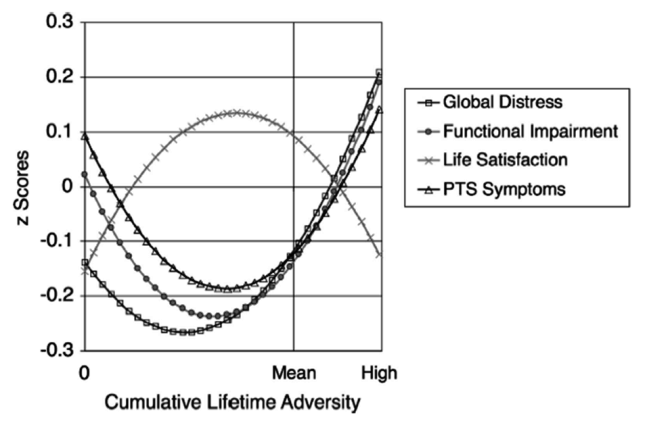
The short answer is: probably not. In a study bearing the Nietzsche-inspired name Whatever Does Not Kill Us: Cumulative Lifetime Adversity, Vulnerability, and Resilience the researchers find that experiencing a moderate amount of “trials and tribulations” over one´s lifetime may foster resilience, resulting in advantages for mental health and well-being. Have a look at this table:

Lifetime AdversityWhat you see is data on a representative U.S. sample of more than 2.000 people. It shows the relationship between participant´s “Cumulative Lifetime Adversity” (CLA; people were asked for negative events in their life, e.g., serious illnesses, bereavement etc.) and several scores for mental health (Life Satisfaction) and its opposites (e.g., signs of Post-Traumatic Stress Syndrome). Precisely, you can see several U-shaped relationships, and one inverse-U-shaped one. The U-shaped ones depicts the relationship between CLA and signs for the absence of mental health, and the inverse shows the relationship between CLA and life satisfaction.

What it means: those people that display the highest levels of satisfaction and the lowest level of “symptoms” have experienced a moderate to average amount of adversity over their lifetime. High levels of adversity can really knock us down and leave us shattered. At the same time, having (almost) no prior experience with hardships can render us vulnerable to corresponding events in the future – and less satisfied with life in general.

So basically, Nietzsche was right. There is saying in Germany:

When you fall down: Stand up. Straighten your crown. Walk on.