Positive Psychology: Standing on which Giants` Shoulders?

The MAPP program is a fulltime program – but combines onsite classes with long-distance learning periods. Part of the distance learning comprises a lot of reading (Who would have thought of that…) and writing essays about a wide array of positive psychology topics. I´ve decided to post some of those essays here on Mappalicious. Surely, they´re not the be-all and end-all of academic writing. But then again, it would also be a pity to bury them in the depths of my laptop…

What has been will be again, what has been done will be done again; there is nothing new under the sun. (Ecclesiastes 1:9)

Standing on a Lego GiantThe aforesaid quote from the Bible reminds us that we all are standing on the shoulders of giants in one way or another. While Positive Psychology as a science is a fairly new development within the greater framework of psychological science (Seligman & Csikszentmihalyi, 2000), its roots can be traced back at least 2,500 years in time. In this essay, I intend to express how the research and practice of positive psychology has been and still is continuously informed by philosophy. I will do so by way of three examples: first and most circumstantial, the notion that our thinking is a powerful intermediary between the “world out there” and our experience of that world; second, the idea that living a life according to certain virtues is accompanied by an elevated level of psychological well-being; and third, the framework of positivity ratios in human development.

Is Buddha the architect of Cognitive-Behavioral Therapy (CBT)?

We are most likely the only mammals alive that can develop symptoms such as a depressive disorder (Sapolsky, 1998). Our superior ability to remember the past (Baddeley, 1998) and unique capability to prospect into the future (Seligman, Railton, Baumeister, & Sripada, 2013) have made us a very successful species – but also prone to psychological malfunctioning in case these “tools” are used improperly. Cognitive-Behavioral Therapy (Beck, 1995) posits that “the poison and the cure” for many of these malfunctions can be traced back to our thinking processes. In his seminal book “Learned optimism”, Seligman (1991) writes: “The way we think about this realm of life can actually diminish or enlarge the control we have over it. Our thoughts are not merely reactions to events; they change what ensues” (pp. 15-16).

This notion can be traced back (at least) all the way to Siddhartha Gautama, the first Buddha. In the Dhammapada (1. verse, 1. chapter, n.d.) he is cited with the words: “All mental phenomena are preceded by mind. Mind is their master, they are produced by mind.” Similar phrases that either point to the notion that the “thing itself” acquires its meaning only via the human mind, or that man is the master of his own fate by controlling his thoughts, can be found in ancient Greek and Roman philosophy (Epictetus: “In a word, neither death, nor exile, nor pain, nor anything of this kind is the real cause of our doing or not doing any action, but our inward opinions and principles.”; from Discourses, chapter 1, n.d.; similar quotes by Marcus Aurelius can be found). About 1,500 years later, Shakespeare (n.d.) puts equivalent words into Hamlet´s mouth in the second act of the second scene: “[…] there is nothing either good or bad but thinking makes it so.” Another 300 years later, there is a related quote by Gandhi (n.d.): “A man is but the product of his thoughts. What he thinks, he becomes.” And finally, before becoming part of the scientific discourse in clinical psychology, the idea of “mind over matter” was propagated by new-age and self-help writers such as Dale Carnegie (1981): “It isn’t what you have or who you are or where you are or what you are doing that makes you happy or unhappy. It is what you think about it.”

Nowadays, the influence of mental processes on our well-being is a well-documented scientific fact. It is the foundation of clinical interventions such as the “ABCDE” tool in CBT (Wells, 1997), as well as most positive (psychology) interventions (Seligman, Steen, Park, & Peterson, 2005). Therefore, it is safe to say that this branch of psychology was heavily informed by the aforementioned philosophers and writers of the past, especially when taking into account that Martin Seligman, one of positive psychology´s founding fathers, earned a bachelor´s degree in philosophy at Princeton before turning his mind towards psychology (Positive Psychology Center, University of Pennsylvania, n.d.).

A Touch of Aristotle

The aforementioned educational background of Martin Seligman might also (partially) explain the strong presence of another “godfather of philosophy”, namely Aristotle. One of the first hallmark projects after the founding of positive psychology was the creation of a compendium of 24 human strengths that group into 6 overarching virtues (Peterson & Seligman, 2004). Aristotle is mentioned 23 times in that textbook. Among other sages of his time, Aristotle proposed that a life worthwhile of living should entail the presence of Eudaimonia which can loosely be translated into the English term “flourishing”. In Aristotle´s opinion, the key to experiencing eudaimonia is leading one´s life according to certain virtues, where a virtue is seen as the middle point between two vices (e.g., courage lies between cowardice and daredevilry). In light of the frequent references to Aristotle it can be assumed that Peterson and Seligman´s idea of character strengths and virtues was heavily influenced by the Greek philosopher. Over the recent years, some evidence on the connection between the presence of character strengths and well-being has been gathered. While not all of the 24 strengths display a distinct correlation with variables such as life satisfaction, concepts such as hope, zest, gratitude, love, and curiosity seem to be present more often in people that report high levels of psychological well-being (Park, Peterson, & Seligman, 2004).

From defining “the Positive” to Systems Intelligence

In addition to standing on the shoulders of bygone giants, positive psychology is also heavily influenced by contemporary philosophers such as Schneider (2001) and Pawelski (2012). Both researchers aid the scientific study of well-being, for instance, by trying to define (and refine) important constructs in positive psychology. By way of example: when the discipline was founded at the onset of the third millennium, it was not utterly clear, e.g., what the term “positive” in positive psychology is actually referring to. 15 years later, we have made some progress pertaining to that question. Pawelski (2012) points out that the “positive” in positive psychology cannot just be the absence of something negative. (Psychological) well-being cannot be explained by looking at what is not there (e.g., unhappiness, mental illness). In recent years, this viewpoint also receives more and more empirical support (Huppert & Whittington, 2003).

Yet, philosophers do not only refine the methodology of positive psychology – they also convey valuable impulses for psychological phenomena to be explored and possible interventions in the context of these phenomena. For instance, an issue that has received a lot of attention in positive psychology is the notion of “positivity ratios”. Fredrickson and Losada (2005) argue that it is possible to enter into an upward spiral of well-being when one manages to experience a significant surplus of positive over negative emotions. While it remains unclear up to now where the exact “tipping point” lies (Brown, Sokal, & Friedman, 2013), there remains a lot of evidence for the idea that, in order for a person to flourish, he or she has to experience positive emotions considerably more often than negative feelings (Fredrickson, 2013). Interestingly, this does not only hold true for a person´s “internal emotional chemistry” but also for the chemistry between two people. John Gottman, one of the world´s most renowned researchers on the subject of marriage was repeatedly able to show that a marriage flourishes when the interactions between the spouses display a ratio of approximately 5:1 in favor of positive (micro-) interactions (Gottman, Coan, Carrere, & Swanson, 1998).

This need for a distinct positivity bias in daily life is also proposed by a contemporary philosopher from Finland, Esa Saarinen. He and his coworkers posit that one way to achieve human flourishing is the development of systems intelligence which is defined as “intelligent behaviour in the context of complex systems involving interaction and feedback” (Luoma, Hämäläinen, & Saarinen, 2010, p. 1). An important framework within systems intelligence is the notion of “Systems of Holding Back in Return and in Advance” (Hämäläinen & Saarinen, 2008, p. 824). These systems can be regarded as a downward spiral in personal interactions because “there is a bias in human mental constitution to be more aware of the contributions others fail to make to me than of the contributions I fail to make to others” (p. 824). The framework seems to mirror important aspects of the research on positivity ratios in positive psychology.

In light of the distinct overlaps between philosophy and the research and practice of positive psychology, it is therefore reasonable to assume these two disciplines will continue to cross-fertilize in the arena of human interaction. And one day, maybe, there will be something new under our sun.

References

  • Baddeley, A. (1998). Human memory. Boston: Allyn & Bacon.
  • Beck, J. S. (1995). Cognitive therapy: Basics and beyond. New York:  Guilford Press.
  • Brown, N. J., Sokal, A. D., & Friedman, H. L. (2013). The complex dynamics of wishful thinking: The critical positivity ratio. American Psychologist, 68(9), 801-813.
  • Carnegie, D. (1981). How to win friends and influence people (revised edition). Retrieved from: http://freewebeducation.org/pdfs/HowToWinFriendsAndInfluencePeople.pdf
  • Epictetus: (n.d.). Discourses. Retrieved from: http://www.bartleby.com/100/715.html
  • Fredrickson, B. L. (2013). Updated thinking on positivity ratios. American Psychologist, 68(9), 814-822.
  • Fredrickson, B. L., & Losada, M. F. (2005). Positive affect and the complex dynamics of human flourishing. American Psychologist, 60(7), 678-686.
  • Gandhi (n.d.). Mahatma Gandhi quotes. Retrieved from: http://en.wikiquote.org/wiki/Mahatma_Gandhi
  • Gottman, J. M., Coan, J., Carrere, S., & Swanson, C. (1998). Predicting marital happiness and stability from newlywed interactions. Journal of Marriage and the Family, 60, 5-22.
  • Hämäläinen, R. P., & Saarinen, E. (2008). Systems intelligence – the way forward? A note on Ackoff’s ‘why few organizations adopt systems thinking’. Systems Research and Behavioral Science, 25(6), 821-825.
  • Huppert, F. A., & Whittington, J. E. (2003). Evidence for the independence of positive and negative well‐being: Implications for quality of life assessment. British Journal of Health Psychology, 8(1), 107-122.
  • Luoma, J., Hämäläinen, R. P., & Saarinen, E. (2010). Acting with systems intelligence: Integrating complex responsive processes with the systems perspective. Journal of the Operational Research Society, 62(1), 3-11
  • Park, N., Peterson, C., & Seligman, M. E. (2004). Strengths of character and well-being. Journal of Social and Clinical Psychology, 23(5), 603-619.
  • Pawelski, J. (2012). Happiness and its opposites. In S. David, I. Boniwell, & A. C. Ayers (Eds.), Oxford handbook of happiness (pp. 326-336). Oxford: Oxford University Press.
  • Peterson, C., & Seligman, M. E. P. (2004). Character strengths and virtues: A handbook and classification. Oxford: Oxford University Press.
  • Positive Psychology Center, University of Pennsylvania (n.d). Dr. Martin E.P. Seligman’s Curriculum Vitae. Retrieved from: http://www.ppc.sas.upenn.edu/vitae.htm#Degrees
  • Sapolsky, R. (1998). Why zebras don’t get ulcers. New York: Freeman.
  • Schneider, S. L. (2001). In search of realistic optimism: Meaning, knowledge, and warm fuzziness. American Psychologist, 56(3), 250.
  • Seligman, M. E. P. (1991). Learned optimism. NewYork: Knopf.
  • Seligman, M. E. P., & Csikszentmihalyi, M. (2000). Positive psychology: an introduction. American Psychologist, 55(1), 5-14.
  • Seligman, M. E. P., Railton, P., Baumeister, R. F., & Sripada, C. (2013). Navigating into the future or driven by the past. Perspectives on Psychological Science, 8(2), 119-141.
  • Seligman, M. E., Steen, T. A., Park, N., & Peterson, C. (2005). Positive psychology progress: empirical validation of interventions. American Psychologist, 60(5), 410-421.
  • Shakespeare, W. (n.d). Hamlet. Retrieved from: http://shakespeare.mit.edu/hamlet/hamlet.2.2.html
  • Wells, A. (1997). Cognitive therapy of anxiety disorders: A practice manual and conceptual guide. Chichester, UK: Wiley.


Picture Source

This is the Good Life now: Writing about Positive Psychology on the first Day of Spring

I just wanted to share this beautiful photo with you. While I write these words, I´m sitting in front of my favorite café in my German hometown, I have a day off – and was asked to write an article on Positive Psychology for the premier HR and Coaching practitioner magazine. It´s the first day of 2014 that really feels like spring – no need to wear a jacket in the early afternoon sun. And, very appropriately, iPod shuffle mode chose to play me the song you´ll find below the picture…

Coffee in the Sun

The Good Life – Farmer Boys

All you do
All you’ve been through
Has put you where you are today

All you do
Is a photograph of you
Now do you like what’s in the picture?

The time is now
There’s no time for waiting around
You get one shot, don’t run for cover
Until it’s over

This is the good life now
This is the high life now
I can see with my own eyes
That it’s a good, good life

The things you say
Day after day
Make all the difference in the world

The things you hate
Might never go away
But they can’t win if you don’t let them

The time is now
There’s no time for hanging around
This your chance, take it with no doubt
And don’t let go, now

This is the good life now
This is the high life now
I can see with my own eyes
That it’s a good, good life

The 10 Commandments of Positive Psychology…in Songs

  1. If you´re Happy and you know it clap your Hands! – Teddy Rock
  2. Go with the Flow! – Northern Lite
  3. If you can´t be with the One you love – love the One you´re with! – Crosby, Stills and Nash
  4. Find your own Voice! – Stratovarius
  5. You can get it if you really want! – Jimmy Cliff
  6. (Get out your seats and) Jump around! – House of Pain
  7. (Take) A Walk in the Park! – Nick Straker Band
  8. (What doesn´t kill you makes you) Stronger! – Kelly Clarkson
  9. Your Life is Now! – John Mellencamp
  10. It´s always more Fun to share with Everyone! (The Sharing Song) – Jack Johnson

Any suggestions from your side? I´m not a Christian (any more) – so I could very well live with 17 or 333 commandments…

If you´re Happy and you know it clap your Hands!

–> Research on the benefits of positive emotions.


Go with the Flow!

–> Research on the benefits of experiencing flow.


If you can´t be with the One you love – love the One you´re with!

–> Research on the benefits of positive relationships.


Find your own Voice!*

–> Research on the benefits of finding meaning and purpose in life.


You can get it if you really want!

–> Research on the benefits of grit and achievement.


(Get out your seats and) Jump around!

–> Research on the benefits of physical exercise.


(Take) A Walk in the Park!

–> Research on the benefits of spending time in nature.


(What doesn´t kill you makes you) Stronger!

–> Research on the benefits of post-traumatic growth.


Your Life is Now!

–> Research on the benefits of meditation and mindfulness.


It´s always more Fun to share with Everyone! (The Sharing Song)**

–> Research on the benefits of altruism.


* I just couldn´t resist putting one of favorite metal bands in this list. Kiitos, Stratovarius!

** The last song is also a hint at what to do with this post… 🙂

Positive Psychology in Germany – where are you?

Flag - German SmileyIn terms of age, Positive Psychology is now in its teenage years. Most of the stuff that´s been happening so far – be it research or practice – is located in in the USA (but PP is pretty well-developed in other Anglo-Saxon cultures such as the UK and Australia as well).

But what about my Germany, my mother country? Well, Germans in general are known for a lot of sought-after character traits – but we may just not be the perfect audience for Positive Psychology. At the end of the day, we´re not really the shiny happy people, right? And the more we need PP…maybe.

There are a few German PP researchers out there, but typically, they tend to work in the U.S., such as Matthias Mehl. I´m the third German MAPPster. The first one is Johannes Eichstaedt who is now a Ph.D. student at Penn´s Positive Psychology Center. The second one is Judith Mangelsdorf who now pursues a Ph.D. at the Max Planck Institute for Human Development in Berlin.

A couple of months ago, the German (-speaking) Association of Positive Psychology was founded (is also associated with IPPA, the International Positive Psychology Association). In addition, a lot of information can be found via www.seligmaneurope.com.

If you are in Germany and interested in Positive Psychology – please reach out to me…


Picture source

Somaesthetics: On the Role of Physical Exercise and “neck-down” Interventions in Positive Psychology

The MAPP program is a fulltime program – but combines onsite classes with long-distance learning periods. Part of the distance learning comprises a lot of reading (Who would have thought of that…) and writing essays about a wide array of positive psychology topics. I´ve decided to post some of those essays here on Mappalicious. Surely, they´re not the be-all and end-all of academic writing. But then again, it would also be a pity to bury them in the depths of my laptop…

Jump Jump

Sir Winston Churchill, British prime minister during World War II, is often cited with the quote “First of all: No sports.”* At the same time, it is well-known that he experienced recurring bouts of severe depression all through his life. Churchill is publicly perceived as one of the greatest political leaders of the 20th century – but he may have erred severely pertaining to the issue of physical activity. I will argue that building people´s self-efficacy and perception of agency should be a goal of all positive interventions, and that “neck-down” interventions, such as regular physical activity, are an easily accessible instrument to build up these resources.

In his review article that covers 30 years of research on goal-setting, Locke (1996) points out the importance of conscious goal-setting for motivational processes. To support this notion, he elaborates on different conditions and processes that foster the relationship between goals, motivation, and performance. For instance, he states that goal difficulty, goal clarity, and commitment to one´s goals are enablers of high performance across a wide array of tasks. In addition, he explicates how frequent goal-directed feedback and beliefs about the attainability of one´s objectives are beneficial to high levels of achievement. Ideally, these beliefs can initiate an upward spiral: Self-efficacy is conducive to attaining goals, which in turn builds up more self-efficacy, which in turn helps to attain more difficult goals in the future. Furthermore, Locke argues that the process of effective goal-setting can be taught and learned – which is important because reaching goals, especially difficult ones, is beneficial to build and sustain personal satisfaction with life.

Somewhat similar to Locke´s findings, hope theory (Lopez, Snyder, Magyar-Moe, Edwards, Pedrotti, Janowski, et al., 2004) stresses the human capacity for setting goals, envisioning approaches that enable us to reach those goals, and thus for summoning the necessary motivation to follow through. Hope is delineated as the expectancy that a change for the better is possible, thereby being a meta-resource for all kinds of change processes. Without hope, they would probably be no impulse to act at all. People can be hopeful about goals in general, broad aspects of life, and also very specific goals. The authors posit – again somewhat similar to goal-setting theory – that hope can initiate an upward spiral: Initial hope increases the probability for early progress which than acts as a resource for building further hope.

As expressed in the first paragraph, there is considerable support for the idea that physical activity such as regular jogging or working out at a gym can be a way to build up self-efficacy and optimism. Most interestingly, this increase in self-efficacy may not be confined to that specific domain of activity. There is some evidence that there may be a (positive) spillover effect to other areas of life. In this spirit, Richard Shusterman (2006) makes the case for a new research agenda called Somaesthetics. He claims that the branch of sciences labeled as “the Humanities” has neglected the role of the body over the last 2,500 years. Arguing that the body is the “tool” for each and every human performance, Shusterman posits that coming to a better understanding of the interplay between the body and human cognition and emotion could improve our understanding of (positive) developmental processes in general. In his flow of arguments, Shusterman suggests the body is a major source of agency and autonomy since physical movement is the perfect embodiment of exerting free will. Later in his article, he also elaborates on how performers of any every kind can profit from an enhanced bodily awareness since it will help them to practice (and subsequently, perform) more stress-free and therefore, longer. Yet, in his opinion, a fully functioning body is not just a means to an end, but can be an end in itself – since feeling healthy and fully-functional brings about a pleasure of its own kind.

Much in the same vein, Mutrie and Faulkner (2004) state that the body plays an essential role in human cognition and emotion. They summarize their article by stating there is convincing evidence that supports the link between physical activity and well-being, first by preventing mental health problems, second by functioning as a direct treatment of mental disorders, and third by improving the quality of life of people with mental health problems as well as the non-clinical population. Similar to Shusterman (2006), Mutrie and Faulkner believe this to be a result of the specific way physical activity is capable of strengthening self-efficacy and perceived autonomy, the feeling of being in control, and optimism. They conclude by saying that, in their opinion, regular physical exercise embodies the principles of positive psychology to a great extent and should therefore complement the extant canon of positive interventions.

To summarize: Building up self-efficacy, a feeling of agency, and optimism, is an underlying principle of positive interventions. “Neck-down” interventions can be instrumental in building up these general resources. To a varying extent, physical activity is accessible to (almost) every person on this planet, can be initiated at will, and comes at virtually no cost (in the case of jogging etc.). Yet, it is not only a means to end – but rather a pathway to well-being itself.

References

  • Locke, E. A. (1996). Motivation through conscious goal-setting. Applied and Preventive Psychology, 5(2), 117-124.
  • Lopez, S. J., Snyder, C. R., Magyar-Moe, J. L., Edwards, L., Pedrotti, J. T. Janowski, K., et al. (2004). Strategies for accentuating hope. In P. A. Linley & S. Joseph (Eds.), Positive Psychology in Practice (pp. 388-404). Hoboken: Wiley.
  • Mutrie, N., & Faulkner, G. (2004). Physical activity: Positive psychology in motion. In P. A. Linley & S. Joseph (Eds.), Positive Psychology in Practice (pp. 146-164). Hoboken: Wiley.
  • Shusterman, R. (2006).Thinking through the body, educating for the humanities: A plea for somaesthetics. Journal of Aesthetic Education, 40(1), 1-21.
*However, there is considerable evidence that this may be a misquotation.

There is no way to Happiness. Happiness is the way. But: to what or where?

“There is no way to happiness. Happiness is the way.” is a quote by the Buddha. I have not spoken to him in person (at least not to his 2,500 B.C. incarnation…) but what he probably meant is that happiness is not a goal that can be attained (for good). Rather, happiness is a consequence (or rather: byproduct) of doing certain things – and refraining from doing certain other things. This view opposes modern materialistic notions of life where we are repeatedly told something along the lines of “If you achieve X/if you manage to get Y – then you´ll be happy.”

Buddha´s quote is in line with other great thinkers of his time: Aristotle thought that eudaimonia (the “good life”, flourishing) was a byproduct of leading a virtuous life, where a virtue can be found right in the middle between two vices (e.g., courage lies between cowardice and imprudence). Confucius equally propagated leading a life guided by certain virtues. For instance, he formulated an early version of the Golden Rule that was made famous in the West by my compatriot Immanuel Kant.

The Science of Positive Psychology takes these sages at their word – and has gathered some empirical evidence on the issues. By way of example, happiness is a consequence of…

But if happiness is a way instead of a destination – I assume it´s also reasonable to ask: the way to what or where?

Man and Dog at Dawn

Typically, we ask ourselves what we have to do in order to be happy. But what if happiness is not the goal?

What if happiness were the input variable – not the outcome?

By now, we do know a lot about this way of looking at psychological well-being. For instance, happiness leads to …

In order to start being happy right now, I suggest you (re-)visit this video

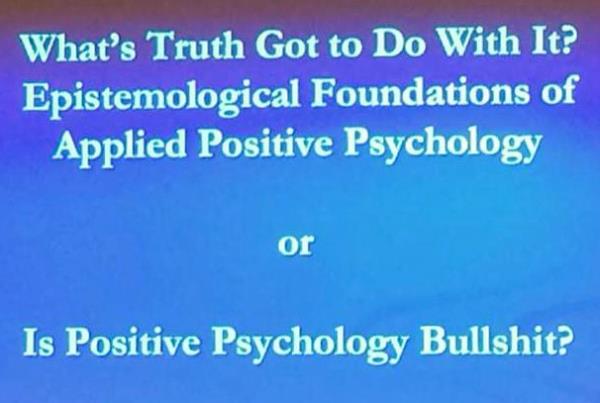
On Positive Psychology, Bullshit, and why you need a Chief Philosophy Officer (CPO)

At our recent onsite at Penn, we had a stimulating discussion on bullshit with James Pawelski – who wears the hat of MAPP´s academic director and at the same time that of Chief Philosophy Officer (CPO). Now the job of a philosopher is to sit in his/her armchair, ask you unnerving questions – and thereby shake the grounds of everything you ever believed in. Or at least something like that … which … probably … is a good thing. I don´t know.

By the way, that´s by far the easiest way to be philosophic: Just say “I don´t know” a lot. But you have to say it in a smirk philosophic kind of tone – or else, you´re just a dumbass who, well, doesn´t know stuff. Which brings me to the question: Do our schools teach us to be anti-philosophers? After all, saying “I don´t know” a lot in class will surely get you in trouble – while a decent capability in the fine art bullshitting can get you at least half-way through your Ph.D. program – and sometimes, published in first-tier journals.

So, I just wanted to write something along the lines of “But I digress…” to lead over to next section. Yet, curiously – I´m already there. Philosophy moves in mysterious ways…

When an honest man speaks, he says only what he believes to be true; and for the liar, it is correspondingly indispensable that he considers his statements to be false. For the bullshitter, however, all these bets are off.

Positive Psychology = BullshitWhat is that thing: Bullshit? Well, what I like about philosophers so much is the fact that there are so many of them – and that they´ve started doing what they do (“philosophizing”…) more than 2,500 years ago. So there´s a really good chance that – whenever you have a question or a problem – some philosopher will already have thought about it. Most certainly, this is true for the subject of bullshit. Harry G. Frankfurt, professor emeritus of Princeton, has written a witty (and for a philosophical piece) pleasantly short and graspable essay on that overdue topic.

The essay starts with the skillfully crafted sentence “One of the most salient features of our culture is that there is so much bullshit.” and then moves on to explain why that could be the case; to finally define the nature of bullshit – especially in its relationship to adjacent concepts such as “truth” and “lie”. The following section represents a good synopsis of Frankfurt´s argument:

It is impossible for someone to lie unless he thinks he knows the truth. Producing bullshit requires no such conviction. A person who lies is thereby responding to the truth, and he is to that extent respectful of it. When an honest man speaks, he says only what he believes to be true; and for the liar, it is correspondingly indispensable that he considers his statements to be false. For the bullshitter, however, all these bets are off: he is neither on the side of the true nor on the side of the false. His eye is not on the facts at all, as the eyes of the honest man and of the liar are, except insofar as they may be pertinent to his interest in getting away with what he says. He does not care whether the things he says describe reality correctly. He just picks them out, or makes them up, to suit his purpose.

So where does Positive Psychology fit in here? And why is it really a good thing (I´m being honest to Flying Spaghetti Monster here!) to have a CPO somewhere at your side?

The truth is: a lot of the subjects in Positive Psychology sound like pure bullshit on the face of it. We´re all about well-being, happiness, virtues, meaning, and other fuzzy wishy-washy touchy-feely stuff. It is quite easy to get carried away in those diffuse realms of the conditio humana.* What separates Positive Psychology as a science from all that self-help literature out there is … well, that it´s a science. We give our best to approach that touchy-feely stuff with double-blind experiments, large-scale, and longitudinal research designs. We like to sell our pudding, point well-taken, but want to make sure first that there is enough scientific proof to it.

Our CPO James Pawelski really helps us to stay “grounded” while wrestling with all those new and exciting Positive Psychology concepts. He supports us in sharpening our minds while moving forward on our learning journey. He never gets tired of reminding us to be careful about what we say, how we say it, and to be aware of the assumptions our newfound knowledge is based upon.

And: he can talk for three hours nonstop just about the different meanings of the word “positive” in Positive Psychology. It´s a beautiful thing to behold.

What he does is absolutely essential. Already, there are prominent people out there that seem not to be able (or willing…) to grasp the difference between ordinary self-help lingo and the science of Positive Psychology. All the more we have to be careful. We have to know where our very own “red line” is – the one that crosses that grey area where talking about something we sufficiently know and understand turns into bullshitting. In Frankfurt´s words:

Bullshit is unavoidable whenever circumstances require someone to talk without knowing what he is talking about. Thus the production of bullshit is stimulated whenever a person’s obligations or opportunities to speak about some topic are more excessive than his knowledge of the facts that are relevant to that topic.

Thus, I stop at this point. My knowledge of bullshit is exhausted.


*Throwing in some Latin or Greek in your writing makes you sound very philosophical. Especially, when you say “I don´t know” in Latin or Greek…

PowerPoint slide © James Pawelski; photographed by Katrina Calihan

Field of Dreams: Positive Psychology at the Movies

As we´ve entered the second semester of the MAPP program, the subjects have changed. To put it black & white: while the first semester was (mostly) focused on the theory of Positive Psychology, the second semester zooms in on the application in different domains (e.g. healthcare, coaching, consulting with organizations). One of the courses explicitly focuses on the value of the “humanities” (music, art, philosophy, history, etc.) for enhancing “the good life”. That´s why I´ve been writing so much about my love for heavy metal in recent posts.

Positive Psychology at the MoviesNow, a lot of people may not like to go the theater, opera, or museums that much. But there are hardly any people that do not like to go the movies. As such, I am thrilled that some researchers explicitly focus on cultivating psychological well-being, meaning in life, and similar “positive constructs” via watching the “right kind” of movies. One of those people is Ryan Niemiec who also was a guest lecturer at our January onsite period. He´s the author of Positive Psychology at the Movies – and also happens to be the director of the VIA Institute on Character.

Field of DreamsDrawing on the insights of this branch of Positive Psychology, from now on, we´re going to have a movie night once every onsite. Last night, lead by Marty Seligman, we watched Field of Dreams (1989) starring Kevin Costner. Now this film is not that well-known in my home country Germany because baseball is just not a big thing in our culture.* Even though, I tremendously enjoyed watching that film since – at the end of the day – baseball is just used an analogy for conveying ideas about callings, purpose, meaning in life, reconciliation, and finding peace of mind (and heart).

Actually, the whole plot very much reminded me of a psychotherapeutic method by the name of Family Constellations that has become a sort of “movement” in Germany, but is really not well-known anywhere else. I do not wish to expand on this here – but if you´re interested to know more about this: here you´ll find a concise scientific paper in English on the underpinnings and application of this method.

So, it´s Saturday. If you go to the movies tonight, why not put on those “positive psychology glasses” and e.g., look for the expression of character strengths in the protagonists?

* The only baseball player that I really knew about before watching the movie is Yogi Berra – who is quite famous for his brainy quotes (Yogiisms) such as: “Always go to other people’s funerals, otherwise they won’t go to yours.”

P.S.

Another valuable resource is the film index at cinematherapy.com.

Positive Psychology Speaking Tour: Martin Seligman is coming to Europe

If you are interested in Positive Psychology and happen to live in (central) Europe, you might be interested to hear that Martin Seligman is coming to Germany in the summer of 2014 together with some other big names in the field, such as Mihály Csíkszentmihályi, and Barbara Fredrickson for several conferences. This is a great way to get updated on the latest developments in Positive Psychology. The presentation will be in English and translated into German. For more information, please refer to this (German) Flyer.

PP_Speaking_2014