If you are interested in Positive Psychology and happen to live in (central) Europe, you might be interested to hear that Martin Seligman is coming to Germany in the summer of 2014 together with some other big names in the field, such as Mihály Csíkszentmihályi, and Barbara Fredrickson for several conferences. This is a great way to get updated on the latest developments in Positive Psychology. The presentation will be in English and translated into German. For more information, please refer to this (German) Flyer.
Martin Seligman
Great Overview of Positive Psychology Courses
The MAPP program at Penn probably is the most advanced Positive Psychology program on this planet.* You get to learn directly from Martin Seligman and some of his closest collaborators. But then, it´s not the only program on earth – there´s lots of cool stuff out there. So, if you cannot manage to move to Philadelphia for 10 month (or travel back and forth – as in my case), you might want to check our this website that lists 10 of the most promising courses and programs out there…
* Hey … I mean … what else did you expect me to say…?
2051: Positive Psychology, Optimism, and the Florentine Moment in Time…
Tempus fugit. The first half of the MAPP program 2013/14 is over. Actually, the second and final semester is well on its way already. New subjects, new lecturers, lots of new homework…
I guess this is a good time engage in a little retrospection – and to have a look at the future as well.
I still remember sitting in the classroom at Penn on the first day, listening to Martin Seligman´s deep and sonorous voice, where he lectured on the history of positive psychology. At some point, one of my MAPP classmates asked him about his vision for positive psychology. What should be its contribution to mankind in the future?
Without much hesitation, Marty told us about his moonshot goal for positive psychology. “By 2051, I want 51% of the world´s population to be flourishing (according to the PERMA outline)”. Now in 2051, Marty will be 109 years old. So there´s good chance he´s talking about his legacy here. Could this be possible? After all, we still seem to be very far away from that number. War, poverty, and hunger are still raging in many parts of the world. But the truth is:
Things are getting better day by day, year by year.
Now I am a die-hard optimist. So if you feel I am not to be trusted, you may trust some experts (and their stats…).
- Over the last 40 years, people have managed to rise above hunger and poverty by the billions. And this trend is very likely to continue. If you would like to know more, please watch this fabulous TED talk by Hans Rosling.
- The likelihood of dying via homicide has decreased dramatically over the last century. Yes, there still are wars – and there still is murder. But the truth is: on a global scale, life on earth has never been safer. And once again, the trend is likely to continue. If you would like to take a deep dive, please watch Steven Pinker´s TED talk on the decline of violence.
- Overall, we have very good reasons to be (fundamentally) optimistic about the future of mankind. Again, if you´d like to know more, please watch this TED talk by Robert Wright on zero-sum-games, optimism, and human progress.
Positive Psychology wants to play its part in this overall development by teaching people the art and science of flourishing – how to lead a meaningful, positive, and accomplished life while being actively engaged in our closer and larger social networks.
Positive Psychology has first been embraced by coaches, psychotherapists, and physicians. It is now entering the workplace more and more. And the next important step will be:
How can we bring Positive Psychology into education, community management, and policy-making? How can we bring it to China and India – those countries that account for almost 40% of the global population?
Marty Seligman believes that we (at least the western/developed world) now are at a Florentine moment in time. During what came to be known as the Renaissance, the Italian city of Florence became very rich via trading, and therefore at the same time developed into a flourishing center for all kinds of arts and culture because of all that affluence. So where are we – today? In Marty´s words (taken from his book “Flourishing”):
The wealthy nations of the world – North-America, the European Union, Japan, and Australia – are at a Florentine moment: rich, at peace, enough food, health, and harmony. How will we invest our wealth? What will our renaissance be?
Time will tell. I´ve decided for myself that I want to be a part of that movement and upward trajectory. Not only does it feel better to be optimistic – it´s also rational. The alternative, being a (fundamental) pessimist, doesn’t make any sense to me (and I´ve got the data on my side…). What´s the use of being pessimistic? I am a young father – and I would love to have more children. How could I want to want this without believing there´s a good (or at least: better) future ahead, without believing this world fundamentally is a good place to live in?
Once again, time will tell. The picture beneath these lines was taken at a party at Marty Seligman´s house when he generously invited the 2013/14 MAPP students and faculty to have a Christmas celebration at his house on December 7, 2013.
The next day, final day of the first MAPP semester, it was also Marty´s part to speak the closing words. Quite obviously very moved, he cited a passage from Kim Stanley Robinson´s book The Years of Rice and Salt:
“We will go out into the world and plant gardens and orchards to the horizons, we will build roads through the mountains and across the deserts, and terrace the mountains and irrigate the deserts until there will be garden everywhere, and plenty for all, and there will be no more empires or kingdoms, no more caliphs, sultans, emirs, khans, or zamindars, no more kings or queens or princes, no more quadis or mullahs or ulema, no more slavery and no more usury, no more property and no more taxes, no more rich and no more poor, no killing or maiming or torture or execution, no more jailers and no more prisoners, no more generals, soldiers, armies or navies, no more patriarchy, no more caste, no more hunger, no more suffering than what life brings us for being born and having to die, and then we will see for the first time what kind of creatures we really are.”
Time will tell, Marty. But I´m with you…
Micro-Moments of Love: A short Story on Meaning in Life
The MAPP program is a fulltime program – but combines onsite classes with long-distance learning periods. Part of the distance learning comprises a lot of reading (Who would have thought of that…) and writing essays about a wide array of positive psychology topics. I´ve decided to post some of those essays here on Mappalicious. Surely, they´re not the be-all and end-all of academic writing. But then again, it would also be a pity to bury them in the depths of my laptop…
Introduction
Positive psychology stresses the importance of close relationships, be it friendship, romantic love, family, or the support of a larger social entity (Reis & Gable, 2003). When asked to give a definition of positive psychology, the late Christopher Peterson used to say: “Other people matter.” (2006, p. 249). Fredrickson (2013) complements this remark by asserting that love (and its benefits) cannot be a matter of one person, but can only exist in pairs or groups of people. For authors like Vaillant (2008) and Seligman (2011), relationships are of uttermost importance as well. They are embodied by the letter “R” in the acronym PERMA, which represents Seligman´s framework of human flourishing. Additionally, it is hypothesized that close relationships can serve as a major source of meaning in life (Steger, 2009). This should hold true especially if one of the person´s top character strengths (Peterson & Seligman, 2004) is the “capacity to love and to be loved” – which for me is the case. Therefore, this story focuses on love between father and son as an “active ingredient” in the creation of meaning.
Micro-Moments of Love: A short Story on Meaning in Life
On 30th October 2013, my son Mika turned one year old. This year as a young father has been the most transformative experience of my life. It is said that having a child turns the “M” in “Me” upside down, converting it into “We”. By now I know this is absolutely true.
Having a child turns the M in Me upside down.
It is transformed into a We.
When I had to leave Germany for the U.S.A. on 3rd September 2013 to attend the so-called immersion week of the 2013/14 Master of Applied Positive Psychology program at University of Pennsylvania, I was deeply worried. My job as a manager at Bertelsmann, Europe´s largest media company, requires me to travel a lot. But until that day, I had never been away from my boy for more than two nights in a row – and even that could be heartbreaking. Yet, back then I had to leave for a whole week. For whatever reason, one of my greatest fears was that Mika would forget me and “turn cold” in the meantime. Happily, I can say this notion was utter foolishness on my part.
Mika is a wild boy. We have this little ritual: When I return home from work on weekdays, my wife will wait at the door, holding him in her arms. When he spots me, you can see in his eyes that it takes him a little while to realize that his daddy is home. He will look at me with a blank expression. In my head, I start counting the seconds: twenty-one … twenty-two … twenty- … and then his whole face will transmute into the acme of joy. He will squeak with glee and hold up his arms, meaning: Daddy, grab and hug me! He will be really wild in his excitement, hit me on the cheek, kick my belly, and bite my nose. After seven seconds or so, he will beckon me to let him down on the floor again – and he will turn his attention to whatever toy is in reach at that moment.
But when I came home from Philadelphia in the early afternoon of 9th September, it was different. Really different. Mika had just woken up from his afternoon nap. He was standing upright, holding on to the guardrail of his crib, the lights still turned down low. I slowly entered his room and walked to the window, opening up the roller blind just a little bit so the afternoon sun could sneak into the room. Then, I stepped to the side of his bed and looked at him. And Mika looked back with that blank expression on his face. And in my head, I started to count the seconds again: twenty-one … twenty-two … twenty-three … twenty-four … twenty-five – and then I felt he really had forgotten about me.
But at last, he lifted up his arms. Calm. Not smiling. And I picked him up and he hugged me. And he laid down his head on my chest and for the eternity of about thirty seconds it stayed there. He then looked up, gazing at my face. Calm. Not smiling. After about five seconds, he rested his head again for another fleeting eon. Finally, he looked up again. And his whole face transformed into the acme of joy. And he squeaked with glee, and he hit me on the cheek, and he kicked my belly, and bit my nose. And after seven seconds or so, he made me let him down on the floor and went to play. And I cried.
References
Fredrickson, B. L. (2013). Love 2.0: How our supreme emotion affects everything we feel, think, do, and become. New York: Hudson Street Press.
Peterson, C. (2006). A primer in positive psychology. New York: Oxford University Press.
Peterson, C., & Seligman, M. E. P. (2004). Character strengths and virtues: A handbook and classification. Washington, D.C.: American Psychological Association.
Reis, H. T., & Gable, S. L. (2003). Toward a positive psychology of relationships. In C. L. Keyes & J. Haidt (Eds.), Flourishing: The positive person and the good life (pp. 129-159). Washington, DC: American Psychological Association.
Seligman, M. E. (2011). Flourish: A visionary new understanding of happiness and well-being. New York: Free Press.
Steger, M. F. (2009). Meaning in life. In S. J. Lopez (Ed.), Oxford handbook of positive psychology (pp. 679-687). Oxford, UK: Oxford University Press.
Vaillant, G. (2008). Spiritual evolution: How we are wired for faith, hope, and love. New York: Broadway Books.
When feeling good feels better than good: the Benefits of Emotional Contrasting
The MAPP program is a fulltime program – but combines onsite classes with long-distance learning periods. Part of the distance learning comprises a lot of reading (Who would have thought of that…) and writing essays about a wide array of positive psychology topics. I´ve decided to post some of those essays here on Mappalicious. Surely, they´re not the be-all and end-all of academic writing. But then again, it would also be a pity to bury them in the depths of my laptop…
But what if pleasure and displeasure were so tied together that whoever wanted to have as much as possible of one must also have as much as possible of the other — that whoever wanted to learn to “jubilate up to the heavens” would also have to be prepared for “depression unto death”?” And that is how things may well be.
(Nietzsche)
One of my most important teachers while training to become a coach regularly used a metaphor in order to convey the idea that, while there are a lot of people out there that feel good about their lives, there may be separate groups of individuals that may feel equally good, but still radiate a disparate ‘energetic signature’. Using the concept of rebirth (without necessarily believing in it), he told us that, because of their karma, some people are entitled to what could be described as a ‘recreational incarnation’. After a lot of suffering in former incarnations, they now get to live a pleasant and happy life without too much pain, loss, and other turbulences – resulting in an affable, joyful, but (potentially) also slightly shallow character. On the other hand, there are people that know the ‘Dark Night of the Soul’ from their own experience earlier in the current life. While they can be just as happy and agreeable as the aforementioned group, they tend to be somewhat graver or deeper.*
In this paper, I want to take a look at this distinction. At a less arcane level, the question could be: When two people display the same value on a measure that is supposed to quantify happiness – do they really feel the same when one person has been at that level for (more or less) her whole life, while the other has experienced longer periods of considerably unhappier emotional states?
Positive emotions play a central role in positive psychology (Fredrickson, 2001; Fredrickson, 2009). Because of the particular emphasis on positive affect especially during the early period of the field, some scholars criticized positive psychologists for excluding the negative side of human emotions from their inquiries (e.g., Tennen & Affleck, 2003). It is important to say that this is, in fact, not the case (Seligman & Pawelski, 2003; Peterson, 2006). Rather, positive psychology asserts that negative emotions do exist and are just as ‘natural’ as positive emotions. It´s just that the focus of researchers and practitioners, for the first 100 years of psychology as a science, has been firmly on the negative dimension of human experience, which now warrants a shift towards the opposite direction (Seligman & Csikszentmihalyi, 2000).
For example, one branch of research in (positive) psychology focuses on bouncing back from negative experiences (Tugade & Fredrickson, 2004), coping with unfortunate events (Folkman & Moskowitz, 2000), psychological resilience in the face of adversity (Masten, 2001), and, particularly, post-traumatic growth (Tedeschi & Calhoun, 1996; Linley & Joseph, 2004; Tedeschi & Calhoun, 2004). By way of example, there is considerable evidence that a person cannot only recover and get back to normal after a severely stressful event such as a potential life-threatening illness, but can actually attain a higher level of well-being and satisfaction, e.g., via finding a deeper meaning or a more profound sense of purpose in life (Helgeson, Reynolds, & Tomich, 2006; Lyubomirsky, 2008). So while, by and large, it seems difficult to sustainably alter a person´s general level of happiness (Lykken & Tellegen, 1996), there is reason to believe that overcoming extremely stressful events may result in such a shift.
But there may be other mechanisms that can explain how we can benefit psychologically from having gone through troubled times. Even if a person may not be happier than a fellow human being with regard to objective measurement, the aforementioned may still perceive his or her state as being more favorable than the latter person. For a thought experiment, let´s consider two people of similar age and other characteristics that both display scores around the 80th percentile on a measure that captures happiness or a similar variable of psychological well-being. The difference is: the first person has by and large been on that level for his previous life, while the other person has suffered from recurring episodes of depression – but has now recovered for good. Will being equally happy actually feel the same for both? I argue that this is not the case. Rather, I contend the second person will be happier on the subjective level (qualia). She will feel happier about being happy because she can still remember how it felt to be severely unhappy. Why should that be the case?
One of the earliest objects of investigation in psychological science has been human perception, e.g., our ability to discern contrasts (Heidelberger, 2004). While scholars mostly focused on contrasts as perceived on the sensory level (light intensity, loudness, weight etc.), some scientists early on investigated contrasts pertaining to the emotional sphere (Bacon, Rood, & Washburn, 1914). For instance, Manstead, Wagner, and MacDonald (1983) have shown that we tend to find humorous film content to be funnier when we were previously exposed to a horror movie (and vice versa). Obviously, the fear that is elicited by the horror movie makes the enjoyment of the comedy more intense.
While the aforementioned emotional contrast is perceived when the stimuli are presented in close temporal connection, it seems likely that this process also works for stimuli that are being felt at different points in time. It is perfectly possible to contrast a current emotional state to that of past events via voluntarily accessing episodic memory. When we compare feeling good in the present to feeling considerably worse in the past, the current emotional condition can subjectively be enhanced by a kind of meta-emotion (“It really feels good feeling so much better than how I felt back in the days…”).
So while it is common sense that ‘feeling good just feels good’, we should not forget about having felt worse in the past. It just might give us that little extra kick.
* Often, he also used to contrast this ‘species’ with the mythological character of Chiron, the ‘wounded healer’.
References
Bacon, M. M., Rood, E. A., & Washburn, M. F. (1914). A study of affective contrast. The American Journal of Psychology. 25(2), 290-293.
Folkman, S., & Moskowitz, J. T. (2000). Positive affect and the other side of coping. American Psychologist, 55(6), 647-654.
Fredrickson, B. L. (2001). The role of positive emotions in positive psychology: The broaden-and-build theory of positive emotions. American Psychologist, 56(3), 218-226.
Fredrickson, B. L. (2009). Positivity: Top-notch research reveals the 3 to 1 ratio that will change your life. New York: Crown Publishing.
Heidelberger, M. (2004). Nature from within: Gustav Theodor Fechner and his psychophysical worldview. Pittsburgh: University of Pittsburgh Press.
Helgeson, V. S., Reynolds, K. A., & Tomich, P. L. (2006). A meta-analytic review of benefit finding and growth. Journal of Consulting and Clinical Psychology, 74(5), 797-816.
Linley, P. A., & Joseph, S. (2004). Positive change following trauma and adversity: A review. Journal of Traumatic Stress, 17(1), 11-21.
Lykken, D., & Tellegen, A. (1996). Happiness is a stochastic phenomenon. Psychological Science, 7(3), 186-189.
Lyubomirsky, S. (2008). The how of happiness. New York: Penguin.
Manstead, A. S. R., Wagner, H. L., & MacDonald, C. J. (1983). A contrast effect in judgments of own emotional state. Motivation and Emotion, 7(3), 279-290.
Masten, A. S. (2001). Ordinary magic: Resilience processes in development. American Psychologist, 56(3), 227-238.
Peterson, C. (2006). A primer in positive psychology. New York: Oxford University Press.
Seligman, M. E., & Csikszentmihalyi, M. (2000). Positive psychology: an introduction. American Psychologist, 55(1), 5-14.
Seligman, M. E., & Pawelski, J. O. (2003). Positive psychology: FAQS. Psychological Inquiry, 14(2), 159-163.
Tedeschi, R. G., & Calhoun, L. G. (1996). The posttraumatic growth inventory: Measuring the positive legacy of trauma. Journal of Traumatic Stress, 9(3), 455-471.
Tedeschi, R. G., & Calhoun, L. G. (2004). Posttraumatic growth: Conceptual foundations and empirical evidence. Psychological Inquiry, 15(1), 1-18.
Tennen, H., & Affleck, G. (2003). While accentuating the positive, don’t eliminate the negative or Mr. In-Between. Psychological Inquiry, 14(2), 163-169.
Tugade, M. M., & Fredrickson, B. L. (2004). Resilient individuals use positive emotions to bounce back from negative emotional experiences. Journal of Personality and Social Psychology, 86(2), 320-333.
7 common Misconceptions about Positive Psychology
Positive Psychology is not Happyology
Ok. So there´s some truth in this. Positive psychology indeed tries to understand the role of positive emotions in the good life. But they are only one of the five key elements in Martin Seligman´s PERMA concept. I guess most positive psychologists would agree that – at the end of the day – concepts like meaning in life and positive relationships are more important for a life well-lived. Additionally, it is important to acknowledge that positivity is not (only) and end in itself. It may be a powerful way to attain other important things in life (e.g., success at work).
Positive Psychology is not Kitchen Sink Psychology
While there´s nothing wrong with kitchen sink psychology per se, it has to be noted that laypersons get things wrong a lot of times. Even though we should be all experts at living (because that´s what we do all day long…), many people bear serious misconceptions on what makes for a good and happy life. This is where positive psychology as a data-driven science steps in – and often comes up with counterintuitive findings. For instance, if you´re into social media, you´ll know all this TGIF (Thank God it´s Friday) stuff people put on Facebook and Twitter on Friday afternoon. But scientific inquiry time and again is able to show that most people are happier while at work compared to their leisure time.
Positive Psychology is not Self-Help/Positive Thinking
Now this one is so important that I may have to write it down three times. Here we go…
- Positive Psychology is not Positive Thinking!
For sure, there are similarities in the subject matters of positive psychology and positive thinking. By way of example, both are concerned with cultivating optimism in individuals, since being optimistic (most of the time) is associated with an array of beneficial outcome variables. The difference is: positive psychology is a science. It´s grounded in thorough academic research. Of course it´s possible to arrive at correct conclusions without conducting large-scale studies – but personally, I feel a lot better when what I recommend to my clients is based on coherent theories and scientific evidence.
Positive Psychology is not headed by some dubious Guru Elite
This point is closely connected to the aforementioned one. Positive psychology is spear-headed by some of the most widely acclaimed psychologists of our time. Among them are Martin Seligman, former president of the American Psychological Association, Mihaly Csíkszentmihályi, and Barbara Fredrickson. And: Daniel Kahneman, Nobel Laureate of 2002, also is among the major contributors to the literature on psychological well-being. Among other things, he´s a co-editor of the seminal book Well-Being: The Foundations of Hedonic Psychology. Yet, the crucial difference between these people and the common self-help guru is not the length of their Wikipedia articles – it´s something else that can be found in this post.
Positive Psychology is not about ignoring negative Emotions
Once again: positive psychology is not about being happy-smiley all day long. It is not trying to eradicate “the Negative”. It´s just that psychology as an academic discipline has very much focused on negative phenomena (such as fear and depression) for the first hundred years. Positive psychology wants to point the spotlight to the positive side of our emotional and behavioral continuum in order to create a more balanced view of human functioning. Actually, negative events and emotions play a crucial role in studying so-called post-traumatic growth which basically is concerned with the question: How can we profit in the long run from going through really hard times in our lives?
Positive Psychology is not only for rich white People
This concern was issued in a recent article by James (Jim) Coyne, PhD, a Clinical Psychologist and Professor in the Department of Psychiatry, University of Pennsylvania – the same university that Martin Seligman is teaching at. Again, there´s a grain of truth here. Positive psychology was coined at several high-end private universities in the U.S. As with virtually all psychological theories, they are first tested empirically using samples of undergraduate students at those universities the researchers teach at. And since these tend to be predominantly affluent white people, there´s is some truth to that criticism. But once again: that´s true for almost any piece of research in any branch of psychology out there. Positive psychologists do acknowledge this caveat and continually try to broaden their (research) perspective, reaching out to international samples and other diverse target groups.
Positive Psychology is not ignoring its Roots, e.g. Humanistic Psychology
Positive psychologists readily do acknowledge the theories and findings that came out of Humanistic Psychology, thereby standing (partly) on the shoulder of giants like Abraham Maslow and Carl Rogers. Additionally, positive psychology draws heavily on the ancient wisdom of some of the great philosophers. A lot of positive psychologists seem to be very fond of William James, and especially Aristotle and his conception of Eudaimonia. The crucial difference once again is positive psychology´s strong foundation in (experimental) research.
P.S.
I´d really like to have your feedback on this one. Do you agree? Do you disagree? What did I forget?
The crucial Difference between ‘Positive Psychology’ and ‘Positive Thinking’
Here´s a dialogue I´ve gone through a lot of times lately – it goes a long the lines of this:
- Friend: “Hey Nico, I´ve seen (on Facebook…) that you´re a student again. You´re at Penn, right?”
- Nico: “Yep.”
- Friend: “So what are doing?”
- Nico: “I study positive psychology.”
- Friend: “Oh yes, positive thinking. I really like that. You know, I´ve read … (substitute all kinds of self-help books by Joseph Murphy, Dale Carnegie, Napoleon Hill, Rhonda Byrne, … , Tony Robbins).
- Nico: “Duh…”
So, I´m not going to deny that there are a lot of similarities in the subject matters of positive psychology and positive thinking. By way of example, both are concerned with cultivating optimism in individuals, since being optimistic (most of the time) is associated with an array of beneficial outcome variables. So where´s the difference, then?
Here I am, sitting in Jon Huntsman Hall at University of Pennsylvania, listening to some of the most widely-acclaimed psychologists of our time. And there are some sentences which I really hear a lot of the time. Here there are:
- I was wrong.
- I changed my mind.
- I made a mistake.
- I don´t know.
- I´m not sure about…
- We don´t know enough about…
- We should really be careful to say…
I rest my case.
Biophilia: If you feel Blue, touch Green!
One of the speakers at this year´s MAPP Summit has been Charlie Scudamore. He´s Vice Principal of Geelong Grammar School (GGS) in Australia. For several years now, this school has implemented the principles of Positive Psychology in its curriculum, or, for that matter, in the way the school managed on the general level. Therefore, Martin Seligman awarded Charlie with the ‘Pioneer Award’ for the application of Positive Psychology – he is now considered as one of the founding fathers of Positive Education. If you are interested in the way that Positive Psychology is implemented at GGS please click here.
In his talk, Scudamore also touched the aspect of Biophilia. The ‘Biophilia Hypothesis’ draws on evolutionary psychology to support the idea that there is an instinctive bond between human beings and other living systems. By way of example, there´s considerable evidence that spending time in the woods, or just adding plants to a room, can have a mood-boosting effect and alleviate depressive symptoms. That´s why spending time outside, especially in the ‘wilderness’, plays an important part at GGS. Charlie´s summary of this issue: “If you feel blue, touch green!”
Want to learn from a certified Genius? Come to MAPP…
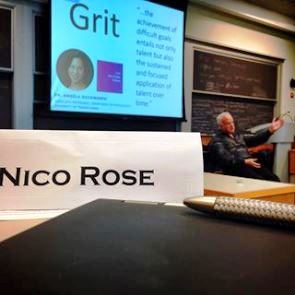
If you´re like most people, you´re not going to be particular fond of statistics. But: Lo and behold – it can be fun! You just need the right teacher. In the case of the MAPP program, it is Angela Duckworth who was just awarded with a McArthur Fellowship – a prize that is informally also called “Genius Grant”. Angela received this award for her research on the concept of Grit which has shown to be a predictor of (academic) success above and beyond the predictive power of intelligence. In the picture, you can see Marty Seligman in the classroom the moment he told us about Angela´s achievement.
Now it might put a little extra pressure on us being taught by a genius – but who cares? When I compare this experience to learning statistics during my undergrad studies – it´s light years apart. You just need a teacher who loves to teach. So my mantra for today is:
Not the same! On being (un-)happy in the Past, Present, and Future
Are you happy? That´s a rather easy question to answer, don´t you think? Well, turns out it´s not that easy. Because it really makes a difference what you are thinking about while trying to answer this question. What are the standards you use while evaluating your ‘human condition’?
In Positive Psychology, there are (at least) three different perspectives on this issue and they center on the timeframe that is used for evaluating one´s happiness. It is literally possible to be (un-)happy in the past, present, and future – and there´s considerable evidence that these perspectives are separate from each other (albeit closely related).
When talking about ‘happiness in the past’, we usually refer to the construct of satisfaction with life which is a global cognitive evaluation of one´s life (so far). To date, it is the most widely used measure of psychological well-being.*
When talking about ‘happiness in the present’, we usually refer to what you do when actually ask somebody “How do you feel (right now)?” How much positive or negative affect do you feel in this moment? In terms of measurement, the most widely used instrument is the so-called PANAS (Positive and Negative Affect Schedule).
And finally, there´s ‘happiness in the future’ which is concerned with our optimism. How happy do you expect to be at time X in the future?
Now the interesting thing is: all three aspects will to a certain extent determine how happy you are today. And they can be tackled and improved separately (but that´s not today´s story…)
For today: if you would like to find out how you´re doing in the past, present, and future, you can take tests at Martin Seligman´s homepage. They can be found (among others) in the menu questionnaires.
*I´ve also used that one in the study that my book is based on.
Foto credit: Pamela Moore – www.istockfoto.com