My Mind´s MAP(P): The 4-minute Ivy League Diploma in Positive Psychology

MAPP 9 Superhero MedalFor one of our MAPP final papers, we were asked to come up with a list of bits and pieces of insight, those “eureka moments of comprehension” we´ve had over the two semesters at Penn. I´d like to share those with you as a kind of “MAPP in a nutshell”. As I like to tie knowledge to those teachers that are “responsible” for my comprehension, I will present them to you in that way. Therefore, I´ve created a list of (to my knowledge) all the persons that have taught in MAPP 9 at one point or the other, and will name those that have provided me with an especially memorable insight. Those perceptions do encompass theoretical insights from positive psychology, its real-world application (or its contribution to real-world application of other psychological concepts), or style of (teaching) delivery…

Roy Baumeister: Bad is stronger than good (precisely: bad events and emotions create a stronger and longer-lasting impact on our brains). Therefore, we need to purposefully create more positive events and emotions in our lives to counterbalance this one-sidedness (with a tip to the hat to John Gottman…).

Dan Bowling: Everything that can be done can also be done with style. It makes the world a brighter place.

Art Carey: Has shown me how important the process of writing is for my own life – and that part of my future career should consist of getting paid for being a “wielder of words”.

David Cooperrider: Words create worlds. Accordingly, positive words will create (mostly) positive worlds – whereas negative words will create (mostly) negative worlds. So use your words wisely, especially your questions – as they tend to create the worlds within other people´s minds.

Angela Duckworth/Peggy Kern: Woohoo! Learning (and teaching…) statistics can be fun. Go figure…

Jane Dutton: High-Quality Connections (HQC) are the high-octane fuel of every organization. Suspend your judgment and try to walk a mile in your fellow men´s shoes before coming to any conclusion. Build trust via giving open, positive feedback – if possible, on a daily basis.

Chris Feudtner: Keeping an open heart while working in dark places (e.g. palliative care units for children) can grant you an enormous “aura” and tangible “clarity of the mind”. When there´s nothing left, there can still be hope. What do we hope for – when there´s no other option left but hope?

Barbara Fredrickson: Positive emotions are not a trifle. They are essential building blocks for our well-being and should be fostered actively.

Adam Grant: It is more blessed smarter to give than to receive. Being altruistic does not turn you into a doormat. It can lead to success, even in competitive corporate environments.

Jonathan Haidt: 1) There are no good reasons (at least not good enough) to be pessimistic about the fate of mankind. Judged by most empirical indicators, it´s not foolish to say that we are on an “upwards trajectory”: things are bound to get better. On that note, I would also like to thank my classmate David Nevill for giving me the sentence “We never have enough data to be pessimistic.” It continues to inspire me, even on a sort of metaphysical level. 2) Look to the extreme ends of the (positive) emotional continuum, e.g., to emotions such as awe and elevation. They may be powerful change catalysts.

Emilia Lahti: You have tons of soul mates somewhere out there. They may live at the other end of the world. But eventually, some of them will find you (especially if you start a blog, that is…)

Ellen Langer: Everything that can be done is worth being done mindful. It leads to better results and more satisfaction. Plus: Don´t fear getting old.

Daniel Lerner: Everything that can be done can also be done with “an eye for excellence”. It pushes the boundaries of human achievement.

Chris Major: A man with a true purpose is (almost) unstoppable.

Ryan Niemiec: 1) Strengths matter more than frailties. They are the key to our “true self” and the building blocks on our road to (work and life) satisfaction. 2) A movie is never “just a movie”. It´s a lesson on character strengths.

Off the Beat: Singing is life!

Ken Pargament: Even atheists value the “sacred moments” in their lives. Find them, cultivate them, and cherish them. They are valuable.

James Pawelski: 1) Trust the process. 2) It´s always valuable not to be the smartest person in the room. 3) Know which giants´ shoulders you are standing on. 4) There is nothing more practical than a good theory (and a proper definition). 5) Know the limits of your knowledge. 6) Positive psychology is grounded in meliorism (the belief that people/things can improve/be better than they are today). 7) You can be a proper scientist and nevertheless enjoy Tony Robbins.

Isaac Prilleltensky: Fairness on the community and societal level influences our individual well-being. Countries with developed democracies, a high degree of personal freedom, generous social security systems and relatively small gaps between top earners and “normal” workers are the happiest (on average)

John Ratey/Tom Rath: Move your ASS! Your brain will appreciate it.

Ann Roepke: Our life is a narrative and as such, we do have tremendous power over it by actively re-writing or pre-writing the storylines.

Esa Saarinen: Don´t hold back. Create systems of generosity. Err on the giving side. Embrace your inner (and outer!) “weird”.

Barry Schwartz: 1) Most times, “good” is “good enough”. 2) Purposefully limit the choices you have to make in life. E.g., choose not to choose by setting defaults and creating habits.

Martin Seligman: Think and dream big.

Daniel Tomasulo: Everything that can be done can also be done with a twinkle in the eye. Makes hard work feel “easy”.

Amy Wrzesniewski: Purpose and meaning (at work) are the result of finding work that integrates your strengths, passions, and values. The calling comes from within. Other people matter (at work, too).

I am deeply thankful to all of you!


P.S. Thanks to my classmate Linda Rufer for designing those MAPP 9 superhero medals. The backside says I was voted “most mappalicious” person in our cohort. Whatever that means at the end of the day… 🙂

Positive Psychology and MAPP at Penn: Doing that Namedropping Thing

Actually, I should be busy writing on my MAPP final papers right now. But then, taking short breaks is supposed to help your mind stay fresh, right?

By now, a lot of people that have read my blog also contacted me to ask about my MAPP experience. Obviously, it´s not that easy to tell a story of 10 months in a few sentences. Hey, that´s why I started this blog in the first place…* There´s also been some questions about the tuition – and to be honest, it´s not exactly a bargain. I could have not taken part without some generous support from my employer (or rather: my boss). But hey – Penn belongs to the Ivy League and that comes with a price tag.

If you´d like to know why I am convinced that it was worth each and every penny (and much more…), please read my blog front to back. Otherwise, you might be convinced by the sheer (work-)force of people that you’ll  have the pleasure and honor to learn from. So here is the name-dropping list. Please note that the guest lecturers and assistant instructors will vary from year to year (C = core faculty; G = guest lecturer; A = assistant instructor that has taught part of a class at some point):

That´s value for money…

*And to become super-duper famous, of course…

Mappsterview No. 4: Dan Bowling on Turning the Tide at Coca-Cola and Lawyer (Un-)Happiness

I was in the ninth cohort of the Master of Applied Positive Program at Penn. Consequently, there are tons of brilliant MAPP Alumni out there that have very fascinating stories to tell: about their experience with the program, about Positive Psychology in general – and about themselves of course. I really want to hear those stories. That´s why I started to do Mappsterviews* with my predecessors.

Today, you are going to meet Dan Bowling, very successful lawyer turned very successful manager turned very successful Law and Positive Psychology teacher and researcher. Actually, I´m supposed to be writing MAPP finals instead of blogging right in this moment. Such is life. Our final papers are a lot about going through our former papers and teaching notes, about integrating and “hunting the good stuff”. Yesterday, I wrote a passage about my “heureka moments” in MAPP. And since I like to link my insights to the people that are “responsible” for those insights, here´s what I wrote about Dan Bowling:

If something is worth doing, it’s worth doing it with style.

Please introduce yourself briefly:

Dan BowlingMy name is Dan Bowling. I am Senior Lecturing Fellow at Duke Law School, where I teach courses on labor law, employment law, and positive psychology and the practice of law. These classes seem to be popular among the students, maybe because I bring pizza and wine for the class every now and then. I also run a small consultancy, Positive Workplace Solutions LLC, which provides executive coaching and legal consulting for C-Level executives and professionals (I am a licensed attorney). I work with Martin Seligman’s team at UPenn’s Positive Psychology Center doing empirical research on strengths and lawyers, and have helped teach in MAPP for the past 5 years. I speak regularly at legal and/or positive psychology conferences, and write a featured blog for Talent Management Magazine called Psychology at Work. I tweet silly and irrelevant stuff @BowlingDan if you would like to follow me.

What got you interested in Positive Psychology in the first place?

I have always been fascinated by different personality traits. I started my career after graduating from Duke Law in 1980 as a labor and employment litigator and it struck me how important a role personality played in why one employee sues you and another doesn’t, even if their job circumstances are the same. I made partner in a large Atlanta law firm in 1986 but was shortly thereafter recruited by Coca-Cola to help form the new law department of its bottling operations, which it spun off as Coca-Cola Enterprises in the largest IPO in history. My interests in the psychological components of work continued during my career with Coca-Cola Enterprises, where I held a variety of jobs including President of a nine-state, 2 billion dollar operating region, as I developed a firm belief in the link between optimism and positive emotions in employee and corporate performance.

I had the opportunity to put my theories into practice in the latter stages of my career, when I was named head of human resources for the entire company. Frankly, the organization was down. We were under legal assault by small groups of hostile employees. Rather than aggressively defending the claims – which I found spurious – our programs and energies were focused on an agonized self-examination of what we did to prompt such claims. The halls were full of consultants and lawyers and days were consumed by meetings, all focused on what was “wrong” with us and how we could treat it. Not surprisingly, our “disease” was metastasizing, and corporate maladies previously unknown (or non-existent) were being discovered and stern remedies subscribed. Managers and employees forgot about selling Coke and spent their time instead in a variety of “workshops,” the corporate equivalent of Mao’s re-education camps.

Our new HR team decided to flip the paradigm, and look at what was right about the company – a focus on the life above zero, as Marty Seligman says. It didn’t take long to learn that the vast majority of the employee grievances were brought by a handful of perpetually complaining employees, often sponsored by outside interest groups, and were generally unfounded. We also found that most of our employees were quite happy with us as an employer. We starting asking a very basic question of ourselves: “Why is it 95% of our HR programs and initiatives are focused on the 5% of employees who hate us? Why spend our precious resources and energies on the perpetually dissatisfied few? Why not focus on efforts on those who want to build a better company and believe we can?” Eventually, we resolved our issues quite successfully, the grumblers moved on, and we spent the rest of our time in HR doing things to hire and engage people who were a positive contribution to our company. When I turned 50, it was time to move on, so I joined the Duke Law faculty teaching labor and employment law, while continuing my research into optimism and positive personality traits by receiving a masters in applied positive psychology at the University of Pennsylvania.

Your are a lawyer, you teach law, and via MAPP (at the lastest…) you know that lawyers are among the unhappiest professions. Why do you think that is the case?

That question is at the core of my current research and writing interests. First, I must challenge the premise – I think the data is not conclusive that lawyers are among the unhappiest professions, although the majority of the literature seems to suggest so. Regardless, law school and law practice seem to exacerbate depressive tendencies in persons with those tendencies, which isn’t surprising given the number of hours lawyers work in pressurized environments on things they are not intrinsically motivated to do. But as to whether lawyers as a population are significantly unhappier than other large groups of highly educated professionals, more research is needed.

Do you have plans to do anything about that?

To effect real change in the profession, it is of critical importance to establish a link between well-being and legal professionalism for the happiness of lawyers to be taken seriously, and my goal is to help provide that framework for the legal profession.

According to what you´ve learned about Positive Psychology, if I were the CEO of a company: what are three things that I should start doing right away?

1) Identify and develop leaders who are optimistic and enthusiastic about the success of others; 2) incorporate strengths-based employee assessment and development programs; and 3) use better psychometrics to support the hiring and talent acquisition process.


Thank you, Dan, for this Mappsterview! If you are a MAPP alumnus and would like to have your story featured here – please go ahead and shoot me an e-mail!

“Focus on What´s Working”: New Management Article on Positive Psychology

***Mainly for readers who know German***

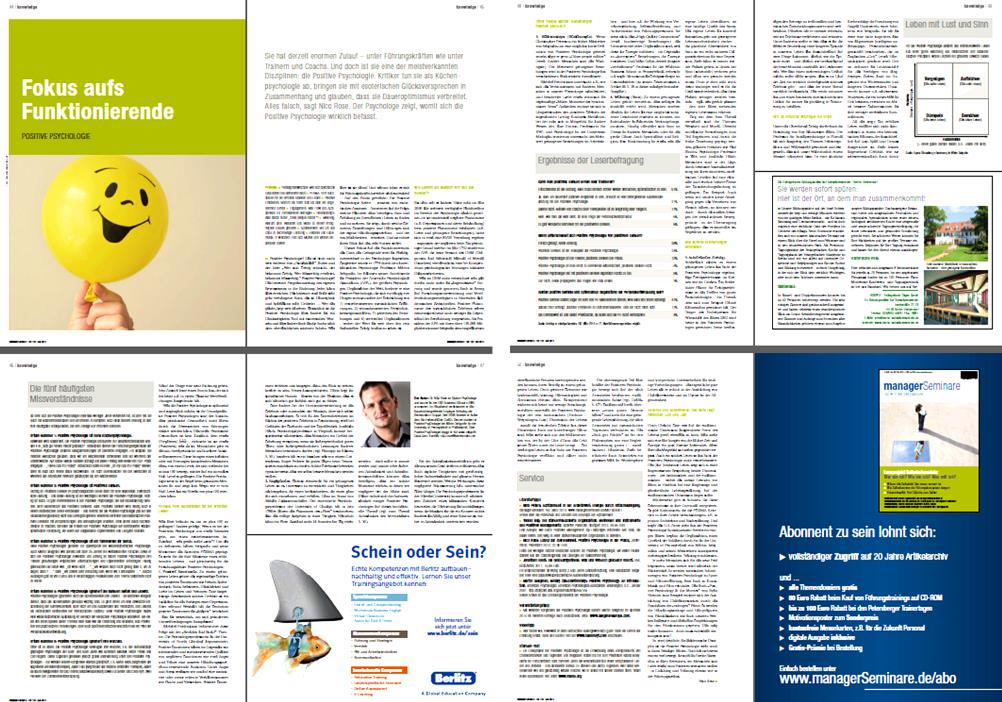
Yesterday, the new issue of “managerSeminare”, Germany´s premier monthly trade magazine on coaching, training, and HR topics was published. It features my 7-page article on the state-of-the-art of Positive Psychology, concisely covering a lot of the topics we´ve been learning in the MAPP program so far.

If you know some German: Enjoy!

Fokus aufs Funktionierende

Bibliophilia: How Reading and Writing can Save our Soul

MAPP is a fulltime program – but combines onsite classes with long-distance learning periods. Part of the distance learning comprises a lot of reading (…who would have thought of that…) and writing essays about a wide array of positive psychology topics. I´ve decided to post some of those essays here on Mappalicious. Surely, they´re not the be-all and end-all of academic writing. But then again, it would also be a pity to bury them in the depths of my laptop…

Library - Mind - Hospital

I´ve visited the center of the earth. I´ve travelled 20.000 leagues under the sea. And I´ve toured around the world in 80 days. Three times, actually. And most of that journeying happened while sitting in the bathtub of my parent´s home. When I was a kid, I used to be a semi-professional tennis player. Upon returning home after long weekends of tournaments, I would head straight to my parent´s bathroom and into the bathtub – to stay there for hours and hours, until my skin would be all shriveled. Most of the times, my companion (and therefore, first literary love) would be Jules Verne, or rather, those heavy editions with linen covers of Verne´s most famous novels that my grandpa gave to my father – and my father to me. Ever since that time, I have been an enthusiastic reader. My taste in books changed, obviously. In came Stephen King, Jostein Gaarder, Nick Hornby, Douglas Adams, and even Joanne K. Rowlings Harry Potter, among others. And out they went again. For several years now, I have been reading non-fiction for the most part. But the pleasure of reading remains. For me, it is an act of uttermost hedonic value. But that is not what this essay is all about. Instead, I will try to convey how literature informs our understanding of (psychological) well-being, and how reading and writing can have a therapeutic effect and build psychological acumen and resiliency.

In the Beginning was the Word

There are many descriptions and analogies for the unique quality of the human race. Common wisdom from biology holds that we are “homo sapiens (sapiens)”, the knowing (or discerning) man (Semino, Passarino, Oefner, Lin, Arbuzova, Beckman, …, & Underhill, 2000). But that is by far not the only description for the “pride of creation”. There are researchers who argue the most important feature that distinguishes man from his mammalian ancestors is our ability to create, remember, and narrate stories – that we are “homo narrans”: the story-telling men (Niles, 1999). Through the narration of stories, man used to recollect and still does recollect his own history, interprets it, and transfers it to the future generation(s), thereby shaping Hegel´s “world spirit” that strives to recognize itself (Hegel, 1822).

But storytelling is almost never done for sheer fun of it, or for objectively reporting was has been before. Telling stories, be it in traditional oral style, in print, or some audio-visual presentation mode, almost always has some instructive, some prescriptive quality to it. Whoever creates or narrates the story oftentimes wants to instill a change in the recipient, wants him to know or even be something else when the story is over. This educational facet of storytelling can be traced all the way through the literary history, from Homer´s “Iliad” and “Odyssey” and Aesop´s fables, to early religious accounts such as the “Upanishads” and the Bible, to medieval works such as Dante´s “Divine Comedy”, Shakespeare´s works of drama (e.g., “Hamlet”), to the early (e.g. Goethe´s “Wilhelm Meister´s Apprenticeship”) and later (e.g. Dickens´s “Great Expectations”) “Bildungsroman” – all the way up to 20th century masterpieces such as de Saint-Exupéry “Little Prince” and New Age classics along the lines of Bach´s “Jonathan Livingston Seagull” or Coelho´s “Alchemist”.

Oftentimes, this educational element is conveyed by carefully depicting the protagonists´ lifestyles – in order to then confront the recipient with the outcomes of these modes of existence. By way of example, both Leo Tolstoy´s “The Death of Ivan Ilych” (1886/2010) and Willa Cather´s “Neighbour Rosicky” (1932/2010) try to educate the reader (among other things) on the value of and human need for close relationships. While Cather portrays the distinctly positive outcomes of understanding that “no man is an island”, Tolstoy´s narrative describes Ivan Ilyich as a human being that literally dies of social and emotional isolation. So, while both stories do not contain any “how-to advice” such as modern self-help books, it remains unequivocal that they try to convey some underlying and implicit understanding of human well-being, that they represent a prescription for “a life well-lived”.

It´s never too late to have a good Childhood*

A special and utmost important kind of story is the story that we tell about ourselves – to ourselves and other people. On that note, psychotherapy has long since discovered the importance of stories and story-telling. It´s not for nothing Freud´s Psychoanalysis is frequently referred to as a “talking cure”. More and more evidence emerges for the notion that being able to convey a coherent and meaningful account of one´s life is a fundamental building block of psychological well-being (Baerger & McAdams 1999). This idea is not only part of the academic literature, but also an important element of pop culture such as the “connecting the dots” element in Steve Jobs´ hugely popular Stanford Commencement Address (2005).

By now, there exists a multitude of ways that stories and storytelling are consciously imbedded into the psychotherapeutic process. By way of example, the branch of “Narrative Therapy” (Monk, Winslade, Crockett, & Epston, 1997) distinctly focuses on those (life) stories that a client brings into the therapeutic setting. Taking on another angle, Cinematherapy (Sharp, Smith, & Cole, 2002) and Bibliotherapy (Cuijpers, 1997) use the potential healing power of existing works of literature, poetry, and film to sow the seed for desirable changes in clients´ mental models and, subsequently, behavioral patterns. Taking on a more active approach, Writing Therapy (Pizarro, 2004) offers relief for patients suffering from severe stress and psychological trauma through the act of writing one´s own account of those stressful events. While the raw facts, the objective events that happened in the past, cannot be altered any more, it is very much possible to change once rational and emotional perception of that same past. It is absolutely possible to “come to terms” with one´s life history, e.g., by consciously creating mental distance to it, by altering its emotional valence, or retroactively finding a deeper meaning in what happened to us earlier (Pennebaker, 1997). Especially the act of discovering a heightened sense of meaning and purpose in life – which is a sign of post-traumatic growth (Tedeschi & Calhoun, 2004) – seems to have very beneficial on our psychological well-being (Singer, 2004).

But the favorable outcomes of writing are not limited to the stories of our past. Some psychologists, especially in the emerging field of Positive Psychology (Seligman & Csikszentmihalyi, 2000), stress the importance of (possible) future events for our well-being. Seligman, Railton, Baumeister, and Sripada (2013) describe the human species as beings that are drawn by the future rather than being driven by the past. As such, actively engaging in the creation of a desirable future is a sign of optimal psychological functioning. On that note, positive psychologists have tried to create interventions that help to consciously facilitate the process of optimistic prospection. One of these interventions is based on visualizing and writing about one´s “best possible self” – where subjects are instructed to “imagine yourself in the future, after everything has gone as well as it possibly could” (Sheldon & Lyubomirsky, 2006, p. 77). Doing this regularly has shown to boost satisfaction with life and an optimistic mindset, among other things – even beyond the time of actively carrying out the exercise.

To draw to a close, I´d like to cite Joseph Campbell, the famous mythologist who discovered that most well-known stories follow a very similar pattern, the so-called “Monomyth” (“The Hero´s Journey” in the pop culture). Campbell once said in an interview: “We must let go of the life we have planned, so as to accept the one that is waiting for us.” Campbell´s monomyth theory posits that compelling stories can typically be structured into twelve different stages (Lang & Trimble, 1988). In stage eight, the hero is supposed to find a magic elixir that will help him to overcome his enemies and bring long-desired changes to the world from which he originally came. Personally, I hope that Positive Psychology will be mine…

References

Andrews, D. H., Hull, T. D., & Donahue, J. A. (2009). Storytelling as an instructional method: Definitions and research questions. Interdisciplinary Journal of Problem-based Learning, 3(2), 6-23.

Sharp, C., Smith, J. V., & Cole, A. (2002). Cinematherapy: Metaphorically promoting therapeutic change. Counselling Psychology Quarterly, 15(3), 269-276.

Baerger, D. R., & McAdams, D. P. (1999). Life story coherence and its relation to psychological well-being. Narrative Inquiry, 9(1), 69-96.

Cather, W. (2010). Neighbor Rosicky. In Obscure destinies (pp. 1-38). Oxford, UK: Oxford City Press. (Original work published in 1932).

Cuijpers, P. (1997). Bibliotherapy in unipolar depression: A meta-analysis. Journal of Behavior Therapy and Experimental Psychiatry, 28(2), 139-147.

Hegel, G. W. F. (1822). The philosophy of history. New York: Dover Publications.

Jobs, S. (2005). Stanford Commencement Address, retrieved from: http://www.youtube.com/watch?v=UF8uR6Z6KLc

Lang, J. S., & Trimble, P. (1988). Whatever happened to the Man of Tomorrow? An examination of the American monomyth and the comic book superhero. Journal of Popular Culture, 22(3), 157-173.

Monk, G.,Winslade, J., Crockett, K., & Epston, D. (Eds.). (1997). Narrative therapy in practice: The archaeology of hope. San Francisco: Jossey-Bass.

Niles, J. D. (1999). Homo narrans. The poetics and anthropology of oral literature. Philadelphia: University of Pennsylvania Press.

Pennebaker, J. W. (1997). Writing about emotional experiences as a therapeutic process. Psychological Science, 8(3), 162-166.

Pizarro, J. (2004). The efficacy of art and writing therapy: Increasing positive mental health outcomes and participant retention after exposure to traumatic experience. Art Therapy, 21(1), 5-12.

Seligman, M. E., & Csikszentmihalyi, M. (2000). Positive psychology: An introduction. American Psychologist, 55(1), 5-14.

Seligman, M. E., Railton, P., Baumeister, R. F., & Sripada, C. (2013). Navigating into the future or driven by the past. Perspectives on Psychological Science, 8(2), 119-141.

Semino, O., Passarino, G., Oefner, P. J., Lin, A. A., Arbuzova, S., Beckman, L. E., … & Underhill, P. A. (2000). The genetic legacy of paleolithic homo sapiens sapiens in extant Europeans: AY chromosome perspective. Science, 290(5494), 1155-1159.

Sheldon, K. M., & Lyubomirsky, S. (2006). How to increase and sustain positive emotion: The effects of expressing gratitude and visualizing best possible selves. Journal of Positive Psychology, 1(2), 73-82.

Singer, J. A. (2004). Narrative identity and meaning making across the adult lifespan: An introduction. Journal of Personality, 72(3), 437-460.

Tedeschi, R. G., & Calhoun, L. G. (2004). Posttraumatic Growth: Conceptual Foundations and Empirical Evidence. Psychological Inquiry, 15(1), 1-18.

Tolstoy, L. (2010). The death of Ivan Ilych. New York: SoHo Books. (Original work published in 1886).

Vaughan, S. C. (1997). The talking cure: the science behind psychotherapy. New York: Putnam and Sons.

*That phrase is most commonly attributed to Novelist Tom Robbins.

Header picture taken from the Facebook fan page of Random House, Inc.

Mappsterview No. 3: David Yaden on Self-Transcendence and “Well-Being for the Dying”

I´m in the ninth cohort of the Master of Applied Positive Program at Penn. Consequently, there are tons of brilliant MAPP Alumni out there that have very fascinating stories to tell: about their experience with the program, about Positive Psychology in general – and about themselves of course. I really want to hear those stories. That´s why I started to do Mappsterviews* with my predecessors.


In Mappsterview No. 3, you´re going to get to know David Yaden who was in MAPP 8 and is now an assistant instructor in the current program. David is a very special person because he always gives me good grades …well: just read for yourself!

David Yaden - PPC

Please introduce yourself briefly:

I study self-transcendent experiences (which are basically peak or spiritual experiences), meaning and purpose in life, and death. Currently, I work as a researcher at the University of Pennsylvania at the Positive Psychology Center and in collaboration with UPenn’s Center for Cognitive Neuroscience. I also work as a consultant and public health educator with Lourdes Health System and I serve as a Humanist Chaplain for Rutgers University. I primarily study the psychology and neuroscience of self-transcendent experiences, but I am also interested in end-of-life issues.

What did you do before MAPP?

I was more of an entrepreneur. After undergrad, I started a health and wellness practice (Integrative Mind-Body Health) to teach people about relaxation techniques, wellness, and well-being. My practice has been sub-contracted by Lourdes Health System for several years. I also started a healthcare consulting practice (Psychosocial Consulting), which initially served medical practices but the work has moved into more technical healthcare business consulting, my primary account is now a medical imaging engineering firm.

My main reason for applying to MAPP was to determine whether I was more of an entrepreneur, a clinician, or an academic researcher. It turns out that of these three I’m best suited for academic research. Ideas light my mind on fire – they move me on an emotional level – so working in this area excites me on a daily basis. My research feels like a real calling.

What got you interested in Positive Psychology?

My journey to positive psychology began with a spontaneous “mystical” experience of self-transcendence. In one instant, my life seemed to go from mild despair and meaninglessness to absolutely overflowing with a joyful and loving sense of meaning and purpose. Much of my adolescent angst was resolved in one overwhelming moment. I’m not alone in this – experiences like mine, which William James describes in The Varieties of Religious Experience, are surprisingly common. Research suggests that today about 33% of cross-cultural samples report something like them. This means that about 1 out of every 3 of your readers will be nodding their heads in recognition when they read this. One scale, the “Mystical Experience Questionnaire” gives a sense of the experience through its items:

  • “Experience of the insight that ‘all is One.’”
  • “Awareness of the life or living presence in all things.”
  • “Feeling that it would be difficult to communicate your own experience to others who have not had similar experiences.”

My attempts to understand this experience led me through academic studies and “real world” experiences that I would not have had otherwise. My studies include comparative religion, philosophy, psychology, and cognitive neuroscience. Experientially, I graduated Marine Corps. Boot Camp and participated in Zen meditation retreats to study rites of passage. I have also traveled and taken psychedelic drugs (legally) to learn more about how certain triggers and circumstances can facilitate self-transcendent states of mind. While these experiences never re-captured my initial experience, many came close. I now believe that many group rituals and contemplative practices have tremendous value. I still meditate and go on retreats, for example. I also promote the on-going psychopharmacology research on psilocybin (a psychedelic substance) at John Hopkins and NYU, and I believe that we will see a return of immersive interventions similar to rites of passage in psychology’s near future.

I should also say that I see my research through a purely psychological lens, and I work hard to keep from engaging in metaphysical speculation. While I was raised religious – and still feel generally positive about religion – I became an atheist at a young age. After my mystical experience, however, I became very spiritual – after all, “seeing is believing”, right? Well no, actually… As Dr. Jon Haidt once said to me, “seeing is perceiving.” After studying philosophy and neuroscience, I realized that I can’t know the true nature of existence or consciousness. This humbled me tremendously. Coming to terms with the fact that we lack certainty about these issues was, and is, a difficult but very valuable process. Now I consider myself an agnostic – this keeps me living in wonder at the mystery that surrounds us. This view also allows me to understand the perspective of religious, spiritual, and secular people alike, which has been particularly important while volunteering with Hospice and doing chaplaincy work. In these areas, the main focus is on helping people rather than getting caught up in debates about belief systems.

My research eventually led me to the work of Dr. Andrew Newberg, who studies the neuroscience of mystical experiences. He is best known for putting long-term meditators and nuns into neuroimaging scanners (like SPECT and fMRI) to see what is going on in their brains while they experience self-transcendent states of unity. He seemed to understand the subjective side of these experiences, was conducting useful and fascinating research on the topic, and wasn’t trying to prove any points based on a particular belief system. Rather than having a metaphysical axe to grind, he frames his work as a strictly scientific endeavor that has the potential to help people. In fact, his respectful and open-minded way of presenting his research often leads people of both extremes of belief to use his research as “proof” that their particular worldview is right.

Atheists say, “See! These experiences are only in the brain” and believers say, “See! These experiences are even in the brain!”

Of course, the data does nothing to prove either of these metaphysical positions correct, but it does advance our scientific understanding of the actual experiences tremendously.

At some point in this process, I saw that Dr. Seligman was on the board of advisors for Dr. Newberg’s lab. I recognized Dr. Seligman’s name from psychology textbooks during my undergrad training. After I learned about his positive psychology initiative, I began to hear about it everywhere. The director of the psychology lab I worked in at the time referred to his work, my Zen teacher brought up positive psychology in his talks (called “teishos” in the Zen tradition), and I remembered that my undergrad study group “Jedi Mind Tricks,” had briefly covered this topic. Once I started reading more of Seligman’s work, I couldn’t learn enough. For a few months I became a hermit in order to read books and articles by him and the other usual suspects in positive psychology (Barbara Fredrickson, Jonathan Haidt, Paul Bloom, Jane Gillham, etc…). After hearing James Pawelski discuss the Masters of Applied Positive Psychology program at an info session, I knew I was hooked. I applied that fall.

As stated above, one of your research areas is the experience of self-transcendence. Can you please elaborate on that?

“Getting out of your head” is one way that I’ve been thinking about self-transcendence lately. Self-transcendent experiences (STE’s) are temporary states of unity with something beyond the self. They range from the routine, like getting lost in a piece of music, to the transformative, such as the mystical experience that I had. Other experiences fall in-between these extremes, like states of mind experienced during meditation or while making love, for instance.

I am working with a dream team of researchers to formalize the definition and spectrum on which STE’s occur – something we call “the unitary continuum.” We are applying for a Templeton grant to study how often these experiences occur, what kind of people experience them and under what circumstances, how people describe them, what biological processes are associated with them, and how they relate to outcomes like well-being and altruistic behavior. To learn more about how these experiences work on the neurological level, we are currently utilizing non-invasive brain stimulation techniques to try to elicit self-transcendent experiences at UPenn’s Center for Cognitive Neuroscience.

Evidence suggests that unlike many interventions in psychology that have small effect sizes and are relatively short-lived, the more intense varieties of self-transcendent experiences can be positively transformative. Some studies show that certain beneficial effects of mystical experiences of self-transcendence, like increased well-being and altruistic behavior, can last years, decades, or even a lifetime. Many people rate these experiences among the most meaningful of their entire lives – alongside events like marriage and childbirth.

If I wanted to foster the presence of self-transcendence in my life: where, or with what should I start?

There are two broad paths to more self-transcendence that have the most evidence behind them, contemplative practices and group connection. In terms of contemplative practices, meditation, prayer, yoga, or even simple relaxation techniques are a great place to start. For group connection, attending church, going to a concert, or participating in anything that involves group cooperation can elicit a sense of self-transcendence.

I would also point you to the research on self-transcendent positive emotions by Barbara Fredrickson, Awe by Dacher Keltner and Jonathan Haidt, Flow by Mihayli Csizkszentmihalyi, Mindfulness by Richard Davidson and Britta Holzel, Peak Experiences by Abraham Maslow, and Mystical Experiences by Ralph Hood and Andrew Newberg. We are calling these “The Varieties of Self-Transcendent Experience” in an obvious nod to William James.

You´re also interested in end-of-life healthcare. How is that a “positive” topic?

Death is scary, dying is difficult, and in our society we don’t do a particularly good job of handling either particularly well (see Atul Gawande’s brilliant article “Letting Go”). Attempts to improve the dying process typically do so by reducing suffering, and I am a great proponent of these efforts. Hospice is one of the very few examples of truly cross-disciplinary, holistic health-care. Palliative care (or “comfort care”) has even recently become a specialty that physicians can study. We have made great collective strides in reducing the pain and suffering of those who are actively dying.

At the same time, I believe that we can do more than reducing pain alone. Hospice care provides art and music therapists, compassionate presence from volunteers, and visits from chaplains. Soaringwords is an organization run by fellow MAPPster Lisa Buksbaum that is also doing wonderful work in this area. These are just a few examples of an amazing start, and I think we can build on these beginnings. Well-being is important for people, period. The fact that someone is actively dying should not exclude them from positive interventions. The dying process is still part of life, and this experience could be improved by making options available that promote well-being. I suspect elements of well-being like meaning and relationships will be shown to be particularly valuable.

Research on mindfulness practices and psychedelic sessions at end-of-life have shown that remarkable improvements in well-being and reductions in anxiety and depression are now possible. Based on this research, I predict that within ten years, when one is pronounced terminally ill (about six months to live) they will have the option of undergoing a psychedelic session. I am very surprised to be saying this, but the evidence of positive benefit is so strong that I think policy makers will eventually be morally obligated to permit research and application in this domain. Physicians and patients will demand access to these substances, especially as research reaches a tipping point of demonstrating their potential to relieve suffering.

David Yaden with other Mappsters

David Yaden with fellow Mappsters

Thanks a lot, David, for this Mappsterview!

* If you are a MAPP alumnus and would like to have your story featured here – please go ahead and shoot me an e-mail!

Positive Psychology: Standing on which Giants` Shoulders?

The MAPP program is a fulltime program – but combines onsite classes with long-distance learning periods. Part of the distance learning comprises a lot of reading (Who would have thought of that…) and writing essays about a wide array of positive psychology topics. I´ve decided to post some of those essays here on Mappalicious. Surely, they´re not the be-all and end-all of academic writing. But then again, it would also be a pity to bury them in the depths of my laptop…

What has been will be again, what has been done will be done again; there is nothing new under the sun. (Ecclesiastes 1:9)

Standing on a Lego GiantThe aforesaid quote from the Bible reminds us that we all are standing on the shoulders of giants in one way or another. While Positive Psychology as a science is a fairly new development within the greater framework of psychological science (Seligman & Csikszentmihalyi, 2000), its roots can be traced back at least 2,500 years in time. In this essay, I intend to express how the research and practice of positive psychology has been and still is continuously informed by philosophy. I will do so by way of three examples: first and most circumstantial, the notion that our thinking is a powerful intermediary between the “world out there” and our experience of that world; second, the idea that living a life according to certain virtues is accompanied by an elevated level of psychological well-being; and third, the framework of positivity ratios in human development.

Is Buddha the architect of Cognitive-Behavioral Therapy (CBT)?

We are most likely the only mammals alive that can develop symptoms such as a depressive disorder (Sapolsky, 1998). Our superior ability to remember the past (Baddeley, 1998) and unique capability to prospect into the future (Seligman, Railton, Baumeister, & Sripada, 2013) have made us a very successful species – but also prone to psychological malfunctioning in case these “tools” are used improperly. Cognitive-Behavioral Therapy (Beck, 1995) posits that “the poison and the cure” for many of these malfunctions can be traced back to our thinking processes. In his seminal book “Learned optimism”, Seligman (1991) writes: “The way we think about this realm of life can actually diminish or enlarge the control we have over it. Our thoughts are not merely reactions to events; they change what ensues” (pp. 15-16).

This notion can be traced back (at least) all the way to Siddhartha Gautama, the first Buddha. In the Dhammapada (1. verse, 1. chapter, n.d.) he is cited with the words: “All mental phenomena are preceded by mind. Mind is their master, they are produced by mind.” Similar phrases that either point to the notion that the “thing itself” acquires its meaning only via the human mind, or that man is the master of his own fate by controlling his thoughts, can be found in ancient Greek and Roman philosophy (Epictetus: “In a word, neither death, nor exile, nor pain, nor anything of this kind is the real cause of our doing or not doing any action, but our inward opinions and principles.”; from Discourses, chapter 1, n.d.; similar quotes by Marcus Aurelius can be found). About 1,500 years later, Shakespeare (n.d.) puts equivalent words into Hamlet´s mouth in the second act of the second scene: “[…] there is nothing either good or bad but thinking makes it so.” Another 300 years later, there is a related quote by Gandhi (n.d.): “A man is but the product of his thoughts. What he thinks, he becomes.” And finally, before becoming part of the scientific discourse in clinical psychology, the idea of “mind over matter” was propagated by new-age and self-help writers such as Dale Carnegie (1981): “It isn’t what you have or who you are or where you are or what you are doing that makes you happy or unhappy. It is what you think about it.”

Nowadays, the influence of mental processes on our well-being is a well-documented scientific fact. It is the foundation of clinical interventions such as the “ABCDE” tool in CBT (Wells, 1997), as well as most positive (psychology) interventions (Seligman, Steen, Park, & Peterson, 2005). Therefore, it is safe to say that this branch of psychology was heavily informed by the aforementioned philosophers and writers of the past, especially when taking into account that Martin Seligman, one of positive psychology´s founding fathers, earned a bachelor´s degree in philosophy at Princeton before turning his mind towards psychology (Positive Psychology Center, University of Pennsylvania, n.d.).

A Touch of Aristotle

The aforementioned educational background of Martin Seligman might also (partially) explain the strong presence of another “godfather of philosophy”, namely Aristotle. One of the first hallmark projects after the founding of positive psychology was the creation of a compendium of 24 human strengths that group into 6 overarching virtues (Peterson & Seligman, 2004). Aristotle is mentioned 23 times in that textbook. Among other sages of his time, Aristotle proposed that a life worthwhile of living should entail the presence of Eudaimonia which can loosely be translated into the English term “flourishing”. In Aristotle´s opinion, the key to experiencing eudaimonia is leading one´s life according to certain virtues, where a virtue is seen as the middle point between two vices (e.g., courage lies between cowardice and daredevilry). In light of the frequent references to Aristotle it can be assumed that Peterson and Seligman´s idea of character strengths and virtues was heavily influenced by the Greek philosopher. Over the recent years, some evidence on the connection between the presence of character strengths and well-being has been gathered. While not all of the 24 strengths display a distinct correlation with variables such as life satisfaction, concepts such as hope, zest, gratitude, love, and curiosity seem to be present more often in people that report high levels of psychological well-being (Park, Peterson, & Seligman, 2004).

From defining “the Positive” to Systems Intelligence

In addition to standing on the shoulders of bygone giants, positive psychology is also heavily influenced by contemporary philosophers such as Schneider (2001) and Pawelski (2012). Both researchers aid the scientific study of well-being, for instance, by trying to define (and refine) important constructs in positive psychology. By way of example: when the discipline was founded at the onset of the third millennium, it was not utterly clear, e.g., what the term “positive” in positive psychology is actually referring to. 15 years later, we have made some progress pertaining to that question. Pawelski (2012) points out that the “positive” in positive psychology cannot just be the absence of something negative. (Psychological) well-being cannot be explained by looking at what is not there (e.g., unhappiness, mental illness). In recent years, this viewpoint also receives more and more empirical support (Huppert & Whittington, 2003).

Yet, philosophers do not only refine the methodology of positive psychology – they also convey valuable impulses for psychological phenomena to be explored and possible interventions in the context of these phenomena. For instance, an issue that has received a lot of attention in positive psychology is the notion of “positivity ratios”. Fredrickson and Losada (2005) argue that it is possible to enter into an upward spiral of well-being when one manages to experience a significant surplus of positive over negative emotions. While it remains unclear up to now where the exact “tipping point” lies (Brown, Sokal, & Friedman, 2013), there remains a lot of evidence for the idea that, in order for a person to flourish, he or she has to experience positive emotions considerably more often than negative feelings (Fredrickson, 2013). Interestingly, this does not only hold true for a person´s “internal emotional chemistry” but also for the chemistry between two people. John Gottman, one of the world´s most renowned researchers on the subject of marriage was repeatedly able to show that a marriage flourishes when the interactions between the spouses display a ratio of approximately 5:1 in favor of positive (micro-) interactions (Gottman, Coan, Carrere, & Swanson, 1998).

This need for a distinct positivity bias in daily life is also proposed by a contemporary philosopher from Finland, Esa Saarinen. He and his coworkers posit that one way to achieve human flourishing is the development of systems intelligence which is defined as “intelligent behaviour in the context of complex systems involving interaction and feedback” (Luoma, Hämäläinen, & Saarinen, 2010, p. 1). An important framework within systems intelligence is the notion of “Systems of Holding Back in Return and in Advance” (Hämäläinen & Saarinen, 2008, p. 824). These systems can be regarded as a downward spiral in personal interactions because “there is a bias in human mental constitution to be more aware of the contributions others fail to make to me than of the contributions I fail to make to others” (p. 824). The framework seems to mirror important aspects of the research on positivity ratios in positive psychology.

In light of the distinct overlaps between philosophy and the research and practice of positive psychology, it is therefore reasonable to assume these two disciplines will continue to cross-fertilize in the arena of human interaction. And one day, maybe, there will be something new under our sun.

References

  • Baddeley, A. (1998). Human memory. Boston: Allyn & Bacon.
  • Beck, J. S. (1995). Cognitive therapy: Basics and beyond. New York:  Guilford Press.
  • Brown, N. J., Sokal, A. D., & Friedman, H. L. (2013). The complex dynamics of wishful thinking: The critical positivity ratio. American Psychologist, 68(9), 801-813.
  • Carnegie, D. (1981). How to win friends and influence people (revised edition). Retrieved from: http://freewebeducation.org/pdfs/HowToWinFriendsAndInfluencePeople.pdf
  • Epictetus: (n.d.). Discourses. Retrieved from: http://www.bartleby.com/100/715.html
  • Fredrickson, B. L. (2013). Updated thinking on positivity ratios. American Psychologist, 68(9), 814-822.
  • Fredrickson, B. L., & Losada, M. F. (2005). Positive affect and the complex dynamics of human flourishing. American Psychologist, 60(7), 678-686.
  • Gandhi (n.d.). Mahatma Gandhi quotes. Retrieved from: http://en.wikiquote.org/wiki/Mahatma_Gandhi
  • Gottman, J. M., Coan, J., Carrere, S., & Swanson, C. (1998). Predicting marital happiness and stability from newlywed interactions. Journal of Marriage and the Family, 60, 5-22.
  • Hämäläinen, R. P., & Saarinen, E. (2008). Systems intelligence – the way forward? A note on Ackoff’s ‘why few organizations adopt systems thinking’. Systems Research and Behavioral Science, 25(6), 821-825.
  • Huppert, F. A., & Whittington, J. E. (2003). Evidence for the independence of positive and negative well‐being: Implications for quality of life assessment. British Journal of Health Psychology, 8(1), 107-122.
  • Luoma, J., Hämäläinen, R. P., & Saarinen, E. (2010). Acting with systems intelligence: Integrating complex responsive processes with the systems perspective. Journal of the Operational Research Society, 62(1), 3-11
  • Park, N., Peterson, C., & Seligman, M. E. (2004). Strengths of character and well-being. Journal of Social and Clinical Psychology, 23(5), 603-619.
  • Pawelski, J. (2012). Happiness and its opposites. In S. David, I. Boniwell, & A. C. Ayers (Eds.), Oxford handbook of happiness (pp. 326-336). Oxford: Oxford University Press.
  • Peterson, C., & Seligman, M. E. P. (2004). Character strengths and virtues: A handbook and classification. Oxford: Oxford University Press.
  • Positive Psychology Center, University of Pennsylvania (n.d). Dr. Martin E.P. Seligman’s Curriculum Vitae. Retrieved from: http://www.ppc.sas.upenn.edu/vitae.htm#Degrees
  • Sapolsky, R. (1998). Why zebras don’t get ulcers. New York: Freeman.
  • Schneider, S. L. (2001). In search of realistic optimism: Meaning, knowledge, and warm fuzziness. American Psychologist, 56(3), 250.
  • Seligman, M. E. P. (1991). Learned optimism. NewYork: Knopf.
  • Seligman, M. E. P., & Csikszentmihalyi, M. (2000). Positive psychology: an introduction. American Psychologist, 55(1), 5-14.
  • Seligman, M. E. P., Railton, P., Baumeister, R. F., & Sripada, C. (2013). Navigating into the future or driven by the past. Perspectives on Psychological Science, 8(2), 119-141.
  • Seligman, M. E., Steen, T. A., Park, N., & Peterson, C. (2005). Positive psychology progress: empirical validation of interventions. American Psychologist, 60(5), 410-421.
  • Shakespeare, W. (n.d). Hamlet. Retrieved from: http://shakespeare.mit.edu/hamlet/hamlet.2.2.html
  • Wells, A. (1997). Cognitive therapy of anxiety disorders: A practice manual and conceptual guide. Chichester, UK: Wiley.


Picture Source

Are you short on Willpower and Self-Regulation? These Apps can help You…

Good Habit MakerIf you are like most people, willpower and self-regulation may not exactly be among your top strengths. E.g., for most of us, self-regulation is located pretty close to the bottom of the list when filling in the VIA questionnaire on 24 character strengths – which is based on Seligman´s and Peterson´s book Character Strengths and Virtues.

But then, breaking or making habits is one of the most important tasks when trying to succeed at a personal change project. So lo and behold! There´s help on the way. In earlier days, people would tie a knot in their handkerchiefs to help them remember things. These days, people don´t use handkerchiefs that much – but most of us do have a smartphone (or two…). And of course, there´s lots of apps around that strive on the fact that our spirit is willing but the flesh is weak.

Balanced AppHere, I´d like to introduce you to three app that I´ve started using at the onset of the year:

On New Year´s Eve, I´ve decided I´d like to become a “nicer” person this year. It´s not that I´m an asshole right now – I just thought I could put a little extra effort in it. Probably a “side effect” of being in the MAPP program…

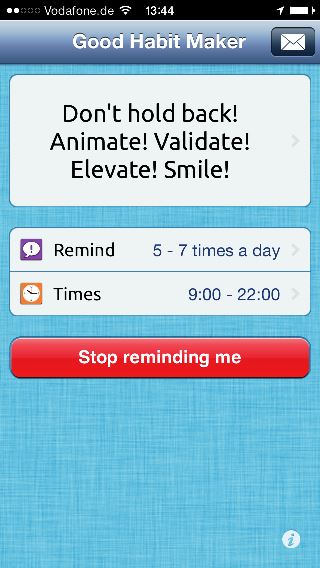
OK. The Good Habit Maker is a nice little (free) app that does only one thing: at pre-selected intervals over the day, it’ll push one sentence to your smartphone´s screen, e.g. your personal change mantra. Helps a lot to bring your mind back to what you want to achieve during busy schedules.

Grid Diary AppThe app Balanced is a little more refined, it´s a sort of task manager. You can enter specific tasks that you want to accomplish, and the quantities/intervals you intend to fulfill (e.g., “watch a TED talk once a week”). The app will then continuously remind you to complete those tasks until they are done. It also keeps track of you levels of completion and timeliness. There´s a demo version that is limited to a small number of tasks – the full version comes at $ 2.99.

And finally, the Grid Diary: as the name suggests, it´s a nice and clean diary app. The useful twist: you can pre-select (or enter your own…) specific questions. So instead of having to think about what to write each and every evening, the app will make you respond to the prompts that you specifically chose to be given. By way of example, I use it as a gratitude journal, which is one of the pre-eminent interventions in Positive Psychology. It´s free but offers some in-app purchases.

Enjoy! Keep it going! And for some extra energy, power up your Sisu!

What makes Life meaningful? 3 Answers for You…

My Direction

One of the letters in Martin Seligman´s PERMA outline of Positive Psychology is M for Meaning (in life). In this post, I would like to point you to three outstanding resources on that topic:

First, check out Maria Popova´s fabulous Brain Pickings site – in this case her essay on Viktor Frankl´s Logotherapy and his conception of meaning in life.

Ultimately, man should not ask what the meaning of his life is, but rather he must recognize that it is he who is asked. In a word, each man is questioned by life; and he can only answer to life by answering for his own life; to life he can only respond by being responsible.

Second, you might want to have a look at Michael Steger´s TEDx talk – where he explains why and how meaning in life can be a matter of life an death; and what role relationships play in that piece.

And third, here´s a link to a website I discovered recently which contains a psychological test that can help you to find your personal “purpose pattern” (at work). It was created by a team around Aaron Hurst, author of The Purpose Economy. I found that some familiar MAPP faces are also associated with that project, namely “Chief Giving Officer” Adam Grant, and Job Crafting Authority Amy Wrzesniewski.

Enjoy!