Want to be the Boss? Be Happy, Science says, and you´ll be a Good Leader

Happy BossFor a moment, think about a leadership person (a.k.a. boss) in your life that you really liked working for. How could that person be described, what kind of personality did he/she convey? Was he/she more the grumpy moaner – or rather an upbeat “Sunday´s child”?

Turns out that this question is not only about likeability but also about leadership effectiveness. In a recent meta-analysis* published in The Leadership Quarterly titled Is a happy leader a good leader? A meta-analytic investigation of leader trait affect and leadership, Dana L. Joseph and her colleagues found that – broadly speaking – happier leaders also tend to be more effective leaders. In the words of Joseph and her colleagues:

Our analyses show that leader trait affectivity, particularly leader trait positive affect, plays a significant role in predicting leadership criteria.

A happy boss is a good boss.

They also find that the relationship between leader happiness and effectiveness may not be a direct one. Rather, it seems that happy bosses predominantly engage in a special leadership style that has been coined transformational leadership. As opposed to more traditional leadership styles (telling people what to do and controlling them; management by objectives etc.), transformational leadership, according to Joseph et al., consists of the following dimensions:

  • idealized influence, or the extent to which a leader displays conviction and behaves in a way that causes followers to identify with him/her;
  • inspirational motivation, which involves communicating optimism and challenging followers to meet high standards;
  • intellectual stimulation, or the extent to which a leader takes risks, challenges assumptions, and encourages follower creativity;
  • and individualized consideration, which is characterized by follower mentoring, attending to follower needs, and listening to follower concerns.

Now, does that sound like the behavior of a boss we´d all like to work for? My answer is a clear yes. And it predominantly starts with that person´s happiness.

* A special type of study that statistically aggregates previous study results to provide an overview of a specific branch of research.

7 Research Articles linking Happiness and Subjective Wellbeing to Performance and Success Measures

One of the most stunning ideas from the field of Positive Psychology is that happiness (and other forms of positive affect) are not only a consequence, but also a prerequisite for success and performance in organizations. Yet, to be honest, the empirical evidence is still very scarce. Especially the link between employee happiness and performance on the organizational level is still uncharted territory to a great extent. Yet, some things are out there – here´s a little compilation for you.

  1. The benefits of frequent positive affect: does happiness lead to success
  2. Happiness at work
  3. The moderating role of employee positive well being on the relation between job satisfaction and job performance
  4. Psychological well-being and job satisfaction as predictors of job performance
  5. The Happy-Productive Worker Thesis Revisited
  6. On the role of positive and negative affectivity in job performance: A meta-analytic investigation
  7. Well-being and organizational performance: An organizational-level test of the happy-productive worker hypothesis

Happiness_Success

Study Alert: The Positive Psychology of Cat Content

Mappalicious - Cat ContentI knew it! I kneeeeew it!!! If millions and millions of people do something, there must be a good reason. Even if those people don’t know exactly why they are doing it.

Do you fancy watching cat content on the Internet? I do. Well, I have two real cats myself, but still Iindulge in a feline YouTube spree at least once a week. Makes me smile, makes me happy. Love it…

Researchers at Indiana University now surveyed some 7.000 people on their behavior of watching cat content online. Here’s what they found (excerpts taken from the study report on the University’s homepage):

  • They were more energetic and felt more positive after watching cat-related online media than before.
  • They had fewer negative emotions, such as anxiety, annoyance and sadness, after watching cat-related online media than before.
  • They often view internet cats at work or during studying.
  • The pleasure they got from watching cat videos outweighed any guilt they felt about procrastinating.

That’s it! Cat content = happiness. For those that now go “Duh…” because they already knew: At least, now we have science on our side…

Study Alert: The Smell of Happiness 

If you are somewhat like me, you don’t really fancy smelling other people’s sweat. But if – for whatever reason – life puts you in a situation where you have to: Make sure it’s the sweat of happy people. Why?

Because it just might make you happy (at least: happier), too. A recent study titled A Sniff of Happiness finds that people who are exposed to the body odors of happy people tend to show increasing signs of happiness themselves, e.g., they smile more compared to the time before that “exposure”.

In the words of the researchers:

We observed that exposure to body odor collected from senders of chemosignals in a happy state induced a facial expression and perceptual-processing style indicative of happiness in the receivers of those signals. Our findings suggest that not only negative affect but also a positive state (happiness) can be transferred by means of odors.

So if you are a happy person: Please throw away that antiperspirant. Make the world a more joyful place… 😉

Crying for Joy on Father´s Day (Little Guru series)

Nico - Little GuruI have to admit: I weep easily. But then, I mostly cry for joy. Very frequently, my heart just overflows with love or gratitude – and my eyes seem to be the only outlet.

Today is a bank holiday in Germany, so unlike most workdays, I sat down to have an unhurried breakfast with my wife and the Little Guru. Towards the end, they played my wife´s favorite song on the radio, so she got up, went from the dining room into the living room and started to dance playfully. Of course, the Little Guru wanted to join in.

Ten seconds later, they were holding hands and jumping around in circles, laughing and shouting boisterously. All of that time, the bright morning sun entered the room through our large garden windows, lighting up their faces, giving them an almost angelic complexion.

I watched them for a minute or so – and that´s when I cried again. I am lucky.

Happy Father´s Day to all of you!

Mindful Farting: 5 Easy Tips To Get Started

First things first: in case you´ve been reading my blog in the past, you will know that I´m a big fan of mindfulness and mindfulness exercises. If you´re here for the first time, let me tell you: I love mindfulness. There, I´ve said it. Just in case…

What I don´t like at all is the fact that there´s a developing “industry” around this truly valuable topic, taking it, and turning it into just another of those (marketing) fads that are all to common in the multi-billion dollar self-help business. I was inspired to write the post you´ll find below after reading the piece “The Muddied Meaning of Mindfulness” in the New York Times. The author tracks the aforementioned (d)evolution and concludes that by now, “mindfulness seems perilously close to the doggerel from the same playbook that brought us corny affirmations, inner children, and vision boards“.

To “prove” the point that a lot of what is written on mindfulness these days may actually be fluff talk, I typed “mindful eating” into the Google search bar, took the first “listicle” type article I could find, and basically just erased two or three sentences. Then, I exchanged all those words relating to the realm of food with expressions from the realm of digestion, most notably flatulence. Result: the meaning of the piece basically stayed the same – more or less. But do judge for yourself… 🙂

Please note: I do not intend to offend any directly with this post. Neither the Huffington Post, nor the writer who crafted the original piece. In this case, they are just a victim of the superior Google rank. And most certainly, I´m not opposed to mindful and healthy eating habits.

Instead, please take this article as a reminder to be mindful about mindfulness. Or just a bad case of German humor…

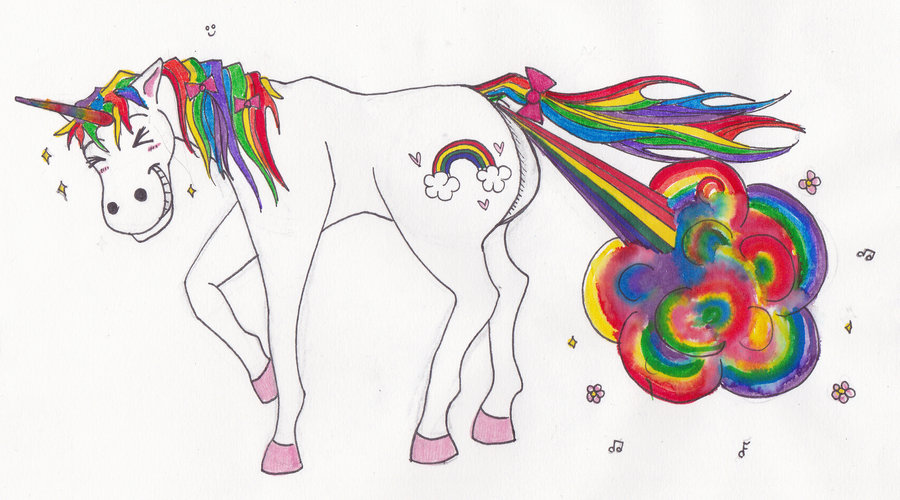
rainbow_farting_unicorn_by_ahiruluver602-d4rdxgxMindful Farting: 5 Easy Tips To Get Started

From how not to fart when you are pregnant, to the endless lists of the latest must-have superfoods, discussion about healthy farting tends to focus on what we fart. 

Much less attention is paid to the question of how we fart. 

Yet a growing body of research suggests that changing our attitudes and practices around farts and farting rituals may be every bit as important as obsessing over what it is we actually squeeze out of our bowels. Mindful farting (also known as intuitive farting), a concept with its roots in Buddhist teachings, aims to reconnect us more deeply with the experience of farting — and enjoying — our gasses. Sometimes referred to as “the opposite of diets,” mindful farting is based on the idea that there is no right or wrong way to fart, but rather varying degrees of consciousness about how we are farting and why. The goal of mindful farting, then, is to base our farts on physical cues, such as our bodies’ signals, not emotional ones — like farting for comfort. 

The idea was featured in a New York Times article last year, in which journalist Jeff Gordinier visited a Buddhist monastery where practitioners were encouraged to fart in silence, and sniff every bit of gas as they explored its tastes, textures and smells in minute detail. The article inspired a somewhat skeptical response from our own Robin Shreeves, who noted that in her household full of young boys, the notion of farting in silence seemed like mission impossible, and might even be detrimental, given that mealtimes are often when the family gets a chance to actually converse.

But mindful farting doesn’t have to be an all-or-nothing affair.

In fact, as the New York Times article stated, there are plenty of ways to work mindfulness into your daily flatulence habits without the need to become a fully robed monk, or grind on a tiny fart for three days straight.

As a registered dietitian, I am a firm believer that finding ways to slow down and fart intentionally is all a part of developing a truly healthy flatulence culture. And some early research into mindful farting would seem to back this up. One study, for example, tracked more than 1,400 mindful farters and showed them to have lower body weights, a greater sense of well-being, and fewer symptoms of farting disorders.

But mindful farting will only work for you can make it compatible with your lifestyle. 

Here are some of my favorite tips to introduce mindfulness to fart-times in an easy, accessible fashion.

Fart slower. Farting slowly doesn’t have to mean taking it to extremes. Still, it’s a good idea to remind yourself, and your family, that farting is not a race. Taking the time to savor and enjoy your gasses is one of the healthiest things you can do and you’ll probably find yourself noticing flavors you might otherwise have missed. If you have young children, why not try making a game of it — who can fart their farts the longest?

Savor the silence. Yes, farting in complete silence may be impossible for a family with children, but you might still encourage some quiet time and reflection. Again, try introducing the idea as a game — “let’s see if we can fart for two minutes without talking”.

Silence the phone. Shut off the TV. Our daily lives are full of distractions, and it’s not uncommon for families to fart with the TV blaring or one family member or other fiddling with their iPhone. Consider creating family fart-time, which should, of course, an electronics-free zone. I’m not saying you should never fart in front of the TV, but that too should be a conscious choice that marks the exception, not the norm. 

Pay attention to flavor. The tanginess of a lemon, the spiciness of arugula, and the crunch of a pizza crust— paying attention to the details of our farts can be a great way to start farting mindfully. After all, when you fart on the go, it can be hard to notice what you are even sniffing, let alone truly savor all the different sensations. If you are trying to introduce mindful farting to your family, consider talking more about the flavors and textures of the gasses. Ask your kids what the avocado smells like, or how the hummus feels. And be sure to share your own observations and opinions too. (Yes, this goes against the farting in silence piece, but you don’t have to do everything at once.)

Know your gasses. Mindfulness is really about rekindling a relationship with our farts. Even when you have no idea where the gasses you are blowing have come from, try asking yourself some questions about the possibilities: Who grew this? How? Where did it come from? How did it get here? Chances are, you’ll not only gain a deeper appreciation for your farts, but you’ll find your digestion habits changing in the process, too. 

Like I say, mindful farting does not have to be an exercise in super-human concentration, but rather a simple commitment to appreciating, respecting and, above all, enjoying the farts you blow every day. It can be practiced with salad or ice cream, donuts or tofu, and you can introduce it at home, at work, or even as you fart on the go (though you may find yourself doing this less often).

And while the focus becomes how you fart, not what you fart, you may find your notions of what you want to digest shifting dramatically for the better, too.

Picture Source

The world of the happy is quite different from the world of the unhappy.

It´s always a crime to divorce a Wittgenstein quote from its context – but I´ll do it anyway:

Wittgenstein - HappyWhat we can definitely say today is that happy people see the world differently – and I mean literally, not metaphorically. When looking at the same visual information, happy people seem to see more of the scenery, they have a different scope. And this scope, in turn, seems to enlarge their mental scope, thereby transferring the broadening quality to the metaphorical level – which, at the end of the day, makes happy people e.g., more creative. If you´d like to know more, please have a look at these articles.

Psychology is still ruled by the Disease Model. But Positivity and Strength-Orientation are gaining Ground

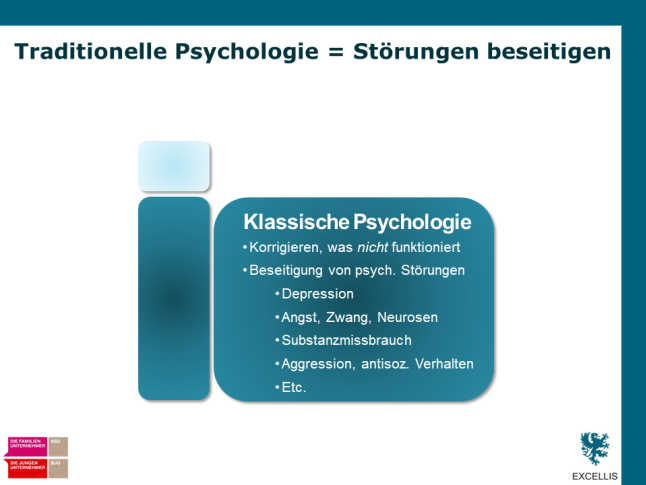
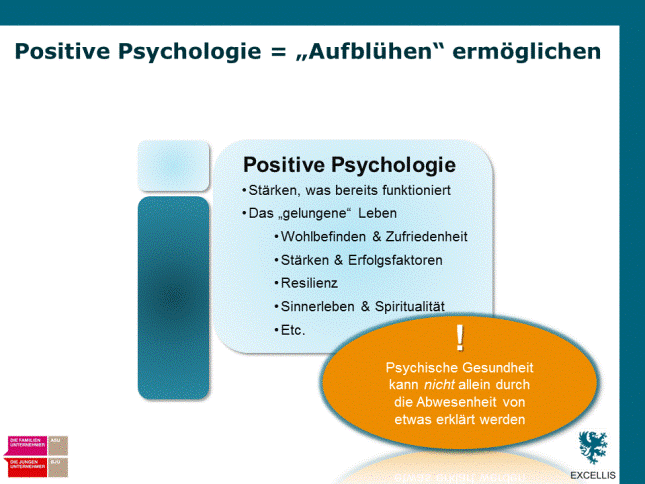
When I talk about Positive Psychology in Germany, I also talk about the necessity for this rather recent branch of research and practice (see the slides below), referring to the fact that most psychological research is centered around a disease model, thereby concentrating on mental illness, its antecedents, and cures – just as Martin Seligman and Mihály Csíkszentmihályi propose in their seminal article Positive Psychology: an Introduction.

Today, I wanted to check if this is really true – and if the onset of Positive Psychology at this millennium has does anything to change that conjectured imbalance. Therefore, I went to Google Scholar and searched for articles which titles` contain either the words depression, anxiety, happiness, or life satisfaction. For a first round, I limited the search to articles that were published between 1900 and 1999. For a second round, I counted all the articles that have been published afterwards. Here´s what I´ve found:

Depression Happiness Graph

A first stunning finding* is the fact that, in the last 15 years, more papers were published than in the previous 100, no matter on what subject. Whether that is a desirable development with regard to quality and impact remains to be seen.

But more importantly, the imbalance between research focusing on desirable vs. undesirable states is clearly visible in the chart. In the 20th century, papers focusing on depression outnumber those focusing on happiness by a factor of 13. For anxiety and life satisfaction, it´s factor 10.9.

Now what has changed over the last 15 years? The answer is: Positive Psychology has made quite an impact: an increasing publication rate in this branch of psychology results in a (at least slightly) more balanced ratio. Depression outnumbers happiness by “only” 5.7, anxiety outnumbers life satisfaction by “only” 5.8.

I´ve put the world “only” in parentheses since that still is very far away from a sort of equilibrium. But progress has been achieved. And there will be more…

Traditional Psychology  Positive Psychology - Dr. Nico Rose


* Of course, the overall number of publications is much higher. But I suppose that counting papers containing a specific word in the title is a pretty decent proxy for the general writing activity in a sub-branch of research.

March 20 is International Happiness Day! Join our virtual Conference feat. +30 Positive Psychology Experts

International_Happiness_Day_2015Ever since 2012, March 20 is UN´s International Happiness Day. All around the world, people will celebrate and host events to educate their fellow human beings on all things happiness, well-being, and flourishing.

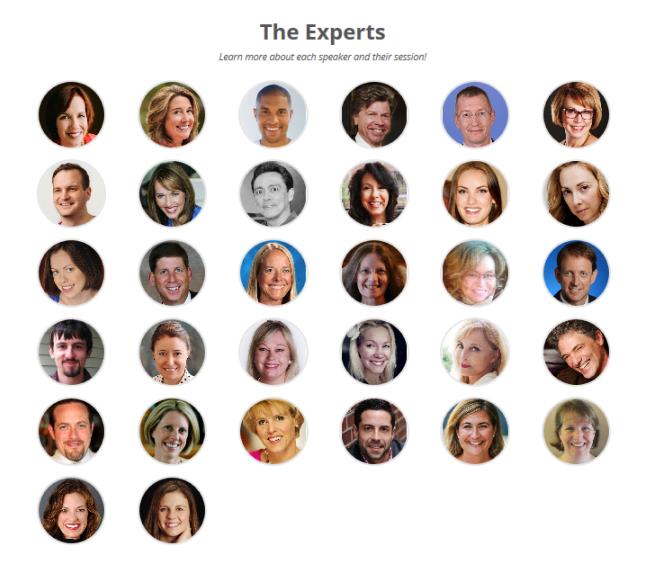
And I´m in as well – as part of a Virtual Happiness Conference. 32 fellow Penn Mappsters were interviewed on their favorite Positive Psychology subject, among them a lot of people you might already know because they were featured on Mappalicious in one way or the other, e.g. Emilia “Queen of Sisu” Lahti. All in all, there´s more than 24 hours of video material available.

All content will be online for free until March 26. After that, you can purchase the videos. Every cent will go to the Christopher Peterson Memorial Fellowship which helps future students to afford attending Penn´s MAPP program.

As for my part: I was interviewed by the fabulous Lisa Sansom on the role of Positive Psychology in coaching, the subject of Self-Permission, and the “German way” of Positive Psychology. This is the link to the conference site.

Enjoy – and please share to good news!

International Happiness Day Experts