3 Questions for Emily Esfahani Smith, Author of “The Power of Meaning: Crafting a Life That Matters”

emily_esfahani_smithEmily Esfahani Smith is a writer and fellow Penn MAPP alum. She writes about culture, relationships, and psychology. Her writing has appeared in the Wall Street Journal, New York Times, The Atlantic, and other publications. A few days ago her first book, The Power of Meaning: Crafting a Life That Matters, was published. Today, she took some time to talk about her work on Mappalicious.

Emily, in your book, you propose there are four pillars of a meaningful life: belonging, purpose, transcendence, and storytelling. I´ve already come across the first three while studying Positive Psychology, the last one seems to be a very unique angle. So what´s the story with storytelling?

When people say their lives are meaningful, it’s because three conditions have been satisfied, according to psychologists—they feel their lives matter and have worth; they feel their lives are driven by a sense of purpose; and they believe their lives are coherent or comprehensible. Storytelling relates to that third prong of meaning, coherence. Storytelling is the act of taking our disparate experiences and weaving them into a whole. Rather than seeing their experiences as random or disconnected, people who feel their lives are meaningful see their experiences as part of a narrative that explains who they are and how they got to be that way. Another word for storytelling is sense-making—when we tell stories, we’re really trying to make sense of our experiences.

One of the people I interviewed for my book, for example, told me that experiencing adversity as a child ultimately made him a more compassionate person—that’s the story he tells about his adversity; that’s how he makes sense of it. But storytelling isn’t just about understanding ourselves more deeply, it’s also about understanding others. When we watch movies or read novels or listen to a friend’s story, we’re ultimately gaining more wisdom and perspective about what it means to be human.

power_meaning_esfahaniIn my day job, I´m heading a department in a multinational corporation. Therefore, I take special interest in the application of Positive Psychology in organizations. Do those four pillars you describe also apply to meaning in work – or are there additional aspects leaders should consider when thinking about their employees´ experience?

One of the most exciting trends of the last few decades has been the emergence of what I call “cultures of meaning” in institutions like corporations. Many companies are actively building cultures of meaning for their consumers and employees by relying on the four pillars of meaning.

A great example is the apparel brand Life Is Good, which sees its purpose as spreading hope and optimism around the world. It does this with its apparel, which has the words Life Is Good emblazoned on it. Many consumers have written to the company saying that its elevating message has helped them get through adversities and tragedies like cancer and losing loved ones. The leaders at Life Is Good have shared those stories with their employees, to show them that their work is making a positive impact on others. Life Is Good also has a non-profit arm that helps children facing adversities. When I spoke to several of the employees at the company—from a receptionist to a designer—they all told me that they are driven by the good that their company is doing in the world. So here, I see Life Is Good relying on the pillars of purpose and storytelling to create cultures of meaning.

It’s important for leaders to be aware of whether employees are experiencing their work as meaningful. Nothing engages or motivates employees quite like meaningful work—and research by Adam Grant suggests that doing meaningful work makes employees more productive, too (Adam´s interview on Mappalicious can be found here).

I feel my life is already pretty meaningful. I´m happily married and have two beautiful kids. Additionally, I can spend a lot of my time working on things I deeply care about and help other people. But I´m not so sure about the storytelling part. What are some steps I could take to enhance my experience of meaning in life via this pillar?

Storytelling requires reflection. I would recommend setting aside some time—maybe 15 minutes a day a few times a week—to either think or write about your life story. That may sound daunting or vague, but here are some specific things you can reflect on during that time.

1. Try dividing your life into chapters. How many chapters are there? What is the title or theme of each chapter? What makes each chapter unique? What chapters are yet to come? How many future chapters are there? What do you want the final chapter to say?

2. When you look back on your life, what were the turning points? What were the high points and the low points? How did those experiences change you? What did you learn from them? Are you still working to process them?

3. Reflect on the places in your life that played a formative role in your development—like where you grew up, perhaps, or where you went to college, or where you first met your husband or wife. While you’re thinking about these places, ask yourself: why were your experiences there so meaningful? How did they change you? What would your life have been life if you had grown up somewhere else or gone to a different school? What does it feel like being back in those places?

I’d like to add that storytelling is a pillar that takes work—sometimes we have to go over and over an experience hundreds of time before we can begin to make sense of it and understand how it fits into the broader arc of our lives. But it’s ultimately worth it, because that sense-making process brings us wisdom, resolution, and even a measure of peace.

Thank you, Emily, and best of luck with your book!

***********

For more info on Emily and her work, please check out her The Psychology Podcast, or recent features on The Psychology Podcast, Heleo and Virgin.
Staying Sane, Cavemen-Style

gorilla_laptopMankind is a smart bunch. We´ve learned how to put a man on the moon, how to build skyscrapers as high as mountains, and we have access to all the knowledge in the world via small devices in our pockets made of plastic, metal, and some microchips. We can travel back and forth between the continents in a matter of hours. We´ve developed sophisticated treatments for all kinds of human ailments, helping us to become as old as some of the trees. That´s impressive and utterly admirable.

Yet, all these upsides of modern life seem to take a toll on our bodies and minds. In most Western societies, the level of obese people is growing steadily, as is the pervasiveness of psychological disorders such as depression and anxiety-related conditions. Is this the price society has to pay for the comforts of the modern life? And more importantly:

Could we reverse these effects by turning to a more “primitive” lifestyle?

Here´s the thing: I´m sure, on the whole, we´re a lot smarter than our Neanderthalian ancestors. But being smart does not automatically lead to making smarter decisions. Let´s look at their way of life for a moment. Born in 1978, I´m not a contemporary witness – yet I´m an avid reader and watch a lot of documentaries. Here´s how I imagine life must have been for them:

  • They lived in tribes of several larger families with close bonds between the members of their group.
  • They had to toil hard in order to survive, but when their work was done (having enough food to sustain the tribe), they relaxed, played, created art, and made love.
  • The men hunted in small groups, sometimes for several days in a row. When doing so, they walked or even ran a double-digit mileage per day.
  • While chasing prey, they didn’t talk much. Instead, they focused on their immediate surroundings, the animals´ smells, sounds, and their tracks.
  • When the hunt was successful, they returned home, shared their game with everybody, and also shared their hunting lore by the fireside.
  • The women also walked long distances several time per week while searching for fruits and nuts. Some of them stayed home to take care of the tribe´s offspring. When not searching for food, they created tools, pottery, and clothing.
  • Whenever possible, they all slept long, especially in winter. They also took several naps over the course of the day whenever the environment was save.

Now let’s take this narration and transfer into more modern terms. What we have here are people who…

  • spend a lot of time with their friends and the ones they love (here´s some science on the psychological upsides of bonding);
  • finish the equivalent of a half-marathon three or four times a week (here´s some science on the psychological upsides of intense physical exercise);
  • spend most of their time in natural green environments (here´s some science on the psychological upsides of biophilia)…
  • …and practice an intuitive form of mindfulness while doing so (here´s some science on the psychological upsides of staying in the present moment).

Additionally, they…

Depression and anxiety as the body´s warning signs?

Compare this to what most Westerners are doing:

  • We eat too much food that we don´t have to struggle for.
  • We sit too much and walk too little.
  • We work insane hours, yet don´t sleep and play enough.
  • We spend too much time alone or among people we don´t really care about.
  • We get lost in cyberspace instead of staying with what´s at hand.
  • We focus too much on promoting ourselves instead of promoting the common good.

Put in simple terms, I think this is what our bodies are trying to tell us:

Hey man, you’re doing this wrong. You’re spending your time doing the wrong things, and I don’t feel safe and sound in these places you’re taking me. And where are the familiar faces that I love? But hey, I can’t explain this to you in a straight way, I don’t have words. That’s why I make you feel anxious and miserable. This is my wake-up call.

Let me close by saying that I don’t argue we should all return to an aboriginal lifestyle. I’m a city-boy all the way through. I like my work at the office, I love going out for dinner, and having a grocery store and a hospital in close proximity. But I also try to take care of myself and my body, I try to create meaning by helping people live more significant lives (e.g., via this blog…) – and ever since being married and having kids, I stay home a lot.

I guess, as ever so often, it comes down to finding the right balance.

Treating Yourself with Kindness: On Self-Compassion

For several decades, developing self-esteem in children and adults has been the holy grail of fostering healthy attitudes towards the self. Yet, starting in the early 1990s, criticism arose, pointing towards the absence of positive consequences of having high self-esteem, and highlighting several negative consequences, such as dismissing negative feedback or taking less responsibility for harmful actions. In an influential review article from 2003 titled Does High Self-Esteem Cause Better Performance, Interpersonal Success, Happiness, or Healthier Lifestyles?, Roy Baumeister and colleagues conclude:

We have not found evidence that boosting self-esteem (by therapeutic interventions or school programs) causes benefits. Our findings do not support continued widespread efforts to boost self-esteem in the hope that it will by itself foster improved outcomes.

In the same year, Kristin Neff from the University of Texas at Austin introduced a different kind of healthy attitude towards the self – which may be especially helpful in times of suffering, or when facing adversity: Self-compassion, rooted in the ancient Buddhist traditions of mindfulness and compassion, and Western adaptations such as Mindfulness-Based Stress Reduction (MBSR). In the words of Neff:

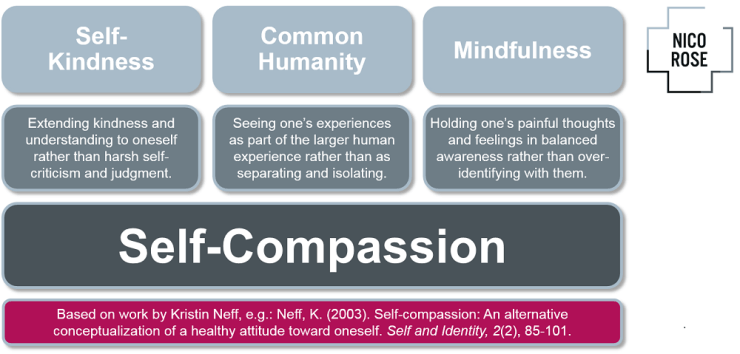
[…] When faced with experiences of suffering or personal failure, self-compassion entails three basic components: (a) self-kindness — extending kindness and understanding to oneself rather than harsh judgment and self-criticism, (b) common humanity — seeing one’s experiences as part of the larger human experience rather than seeing them as separating and isolating, and (c) mindfulness — holding one’s painful thoughts and feelings in balanced awareness rather than over-identifying with them.

self_compassion_framework_neu

Furthermore:

[…] Self-compassion may entail many of the psychological benefits that have been associated with self-esteem, but with fewer of its pitfalls. Self-compassion represents a positive emotional stance towards oneself, in that one extends feelings of kindness and caring toward oneself. It helps to motivate productive behavior and protect against the debilitating effects of self-judgment such as depression and anxiety. Self-compassion, however, is not based on the performance evaluations of self and others, or on congruence with ideal standards. In fact, self-compassion takes the entire self-evaluation process out of the picture […].

In the meantime, self-compassion has shown to be a valuable tool for personal development and fighting symptoms such as anxiety and depression. Long-form and short-form scales for measuring self-compassion have been developed, an effective training program has been devised, and a recent meta-analysis finds that fostering self-compassion effectively helps to alleviate several psychopathologies (please see links to research papers below. You can find out more about self-compassion (e.g., free exercises and training opportunities) via Kristin Neff´s homepage.

Some of the core papers on self-compassion (linking to PDFs):

Positive Psychology News Digest | No. 01/2017

mappalicious_news_digest_2017My favorite news and blog articles covering Positive Psychology and adjacent topics from (roughly) the last seven days.

New York Times: The Year of Conquering Negative Thinking by Lesley Alderman


New York Magazine: Living With Purpose Yields a Longer Life and Higher Income by Drake Baer


Guardian: From Groundhog Day to … Raging Bull? – films to inspire and uplift by Peter Bradshaw


New York Magazine: Small Things to Remember to Change Your Life for the Better by Melissa Dahl


Fast Company: How To Use Brain Science To Be Your Best Self In 2017 by Lydia Dishman


Greater Good Science Center: What Does a Compassionate Workplace Look Like? by Nir Eyal & Monica Worline


Harvard Business Review: To Recover from Failure, Try Some Self-Compassion by Christopher Germer


Psychology of Wellbeing: The Law of Diminishing Returns, Applied by Jeremy McCarthy


Fast Company: 10 Science-Backed Ways To Be More Positive In 2017 by Gwen Moran


Inc: 5 things science learned about happiness last year by Jessica Stillman


Greater Good Science Center: How to Reduce Rudeness in the Workplace by Jill Suttie


Wharton Knowledge: Why Mental Bandwidth Could Explain the Psychology Behind Poverty, no author

Lots of Good Luck for 2017!

Chimney Sweepers - Good LuckIn Germany, chimney sweepers are seen as symbols of good luck (as is some other countries, too) – especially rubbing one of the golden buttons of their traditional uniforms. Therefore, in the beginning of the year, they parade through the streets and give candy to children. Today, I was able to take this photo as a bunch of them were lining up for the local newspaper. That’s a lot of luck in one picture! 🙂

But then, if you don’t believe in lucky charms and would rather like to create your own luck, you might want to (re-)visit my 2014 TEDx talk on this beautiful subject.

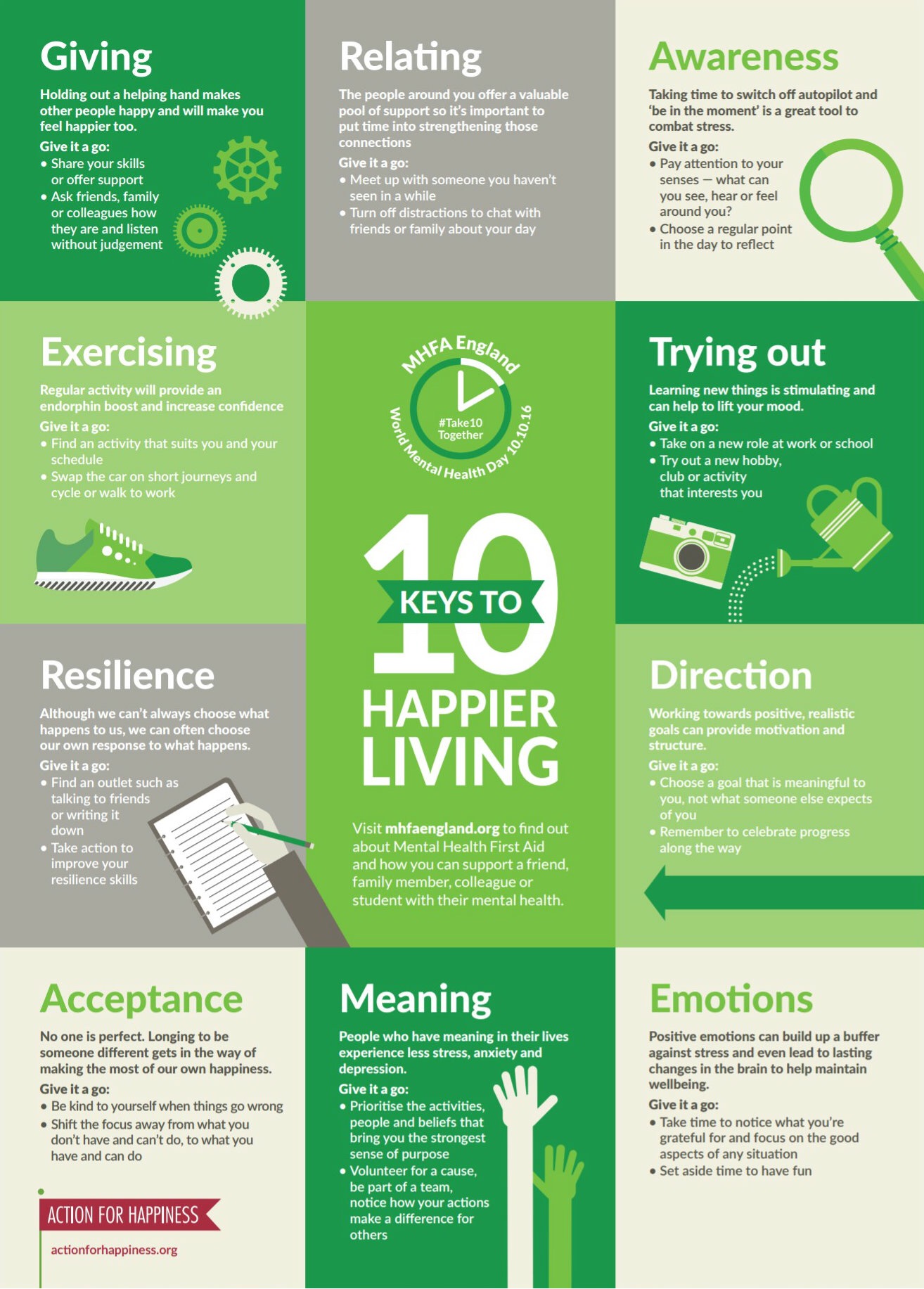
10 Keys to Happier Living [Infographic]

These are the the ten keys to happier living according to Action for Happiness, a UK-Based NGO backed by luminaries such as the Daila Lama and Sir Richard Layard –  focusing on disseminating knowledge on Positive Psychology to the general public and helping people to set up local meetings groups (among many other things). Please help to share the wisdom!

Action for Happiness 

Positive Psychology News Digest | October – December 2016

mappalicious_news_oct_dec_17My favorite pieces covering Positive Psychology and adjacent from the last three months.

New York Magazine: Success Depends on Your Personality More Than IQ by Drake Baer


New York Magazine: The 4 ‘Spaces’ Cities Need to Make People Happier by Drake Baer


New York Magazine: What Good Is Hope? by Drake Baer


Positive Prescription: Looking for Purpose? Ask Yourself These 5 Questions by Samantha Boardman


Huffington Post: Helping others is the key to longevity, study finds by Carolyn Gregoire


Greater Good Science Center: What Will the Theme of Your Life Be in 2017? by Kira Newman


New York Magazine: To Feel More Productive, Take a Break to Do Something Selfless by Cari Romm


New York Magazine: In 2017, Pursue Meaning Instead of Happiness by Esfahani Smith & Jennifer Aaker


Psychology Today: Applying Psychological Science to Meet Your Goals by Erlanger Turner


CNN: How to become more optimistic, no author


Bakadesuyo: Stoicism Reveals 4 Rituals That Will Make You Mentally Strong by Eric Barker


Guardian: Why time management is ruining our lives by Oliver Burkeman


Scientific American: One Skeptical Scientist’s Mindfulness Journey by Scott Barry Kaufman


New York Times: What the West Can Learn From Japan About the Cultural Value of Work by John Lanchester


Psychology Today: Why Wellbeing Is Harder Than It Looks by Michelle McQuaid (Interview with Peggy Kern)


Gallup: The Damage Inflicted by Poor Managers by Marco Nink & Jennifer Robison


Big Think: Compassion Is Weaved Throughout Our Nervous System, Researchers Have Found by Philip Perry


Fast Company: Try This Exercise In Radical Empathy To Minimize Conflict by Elisabeth Segran


CCARE: A Compassionate Resolution for this Season by Monica Worline & Jane Dutton


New York Magazine: Why Danes Think They’re Always The Happiest Country by Drake Baer


The Week: 4 ways to bring more meaning into your life by Eric Barker


Guardian: Are you too old to find success? by Oliver Burkeman


Atlantic: Praise is a consolation prize (about Carol Dweck’s work in growth mindset) by Christine Gross-Loh


Atlantic: Awesomeness Is Everything by Matthew Hutson


Guardian: Happiness depends on health and friends, not money, says new study by Phillip Inman


Washington Post: Leaders are more powerful when they’re humble, new research shows by Ashley Merryman


Psychology Today: Want Your Work to Flourish? Link Strengths and Goals by Ryan Niemiec


New York Magazine: To Be More Productive, First Figure Out Your Productivity Style by Cari Romm


Science Daily: People’s energy in the workplace is key to staff retention, no author


Greater Good Science Center: Is Your Empathy Determined by Your Genes? by Summer Allen


Psychology Today: The Happy Brain by Mark Banschick


Wall Street Journal: The perils of empathy by Paul Bloom


New York Times: How to Choose Happiness by Marie Kondo


Redlands Daily Facts: President Obama — our positive psychologist-in-chief: Guest commentary by Sonja Lyubomirsky


Gallup: What Strengths Tell Us About Men and Women by Jane Miller and Amy Adkins


Creativity Post: 3 Foolproof Ways to Prevent Work Burnout, Backed by Science by Emma Seppälä


Greater Good Science Center: Would the World Be Better Off without Empathy? by Jill Suttie


USA Today: Key to money happiness may be in how you spend it by Russ Wiles


Positive.News: Why now is the time for serious optimism by Seán Dagan Wood


Atlantic: Self-Control Is Just Empathy With Your Future Self by Ed Yong


Heleo: Beyond Grit: The Science of Creativity, Purpose, and Motivation (feat. Angela Duckworth & Adam Grant), no author


New York Magazine: It’s Possible to Train Yourself to Be More Optimistic by Drake Baer


Bakadesuyo: 4 Easy Tricks That Will Make You Productive by Eric Barker


APA: Motivate Employees By Supporting Their Autonomy by Christopher Budnick


Psychology Today: Thinking Errors in Depression by Neil Burton


Greater Good Science Center: How to Only Do Things You Actually Want to Do by Christine Carter


Psychology Today: How to Remain Optimistic Through Change by Susanna Halonen


Quartz: Can money buy happiness? by Catherine Jansson-Boyd


Psychology Today: Is Positive Psychology Proven? (Interview with my Capstone advisor Margaret “Peggy” Kern) by Michelle McQuaid


Harvard Business Review: How to Bring Mindfulness to Your Company’s Leadership by Megan Reitz & Michael Chaskalson


New York Magazine: To Be Happier, Do One Creative Thing Every Day by Cari Romm


Greater Good Science Center: Why Is It So Hard to Make Positive Changes? by Jill Suttie


Guardian: Reasons to be cheerful: how putting other people first will make you happy by Dan Ariely


New York Magazine: The Chinese Word for Anger Shows the Best Way to Get Mad by Drake Baer


Guardian: Why rewards can backfire by Oliver Burkeman


Science for Work: Trust: does it impact team performance… or not? by Wendy Hirsch


Psychology Today: Can We Simplify Wellbeing? (Interview with Aaron Jarden) by Michelle McQuaid


Psychology Today: The Impostor Syndrome and How To Handle It by Adam Molinsky


World Economic Forum: Do you trust your boss? Your answer may depend on where you live by Joe Myers


Wall Street Journal: Civility at Work Helps Everyone Get Ahead by Christine Porath


World Economic Forum: 10 companies that are great at empathy by Stéphanie Thomson


New York Times: Actually, Let’s Not Be in the Moment by Ruth Whippman


New York Magazine: Yes, Quitting Facebook May Make You Happier by Drake Baer


Psychology Today: Can You Be Vulnerable at Work? by Megan Dalla-Camina


Center for Positive Organizations: For a better workplace, make first moments matter feat. Jane Dutton


Harvard Business Review: If You Can’t Empathize with Your Employees, You’d Better Learn To by Annie McKee


Guardian: The pursuit of happiness: could a ‘happy city index’ end Bristol’s blues? by Arit Niranjan


The Positive Organization: Repairing Relationships at Work by Robert Quinn


New York Times: How Exercise Might Keep Depression at Bay by Gretchen Reynolds


Greater Good Science Center: How the Growth Mindset Can Increase Cooperation by Alex Shashkevich


Psychology Today: 7 Ways to Be Awe-Inspired in Everyday Life by Andy Tix


Psychology Today: Neuroscience Research Shows How Mood Impacts Perception by Susan Krauss Whitbourne


New York Magazine: How to (Kind of) Master Your Neuroticism by Drake Baer


New York Magazine: People Really Are Happier When the Sun Is Out Longer by Drake Baer


Psychology Today: Positive Thinking? Overrated by Samantha Boardman


Entrepreneur: 11 Habits of Truly Happy People by Travis Bradberry


New York Magazine: Power Reveals Who You Really Are by Melissa Dahl


Creativity Post: LinkedIn + Positive Psychology: Applying Science To The Way We Work by Stephanie Harrison


Huffington Post: Can You Create Positive Changes From The Bottom Up? (Interview with Chris White) by Michelle McQuaid

Greater Good Science Center: Five Science-Backed Strategies to Build Resilience by Kira Newman


Psychology Today: Positive Emotions and Wellbeing by Marianna Pogosyan


New York Times: The end of Relaxation by Sadie Stein


Huffington Post UK: Have More Conversations That Matter by Mark Williamson


APA.org: Growth after Trauma by Lorna Collier


Guardian: The placebo effect: is there something in it after all? Steve Connor


New York Magazine: Empathy Is Nice, But It’s Not Exactly Necessary by Melissa Dahl


New York Times: Behind Our Anxiety, the Fear of Being Unneeded by The Dalai Lama & Arthur Brooks


New York Post: Are Mormons the happiest people in America? by Mackenzie Dawson


New York Times: Nudges That Help Struggling Students Succeed by David Kirp


Vox: The myth of self-control by Brian Resnick


Psychology Today: How to Have a Positive Powerful Presence by Marcia Reynolds


Psychology Today: Why Don’t We Trust Each Other More? by Nan Russell


Psychology Today: Emotions and Rationality in Leadership by Eyal Winter


New York Magazine: 3 Ways to Get Over ‘Status Quo Bias’ at Work by Drake Baer


Forbes: The Psychology Of Professional Purpose: How To Follow Your Calling by Caroline Beaton


Psychology Today: The Happiness Myth: Why the pursuit of Happiness will make you miserable by Atalanta Beaumont


Atlantic: How to Build a Happier Brain by Julie Beck


Guardian: Want to ‘train your brain’? Forget apps, learn a musical Instrument by Mo Costandi


New York Magazine: By the Way, You Don’t Have to Stop Power Posing by Melissa Dahl


Psychology Today: 3 Fascinating Discoveries About Laughter by Todd Kashdan


Quartz: Scientists explain how happiness makes us less creative by Ephrat Livni


Quartz: Google’s former happiness guru developed a three-second brain exercise for finding joy by Lila MacLellan


The Positive Organization: The Choice to be Transformational by Robert Quinn


New York Magazine: Want to Make Better Decisions? Try ‘Temptation Bundling’ by Jesse Singal


Pursuit (University of Melbourne): Positive Psychology much more than Happyology by Katerine Smith (Interview with my MAPP Capstone advisor Peggy Kern)


Quartz: The Japanese practice of ‘forest bathing’ is scientifically proven to improve your health by Ephrat Livni


Quartz: Positive psychology is rooted in the radical idea that you are not a problem to fix by Tim Lomas


Guardian: Our children are paying a high price for society’s vision of success by Tim Lott


Forbes: Five Behaviors Of People Who Are Happy At Work by Rebecca Newton


GQ: The World’s Happiest Man Wishes You Wouldn’t Call Him That by Michael Paterniti


Psychology Today: The Secret to Achieving Your Dreams No One Tells You About by Emma Seppälä


Mindful.org: How to Free Yourself from Your Personal Stories by Bob Stahl & Steve Flowers


Greater Good Science Center: People Who Trust Technology Are Happier by Deborah Yip


Heleo: Nir Eyal and Monica Worline on Why Cultivating Compassion is Crucial for Success in Business, no author


Science Daily: In the workplace, incivility begets incivility, new study shows, no author


BBC: School league tables ‘should show well-being’ by Sean Coughlin


New York Magazine: A Little Loneliness Can Be a Very Good Thing by Melissa Dahl


Psychology Today: Stoic Truths for a Digital World by John Sean Doyle


The Conversation: Can money buy you happiness? It’s complicated by Cathrine Jansson-Boyd


Inc: The Negative People in your Life are literally Killing you by Jessica Stillman


New York Times: The Art of Making (and Not Making) Plans by Verena von Pfetten


Fast Company: Science-Backed Ways To Build Confidence When You Feel Like You’re Out Of Your League by Stephanie Vozza


Huffington Post: In Defense of Doers by Chris White


Scientific American: Depressed? Do What You Love by Daisy Yuhas


Yahoo Finance: 99 Percent of Employees With High Well-Being and Organizational Support Say Their Employer Is a Good Place to Work, no author


New York Magazine: A Smart Sense of Humor Helps People Survive Being Alive by Drake Baer


Bakadesuyo: This Is How To Unlock Meaning In Life: 4 Proven Secrets by Eric Barker


Greater Good Science Center: How to Teach Happiness at School by Ilona Boniwell


New York Times: Teaching Your Child Emotional Agility KJ Dell’Antonia


Harvard Business Reciew: How Microsoft Uses a Growth Mindset to Develop Leaders by Carol Dweck & Kathleen Hogan


Forbes: How To Train These Six Senses Of Happiness by Jessica Hagy


Psychology Today: The Subtle but Very Real Human Costs of Reorganizations by Victor Lipman


Psychology Today: The Science of Accomplishing Your Goals by Ralph Ryback


Psychology Today: The Top 3 Insights of Highly Innovative Leaders by Emma Seppälä


Creativity Post: You Can’t Clone Talent and Wisdom by Steve Tobak


Psychology Today: How Leaders Can Bring Calm to Chaotic Organizations by Ray Williams

Mappalicious - Positive Psychology news Digest