Yesterday, Fulfillment Daily, a website featuring science-backed information on the good life (a.k.a. Positive Psychology) was launched. I´m going to be a regular contributor. Here, you´ll find my first piece on the psychological upsides of dancing…
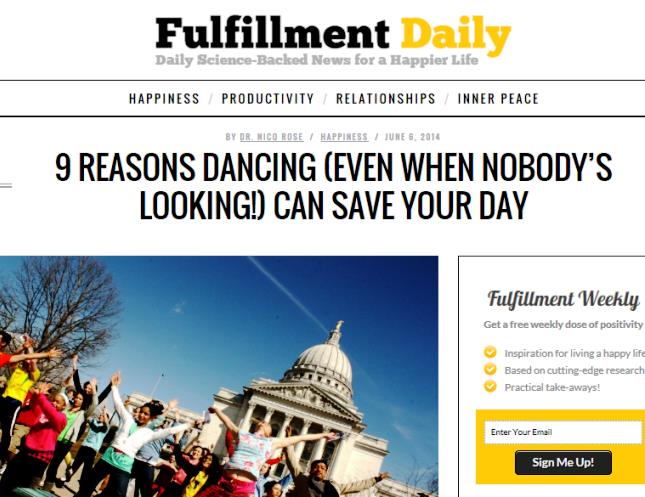
Yesterday, Fulfillment Daily, a website featuring science-backed information on the good life (a.k.a. Positive Psychology) was launched. I´m going to be a regular contributor. Here, you´ll find my first piece on the psychological upsides of dancing…
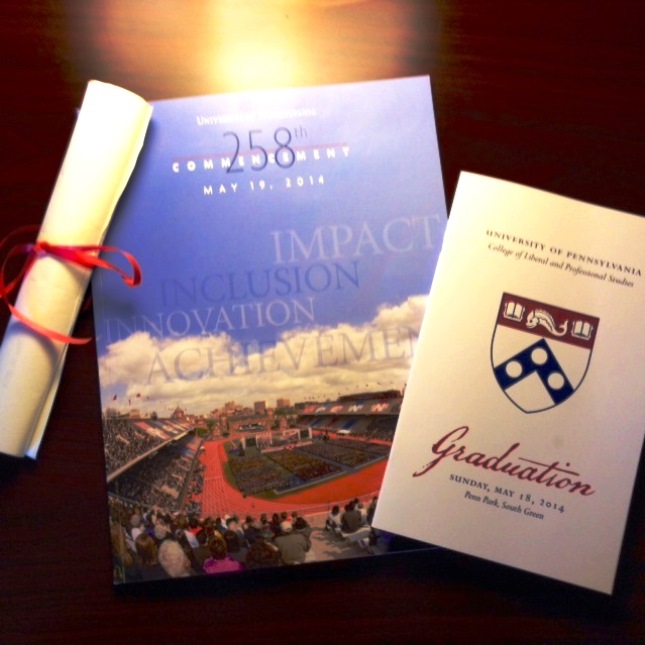 After each on-campus period of the MAPP 2013/14 program, we were asked to write a journal entry, mostly in order to reflect on important insights from the days before. After the final onsite in May, we were also asked to come up with a list of “eureka moments“, tiny bits of knowledge we would like to pass on to future Mappsters so as to help them to make the best of their experience at Penn.
So here´s my list. Please keep in mind that this is my list. The list of a German trying to balance a full-time management job, several sidelines, plus having a family, with successfully making it through a wonderful but very demanding master´s program that entails regular intercontinental flights. So the list of my beautiful classmates could look entirely different. But I would expect some overlap at least…
*That´s (typically, but not necessarily…) a person of the opposite sex you love almost as much as your actual significant other. Just without the sex thing.
** That´s a sophisticated term for “Why should I really read ‘The Death of Ivan Ilych’ when there´s several superb executive summaries on the www?
*** I mean really good ones. German, Suisse, or Belgium brands. Hershey´s fine – but it´s not the real deal.
 Want to say thank you to somebody and don´t know how? Do not fear, for Gratitude Bucket is with you! Gratitude Bucket was created by Zack Prager, a fellow MAPP alum. It´s an easy-to-use website that let´s you create a personal “gratitude space” for a specific person where you (and all the people you invite…) can openly express your gratitude and thereby share it with the world. E.g., this is a bucket for “Sensei” Esa Saarinen after he was injured with a knife earlier this year…
Why should you make another person happy by expressing gratitude? Because it´s one of the most accessible pathways to your own happiness!
I´m excited! On June 15th, a new website will launch. It´s name: Fulfillment Daily. What it says on their website: Fulfillment Daily is a place to get science-backed inspiring news to benefit your own life, inspire others, and, ultimately, contribute to uplifting all of society. We envision a world in which everyone has access to the science of fulfillment.

Among the regular contributors will be some top experts in the field of Positive Psychology. And … um … well … me. The project´s founder is Emma Seppälä, Associate Director at Stanford´s Center for Compassion and Altruism Research and Education. Among the group of writers are Scott Barry Kaufman, author of Ungifted: Intelligence Redefined, Emilia Lahti, Queen of Sisu, and Wharton´s Adam Grant, author of Give and Take. How I managed to be among this group of magnificent people? I don´t know. The Lord moves in mappalicious ways…
You can also follow Fulfillment Daily on Facebook and Twitter.
 If you´ve visited Mappalicious before, by now you will probably know who Esa Saarinen is – as I´ve written about his work several times. During his MAPP lecture in December 2013, he also initiated us to a slightly more informal area of his teachings: the 007 philosophy of life. Unfortunately, that day Wharton´s recording equipment didn´t work that well – so there´s no account of that lecture (and I´m a lazy note-taker…). Hence, I´ll give you my own – heavily Positive Psychology influenced – interpretation of his “theory”, mixed with the bits and pieces I do remember. As a philosopher, I think Esa would approve of this method. You can see the overview in the following picture:

James Bond is always “cool” – at least that´s the impression he makes on other people. He focuses on the situation at hand and the overarching goal of his mission and never gets sidetracked, except for the occasional tête-à-tête – but even those often serve a purpose, e.g., irritating one of the evil guys. At the end of the day, this is a lesson about mindfulness.
Bond is not much of a planner. He makes up his mind and improvises a lot of his moves on the spot, relying on his wits and physical abilities. He knows that the life as a super agent is full of surprises and events that one cannot really prepare for. Therefore, he sticks to a few big goals and decides on the next-best move “then and there”.
James Bond never questions his abilities, he never falters or hesitates. While a real-life person cannot (and maybe shouldn’t…) be equipped with an equal level of self-confidence, this is probably a lesson about self-efficacy, the “power of believing you can”. Self-efficacy is the scientific version of Henry Ford´s aphorism: “Whether you think that you can, or that you can’t, you are usually right.”
When in desperate straits, Bond always has one more trick up his sleeve, usually a tiny gadget given to him by the armorer “Q”. Seen through the lens of Positive Psychology, I think this part refers to the very unique set of signature strengths that we all have – and that we should rely on when to going gets tough. Additionally, it shows that other people matter. Even a lone wolf like Bond needs other people´s support at times.
James Bond understands that style is mostly about simplicity. Similar to the real-life George Clooney, he´s always dressed and groomed extremely well – which means they stick to time-tested essentials. The suit, the hairdo, the car, the handgun, the drink – they all seem to say: Don´t get carried away by fashion, don´t get lost in unnecessary details – no frills. This is also a lesson on efficiency: Bond knows that sticking to certain defaults is the most intelligent way of avoiding unnecessary decision-making – thereby saving up mental capacity for more precarious moments in life than choosing what to wear for dinner.
I think this point has a lot to do with the “connecting the dots”-part of Steve Job´s Stanford Commencement speech. Life can only be lived forward, but the sense-making happens looking backward. Hence, we have to embark on the journey without necessarily knowing where it will end – or what it all means. We have to get moving. Anyway. Otherwise, we won´t even make it to the Bahamas.
Now, this may be the most important part – even though it doesn´t seem that straightforward. I guess that´s why Esa saved it for last. Even though James Bond seems like a cynical, ruthless, and at times even nihilistic person – he´s definitely not. He´s an agent in Her Majesty´s Secret Service: he fights for the safety of his country and “the free world” in general; he´s not in it for himself. That is his true higher purpose. In his lectures, Esa often refers to this part of our lives as “finding the Queen”: We all have to find a queen we can and want to serve. We´re not on this world only for ourselves. Until we´ve understood this crucial point, we´re only living half a life.
There´s is a pretty incredible twist to the aforementioned deliberations: About three months after his lecture in Philadelphia, Esa was stabbed with a knive by a presumably mentally deranged young man when being on his way to a lecture in Helsinki. He sustained a wound on his hand when trying to fight off the assailant and another, more severe, to his abdomen before the attacker could be overpowered. By now, Esa has fully recovered and the young man is on trial for his deeds. Esa has lived through this ordeal with admirable equanimity and does not even demand a punishment for the aggressor.
Below, you´ll find the full recording of his glorious return to the lectern in Helsinki. The lecture is in Finnish but has English subtitles.

This beautiful image was created by the beautiful people at Berkeley’s Greater Good Science Center. And no, our brain doesn´t look like that. But we all have the capacity to develop more of the qualities and entities depicted above. If you´d like to have more input, please watch Emma Seppälä´s (Stanford CCARE) TED talk on the “Science of Social Connection”:
The radio silence on Mappalicious is over. I´ve spent the last 10 days on Cyprus with my family and have committed to a “computer diet” as strictly as possible.
Here´s our #CyprusFamilyjustbeforeSundownonthePlaygroundbesidetheBeachSelfie: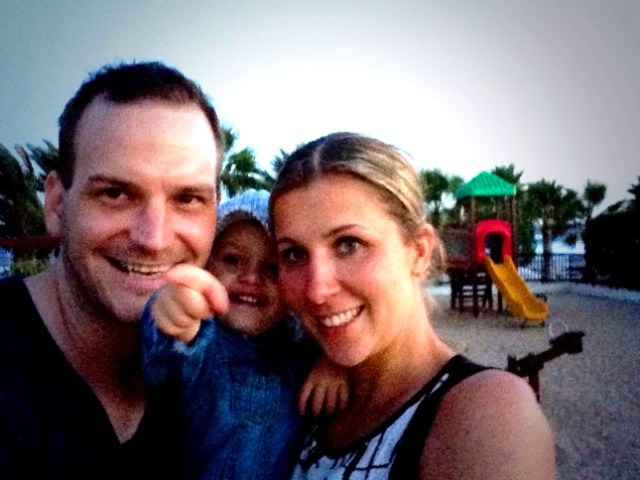
Yesterday, I was a speaker a the iRecruit 2014 conference in Amsterdam. Beforehand, I was interviewed on my views about talent management for the fair´s magazine. You can read that by clicking on the picture below. I am very much convinced that before MAPP, the interview would sounded somewhat differently…

 For one of our MAPP final papers, we were asked to come up with a list of bits and pieces of insight, those “eureka moments of comprehension” we´ve had over the two semesters at Penn. I´d like to share those with you as a kind of “MAPP in a nutshell”. As I like to tie knowledge to those teachers that are “responsible” for my comprehension, I will present them to you in that way. Therefore, I´ve created a list of (to my knowledge) all the persons that have taught in MAPP 9 at one point or the other, and will name those that have provided me with an especially memorable insight. Those perceptions do encompass theoretical insights from positive psychology, its real-world application (or its contribution to real-world application of other psychological concepts), or style of (teaching) delivery…
Roy Baumeister: Bad is stronger than good (precisely: bad events and emotions create a stronger and longer-lasting impact on our brains). Therefore, we need to purposefully create more positive events and emotions in our lives to counterbalance this one-sidedness (with a tip to the hat to John Gottman…).
Dan Bowling: Everything that can be done can also be done with style. It makes the world a brighter place.
Art Carey: Has shown me how important the process of writing is for my own life – and that part of my future career should consist of getting paid for being a “wielder of words”.
David Cooperrider: Words create worlds. Accordingly, positive words will create (mostly) positive worlds – whereas negative words will create (mostly) negative worlds. So use your words wisely, especially your questions – as they tend to create the worlds within other people´s minds.
Angela Duckworth/Peggy Kern: Woohoo! Learning (and teaching…) statistics can be fun. Go figure…
Jane Dutton: High-Quality Connections (HQC) are the high-octane fuel of every organization. Suspend your judgment and try to walk a mile in your fellow men´s shoes before coming to any conclusion. Build trust via giving open, positive feedback – if possible, on a daily basis.
Chris Feudtner: Keeping an open heart while working in dark places (e.g. palliative care units for children) can grant you an enormous “aura” and tangible “clarity of the mind”. When there´s nothing left, there can still be hope. What do we hope for – when there´s no other option left but hope?
Barbara Fredrickson: Positive emotions are not a trifle. They are essential building blocks for our well-being and should be fostered actively.
Adam Grant: It is more blessed smarter to give than to receive. Being altruistic does not turn you into a doormat. It can lead to success, even in competitive corporate environments.
Jonathan Haidt: 1) There are no good reasons (at least not good enough) to be pessimistic about the fate of mankind. Judged by most empirical indicators, it´s not foolish to say that we are on an “upwards trajectory”: things are bound to get better. On that note, I would also like to thank my classmate David Nevill for giving me the sentence “We never have enough data to be pessimistic.” It continues to inspire me, even on a sort of metaphysical level. 2) Look to the extreme ends of the (positive) emotional continuum, e.g., to emotions such as awe and elevation. They may be powerful change catalysts.
Emilia Lahti: You have tons of soul mates somewhere out there. They may live at the other end of the world. But eventually, some of them will find you (especially if you start a blog, that is…)
Ellen Langer: Everything that can be done is worth being done mindful. It leads to better results and more satisfaction. Plus: Don´t fear getting old.
Daniel Lerner: Everything that can be done can also be done with “an eye for excellence”. It pushes the boundaries of human achievement.
Chris Major: A man with a true purpose is (almost) unstoppable.
Ryan Niemiec: 1) Strengths matter more than frailties. They are the key to our “true self” and the building blocks on our road to (work and life) satisfaction. 2) A movie is never “just a movie”. It´s a lesson on character strengths.
Off the Beat: Singing is life!
Ken Pargament: Even atheists value the “sacred moments” in their lives. Find them, cultivate them, and cherish them. They are valuable.
James Pawelski: 1) Trust the process. 2) It´s always valuable not to be the smartest person in the room. 3) Know which giants´ shoulders you are standing on. 4) There is nothing more practical than a good theory (and a proper definition). 5) Know the limits of your knowledge. 6) Positive psychology is grounded in meliorism (the belief that people/things can improve/be better than they are today). 7) You can be a proper scientist and nevertheless enjoy Tony Robbins.
Isaac Prilleltensky: Fairness on the community and societal level influences our individual well-being. Countries with developed democracies, a high degree of personal freedom, generous social security systems and relatively small gaps between top earners and “normal” workers are the happiest (on average)
John Ratey/Tom Rath: Move your ASS! Your brain will appreciate it.
Ann Roepke: Our life is a narrative and as such, we do have tremendous power over it by actively re-writing or pre-writing the storylines.
Esa Saarinen: Don´t hold back. Create systems of generosity. Err on the giving side. Embrace your inner (and outer!) “weird”.
Barry Schwartz: 1) Most times, “good” is “good enough”. 2) Purposefully limit the choices you have to make in life. E.g., choose not to choose by setting defaults and creating habits.
Martin Seligman: Think and dream big.
Daniel Tomasulo: Everything that can be done can also be done with a twinkle in the eye. Makes hard work feel “easy”.
Amy Wrzesniewski: Purpose and meaning (at work) are the result of finding work that integrates your strengths, passions, and values. The calling comes from within. Other people matter (at work, too).
I am deeply thankful to all of you!
P.S. Thanks to my classmate Linda Rufer for designing those MAPP 9 superhero medals. The backside says I was voted “most mappalicious” person in our cohort. Whatever that means at the end of the day… 🙂
Climb* on a chair! 🙂

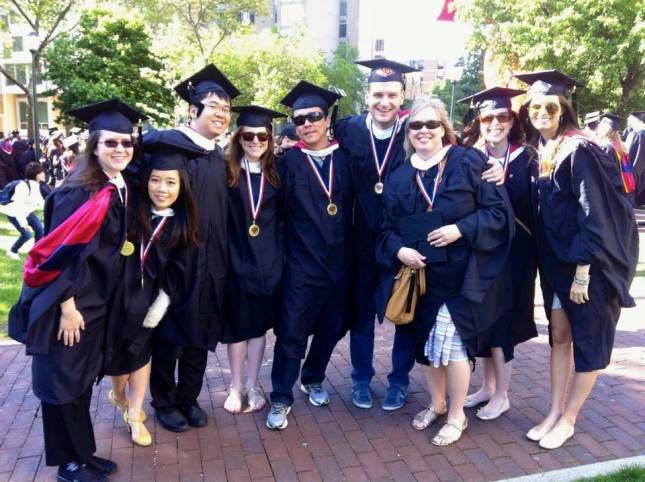
Just came home from a fabulous Penn (MAPP) graduation and commencement weekend. Will post lots more on that shortly…
* A big thank you to my classmate Brandy Reece and her husband for the awesome photo. In that moment, I climbed on my chair to give a special shout-out to our program director James Pawelski who was passing by.
Has there been a special teacher, professor, or mentor that you would like to thank for positively influencing your life? If you´re still looking for the right moment – it might be here right now. Six seniors from Olin College, MA have created the website www.thank-a-teacher.org which lets you express your appreciation in public. The site has really taken off over the last days thanks to exposure on social media.
So below, you will find my thank-you-note to Linda Matesevac, who was my psychology teacher from 1994-95 when I was an exchange student at York Country Day School, Pennsylvania.
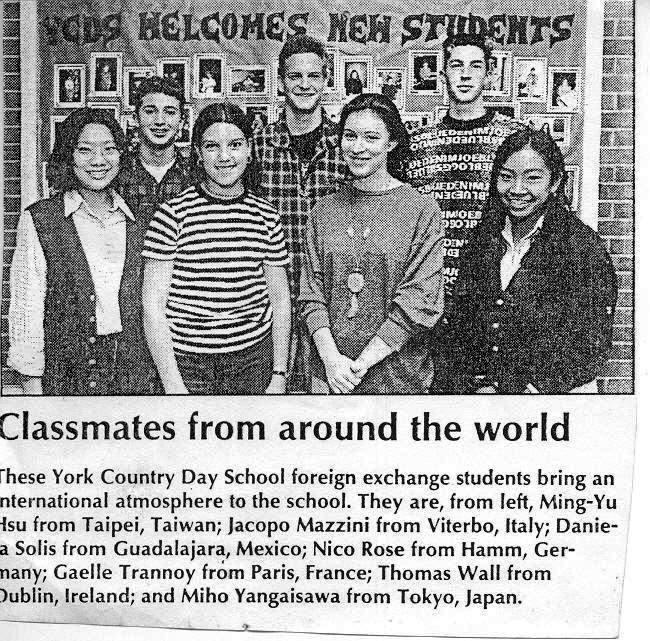
In Germany, psychology is not taught at high-schools. Entering my junior year, I had already (sort of) made up my mind to make it to law school. That changed dramatically over the year. Thanks to Linda, from 1998 on, I majored in psychology at the University of Muenster, Germany. 15 years later, I became part of the 9. cohort of the Master of Positive Psychology program at Penn. I am writing this on the morning of my graduation ceremony. Linda is going to be there – so we´ll meet for the first time in 19 years… 🙂

 Mappalicious