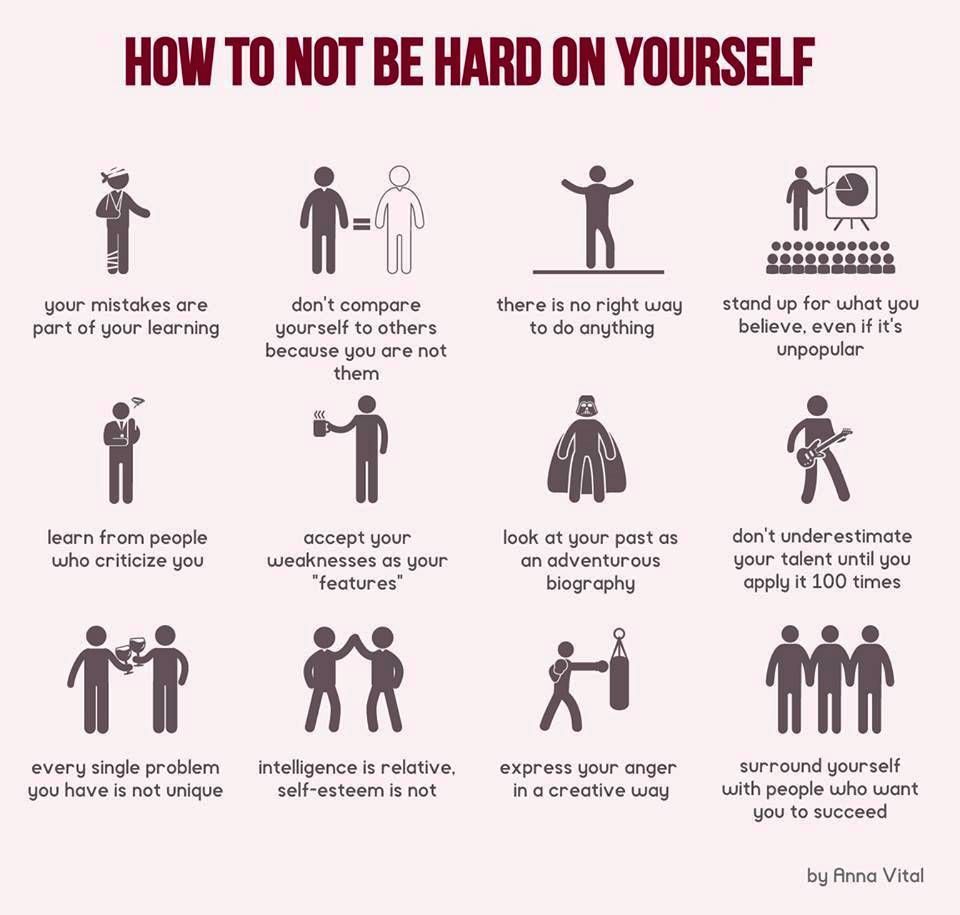
Great Infographic on Self-Compassion: How not to be Hard on Yourself

For UN´s International Happiness Day, I´d like to share with you this great infographic created by information designer Anna Vital. It´s a wonderful piece of advise on the art (and science) of self-compassion. Additionally, you might want to watch Kristin Neff´s TEDx talk on the same topic that you can find in my Positive Psychology TED suggestions. Enjoy!

Self-Compassion - Anna Vital


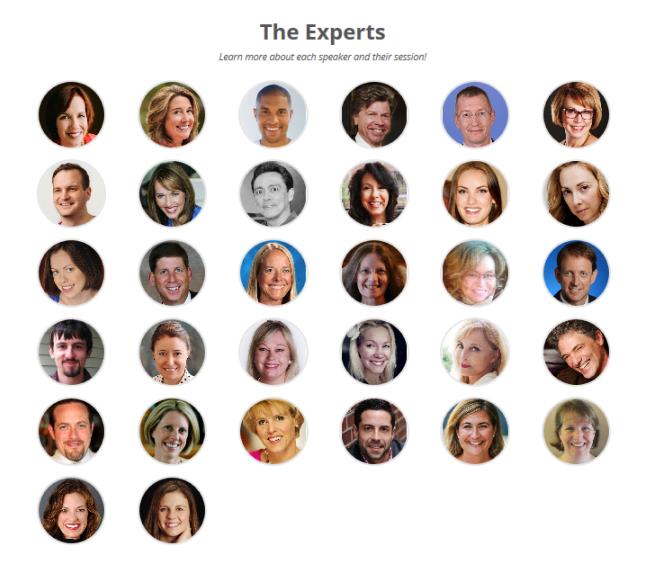
March 20 is International Happiness Day! Join our virtual Conference feat. +30 Positive Psychology Experts

International_Happiness_Day_2015Ever since 2012, March 20 is UN´s International Happiness Day. All around the world, people will celebrate and host events to educate their fellow human beings on all things happiness, well-being, and flourishing.

And I´m in as well – as part of a Virtual Happiness Conference. 32 fellow Penn Mappsters were interviewed on their favorite Positive Psychology subject, among them a lot of people you might already know because they were featured on Mappalicious in one way or the other, e.g. Emilia “Queen of Sisu” Lahti. All in all, there´s more than 24 hours of video material available.

All content will be online for free until March 26. After that, you can purchase the videos. Every cent will go to the Christopher Peterson Memorial Fellowship which helps future students to afford attending Penn´s MAPP program.

As for my part: I was interviewed by the fabulous Lisa Sansom on the role of Positive Psychology in coaching, the subject of Self-Permission, and the “German way” of Positive Psychology. This is the link to the conference site.

Enjoy – and please share to good news!

International Happiness Day Experts

Do you need an Aristotelian Friend in your Life?

A couple of days ago, I wrote a post highlighting a quote by Greek philosopher Epictetus:

The key is to keep company only with people who uplift you, whose presence calls forth your best.

This reminded me of a concept we discussed (and also used) in the MAPP classes at Penn. Aristotelian Friendship. While the concept of Platonic Friendship/Love (a non-sexual relationship that is pursued because the other person inspires the mind and the soul) has entered everyday speech, Aristotelian Friendship seems more uncommon.

Plato_AristotleThe ancient Greeks knew four kinds of love: Eros (sexual desire), Storge (parental/familial love), Agape (divine love, also: charity/compassion), and Philia. Now Philia is closest to our modern understanding of friendship. Aristotle described three kinds of Philia: friendships of utility, friendships of pleasure and friendships of the good.

Friendships of utility are of a shallow kind; today, I guess we would call that networking – it´s more about being acquainted (and potentially useful reciprocally) in the future. Friendships of pleasure take place on a deeper level. Nowadays, we would speak of drinking buddies, or people who share a passion with regard to the same hobby.

Now, the deepest kind of Philia is a friendship for the good. This means that two people enjoy each other´s company because of a mutual admiration for each other´s characters and personalities. And it can also mean not only admiring, but caring about and strengthening the other person´s character and well-being. Therefore, an Aristotelian friend (for the good) will:

  • listen actively when you have to share something good and advise you on how to get more of that into your life;
  • give you frequent feedback on your strengths and “what´s right with you”;
  • but is also honest with you pertaining to your weak spots. Today, we would say: that friend does not let you get away with your sh.t.

Do you have someone like that in your life? Good for you. And if you don´t? Go and find somebody. Now!

Vision Y: Is true Progress possible? Some German Kids think the Answer is: Yes!

Nico Rose - Munich Leadership ConferenceTwo weeks ago, I had the great honor of attending the first Munich Leadership Conference, organized by the Munich Leadership Institute – and hosting brilliant speakers such as Prof. Barry Schwartz, Prof. Barbara Kellerman, and Prof. Franz-Josef Radermacher. The overarching motto of the conference was: “How to achieve true progress”.

I had an active part in the conference, being part of a panel discussion on the question of “What attitudes drive true progress? The other panelists were Thomas Sattelberger, former CHRO of Deutsche Telekom, Kerstin Bund, a journalist who works for the Zeit, Germany´s most popular weekly newspaper, and the aforementioned Prof. Radermacher.

The highlight of the conference was the first public presentation of the so-called “Vision Y” – a framework for a peaceful, more egalitarian, and sustainable future – which a group of students envisioned after having interviewed thought leaders such as Nobel Laureate Muhammad Yunus, scientist/author Nassim Taleb, and German Vice-Chancellor Sigmar Gabriel.

A lot of the things that were presented reminded me of what Martin Seligman told us in the last MAPP class of 2013 about his personal vision for the year 2051. If you are interested in the “Vision Y” (and you should be…), please watch the following short clip that provides an audio-visual summary.

Additionally, Wikipedia founder Jimmy Wales was awarded with the “Deutscher Vordenker Preis 2015” (German Thought Leader Award).

Beautiful Short Film on the Ripple Effect of Kindness and Gratitude

We all know the warm feeling of gratitude in our hearts when we’ve been the beneficiary of an act of kindness. And the really good thing is: in return, we typically want to be kind(er) to others, too. E.g., a recent study by the name of The Social Contagion of Generosity finds that receiving help from strangers prompts us to be kind to other strangers, thereby creating a ripple effect of gratitude and kindness.

This mechanism is beautifully depicted in the following short film from Turkey. Enjoy!

There´s a Negativity Bias in your News. But not, if you follow these People on Twitter

A couple of weeks ago, I pusblished a list of 77 Positive Psychology People and Institutions to follow on Twitter which has grown by now to more than 90 accounts and was also picked by the friendly folks at Fulfillment Daily.

Today, I thought it would be a good idea to check my blog stats to see who profited the most from this. All in all, the post resulted in +4,500 klicks on people´s Twitter accounts. Here´s the Top-10 (excluding the Twitter list I created to follow all of those people):

Positive Psychologists on Twitter

So congratulations to Robert Biswas-Diener, Sonja Lyubomirsky, Paul Bloom, Dan Gilbert, Amy Cuddy, Robert Emmons, David Cooperrider, Jane Dutton, Emilia “Queen of Sisu” Lahti, and Jon Haidt. I hope those clicks converted to a lot of new followers for you!

A Positive Psychology Ancestral Portrait Gallery

The modern age of Positive Psychology started with Marty Seligman being elected APA´s president in 1998. But as the biblical saying goes, “there´s nothing new under the sun”. In very different ways, Positive Psychology is standing on the shoulders of giants – it draws upon a rich history of sages, philosophers, psychologists, and other lucid thinkers. For a short overview, please read this article: Positive Psychology: Standing on which Giants` Shoulders?

To make that point, I´ve created a visual Positive Psychology ancestral gallery (click on the image to enlarge) for a recent talk I´ve given for HR professionals. What do you think of it? And even more important – from your point of view: Who should be on there that is not right now?*

Positive_Psychology_Ancestors_Gallery


* E.g., I sense a slight absence of women…

My favorite Subject in School? Happiness, of course!

If you are lucky, Positive Psychology will be coming to a school near you soon. Positive Education as part of Positive Psychology seems to be really taking off at this point in time. There is an early article by Seligman et al. (Positive education: positive psychology and classroom interventions) – but just recently, the International Positive Education Network (IPEN) was launched. According to its website, the goal of IPEN is

to bring together teachers, parents, academics, students, schools, colleges, universities, charities, companies and governments to promote positive education. Our goals are to support collaboration, change education practice and reform government policy.

On the question “Why Positive Education?” the website states:

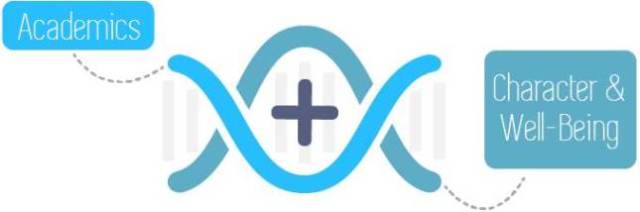
Positive education challenges the current paradigm of education, which values academic attainment above all other goals. Drawing on classical ideals, we believe that the DNA of education is a double helix with intertwined strands of equal importance:
 

IPEN

  1. The fulfillment of intellectual potential through the learning of the best that has been thought and known.
  2. The development of character strengths and well-being, which are intrinsically valuable and contribute to a variety of positive life outcomes.

For quite a long time, Geelong Grammar School in Australia has been the hallmark of applied Positive Education. But more schools shall follow soon. Even in Germany – which typically does not pick up Positive Psychology topics that fast – has seen some Positive Education initiatives as early as 2007. We have a movement called Schulfach Glück (“School Subject Happiness”) which is backed by the “Fritz-Schubert-Institute”. They bring a positive curriculum especially to primary schools, helping teachers to teach topics to their classes such as joy and motivation, curiosity and courage, and mindfulness and respect.

By now, Fritz Schubert has authored three books on this initiative. The effectiveness of the program was recently evaluated in a study comparing classes who completed the curriculum to control groups. The treatment groups displayed higher subjective well-being and self-esteem at the end of the school year. The research article is written in German, but there´s an English abstract:

Applying a quasi-experimental pre-posttest design, we examined the effectiveness of a new teaching unit called school subject happiness. The investigation took place at two vocational schools that had established this subject in the school year 2010/11. Effects of one school year of instruction in the school subject happiness on students´ well-being, self-esteem, and self-efficacy are reported. In addition, a moderation effect of the personality traits emotional stability and extraversion was investigated. A total of 106 vocational school students who belonged either to the treatment or the control group participated in the study. At the beginning and at the end of the school year 2010/11, all students completed questionnaires. Beneficial effects were found for affective components of subjective well-being and self-esteem. Furthermore, the effects on self-esteem and cognitive components of well-being were moderated by emotional stability. Students who reported higher emotional stability benefited more from the new teaching unit. For self-efficacy no effect was found. The results are interpreted as partial effectiveness of the program.

The greatest discovery of my generation is that a human being can alter his life by…

The greatest discovery of my generation is that a human being can alter his life by altering his attitudes of mind (William James). Now I guess, the Buddha discovered that a couple years earlier. But it´s still great to know that we´re not the slaves of our minds and feelings.

William James - Attitude