Bad is Stronger than Good! That is why our World desperately needs Positive Psychology…

YodaLuke Skywalker: “Is the dark side stronger?”
Yoda: “No, no, no. Quicker, easier, more seductive.”

If you are one of the few people on the planet that have not seen Star Wars: the dark side (of the Force) was not stronger. As in most Hollywood stories, the good guys win in the end. That´s why we go to the movies in the first place. We want to see an entertaining plot. That means: We want to see the good guy struggling, we want him to take on his challenge. And we want him to win in the end. And they lived happily ever after…

Unfortunately, in real life things look a little different. In real life, “Bad” mostly is stronger than “Good”. I´m not talking about a metaphysical power struggle here, of course. I´m talking about psychological phenomena. Together with some colleagues, MAPP guest lecturer Roy Baumeister has written a review article that goes by the name of this blog post: Bad is Stronger than Good. They´ve gathered tons of empirical evidence on a wide array of psychological mechanisms to lend support to this stance:

  • On the preconscious level, we pay more attention to negative stimuli than to positive stimuli.
  • Negative information is processed more thoroughly than positive information. This can be demonstrated even on the level of neural activity.
  • In terms of impression formation, negative information by far outweighs positive information (telling one lie can make you a “liar” forever).
  • Bad memories are engraved deeper in our brains and can be retrieved more easily.
  • Losing a certain amount of money feels worse than winning the same amount of money feels good. Basically, that´s what Kahneman and Tversky got their Nobel prize for in economics in 2002.
  • Bad events in our lives have a stronger and longer-lasting effect than good events. This is nicely demonstrated by the fact that we do have word for the consequences of very very bad events (trauma), but there´s no corresponding term for the positive side of the emotional continuum.
  • Negative feedback has a stronger and longer-lasting effect on us than positive feedback.
  • Therefore, we put a lot more emphasis on avoiding negative information pertaining to ourselves than focusing on integrating positive information.
  • In close relationships, one bad event can ruin everything. Yet, a lot of positive events cannot save a relationship “forever”.
  • Bad parenting has a stronger negative effect on the development of the children than good parenting has on positive development.

This list could go on forever. And: there´s hardly any exception to be found.

But is it really that bad?

Baumeister et al. argue that we may be evolutionary hardwired to put a strong emphasis on negative stimuli in our environment. At the end of the day, 10,000 B.C., it probably was far more “adaptive” (= useful for spreading your genes) to be the first person in a group spotting that saber tooth tiger lurking behind the bush than spotting those sweet blackberry growing on the bush. In other words, there is an all-pervasive negativity bias that influences our thinking and feeling at all times.

So in a sense, every single human being wears the opposite of rose-colored glasses all the time (and mostly without knowing that we do). Now, if this true, for me, there´s another important implication:

If we are evolutionary hardwired to perceive, process, and remember bad information to a much higher extent than positive information, it follows that – on a more objective level – the world actually is a much better place than we think it is.

Now the big question is: What can we do about this inherent negativity bias? How can we overcome this urge to see everything through “concrete-colored” glasses?

Because I really feel we should! While looking out for threats at all times may have been adaptive in the Pleistocene – it probably is not as helpful in the so-called developed world. We live in relative safety. With very rare exceptions, nobody has to suffer from starvation. When we´re sick, we go to the doctor and receive treatment. Most of us die of old age, not of homicide or wild animals. From more than one point of view, this is a good place to live in.

In spite of this, mental disorders, especially depression and anxiety disorders, are “booming” – for decades by now. While this development certainly has multiple causes, I believe one reason is that the negativity bias has become maladaptive in our times. We are bombarded with thousands of messages via different media outlets each and every day. And the sad truth is that most media tend to focus strongly on negative news, events, and stories – precisely because they know we tend to focus on negative events. It drives their reach and circulation. So obviously, we are constantly exposed to a distinctly negatively biased fraction of what happens in this world – using a set of cognitive tools that are distinctly attuned to the worst part of that already distorted view of reality.

We are constantly exposed to a distinctly negatively biased fraction of what happens in the world – using a set of cognitive tools that are distinctly attuned to the unpleasant parts of that already distorted view of reality.

So what can we do?

Enter Positive Psychology. A short definition of positive psychology could be: “It´s the study of (psychological) things that go well”. By its nature, positive psychology studies positive phenomena: What makes us happy (instead of sad)? How can we find meaning in life (instead of languishing)? How do relationships flourish (instead of being a source of pain)? Etc.

By now, there´s a lot of scientific evidence on those questions. One finding that has popped up in several different domains of inquiry goes as follows: Good is stronger than bad – but only if good outnumbers bad to a considerable extent. In Baumeister et al.´s words:

“This is not say that the bad will always triumph over good, spelling doom and misery for the human race. Rather, good may prevail over bad by superior force of numbers: Many good events can overcome the effect of a single bad one.”

Let´s look at some examples:

Basically, raising the number of positive experiences in our lives is also one of the essential mechanics underlying positive (psychology) interventions, such as the What Went Well exercise or the Gratitude Visit. They create (or shift our attention to the) positive momentum in our lives to counterbalance the all-pervasive negativity.

The truth is: Each and every one of us has to make an effort for good to be stronger than bad.

But what about our daily lives? Who has the time to perform interventions all the time? The truth is: Each and every one of us has to make an effort for good to be stronger than bad. Good thing is: We do not have to be larger-than-life leaders such as Mahatma Gandhi or Nelson Mandela do make an impact. It´s the little things that count (a.k.a. micro-behaviors) – if they come in large amounts. A smile. A thumbs-up. An affirmative nod. A pat on the back. Putting the toilet lid back down…

A little kindness goes a long way.

If you need more inspiration, watch this – again and again if you like:


* For the expert reader: she may have gotten the math wrong initially – but the phenomenon itself can hardly be called into question.

Barry Schwartz on Good Decision-Making and Practical Wisdom

Paradox of ChoicePractical WisdomI really don´t have time to write to today – but I want to want to write something. So instead of composing a longer text, I´d just like to point you to two great TED talks by Barry Schwartz, Professor at Swarthmore and guest lecturer in the MAPP program. The first one is about decision-making and how having too many choices can make us miserable. The second one is about Barry´s conception of practical wisdom. He has also written books on both topics.

xxx

xxx

Systems Intelligence: Getting to Super-Productivity via not “Holding Back”

The MAPP program is a fulltime program – but combines onsite classes with long-distance learning periods. Part of the distance learning comprises a lot of reading (Who would have thought of that…) and writing essays about a wide array of positive psychology topics. I´ve decided to post some of those essays here on Mappalicious. Surely, they´re not the be-all and end-all of academic writing. But then again, it would also be a pity to bury them in the depths of my laptop…

Esa Saarinen´s work on individual and organizational well-being is based on a Systems Intelligence approach (Saarinen & Hämäläinen, 2004; Hämäläinen & Saarinen, 2007; Saarinen, 2013). Systems intelligence, in turn, is based on systems theory/systems thinking (Von Bertalanffy, 1968) which was introduced into organization and management sciences by researchers such as Russell Ackoff (1972; 2006). Systems Intelligence is defined as “intelligent behaviour in the context of complex systems involving interaction and feedback. A subject acting with Systems Intelligence engages successfully and productively with the holistic feedback mechanisms of her environment. She perceives herself as part of a whole, the influence of the whole upon herself as well as her own influence upon the whole” (Hämäläinen & Saarinen, 2004, p. 9). Pertaining to underlying idea of man, the approach is grounded in “a deep belief in the human potential. In its positive overtones and strive towards flourishment […] Systems Intelligence runs parallel to Positive Organizational Scholarship and to Positive Psychology” (Hämäläinen & Saarinen, 2007, p. 4).

What fascinates me most about Saarinen´s work is the concept of “holding back”. On an abstract level, this describes a situation where people choose an “inferior non-cooperative equilibrium solution even if a jointly dominating solution would also be available by cooperation” (Saarinen & Hämäläinen, 2004, p. 35). For instance, a boy and a girl both hesitate to say “I love you” out of fear that the statement could remain unrequited. In this spirit, Hämäläinen and Saarinen (2008, p. 824) describe “‘Systems of Holding Back’, and of ‘Systems of Holding Back in Return and in Advance’. The subject holds back what would benefit the other because the other first holds back from me what would benefit me.”

While I can obviously relate to this concept by way of personal experience, I believe it also markedly extends my understanding of a psychological phenomenon I investigated a while ago (Rose, 2010; 2012). I administered a questionnaire to a German sample of more than thousand people and asked them (among other things) to rate themselves on the following items pertaining to their overarching life goals:

  • Sometimes I doubt that I am allowed to reach my goals.
  • Sometimes I believe that I do not deserve to reach my goals.
  • Sometimes I believe that somehow I am not permitted to reach my goals.

Participants that answered in the affirmative displayed a significantly lower level of satisfaction with life (r = -.48) as measured by the scale of Diener, Emmons, Larsen, and Griffin (1985). Now the question arises: Why should somebody think (or feel) that she is not allowed to reach her goals? Where should this permission come from? Who could issue such a permission – or should have given it in the first place? At the present moment, my intuition is that this could be a structure of anticipatory (internalized) form of holding back: A person expects to be exposed to “holding back” via an external agency and therefore decides to evade the associated “pain” by “not trying” in the first place.

At the other end of the continuum, Hämäläinen and Saarinen (2007, p. 27) believe that “to the extent there are microbehaviours of holding back and a phenomenon of holding back giving rise to Systems of Holding Back, there is also the opposite possibility.” If there are (micro-)behaviours of holding back, there should also be occasions of uplift and elevation.

Bigger PictureSuper-Productivity

One important facet of Systems Intelligence is the investigation and description of a phenomenon characterized as “Super-Productivity” (Saarinen & Hämäläinen, 2004) – which is a result/by-product of systems’ propensity for synergy and emergence. This concept signifies an optimal state of system functioning which in everyday speech is oftentimes described by the saying “The whole is greater than the sum of the parts”. It could be likened to Csíkszentmihályi´s concept of Flow (1990) – but where Csíkszentmihályi´s notion is concerned with an intra-individual phenomenon, Saarinen and his co-author refer to an inter-individual manifestation, a flow between different elements of a system, for instance, the members of a management team or an orchestra.

I am very intrigued by this conception since I have experienced it numerous times in my career as a corporate manager. It rarely happens,* but when it does, the results can be spectacular. By way of example, upon my initiative, Bertelsmann has entered in a joint recruiting project by the name of “Gap Year” (www.gapyear-programm.de) with the German branch of McKinsey, the headquarters of German financial/insurance giant Allianz, and Germany´s leading FMCG producer, Henkel. In spite of being opponents in the so-called “War for Talent” (Chambers, Foulon, Handfield-Jones, Hanklin, & Michaels, 1998), we all swallowed our (corporate) pride and created a cooperative program for recent bachelor graduates. Candidates have to apply only once, and if successful, they enter a 12-months schedule where they complete first-rate internships with three out of the four partner companies. The program has been immensely successful. Not only does it attract the best candidates the market has to offer, it was also awarded several times, and featured in more that 30 (mostly top-tier) articles in the German business press.

In the beginning, there were a lot of doubts about the feasibility and practicality of this project. All parties had to overcome the inherent “free-market egotism” and tune into the needs and requirements of the partner companies. Looking back, I believe that a high amount of interpersonal trust was the key ingredient that has led to successful execution. It would have been easy to “hold back”, to sabotage, or pull out of the project completely. But we decided to see it through – and we were richly rewarded.

* But in real life, the opposite seems to be true. At the lower end of the continuum, there has to be a kind of hypo-productivity: “Most corporations and business schools are less than the sum of their parts.” (Ackoff, 2007, p. 127).

References

Ackoff R. L., Emery F. E. (1972). On purposeful systems. Chicago, Il: Aldine-Atherton.

Ackoff, R. L. (2006). Why few organizations adopt systems thinking. Systems Research and Behavioral Science, 23(5), 705-708.

Ackoff, R. L., Addison, H. J., & Bibb, S. (2007). Management F/Laws. Axminster, UK: Triarchy Press.

Chambers, E. G., Foulon, M., Handfield-Jones, H., Hanklin, S. M., & Michaels, E. G. (1998). The war for talent. McKinsey Quarterly, 3, 44-57.

Csikszentmihalyi, M. (1990). Flow: The psychology of optimal experience. New York: Harper-Perennial.

Diener, E., Emmons, R. A., Larsen, R. J., & Griffin, S. (1985). The satisfaction with life scale. Journal of Personality Assessment, 49(1), 71-75.

Hämäläinen R.P. & E. Saarinen (2007). System intelligent leadership, in R.P. Hämäläinen & E. Saarinen (Eds.), System intelligence in leadership and everyday life (pp. 3-38). Helsinki: Systems Analysis Laboratory, Helsinki University of Technology.

Hämäläinen, R. P., & Saarinen, E. (2008). Systems intelligence – the way forward? A note on Ackoff’s ‘why few organizations adopt systems thinking’. Systems Research and Behavioral Science, 25(6), 821-825.

Rose, N. (2010). Lizenz zur Zufriedenheit [License for Satisfaction]. Kommunikation & Seminar, 5, 12-15.

Rose, N. (2012). Lizenz zur Zufriedenheit [License for Satisfaction]. Paderborn, Germany: Junfermann.

Saarinen, E. (2013). The Paphos seminar. Elevated reflections on life as good work. GoodWork Project Report Series, 80, Harvard University.

Saarinen E., & Hämäläinen, R. P. (2004). Systems intelligence: Connecting engineering thinking with human sensitivity, in R. P. Hämäläinen & E. Saarinen (Eds.), Systems intelligence: Discovering a hidden competence in human action and organisational life (pp. 9-37). Helsinki: Systems Analysis Laboratory, Helsinki University of Technology.

Von Bertalanffy, L. (1968). General system theory: Foundations, development, applications. New York, NY: George Braziller.

Goals: Why SMARTIES are smarter than SMART…

It is the same story each year, isn´t it?

  • I really want to lose weight…
  • I really want to quit smoking…
  • I really want to be physically fit…
  • I really want to have my own business…
  • I really want to meet the wo/man of my dreams…

I guess that´s what the top-5 list of New Year´s resolutions would look like. The problem is: most of these goals have about the same half-life period as that hangover that welcomes a lot of us on New Years´s morning. Yet, per se, goal-setting is not a bad thing – quite the opposite is true. The motivational and performance-enhancing effects of goal-setting are among the most thoroughly researched issues in academic psychology.  If you´d like to know more, please read this article that succinctly summarizes 30 years of goal-setting research.

Besides, there´s lots of help available on the net. When you type in “how to reach goals” on Google you´ll get more than one million hits. Most of these will display smart content. To be more precise: some information on the SMART framework. SMART is an acronym that originally stems from project management theory.* There are lots of slightly different versions on the internet. The most common probably is this one:

Specific: A goal should be stated in a markedly tangible way. The more precise, the easier it will be to take the necessary steps. An example: Instead of “I want to work out more often” it is better state something along the lines of “From now on, I will go jogging twice a week for 45 minutes (on Tuesdays and Thursdays right after work). Additionally, I will do weight training on Saturday afternoons for 45 minutes.” This could be refined even more. As a rule of thumb: the more precise you are able to describe to another person what you intend to do, the better.

Measurable: A goal (as well as the distance between the initial situation and the goal) should be quantifiable. Without measurement, there´s no progress check. Without progress, there´s no lasting motivation. An example: Instead of “I want to lose some weight” it is better to state something along the lines of “I want to weigh 140 pounds and keep that weight as a steady state. In order to achieve this, I will lose 4 pounds on average over the next 6 months – and then keep my weight right there.”

Attainable: A goal should be achievable – but definitely display a certain amount of difficulty. Goals that are completely unrealistic typically destroy our motivation. On the other hand, goals that are reached to easily usually do not yield the success stories we really yearn for. Yet, there´s another connotation to this criterion. We should put our efforts in something that personally attainable – a goal should be in our personal “sphere of influence”. For instance, “Finding the man of my dreams” goes against this criterion. It´s much more helpful to plan concrete actions that are conducive to that overarching goal, e.g., enrolling in a dancing course.

Relevant: A goal should be relevant, in other words: important and meaningful. This may sound self-evident – but it is not at all trivial. Rarely do we question the motivation behind our goals sufficiently. Why do I want what I want? Is this really my goal? And if not: For whom or what am I doing this? Should you realize that a goal is chiefly driven by extrinsic motivation please do exercise some caution. The most beneficial kind of goal is a self-concordant objective – in other words, a goal that is aligned with our deeper values and motives. Following a self-concordant goal is a satisfying process in itself – so no matter if you reach the goal or not: you will profit from trying to do so. From this it follows that one important prerequisite for “good goals” is a sufficient level of self-awareness. One way to attain this is getting to know your (character) strengths. You´ll find a free scientifically validated test here (create a profile, then choose the „VIA Signature Strengths Questionnaire“).

Time-bound: A goal should have a reasonably defined time frame. Without this, there is no rigorous progress review. Additionally, most people are motivated by deadlines – so why not use this extra kick? I guess an example is not needed here.

Ok. So this is the original SMART framework. I assume that most of my readers have been at least somewhat familiar with this. Now the question is: Why do so many personal changes endeavors fail? Is SMART useless? Probably not. But incomplete, most likely. Therefore, here´s my proposal for an extension – based on science and my personal experience as a coach:

SMARTIES

Implementation Intentions: Peter Gollwitzer, a German professor of motivational psychology, has developed a method that tries to bridge the ever-looming implementation gap:  so-called implementation intentions. Because of their structure, they are also called “If-Then-Plans” (Alternatively: “When-Then”).  They function by connecting planned behavior with triggering cues in the proximate environment. Two examples: 1) “Right after I have laid down my briefcase when coming home from work, I will put on my jogging clothes and go for a run. If the weather is really bad, I´ll use the exercise machine instead.” 2) “If I notice a strong urge to smoke, I will put a chewing gum in my mouth immediately.” Once again: the more concrete the plan, the higher the chance for following through.

Exceptions clarified: If you want to create a new habit, making no exceptions at all over the course of the first months is the fastest road to success.  At the same time, it is well-known that the spirit is willing but the flesh is weak. Therefore, it is very helpful to give some thought to the potential occurrence of exceptions and setbacks. For instance: What does smoking one cigarette once in a while mean for somebody who tries to quit? From my experience with coaching clients I know that people tend to frame these exceptions to the new rule as a total failure of the change project – which in turn extinguishes all of their motivation.  In terms of sustainable change, it is therefore helpful to define which exceptions to the new rule will be acceptable – without calling into question the overall endeavor.

Systemic Perspective: Finally, I highly suggest giving some thought to the following issues (this is comparable to a Force-Field Analysis in organizational change management):

How does my goal fit in with the goals and aspirations of important people in my personal context (the external system)? E.g., if you would like to work out from now on for 5 hours per week: Is this time you usually spend with your significant other? And if yes: How do you intend to “compensate” for this?

How does my goal fit into the texture of those goals and intentions that are already in place (the internal system)? It is useful to ask which positive intentions (secondary benefits) are fulfilled by those behavior patterns that you would like to change/eliminate. Your chances of establishing a new behavior pattern are much higher if you manage to transfer these intensions/needs into your new mode of being: By way of example, most smokers do not smoke because they like the taste. Rather, smoking fulfills a calmative function. For some, it´s a means of weight control. Additionally, there is a social aspect to smoking that needs to be considered. So if you want to quit, it is highly advisable to give some thought to the question of how to integrate these requirements into your life as non-smoker.

By the way: it cannot hurt to get some external reference to keep yourself on track. The earlier you manage to turn the envisioned behavior into a habit, the better. In 2014, I use my smartphone, specifically the Good Habit Maker and the app Balanced.


* The original source of the SMART framework is this article (most likely): Doran, G. T. (1981). There’s a S.M.A.R.T. way to write management’s goals and objectives. Management Review, 70(11), 35-36.


Picture source

Tired of meaningless rattled-down Introductions? Try “Serious Introductions”

You probably know this thing: it´s the first day of a seminar or the beginning of some business meeting. The host suggests everybody introduce her- or himself to the other attendees (more or less succinct). Following the common social script, most of the times people will now take turns and give an account of their education, job histories, and – on a good day – their personal status. From my own experience I have to admit: I tend to forget most of the information instantaneously – except for the rare occasion when there´s some shared background with another person.

So why not do it a little differently? I have to admit this may not be the best of ideas on each and every occasion – but then I can imagine a lot of place where this feels really appropriate.

A Serious Introduction

A serious introduction consists of telling a meaningful story about a specific moment in our lives. It could be a moment that is just very important to us, or a moment that shows us at our best, thereby displaying our unique blend of character strengths. To quote my lovely MAPP classmate Patricia De La Torre: It’s a fantastic way to learn about somebody else and to instantly connect with them in the non-cheasiest way possible. So here we go…

This is September 9, 2010. I have a glass of champagne in my hands and feel a one-of-a-kind combination of exaltation and relief. My dress shirt is soaked with sweat from the room temperature of more than 100 degrees Fahrenheit – and from the 30-minute lecture I have given a couple of minutes ago. The first supervisor of my doctoral thesis at European Business School Oestrich-Winkel, has just pronounced I will be awarded the doctoral degree in business sciences with the best possible grade, “summa cum laude”. Now this evaluation consists of the grade for my thesis, which accounts for 70 percent of the total grade; and the grade for the disputation which has just taken place – which accounts for the remaining 30%. My thesis had been graded in-between the top marks – and in order to receive the overall “summa cum laude”, the disputation would have to be an absolute top-notch performance.

Let´s go back in time for a week…

During that final week before my disputation, I did something very unusual: I practiced. In fact, I practiced my ass off. I am used to lecturing regularly, either at conferences, or at the business school where I teach – which has given me a lot of confidence in that matter over the years. I typically will prepare my PowerPoint slides some days before due date alright – but I never ever really think about what to say in advance, let alone learn something by heart. That often results in entertaining but hopelessly overlong lectures. But for once, it had to be different. There are very strict regulations pertaining to the disputation process. You have exactly 30 minutes to convince the doctoral committee of your research, not one minute more, not one minute less.

So I practiced – and I learned my text by heart.

As usual, I prepared my slides. In the morning seven days before the disputation, I practiced for the first time – and went over 45 minutes. I practiced again in the afternoon, talking a little faster, and still went well over 40 minutes. So I cut out one of the slides, practiced again in the evening and finished at 38 minutes. I practiced again before going to bed and stopped at 37 minutes.

For the upcoming six days, I practiced four times a day, once in the morning, once in the afternoon, once in the evening and once before going to bed. I cut out further slides but never made in less than 33 minutes – until the day of the disputation.

I had thrown out another slide spontaneously in the morning and was a little nervous, but clearly not too nervous. I was wearing a tailor-made suit – and my wife, my parents, my parents-in-law and some of my best friends joined the audience to witness the culmination point of a strenuous 5-year period of my life.

Due to practicing hard (I believe), I was at my best that day. Speaking quite clearly, convincingly, seemingly without much effort, and most of all: according to the rules of this extraordinary occasion. I hit the mark in 30 minutes sharp.

Now all this accounts for the exaltation. But what about the relief?

The truth is: joining that doctoral program was – at least from a certain point of view – one of the worst decisions of my life. I´d had lost interest in my research topic during the first year. I felt out of place and out of tune with myself for most of the time. I knew this doctoral thesis was leading neither me (nor someone else) anyhere. I wanted to quit at least once a year but my parents managed to convince me to go on over and over again.

Now it is over. I made it. And I made it worthwhile.

Nico Rose - Disputation

2014: “Don´t hold back! Animate. Validate. Elevate.”

Esa SaarinenLudwig Wittgenstein said: “The limits of my language mean the limits of my world.” From this it follows that adding new words to one´s vocabulary (or a new connotation for a known word) can broaden one´s mind. Therefore, giving a “proper name” to a phenomenon at hand can fundamentally change and deepen our understanding of that same “thing”.

This is exactly what happened to me on December 7th, 2013. It was the last onsite period of MAPP 13/14´s first semester – and we had the great pleasure of having Esa Saarinen as a guest lecturer. Esa is one of Finland´s most widely acclaimed philosophers. With this post, (among other things) I´d like to give him massive kudos:

  • First, for being a really cordial person.
  • Second, for gracefully sporting a style that makes Lapo Elkann look like an old spinster.
  • Third, and foremost, I´d like to thank him for giving me a new word: “Holding Back”.

Systems Intelligence

But first things first. Together with a colleague, Esa has developed and endorses what he calls Systems Intelligence – an extension of systems thinking. In his own words, Systems Intelligence is…

[…] “intelligent behaviour in the context of complex systems involving interaction and feedback. A subject acting with Systems Intelligence engages successfully and productively with the holistic feedback mechanisms of her environment. She perceives herself as part of a whole, the influence of the whole upon herself as well as her own influence upon the whole. By observing her own interdependence in the feedback intensive environment, she is able to act intelligently.” (Hämäläinen & Saarinen, 2007, p. 4)
“The Systems Intelligence approach stems from a deep belief in the human potential. In its positive overtones and strive towards flourishment, as opposed to avoiding pitfalls or neutralizing negatives, Systems Intelligence runs parallel to Positive Organizational Scholarship and to Positive Psychology.” (Hämäläinen & Saarinen, 2007, p. 7)

Holding Back

Now, a central tenet in Systems Intelligence is the notion of “Holding Back”:

“The concept refers to mutually aggregating spirals which lead people to hold back contributions they could make because others hold back contributions they could make. We believe such systems are fundamental to human interaction – indeed, our conviction is that human interaction has a tendency to slide into systems of holding back unless conscious effort is launched to counter this tendency. A negative dance of holding back will prevail unless it is countered time and again.” (Hämäläinen & Saarinen, 2007, p. 26)
“We speak of ‘Systems of Holding Back’, and of ‘Systems of Holding Back in Return and in Advance’. The subject holds back what would benefit the other because the other first holds back from me what would benefit me. Systems Of Holding Back gain momentum […] because there is a bias in human mental constitution to be more aware of the contributions others fail to make to me than of the contributions I fail to make to others.” (Hämäläinen & Saarinen, 2008, p. 824)

A simple example for the phenomenon of “Holding Back”: a young man wants to say “I love you” to a young woman – but refrains from doing so out of fear that the feeling is not mutually. Unfortunately, it´s exactly the same for her. As a consequence, they break up after some time…

Now obviously, this is not something entirely new to me. I´ve experienced things like this myself – and I see similar occurrences on a regular basis when working as a coach. But the term “Holding Back” has induced an elevated level of understanding, a new kind of clarity – and the desire to explore this phenomenon; particularly: what we can do about it…

I´ve decided to make only one New Year´s resolution: 2014 is going to be my year of “Not Holding Back”. I´m going to monitor my behavior closely – and when I detect “Holding Back”, I´m going to figure out why – and then do something about it. 2014 is going to be my personal “Year of Kindness”. I will try hard to be a more considerate person. And I´m going to do it systematically – turning it into a personal change project. My mantra: “Don´t hold back!. Animate. Validate. Elevate.” Keep your eyes peeled, there´s something coming up…

But for now, I wish you an exceptional New Year´s celebration and a happy and healthy year 2o14! 

Don´t hold back

References

Hämäläinen, R. P., & Saarinen, E.  (2007). Systems intelligent leadership. In R.P. Hämäläinen & E. Saarinen (Eds.), Systems intelligence in leadership and everyday life (pp 3-38). Espoo: Helsinki University of Technology.

Hämäläinen, R. P., & Saarinen, E. (2008). Systems intelligence – the way forward? A note on Ackoff’s’ why few organizations adopt systems thinking’. Systems Research and Behavioral Science, 25(6), 821-825.

When feeling good feels better than good: the Benefits of Emotional Contrasting

The MAPP program is a fulltime program – but combines onsite classes with long-distance learning periods. Part of the distance learning comprises a lot of reading (Who would have thought of that…) and writing essays about a wide array of positive psychology topics. I´ve decided to post some of those essays here on Mappalicious. Surely, they´re not the be-all and end-all of academic writing. But then again, it would also be a pity to bury them in the depths of my laptop…

But what if pleasure and displeasure were so tied together that whoever wanted to have as much as possible of one must also have as much as possible of the other — that whoever wanted to learn to “jubilate up to the heavens” would also have to be prepared for “depression unto death”?” And that is how things may well be.

(Nietzsche)

Mental ContrastingOne of my most important teachers while training to become a coach regularly used a metaphor in order to convey the idea that, while there are a lot of people out there that feel good about their lives, there may be separate groups of individuals that may feel equally good, but still radiate a disparate ‘energetic signature’. Using the concept of rebirth (without necessarily believing in it), he told us that, because of their karma, some people are entitled to what could be described as a ‘recreational incarnation’. After a lot of suffering in former incarnations, they now get to live a pleasant and happy life without too much pain, loss, and other turbulences – resulting in an affable, joyful, but (potentially) also slightly shallow character. On the other hand, there are people that know the ‘Dark Night of the Soul’ from their own experience earlier in the current life. While they can be just as happy and agreeable as the aforementioned group, they tend to be somewhat graver or deeper.*

In this paper, I want to take a look at this distinction. At a less arcane level, the question could be: When two people display the same value on a measure that is supposed to quantify happiness – do they really feel the same when one person has been at that level for (more or less) her whole life, while the other has experienced longer periods of considerably unhappier emotional states?

Positive emotions play a central role in positive psychology (Fredrickson, 2001; Fredrickson, 2009). Because of the particular emphasis on positive affect especially during the early period of the field, some scholars criticized positive psychologists for excluding the negative side of human emotions from their inquiries (e.g., Tennen & Affleck, 2003). It is important to say that this is, in fact, not the case (Seligman & Pawelski, 2003; Peterson, 2006). Rather, positive psychology asserts that negative emotions do exist and are just as ‘natural’ as positive emotions. It´s just that the focus of researchers and practitioners, for the first 100 years of psychology as a science, has been firmly on the negative dimension of human experience, which now warrants a shift towards the opposite direction (Seligman & Csikszentmihalyi, 2000).

For example, one branch of research in (positive) psychology focuses on bouncing back from negative experiences (Tugade & Fredrickson, 2004), coping with unfortunate events (Folkman & Moskowitz, 2000), psychological resilience in the face of adversity (Masten, 2001), and, particularly, post-traumatic growth (Tedeschi & Calhoun, 1996; Linley & Joseph, 2004; Tedeschi & Calhoun, 2004). By way of example, there is considerable evidence that a person cannot only recover and get back to normal after a severely stressful event such as a potential life-threatening illness, but can actually attain a higher level of well-being and satisfaction, e.g., via finding a deeper meaning or a more profound sense of purpose in life (Helgeson, Reynolds, & Tomich, 2006; Lyubomirsky, 2008). So while, by and large, it seems difficult to sustainably alter a person´s general level of happiness (Lykken & Tellegen, 1996), there is reason to believe that overcoming extremely stressful events may result in such a shift.

But there may be other mechanisms that can explain how we can benefit psychologically from having gone through troubled times. Even if a person may not be happier than a fellow human being with regard to objective measurement, the aforementioned may still perceive his or her state as being more favorable than the latter person. For a thought experiment, let´s consider two people of similar age and other characteristics that both display scores around the 80th percentile on a measure that captures happiness or a similar variable of psychological well-being. The difference is: the first person has by and large been on that level for his previous life, while the other person has suffered from recurring episodes of depression – but has now recovered for good. Will being equally happy actually feel the same for both? I argue that this is not the case. Rather, I contend the second person will be happier on the subjective level (qualia). She will feel happier about being happy because she can still remember how it felt to be severely unhappy. Why should that be the case?

One of the earliest objects of investigation in psychological science has been human perception, e.g., our ability to discern contrasts (Heidelberger, 2004). While scholars mostly focused on contrasts as perceived on the sensory level (light intensity, loudness, weight etc.), some scientists early on investigated contrasts pertaining to the emotional sphere (Bacon, Rood, & Washburn, 1914). For instance, Manstead, Wagner, and MacDonald (1983) have shown that we tend to find humorous film content to be funnier when we were previously exposed to a horror movie (and vice versa). Obviously, the fear that is elicited by the horror movie makes the enjoyment of the comedy more intense.

While the aforementioned emotional contrast is perceived when the stimuli are presented in close temporal connection, it seems likely that this process also works for stimuli that are being felt at different points in time. It is perfectly possible to contrast a current emotional state to that of past events via voluntarily accessing episodic memory. When we compare feeling good in the present to feeling considerably worse in the past, the current emotional condition can subjectively be enhanced by a kind of meta-emotion (“It really feels good feeling so much better than how I felt back in the days…”).

So while it is common sense that ‘feeling good just feels good’, we should not forget about having felt worse in the past. It just might give us that little extra kick.

* Often, he also used to contrast this ‘species’ with the mythological character of Chiron, the ‘wounded healer’.

References

Bacon, M. M., Rood, E. A., & Washburn, M. F. (1914). A study of affective contrast. The American Journal of Psychology. 25(2), 290-293.
Folkman, S., & Moskowitz, J. T. (2000). Positive affect and the other side of coping. American Psychologist, 55(6), 647-654.
Fredrickson, B. L. (2001). The role of positive emotions in positive psychology: The broaden-and-build theory of positive emotions. American Psychologist, 56(3), 218-226.
Fredrickson, B. L. (2009). Positivity: Top-notch research reveals the 3 to 1 ratio that will change your life. New York: Crown Publishing.
Heidelberger, M. (2004). Nature from within: Gustav Theodor Fechner and his psychophysical worldview. Pittsburgh: University of Pittsburgh Press.
Helgeson, V. S., Reynolds, K. A., & Tomich, P. L. (2006). A meta-analytic review of benefit finding and growth. Journal of Consulting and Clinical Psychology, 74(5), 797-816.
Linley, P. A., & Joseph, S. (2004). Positive change following trauma and adversity: A review. Journal of Traumatic Stress, 17(1), 11-21.
Lykken, D., & Tellegen, A. (1996). Happiness is a stochastic phenomenon. Psychological Science, 7(3), 186-189.
Lyubomirsky, S. (2008). The how of happiness. New York: Penguin.
Manstead, A. S. R., Wagner, H. L., & MacDonald, C. J. (1983). A contrast effect in judgments of own emotional state. Motivation and Emotion, 7(3), 279-290.
Masten, A. S. (2001). Ordinary magic: Resilience processes in development. American Psychologist, 56(3), 227-238.
Peterson, C. (2006). A primer in positive psychology. New York: Oxford University Press.
Seligman, M. E., & Csikszentmihalyi, M. (2000). Positive psychology: an introduction. American Psychologist, 55(1), 5-14.
Seligman, M. E., & Pawelski, J. O. (2003). Positive psychology: FAQS. Psychological Inquiry, 14(2), 159-163.
Tedeschi, R. G., & Calhoun, L. G. (1996). The posttraumatic growth inventory: Measuring the positive legacy of trauma. Journal of Traumatic Stress, 9(3), 455-471.
Tedeschi, R. G., & Calhoun, L. G. (2004). Posttraumatic growth: Conceptual foundations and empirical evidence. Psychological Inquiry, 15(1), 1-18.
Tennen, H., & Affleck, G. (2003). While accentuating the positive, don’t eliminate the negative or Mr. In-Between. Psychological Inquiry, 14(2), 163-169.
Tugade, M. M., & Fredrickson, B. L. (2004). Resilient individuals use positive emotions to bounce back from negative emotional experiences. Journal of Personality and Social Psychology, 86(2), 320-333.

Grit and Flow as alternating Stages on the Road to Achievement?

The MAPP program is a fulltime program – but combines onsite classes with long-distance learning periods. Part of the distance learning comprises a lot of reading (Who would have thought of that…) and writing essays about a wide array of positive psychology topics. I´ve decided to post some of those essays here on Mappalicious. Surely, they´re not the be-all and end-all of academic writing. But then again, it would also be a pity to bury them in the depths of my laptop. So here we go…

Grit and Flow as alternating Stages on the Road to Achievement?

Seligman (2011) posits that engagement, for instance, by regularly entering into a state of Flow (Csikszentmihalyi & LeFevre, 1989), and seeking and realizing achievement (Wiegand & Geller, 2005) on and off the job are two constitutive elements of well-being. These concepts are represented by the letters E and A in the acronym PERMA, Seligman´s current outline of positive psychology. Csikszentmihalyi (1990) characterizes Flow as a state of optimal experience. The most important features of Flow are effortless attention, absence of time awareness, and absence of emotion. Seemingly contradictory, Duckworth, Peterson, Matthews, and Kelly (2007) posit that Grit, characterized as a passion and persistence for long-term goals and the associated exercise of self-control (Duckworth & Seligman, 2005), are key predictors of sustainable achievement. In this paper, I will argue that experiencing Flow and exerting Grit may be alternating stages on the same road to accomplishment – much in the same way that in- and exhaling are interchanging phases of the process of breathing.

At first glance, even though both concepts are perceived as pathways to achievement, Flow and Grit do have characteristics that seem to be somewhat incompatible. Grit is theorized as a stable character trait that does not require an immediate positive feedback loop. Individuals high in Grit are capable of sustaining determination and motivation over long periods despite experiences with failure and adversity (Duckworth et al., 2007). Their passion for long-term objectives is the principal factor that provides the energy required to keep on track amidst challenges and set-backs. Using one´s Grit may be gratifying in the end because it helps us to reach long-term goals – but is doesn´t necessarily have to feel good while still being “on the way”. Often, using Grit is the opposite of the characteristic of effortlessness. In fact, it can lead people to “torture” themselves for the “greater good”.

On the other hand, Flow is a state that is “easy” (Csikszentmihalyi, 1990). While it is important to have feelings of potential control and mastery in order to experience Flow, it does not feel like it is necessary to exert control – things seem to take care of themselves. In fact, most people report that feeling nothing at all is a typical characteristic of being “in the Flow”. Positive feelings only come after the task at hand is done. In addition, experiencing Flow is dependent on regular task-related feedback. It is attained most easily when a person´s skills and the challenge at hand are of equal magnitude.

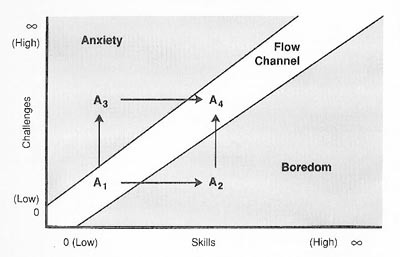
I propose that the relationship of skill level and the difficulty of the task at hand may be the connection between both concepts. Flow is typically depicted as the optimal level between boredom and anxiety:

Flow Channel

Figure 1. The Flow channel (adapted from Csikszentmihalyi, 1990, p. 70).

It seems likely that gritty persons are typically capable of overcoming the anxiety of facing challenges that seem too difficult at first. They perceive obstacles as challenges, and by conquering these challenges, the continuously expand their skill level. This, in turn, will enable them to potentially experience Flow in more difficult situations in the future. Thereby, the gratifying experience of Flow may be the reward for having pushed one´s boundaries just a little further.

To close this essay with an analogy: in my opinion, the relationship between Grit and Flow resembles the interplay of Yin and Yang in Taoism. Yin is the female, soft, or yielding principle. It can be likened to being in Flow. It´s letting go without losing control, it´s doing without doing. On the other hand, exerting Grit can be likened to Yang: it´s the male, hard, or penetrating principle. It´s holding on to preserve control, it´s doing by taking action. These principles seem to be contradictory – but in fact, they are complementary.

References

Csikszentmihalyi, M., & LeFevre, J. (1989). Optimal experience in work and leisure. Journal of Personality and Social Psychology, 56(5), 815-822.
Csikszentmihalyi, M. (1990). Flow: The psychology of optimal experience. New York: Harper-Perennial.
Duckworth, A. L., Peterson, C., Matthews, M. D., & Kelly, D. R. (2007). Grit: perseverance and passion for long-term goals. Journal of Personality and Social Psychology, 92(6), 1087-1101.
Duckworth, A. L., & Seligman, M. E. (2005). Self-discipline outdoes IQ in predicting academic performance of adolescents. Psychological Science, 16(12), 939-944.
Seligman, M. E. (2011). Flourish: A visionary new understanding of happiness and well-being. New York: Free Press.
Wiegand, D. M., & Geller, E. S. (2005). Connecting positive psychology and organizational behavior management: Achievement motivation and the power of positive reinforcement. Journal of Organizational Behavior Management, 24(1-2), 3-25.


Edit:

Just found out that I wasn´t the first person on planet Earth to have the brilliant abovementioned thoughts (What was I thinking anyway…). Here´s a very instructive blog post along similar lines by the name of Grand Unified Theory of Mastery.

On Elevation, Admiration, the Goosebumps, and Mandela

ElevationRecently, I´ve written a post on Jonathan Haidt´s research on the emotion of awe. Closely connected to this emotion is the feeling of elevation. In fact, Haidt posits that elevation oftentimes is a result of experiencing awe. Here´s what he has to say on elevation in one of his research articles on that topic:

“Elevation is elicited by acts of charity, gratitude, fidelity, generosity, or any other strong display of virtue. It leads to distinctive physical feelings; a feeling of ‘dilation’ or opening in the chest, combined with the feeling that one has been uplifted or ‘elevated’ in some way. It gives rise to a specific motivation or action tendency: emulation, the desire ‘of doing charitable and grateful acts also.’ It is the opposite of the disgust reaction towards vice. In sum, elevation is a response to acts of moral beauty in which we feel as though we have become (for a moment) less selfish, and we want to act accordingly”.

According to Haidt, elevation can be distinguished from another ‘other-praising’ emotion: admiration. In his words:

“If elevation is a response to moral excellence that does not benefit the self, […] what is the emotional response to non-moral excellence? What do people feel when they see extraordinary displays of skill, talent, or achievement? We nominate the term admiration.”

The following 3-minute Youtube clip invokes a feeling within me that seems to be a blend of both elevation and admiration. It is an African flash mob song performed by the Soweto Gospel Choir in memory and honor of the late Nelson Mandela.* Obviously, I do not understand one word – but I googled it and supposedly it means something like “Bon Voyage” or “Godspeed”. I feel admiration just by listening to the beautiful voices – but there´s also something else. I´m deeply touched and moved to tears even though I do not know what the lyrics are about. ** But just by watching and listening, you can almost physically touch the love that those singers feel for “Madiba”.

Enjoy!

* Actually, it´s a commercial – but who cares…
** So far, this has happened just once in my life. That time, it was the song “Kawaipunahele” by Hawaiian singer Keali’i Reichel.

TEDx: The happy Secret to better Work

This is a great and immensely funny TEDx Talk bei Shawn Achor. It has got close to 6 million views on the TED homepage. Good job. I didn´t know Shawn before – until yesterday, where he retweeted my blog post on the 7 most common Misconceptions about Positive Psychology. Good job, too. 😉