7 wonderful TED Talks related to Positive Psychology (Self-Motivation, Body Language, Positive Stress… and more)

Here, I present to you seven (more or less…) recent TED talks related to Positive Psychology. Enjoy!

Here´s an older list of 20 TED talks based on Positive Psychology. And by the way: I firmly believe that my own TEDx talk needs to have a least one million views. That´s just 996.783 to go. Are you going to help me out? 🙂

Your Strengths, as seen by Others: The Reflected Best Self™ Exercise

If you’re a bit like me, you do have a hard time talking about your strengths. As a German, I tend to be not that good at this – it basically is not really something that you do in our culture. I could tell you a long story about each and everyone of my flaws, but you probably don’t want to hear that.

Maybe you don’t even know what your strength are. So how are you going to find out? Obviously, there’s lots of tests and questionnaires out there. By way of example, you could take the Gallup StrengthFinder, or the VIA Questionnaire which will display your personal order of 24 character strengths according to a framework by Positive Psychology researchers Christopher Peterson and Marty Seligman.

But then, you might feel uncomfortable with regard to being assessed by an algorithm. Those tests are very reliable but on the other hand, they will only show you results depending on a fixed framework. What others really think of you or perceive as being your strengths could be a lot more nuanced than what those tests will be able to show you.

Granted, it might feel a little awkward asking other people to name your strength. The good thing is: there is a structured framework to achieve just that: the Best Reflected Self™ exercise. It was developed at University of Michigan´s Center for Positive Organizations and you can purchase the official exercise book there in case you want to use the that tool with your students or clients.

But basically, it involves just a couple of easy steps:

1) You ask a group of people that know you (friends, relatives, coworkers, clients etc.) to provide you with feedback. They should tell you what your strengths are from their point of view and ideally provide examples to back up their opinion. Instead of asking people in person, yesterday, I reached out to my network on Facebook to do just that:
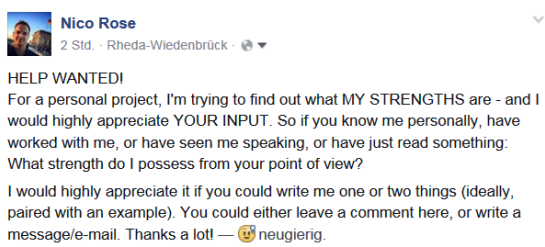
Best_Reflected_Self

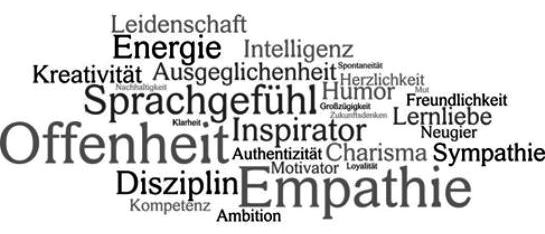
2) You gather all the responses and try to identify common themes. Here, I tried to detect all the words that alluded to a strength, turned them into nouns, and then harmonized those terms that represent very similar concepts. Finally, I took the result and inserted it into http://www.wordle.net. Here´s what came out of it (it´s German, but I guess you´ll understand most of it anyway):

Best Reflected Self - Nico Rose

3) Now, write up a paragraph, summarizing your findings, describing what you are really, really good at: this is your personal strengths profile.

4) Finally, you should reflect on your current life roles with regard to this profile. E.g., does your current job give you frequent opportunities to play on your strengths? And if the answer is “no”: what could you do to adapt your role so it better reflects your best self (–> Job Crafting)?

I have to admit it was really touching to get all this positive feedback. Typically, when you work in an organization, you tend to get feedback (if things go well…) based on what you do well, but mostly on your potential (a.k.a.: where you need to improve).

Explicitly asking people to look on your bright side exclusively yields a special kind of learning experience – it´s like a mirror that somehow manages to make you look really, really good. I definitely know that it´s an idealized picture that I don’t live up to each and every day – but I know that I have it in me. And I can rely on it when life requires me to shine…

No, the Chief Happiness Officer is not the Pizza Guy!

Smiling PizzaAs Positive Psychology has been entering mainstream media outlets over the past years, there have been people advocating for the implementation of ”Chief Happiness Officer” (CHO) role (sometimes also: Chief Wellbeing Officer) in organizations, typically as part of the wider HR/People Operations department. And while I fully endorse the idea in general (as there is a very distinct connection between employee happiness/wellbeing and organizational success, please see this article for an overview) I get really frustrated when reading what this role supposedly is all about. Here´s a selection of what I´ve read in several news outlets and blogs over the past weeks:

  • ordering pizza, ice-cream, massages and the like;
  • organizing office parties;
  • organizing trainings;
  • helping with relocation;
  • helping to individualize workplace furniture and design;

Excuse me – but are you f…..g kidding me? This is the description of a team or human resources assistant. We don´t need a CHO to achieve these things…

The Chief Happiness Officer is not the Pizza Guy!

A CHO that really deserves the C in her title would be a strategic role out and out, someone who reports directly to an organization´s CHRO or even CEO, as employee wellbeing has been shown to impact the bottom line in a pretty direct way. A CHO, the way I see it, should have a least 10 to 15 years of experience in different HR functions (e.g., leadership instruments, employer branding, payroll etc.) and should also have gained some experience in more operational roles to know about the “pain points” of the employees she´s responsible for. She would have (at least) a master´s degree in a field like organizational/occupational/positive psychology, or even an MBA with a specialization in one of those areas – and several years of experience in a leadership role. Increasingly, expertise in predictive data modelling could also be helpful, but I guess this could be delegated to a specialist. The role should be responsible for or at least significantly involved in the following processes and functions:

  1. strategy and mission development;
  2. leadership culture, development and instruments;
  3. training initiatives, especially on leadership;
  4. development of career tracks and work-time models,
  5. performance management including compensation & benefits;
  6. employee surveys, predictive analytics and other (big) data initiatives;
  7. employer branding, recruiting, and retention management;
  8. corporate health initiatives;
  9. workplace design;
  10. internal communications.

Only, if the CHO role is able to significantly influence all these tasks and processes in a concerted approach and is part of (or has regular access to) the company´s top management, it would be possible to leverage the valuable insights that Positive Psychology and especially Positive Organizational Scholarship (POS) have generated over the last 20 years. Image Source

The ROI of Happiness: Spreading the News across Germany

Dr. Nico Rose - Handelsblatt CFO KongressI am super-happy today. Just came back from back-to-back talks on Positive Psychology / Positive Organizational Scholarship in Frankfurt and Munich. On Tuesday evening in Frankfurt, I spoke to a group of about 50 CFOs at a convention hosted by Handelsblatt, one of Germany´s premier financial news outlets. I was a bit nervous since, a) it was a dinner speech and I am not that experienced in giving speeches without a PowerPoint presentation; and b)  I am obviously not a CFO myself – all participants were much older and more advanced in their careers than I am right now. Nevertheless, people were listening attentively and I received a lot of positive feedback. These were my ten main points to convince the financial leaders that investing in their employees´ happiness will bring them a solid financial return:

  1. Compensation: Happy employees are more intrinsically motivated and therefore need less extrinsic motivation. In turn, a happy workforce helps to keep personnel costs at a reasonable level over time.
  2. Health: Happy employees are sick less often, and if they are, return to work after fewer days. This helps to keep healthcare costs in check.
  3. Retention: Happy employees stay with companies for a longer time and create positive word-of-mouth. This helps to keep save costs concerning the functions of employer branding, recruiting, and training.
  4. Cooperation: Happy employees typically display more positive self-regard and therefore are better at handling conflict and situations that entail negotiation.Dr. Nico Rose - Handelsblatt CFO Forum
  5. Engagement: Happy employees display more organizational citizenship behavior (OCB) and therefore are willing to take on responsibility over and beyond their role descriptions and department boundaries.
  6. Innovation: Happy employees are more creative on average. This may foster innovation processes.
  7. Problem-solving: Additionally, they will find solutions to existing problems faster and more frequently.
  8. Meaning: Happy employees experience more meaning at work – which is one of the strongest drivers of motivation and engagement.
  9. Contagion: Happy employees will make other employees happy (at least: happier) by way of emotional contagion, potentially creating an upward-spiral of emotional well-being in the workplace.
  10. Customer Satisfaction: Happy employees will make your customers happy – via their motivation, exceptional engagement, and emotional contagion as well.

Since I was talking to CFOs, I closed my speech by referring to an article from the Journal of Financial Economics. In a paper titled “Does the stock market fully value intangibles? Employee satisfaction and equity prices”, Wharton´s Alex Edmans was able to show that a fictional stock portfolio build out of the “100 Best Companies to Work For in America’’ (as a proxy for companies whose employees are highly satisfied) has significantly outperformed carefully selected benchmarks on a yearly basis between 1984 and 2009. Ain´t that nice? They day after in Munich in a very stylish old movie theater, I spoke about Positive Psychology in general to 160 people working for the German branch of the Bonnier Group, a Scandinavian publishing house. Hopefully, this gave them tons of ideas for new books on Positive Psychology here in Germany. 🙂 Since this was my wife´s birthday and I couldn´t be home that day until dinner, I asked my audience to sing “Happy Birthday” for her – and they did. Thank you, kind people at Bonnier…

Foto credits: Euroforum / Handelsblatt

Study Alert: The Positive Psychology of Cat Content

Mappalicious - Cat ContentI knew it! I kneeeeew it!!! If millions and millions of people do something, there must be a good reason. Even if those people don’t know exactly why they are doing it.

Do you fancy watching cat content on the Internet? I do. Well, I have two real cats myself, but still Iindulge in a feline YouTube spree at least once a week. Makes me smile, makes me happy. Love it…

Researchers at Indiana University now surveyed some 7.000 people on their behavior of watching cat content online. Here’s what they found (excerpts taken from the study report on the University’s homepage):

  • They were more energetic and felt more positive after watching cat-related online media than before.
  • They had fewer negative emotions, such as anxiety, annoyance and sadness, after watching cat-related online media than before.
  • They often view internet cats at work or during studying.
  • The pleasure they got from watching cat videos outweighed any guilt they felt about procrastinating.

That’s it! Cat content = happiness. For those that now go “Duh…” because they already knew: At least, now we have science on our side…

Study Alert: The Smell of Happiness 

If you are somewhat like me, you don’t really fancy smelling other people’s sweat. But if – for whatever reason – life puts you in a situation where you have to: Make sure it’s the sweat of happy people. Why?

Because it just might make you happy (at least: happier), too. A recent study titled A Sniff of Happiness finds that people who are exposed to the body odors of happy people tend to show increasing signs of happiness themselves, e.g., they smile more compared to the time before that “exposure”.

In the words of the researchers:

We observed that exposure to body odor collected from senders of chemosignals in a happy state induced a facial expression and perceptual-processing style indicative of happiness in the receivers of those signals. Our findings suggest that not only negative affect but also a positive state (happiness) can be transferred by means of odors.

So if you are a happy person: Please throw away that antiperspirant. Make the world a more joyful place… 😉

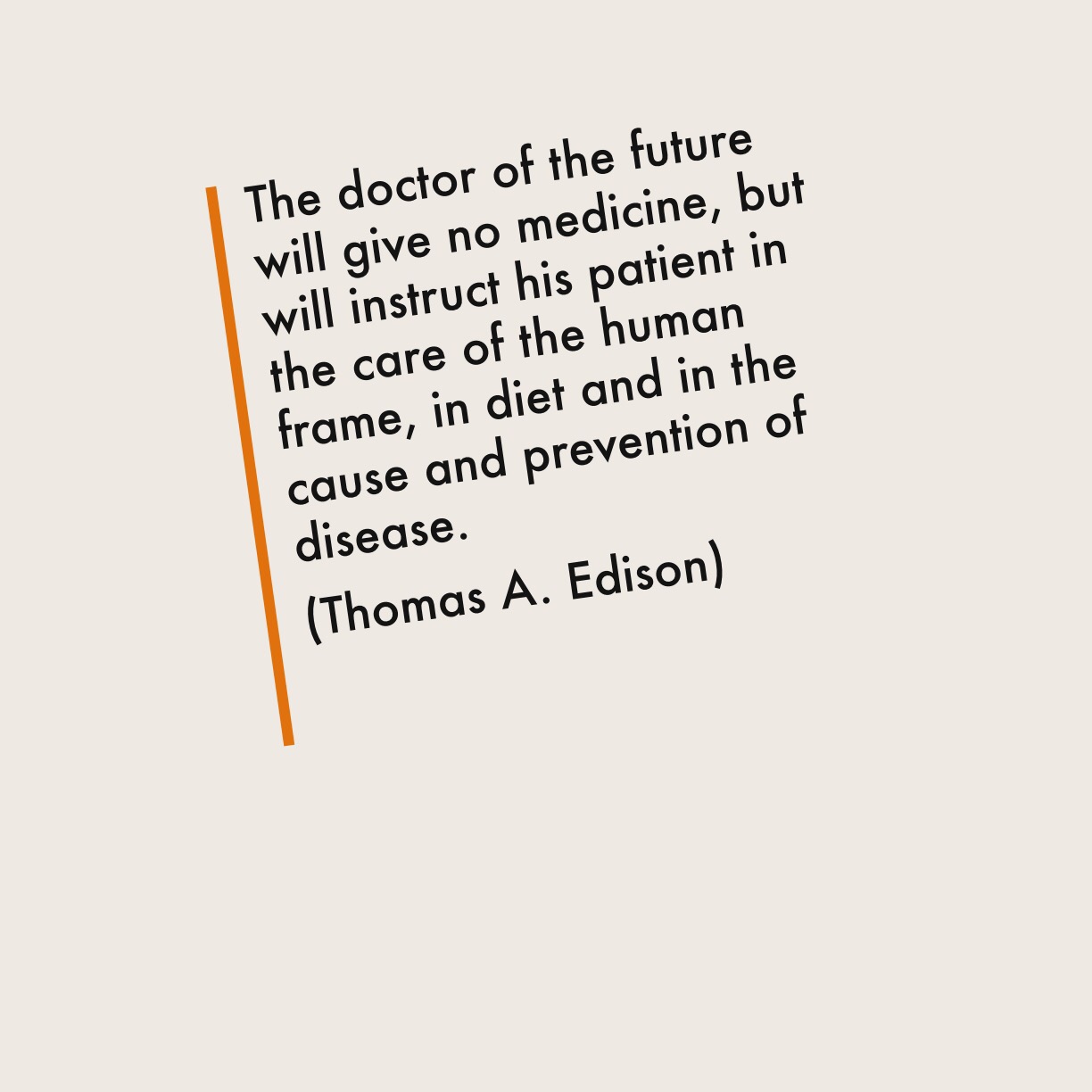
This is what Thomas A. Edison wrote about the Doctor of the Future in 1903

Thomas A. Edison seems to be an endless source of witty quotes and quotable wisdom. I stumbled upon this one some days ago. Transfer his words from medicine to psychology (which practically did not exist at that time) and you get a near-perfect description of what Positive Psychology tries to accomplish in the realm of mental and emotional well-being.

Edison - Doctor of the Future
When I look at how often stuff like Prozac and Ritalin is given to people, there obviously is still a long way to go for us. But it will be done…

I´ve got 99 Words for Happiness, but the Germans only have One

In earlier posts, I´ve shared with you my personal feeling that Positive Psychology and the German language seem to be a bit of a mismatch, as my mother tongue is impoverished with respect to words describing positive experiences and states of being. Later on, I shared a study that is able to demonstrate that some languages are indeed happier than others – in that they are able to “hold” more positivity.

Today, I stumbled upon another piece of evidence pertaining to that matter. Below, you´ll see screenshots of the two most important translation websites in Germany. On the left, you can see the English words, a wide array positive states (of mind). On the right, the German translations are displayed. As you can see, all those English words are translated into the same German expression: Glück.

If Wittgenstein was right, and “The limits of my language means the limits of my world”, then having only a single word for what really should be a wide spectrum of words (corresponding to a wide spectrum of feelings) can be likened to being color-blind. It´s an impaired state of perception, or at least an impaired ability to convey one´s perceptions. And what good are emotions if they cannot be accurately named and shared?

Glueck - Luck

Glueck - Luck

Positive Psychology has Changed the Way I Live, Lead, and Love

Martin Seligman & Nico RoseFacebook has been gentle enough to remind of the fact that my graduation from Penn took place a year ago. If you´d like to know what were my take-aways right at the end of the MAPP program, please read this post: My Mind´s MAP(P).

Looking back with a bit of temporal, spatial, and mental distance, I am able to say that this experience has changed my life in basically all of its important facets. I am not going to tell that I am a “totally different person” or something like that – because it´s not true. But my deep-dive into Positive Psychology has transformed – to some extent – the way I live, lead and love on a very tangible level. I just do some things differently by being more open.

I hope to continue on this path of increasing openness – and I hope I can continue sharing my experience and knowledge with you… 
Penn Graduation 2014