Two new Articles by Dr. Nico Rose on Positive Psychology in the Workplace

Dr. Nico RoseFor my German-speaking readers: I’ve recently published two articles in Positive Psychology in the workplace.

The first one covers the antecedents and consequences of Flow at work. It was published online by the German psychology magazine EMOTION.

The second one is an overview of several concepts in the realm of Positive Psychology in business and features the work of Martin Seligman, Barbara Fredrickson, Jane Dutton, Roy Baumeister, and Shawn Achor.

Share and enjoy!

How Leaders Enable Meaningful Work [Infographic]

Thanks to the stunning infographics of Anna Vital (see them here, here, and here), I’ve decided to learn how to better think and communicate in a visual way. I’m not a designer, so I don’t know how to work with Software packages like Illustrator. Therefore, for the time being I have to use what’s already out there, e.g., the Webdings that come with Microsoft’s fonts.

To start, I´ve chosen a topic that´s very close to my heart: Meaningful work. Prof. Michael F. Steger is one of the world´s foremost authorities on this topic. He created the acronym CARMA to outline a set of leadership behaviors that help employees to perceive their work as being valuable and meaningful.

What do you think?

CARMA_Work

Share and enjoy!

The healthiest Companies outperform their Competition on the Stock Market

Smiling - MappaliciousAre you working for a company that treats you like a valuable human being? Do they care about your psychological and physiological health? Yes? Good for you! And good for them as well!

A couple of weeks ago, I shared Alex Edmans´ studies on how the “Best Companies to work for” in the U.S. outperform their competitors on the stock market. Now here comes another piece of compelling evidence for the idea that treating your employees exceptionally well is not a cost factor, but rather gives your company an edge pertaining to financial performance. For a study published in the Journal of Occupational & Environmental Medicine, a group of researchers compared the stock market performance of companies that were awarded the “. Everett Koop National Health Award”(a prestigious award for companies running outstanding employee health programs named after a former Surgeon General) with the average performance of companies comprising the Standard and Poor’s (S&P) 500 Index. What they´ve found:

The Koop Award portfolio outperformed the S&P 500 Index. In the 14-year period tracked (2000–2014), Koop Award winners’ stock values appreciated by 325% compared with the market average appreciation of 105%.

The researchers conclude that “this study supports prior and ongoing research demonstrating a higher market valuation – an affirmation of business success by Wall Street investors – of socially responsible companies that invest in the health and well-being of their workers when compared with other publicly traded firms.”


Image via Gratisography


Farewell to Competitiveness – Why Companies need a New Operating System

This post is just a little off-topic, but really just a little. Marc Stoffel is the CEO of Haufe-umantis, a Swiss software company. What make him special is the fact that he´s an elected CEO.

Haufe-umantis is special in many ways. Among the peculiarities is the fact that all leaders within the company are chosen by a democratic election – up to the position of CEO. I´ve had the chance to meet Marc on a couple of occasions. He´s a great guy and holds very intriguing conceptions of leadership, organization design, and engagement. One of his quotes still rings in my ears very clearly:

Employees choose their leaders each and every day – whether they are allowed to or not.

Why Companies with Happy Employees outperform their Competition on the Stock Market

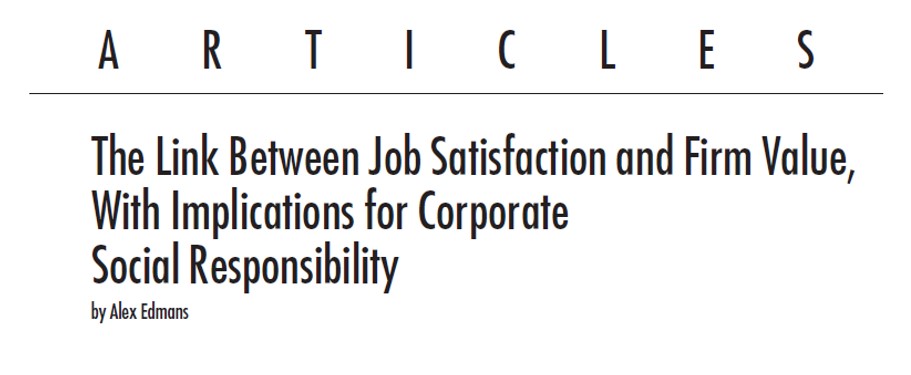
Edmans_SatisfactionDo happy employees affect a company´s bottom line (in a positive way)? What seems like no-brainer is actually quite hard to detect in real life. Studies in Positive Organizational Scholarship have been able to show that happy workers tend to be more productive, but this relation has been mostly detected for individuals, not on the “systems level”.

Alex Edmans, finance professor at London Business School, has been busy trying to change that. He created a hypothetic stock portfolio comprised of the “100 Best Companies to Work For in America” (as a proxy for organizations that treat their employees exceptionally well) and tracked this for more than 20 years. His conclusion: after controlling for confounding variables such as company size and industry, employee-centric companies significantly outperform their competitors year after year.

What more, he also seems to able to detect a causal relationship. Over the years, some firms drop out of the “Best Companies” ranking, while others obviously make it for the first time. Edmans finds that corporations begin to outperform their competition – several years after they´ve managed to be listed on that index.

Here are Edmans´ original research papers on this fascinating topic:

Alternatively, you can read a summary in this piece on The Atlantic: Happy Workers, Richer Companies?

Or, you can have him explain it to you personally via his TEDx talk. Share and enjoy!


Alex Edmans´s talk will also be posted as No. 48 on my topical list of Positive Psychology-infused TED talks, Michael Norton´s is already there.

Job, Career, or Calling? It´s the Attitude, Stupid!

The other day, for a German news outlet I regularly blog for, I wrote something on Amy Wrzesniewski´s research on our orientations towards work – so why not do it here as well.

Conventional wisdom tells us that there are more meaningful (e.g., nurse) and less meaningful (e.g., cleaner) jobs out there. Yet, Wrzesniewski and her colleagues found that the level of meaning (or purpose) we can derive from our work is only partly dependent on the type of job per se. The way we think (or feel) about what we do seems to have more importance in this matter. The researchers describe three separate (but not mutually exclusive) orientations that people can take on vis-à-vis their occupation: a) job; b) career; c) work.

Work Orientation: Job

People in this category tend to perceive their work as a means to an end. They work for the paycheck/benefits to support their life outside of work. Accordingly, they prefer jobs which do not interfere with their personal lives and typically do not have a strong connection to the workplace or their job duties.

Work Orientation: Career

Individuals displaying a “career” orientation are more likely to focus on job attributes related to prestige and success. They will be foremost interested in opportunites for upward movement, e.g., receiving raises and titles, and the social standing that come along with that.

Work Orientation: Calling

Employees with a “calling” orientation typically describe their work as an integral part of their lives and their identities. Accordingly, they feel that their careers are a form of self-expression and fulfillment.

The crucial point is: Wrzesniewski and her colleagues found that individuals displaying a “calling” orientation are more likely to be highly engaged – and satisfied with their work and their lives in general. And while there are types of jobs that indeed yield a higher percentage of employees displaying this attitude, the researchers were able to show that each orientation frequently appears within all walks of life.

Typically, this involves being able to “see the big picture” (and thus, leadership comes into play). E.g., a cleaner in a hospital setting might say that she helps to “save lives” (instead of, e.g., cleaning the beds) because she knows that she helps to kill off bacteria that otherwise might infect and kill the patients.

Now, I don’t know how the people displayed in the following video view their work – but they´ve surely turned it into something extraordinary – even though most of them seem to work in rather ordinary jobs. Enjoy!

German Workforce is especially stressed out. One more reason to bring Positive Psychology to Deutschland

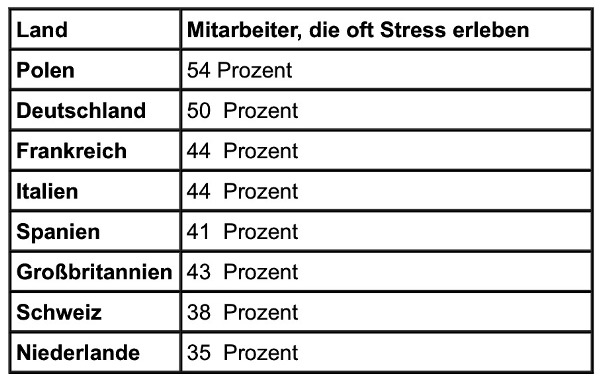
Stress - Germans - ADPThe European branch of HR consulting firm ADP has surveyed some 11,000 employees across eight countries of the continent (link to press release). One of the striking results:

Despite (Or maybe: Due to?) a distinctly flourishing economy which displays an unemployment level at its lowest since the time before the reunification, Germany’s workforce seems to be utterly stressed out. 50% of workers report they are “frequently stressed” at work. That puts us in second place behind the Polish. On the other end of the continuum, stress levels are the lowest in the Netherlands*. Now what is happening here? Are my fellow countrymen really all that stressed? Or is just more accepted, or even en vogue, to report that one is stressed out?

Because the funny thing is: Several other studies show that Germans work considerably less hours per year compared to almost any other nation. Most of us can take between 24 and 30 days of vacation, there’s countless bank holidays – and working hours are pretty acceptable on average (see some more details here). So, by any means, this should be a workers’ paradise. Still, 50% heavily complain about the status quo.

My guess: it’s a question of mindsets, of attention, and focus. I’ve already written several posts on how German culture has an inclination towards “loving the negative”, and how we are overly anxious on average (e.g., how German lacks some positive words; or how studying Positive Psychology to me seemed like a course in being Un-German). Feeling overly stressed at work when we really live in a sort of land of milk and honey seems like a relative of “German Angst” or “Weltschmerz”.

But beware, my fellow countrymen: Positive Psychology will definitely come to a place somewhere near you. Even if I have to do it all by myself…


*According to the cliché, that must be because of all that dope they smoke over there…

Should you really “Follow your Passion“? Yes, but…

StinkefingerOne of the most common pieces of self-help advice is to “follow your passion”. Countless authors propagate this is the surefire way to lasting success and happiness at work (please also read Following your Bliss vs. following your Blisters).

Research suggests that, on the one hand, this may be good advice, but that things are not as simple as they seem, on the other hand. According to Robert J. Vallerand and his colleagues, there is a distinction between what they call harmonious vs. obsessive passion. In general, they define passion as

a strong inclination toward an activity that people like, that they find important, and in which they invest time and energy. Thus, for an activity to represent a passion for people, it has to be significant in their lives, something that they like, and something at which they spend time on a regular basis.

They further propose that

there are two types of passion, obsessive and harmonious, that can be distinguished in terms of how the passionate activity is internalized into one’s core self or identity.

In detail:

Harmonious passion results from an autonomous internalization of the activity into the person’s identity. An autonomous internalization occurs when individuals have freely accepted the activity as important for them without any contingencies attached to it. This type of internalization produces a motivational force to engage in the activity willingly and engenders a sense of volition and personal endorsement about pursuing the activity. Individuals are not compelled to do the activity but rather they freely choose to do so. With this type of passion, the activity occupies a significant but not overpowering space in the person’s identity and is in harmony with other aspects of the person’s life.

Whereas:

Obsessive passion results from a controlled internalization of the activity into one’s identity. Such an internalization originates from intrapersonal and/or interpersonal pressure either because certain contingencies are attached to the activity such as feelings of social acceptance or self-esteem, or because the sense of excitement derived from activity engagement becomes uncontrollable. Thus, although individuals like the activity, they feel compelled to engage in it because of these internal contingencies that come to control them. They cannot help but to engage in the passionate activity. The passion must run its course as it controls the person. Because activity engagement is out of the person’s control, it eventually takes disproportionate space in the person’s identity and causes conflict with other activities in the person’s life.

Vallerand as his coworkers have developed a scale to assess whether a certain aspect in our lives is a harmonious or an obsessive passion, e.g., for harmonious passion:

  • This activity allows me to live memorable experiences.
  • This activity reflects the qualities I like about myself.

And for obsessive passion:

  • I have difficulty imagining my life without this activity.
  • I am emotionally dependent on this activity.

After having developed and validated the scale, they evaluated some of the consequences of having harmonious vs. obsessive passion in our lives. Here’s their synopsis:

Harmonious passion was positively related to positive affective and cognitive (concentration and flow) experiences and to the absence of negative affect during and after activity engagement. In addition, harmonious passion was unrelated to negative affect and cognition when people were prevented from participating in the passionate activity. Conversely, obsessive passion was unrelated to positive affect and cognition during task engagement but positively associated with negative affect during and after activity engagement, as well as when prevented from engaging in the passionate activity.

Additionally, there were able to show that

the positive affect experienced during task engagement seems to spill over onto how the person feels in general in his or her life. More specifically, it appears that harmonious for the activity leads to increases in general positive affect over time even when the person is not directly engaged in the activity.

So, in the future you might want to be a little more careful when giving someone the advice to follow their passion. Only those that are intrinsically motivated and really fit it with the “overall system” of that person will lead to growing satisfaction and a fulfilled live.

Research: Linking “Positive Practices” to Organizational Effectiveness

Stones - GrowthThere are tons of books out there explaining how to use Positive Psychology for boosting the performance of organizations. But the truth is: from a scientific point of view, we really do not know very much about this link. There’s abundant research on the connection of positivity and individual performance – but it remains by and large unclear if this influence on the micro-level yields any outcomes on the macro-level. Of course, it seems to make a lot of sense to infer this relationship – but where’s the research?

A very worthwhile attempt is offered via an article named Effects of positive practices on organizational effectiveness by Kim Cameron and his colleagues. Based on prior research, they developed an inventory of what they call “positives practices”. According to the authors, these can be described as

behaviors, techniques, routines […] that represent positively deviant (i.e., unusual) practices, practices with an affirmative bias, and practices that connote virtuousness and eudemonism in organizations.

In order to do so, they administered a large number of questionnaire items to diverse groups of people. Afterwards, they clustered the answers in order to find common themes and pattern in the data. They found that all positives practices could be categorized into six distinct subgroups:

Caring

People care for, are interested in, and maintain responsibility for one another as friends.

Compassionate Support

People provide support for one another including kindness and compassion when others are struggling.

Forgiveness

People avoid blame and forgive mistakes.

Inspiration

People inspire one another at work.

Meaning

The meaningfulness of the work is emphasized, and people are elevated and renewed by the work.

Respect, Integrity, and Gratitude

People treat one another with respect and express appreciation for one another. They trust one another and maintain integrity.

Having found that structure, they gathered data from several divisions of a financial services company and one operating in the healthcare industry. They asked employees to assess their respective business unit (= the organization as a whole, not individuals) with regard to being a place that possesses the aforementioned attributes. Additionally, they obtained data on several objective and subjective key performance indicators of those business units – and finally looked at the connection of the presence of positive practices and organizational effectiveness measures. Here´s what they´ve Cameron and his colleagues found (in their own words):

In Study 1, positive practices in financial service business units were significantly associated with financial performance, work climate, turnover, and senior executive evaluations of effectiveness. In an industry in which positive practices might be assumed to carry little importance, organizational performance was substantially affected by the implementation of positive practices.

In Study 2, improvement in positive practices over a two year period in health care units predicted improvements in turnover, patient satisfaction, organizational climate, employee participation in the organization, quality of care, managerial support, and resource adequacy.

 In the course of arguing why positive practices should have a performance-boosting effect, the authors conclude that

cognitively, emotionally, behaviorally, physiologically, and socially, evidence suggests that human systems naturally prefer exposure to the positive, so it is expected that organizational performance would be enhanced by positive practices.

Of course, Cameron et al. urge us to be careful not to make strong inferences from their results:

The results of these two investigations, of course, are suggestive and not conclusive.

Still, their work is one of the first and still very rare pieces of research that links positive organizational behavior to organizational effectiveness. I am very much looking forward to scholars who pick up on these findings and expand our knowledge on the positivity-performance link.

22 Positive Psychology-infused Articles every (HR) Leader should know

Positive Organizational ScholarshipPositive Psychology has a lot to offer for leaders, especially those people taking on a leadership role in human resources and people management. In this post, I´ve gathered 22 research articles infused by Positive Psychology (more specifically: Positive Organizational Scholarship) that, in my opinion, have tremendous value for aspiring as well as established managers and entrepreneurs.

The topics comprise desirable attributes and personality variables such as grit, character strengths, and core self-evaluations, how to create positive relationships at work, how employee motivation is created and sustained, how to find meaning and purpose in work, and several review articles, e.g., on the connection of positive emotions and job performance. Enjoy!

P.S.
This is my 300. post since I’ve started Mappalicious about two years ago. Giving myself a slight pat on the back right now…