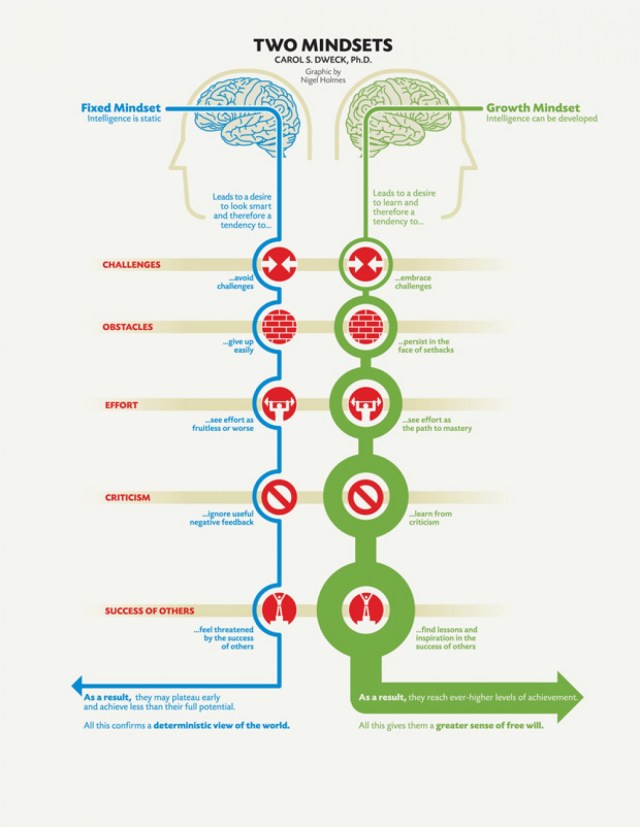
Infographic: Carol Dweck and the Growth Mindset

Now, I´m aware that this infographic (created by Nigel Holmes) has been around for a while – but then, there´s probably some 6,999,000,000 people on this planet who have not seen it as of yet – so I´m doing an important job here. 😉

The Growth Mindset – based on Carol Dweck

Growth Mindset

U.S. Researchers are lucky – as the top-tier Universities are very strong Brands

This is a little off-topic – but over the last days, I came to realize how much easier it appears to be for top (psychology) researchers in the U.S. to “create buzz” around their research and/or book publications compared to their German colleagues.

Over the last weeks, a couple of researchers in the field of Positive Psychology and adjacent whom I am loosely acquainted with (e.g., Adam Grant, Scott Barry Kaufman, and Emma Seppälä) or whom I would like to be loosely acquainted with (e.g., Amy Cuddy – we´re following each other on Twitter; I guess that doesn´t count…) have published new books (Congratulations to all of you!):

Because a) these are all fabulous books; b) they all probably have more than decent PR agents; and c) I follow a heck of a lot of Positive Psychology people on Twitter, Facebook, and LinkedIn my timelines are bursting with posts about their books (reviews, excerpts, and interviews). Now here´s the interesting thing – look at these headlines:

This is a random sample. Even though – from my perspective – Adam Grant has become a sort of personal brand, and Amy Cuddy is well on her way to becoming one (there´s not too many social psychologists who get air time on the Late Show with Stephen Colbert), very often the research is marketed via the university they are affiliated with.

So, it´s clear that these institutions over time have managed to become strong brands. Their names validate and even amplify the messages publicized by their faculties. That’s a really cool thing!

Now, if you are from the U.S. you might say: Duh, tell me something new. But seen from a German perspective, this is really remarkable – because (currently) this would never work over here. You just won’t see a headline along the lines of “A Humboldt University of Berlin Researcher says X” – because the names of the universities do not really add any credibility to the message (at least not in the realm of psychology; with, e.g., engineering, it might be a slightly different story).

As a side note: I have not seen that many headlines featuring my MAPP alma mater, UPenn (with Wharton Business School being the exception). Maybe, it’s time for some more brand-building here?

Stanford_Psych

10 more Blogs on Positive Psychology and adjacent You Need to Know

IMG_2317A while ago, I posted a list of 10 blogs on Positive Psychology and adjacent I frequently visit. Back then, I already said it was hard to limit the selection to only 10 sites. Therefore, here´s another curated list of cool Positive Psychology blogs. Share and enjoy!

Eric Barker writes Barking Up The Wrong Tree. He brings you science-based answers and expert insight on how to be awesome at life. His content has been featured in the New York Times, the Wall Street Journal, Wired Magazine and Time Magazine.

The Greater Good Science Center at Berkeley (co-founded by Professor Dacher Keltner) “studies the psychology, sociology, and neuroscience of well-being, and teaches skills that foster a thriving, resilient, and compassionate society”. They frequently publish articles by their own staff as well as guest articles by eminent researchers.

In their own words, The Creativity Post (co-founded by Scott Barry Kaufman) is “a non-profit web platform committed to sharing the very best content on creativity, in all of its forms: from scientific discovery to philosophical debate, from entrepreneurial ventures to educational reform, from artistic expression to technological innovation – in short, to all the varieties of the human experience that creativity brings to life.”

The Center for Positive Organizations (staff includes Professors Jane Dutton, Kim Cameron, Robert Quinn, and Gretchen Spreitzer) based at the Ross School of Business (University of Michigan) seeks to “inspire and enable leaders to build high-performing organizations that bring out the best in people. We are a catalyst for the creation and growth of positive organizations.” They regularly publish articles by the aforementioned researchers and scholars in Positive Organizational Scholarship.

Paula Davis-Laack is a fellow Penn MAPP alum and writes a regular column called Pressure Proof about “strategies and stories for busy, complicated lives” on Psychology Today.

In their own words, The Pursuit of Happiness is a “group of psychologists, philosophers, educators, and web professionals dedicated to the advancement of scientific knowledge about happiness and depression prevention. We provide science-based information on life skills and habits needed to enhance well-being, build resilience against depression and anxiety, and pursue a meaningful life.” Professor Todd Kashdan is one of the contributors.

Happiness by Design is a column on Psychology Today by London School of Economics´ Professor Paul Dolan. It doesn’t update very often by the posts are cool to read.

Action for Happiness is a movement of people committed to building a happier and more caring society. We want to see a fundamentally different way of life – where people care less about what they can get just for themselves and more about the happiness of others. Sir Richard Layard is among the founders. They publish compelling pieces by top-tier Positive Psychology researchers and experts in their news section.

To my mind, Michael Tomoff is one of the few people who write stuff worth reading on Positive Psychology in German. His blog is called Was wäre wenn? (What if?).

The last one is a sort of honorable mention. The late Professor Christopher Peterson published an immensely insightful and oftentimes very funny Positive Psychology blog via Psychology Today called The Good Life. Even though it has not been updated ever since 2012 (for obvious reasons), I revisit it frequently for inspiration.
Infographic: How to be Wise – as an Entrepreneur (and in Life)

This is another really cool infographic by Anna Vital of Funders and Founders. And I think the quotes she gathered do not only apply to the realm of entrepreneurship but getting sh.t done in general. When I look at that graphic (which means through the lens of Positive Psychology), I see insights on self-efficacy, self-concordance, grit and perseverance, and hope (theory).

Share and enjoy!

Wise_Vital

Two new Articles by Dr. Nico Rose on Positive Psychology in the Workplace

Dr. Nico RoseFor my German-speaking readers: I’ve recently published two articles in Positive Psychology in the workplace.
The first one covers the antecedents and consequences of Flow at work. It was published online by the German psychology magazine EMOTION.

The second one is an overview of several concepts in the realm of Positive Psychology in business and features the work of Martin Seligman, Barbara Fredrickson, Jane Dutton, Roy Baumeister, and Shawn Achor.

Share and enjoy!

Infographic: Building Blocks of the Good Life (PERMA-V)

This is the second artwork (well…) in my self-imposed learning journey on the way to producing decent infographics. This time, I chose Martin Seligman´s PERMA framework, which, by many people, is considered to be the most comprehensive framework of “the good life”, the foundation of Positive Psychology in science and practice.

Since PERMA is not exactly hot from the presses, I added a little twist: For a couple of years now, Marty challenges his students in the Penn Master of Positive Psychology program to propose meaningful additions to the original PERMA outline (Positive Emotions | Engagement | Relationships | Meaning | Achievement). Over time, it became clear that the original framework may be somewhat “neck-up”, thereby omitting aspects such as sports, sex, sustenance, and sleep.

PERMA-V: Positive Psychology, neck-up and neck-down

Therefore, students kept asking for the letter “S” to be added – which ultimately would result in the acronym PERMAS (doesn´t sound too funky…) or SPERMA (uh-uh, not a proper name for a scientific term…). Meanwhile, there seems to be a growing mutual consent to choose the letter “V” for Vitality – and to put it at the end with a hyphen. To my knowledge, this was first proposed by a fellow Mapp graduate, Emiliya Zhivotovskaya.

What do you think?

PERMA_V_Good_Life

Share and enjoy!

How Leaders Enable Meaningful Work [Infographic]

Thanks to the stunning infographics of Anna Vital (see them here, here, and here), I’ve decided to learn how to better think and communicate in a visual way. I’m not a designer, so I don’t know how to work with Software packages like Illustrator. Therefore, for the time being I have to use what’s already out there, e.g., the Webdings that come with Microsoft’s fonts.

To start, I´ve chosen a topic that´s very close to my heart: Meaningful work. Prof. Michael F. Steger is one of the world´s foremost authorities on this topic. He created the acronym CARMA to outline a set of leadership behaviors that help employees to perceive their work as being valuable and meaningful.

What do you think?

CARMA_Work

Share and enjoy!

The surprising and simple Definition of Coaching

There are lots of definitions on coaching – what it is, and what is not. Most of them are rather long and circuitous. When I try to explain the process of coaching to my new clients, I oftentimes used this visual metaphor.

Coaching = Recognizing, understanding, and changing patterns.

What do you think?