A couple of weeks ago, I posted an article from the Huffington Post on the habits of supremely happy people.
Last week, the German edition of Huffpo was launched. The translated this article into German. It is available here.
A couple of weeks ago, I posted an article from the Huffington Post on the habits of supremely happy people.
Last week, the German edition of Huffpo was launched. The translated this article into German. It is available here.
The silence on Mappalicious is officially over. I´ve been travelling over the last 14 days and obviously have been too busy actually living my life in order to write about it in addition. And while doing this, I´ve made an interesting discovery: you can spend your days in New York (arguably the most exciting place on Earth) with a bunch of really nice people and a great program (Broadway musical, boat tour on the Hudson, party at one of the best rooftop bars in town etc.) – and still end up crying your eyes out in the hotel room. Just because you miss baby boy so much. True story…

Which raises a question on the nature of Positive Psychology:
Is Positive Psychology about leading a happy, pleasurable life? Or is it about leading a virtuous, meaningful life?
The answer is: both aspects are important – but if you would ask Marty Seligman, he´d say the emphasis clearly should be on cultivating strengths, virtues, and meaning. While experiencing lots of positive emotion definitley is a goal in Positive Psychology (because it just feels good to feel good; but more important: because positive emotions produce lots of beneficial ‘side effects’) they are only one element (P) of PERMA, Seligman’s theory of human flourishing.
On the overarching level, it is possible to distinguish between the quest for hedonic (pleasurable) and eudaimonic (virtuous) experiences. Both clearly are important for leading a ‘full’ life, but Eudaimonia may just be a little more sustainable in the long run. When creating a 2×2 matrix with Eudaimonia on the one axis and Hedonia on the other, it will look like this:
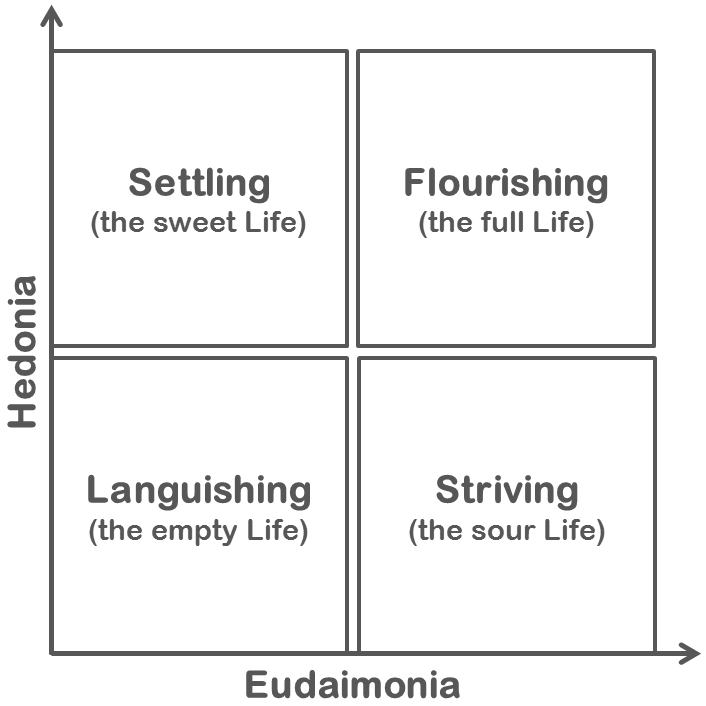
If you´d like to learn more: I´ve written an article in a coaching magazine on that topic about a year ago. It´s in German unfortunately – but I know that many German-speaking people are reading this blog, too…
A couple of days ago, I finished The Paradox of Choice by Barry Schwartz and wrote a short article on the idea that unlimited choice can make us miserable. In the meantime, I picked up a true classic of Positive Psychology: Flow by Mihály Csíkszentmihályi* (actually, it was written about 10 years before Seligman and Csíkszentmihályi coined the term Positive Psychology). Now there are some interesting parallels in those two texts, namely on setting boundaries for oneself to enjoy more freedom and thus to experience order in consciousness (which is one definition of Flow).

By Oliver Kurmis via Wikimedia Commons
I have a full-time job as a manager, I work as a coach on the side, teach at a business school, study in the MAPP, run several blogs and publish articles in practitioner journals very regularly – and I am a husband and a father. Therefore, people often ask me about my time management. The truth is: I may be somewhat of a workaholic (in a positive sense) and I do not regularly get those eight hours of sleep that my body craves for. But the other side of the coin is: I do not waste any of my time! There simply are a lot of things that I choose not to do – even though I know I would immensely enjoy them.
Let´s see what Csíkszentmihályi has to say on what could be called ‘fake flow’:
“[I]nstead of using our physical and mental resources to experience flow, most of us spend many hours each week watching celebrated athletes playing in enormous stadiums. Instead of making music, we listen to platinum records cut by millionaire musicians. Instead of making art, we go to admire paintings that brought in the highest bids at the latest auction. We do not run risks acting on our beliefs, but occupy hours each day watching actors who pretend to have adventures, engaged in mock-meaningful action.”
Enter Barry Schwartz:
“But if unrestricted freedom can impede the individual’s pursuit of what he or she values most, then it may be that some restrictions make everyone better off. And if “constraint” sometimes affords a kind of liberation while “freedom” affords a kind of enslavement, then people would be wise to seek out some measure of appropriate constraint.”
I intuitively threw out my game console at age 14. Back then, I spent day after night after day playing strategy games like ‘Sim City’ or ‘Civilization’, which is totally fine – for a teenager. The thing is: I´m pretty sure I´d still do it today. Those games fulfill the requirements for a flow experience to a very high extent (goal clarity and immediate feedback, high level of concentration, balance between skills and challenge, feeling of control, effortlessness, altered perception of time, melting together of action and consciousness, autotelic quality).
But it is not the real McCoy. It does not get things going in the real world. And while I would never argue that playing is not for grown-ups, as always, it’s the dose that makes the poison. Same thing with watching TV: I know there are a lot of absolutely great TV series out there. I´m positively sure I would immensely enjoy ‘Mad Men’, ‘Breaking Bad’, ‘Boardwalk Empire’, and all the other Emmy-winning masterpieces out there. That´s why I have never watched a single episode. I choose not to be immersed in those artificial worlds. I feel my life is fascinating enough.
Let´s hear Csíkszentmihályi once more:
“The flow experience that results from the use of skills leads to growth; passive entertainment leads nowhere. Collectively we are wasting each year the equivalent of millions of years of human consciousness. The energy that could be used to focus on complex goals, to provide for enjoyable growth, is squandered on patterns of stimulation that only mimic reality.”
I take my hat off to the producers of those series. It takes a lot of effort and human consciousness to create them. But how much consciousness is lost by consuming them? I don´t like to squander mine. Maybe we can all learn a lesson from Odysseus: sometimes, we need to be tied up in order to hear the music…
*If you´ve ever wondered how to pronounce his name in English: it´s something along the lines of ‘Me-High Chicks-Sent-Me-High’. 🙂
On September 22, the ‘Bundestag elections’ will take place. The Germans are to decide which political party (or rather, coalition of parties) is to govern the ‘nation of poets and thinkers’ over the upcoming four years. Pollsters are very sure that the Christian Democratic Union (CDU, lead by Angela Merkel) will be victorious – but that does not necessarily mean Merkel will be able stay in the chancellery. The Free Democratic Party (FDP), Merkel´s ‘natural’ coalition partner, may turn out to be too weak to go on with the reigning coalition. Apart from the results per se, I´m really curious to see what the voter turnout is going to be. The following graph (© Wahlschlepper) shows this figure for every Bundestag election since 1949: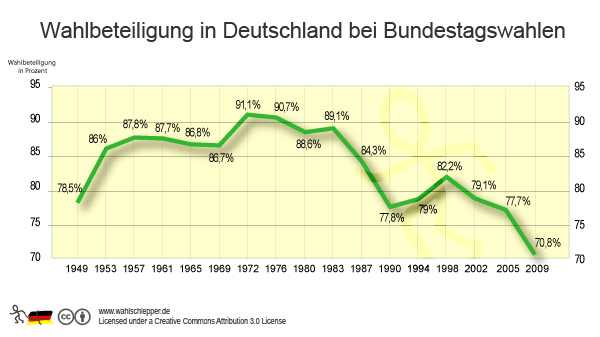
Obviously, there is a steep decline of voter turnout (or rather: a notable increase in the numbers of nonvoters) since the 1998 election that lead to the voting out of Helmut Kohl. Before that, a decline is observable as well, beginning after 1983, the year, Kohl was re-elected for the first time. I guess, all throughout the 80ies, a lot of people (his supporters as well as his opponents) thought Kohl was going to win anyway – so there was no need to show up.
But I feel it´s something else when looking at the years after Kohl´s dismissal. I wonder if this increase in nonvoting behavior can be explained by the theory of Learned Helplessness (LH). Martin Seligman spent most of his career prior to becoming one of the founding fathers of Positive Psychology in the not-so-positive realm, e.g., studying the nature of depression – which eventually led to his formulation of the theory of LH. In an nutshell, this is a psychological state that leads to behaviors such as passiveness and apathy. It can be elicited by exposing subjects to conditions where they repeatedly experience that their actions have no effect on the outcome of future events (e.g., avoiding a painful electric shock). A lack of control with regard to future events makes people impassive – and oftentimes, miserable. So where is the link to the upcoming elections?
Put simply: since Helmut Kohl´s dismissal, in Germany you can pretty much not be sure any more about getting those politics you´ve voted for. And I´m not talking about silly voting pledges here. I´m talking about the fundamentals of what it (supposedly) means to be a ‘conservative’ as opposed to being a ‘liberal’. Lets put aside for the time being that the political landscape in Germany may be a bit more complicated that its U.S. counterpart – mainly due to the existence of several smaller parties in addition to the ‘big two’: the Christian Democrats and the Social Democratic Party (SPD).
Now suppose you vote for the Republican party in the U.S., they win – and a certain time after the election, they cut down on the military budget, start to mess with the nuclear power lobby, or think out loud about a financial transaction tax. Or, on the other hand, you vote for the Democrats, they win, and shortly after the election, they lower the top income tax rate, pass a bill that severely cuts the welfare budget, and becomes immensely popular among the nations corporate top executives. Sounds strange? But basically, that is what has happened in Germany over the last decade.
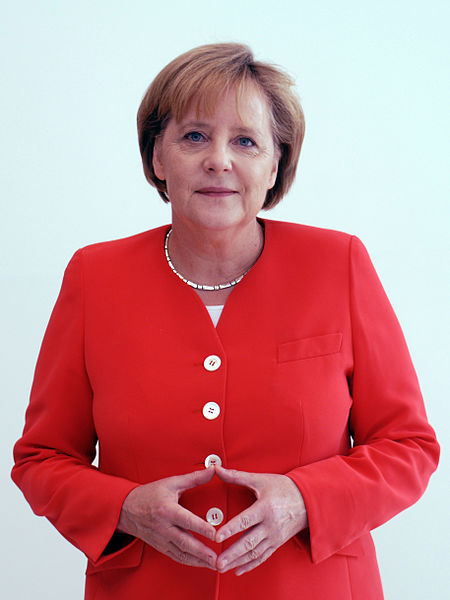
Gerhard Schröder, social-democratic chancellor from 1998 – 2005 (in a coalition with the Greens) has…
By Armin Linnartz via Wikimedia Commons
Angela Merkel, with her ‘conservative’ coalition, on the other hand, since 2005 has:
So is this the reason for the German ‘Politikverdrossenheit’ (disenchantment with politics)? Because we cannot be sure we´ll get what we vote for? Anyway, pollsters say there´s a considerable likelihood for a new edition of the ‘Grand Coalition‘ (a coalition of CDU & SPD). Both Merkel and her opponent, Peer Steinbrück do not grow tired of saying that this would be the worst outcome. But I guess, in secret, that´s a wrap already…
I´m in London for a couple of days. No time to blog. Still, you might want to check out this comprehensive article on Positive Psychology from the Huffington Post:
Please have a look at this great blog post from a 2012/2013 Mappster:
The fourth day of MAPP immersion week was again crammed with extraordinary lectures by extraordinary lecturers. The morning belonged to Roy Baumeister, one of the most highly acclaimed social psychologist in the world. He has conducted studies on a multitude of phenomena over the years, but may be known best for his research on willpower and self-control, carrying out experiments something along the line of this: He will put people in a room and have them sit at a table. On the table, there´s a plate full of tasty chocolate cookies; and another one with something to eat that is not attractive at all. People are told to wait for a couple of minutes. In addition, half of them are told not to touch the cookies – while it is totally o.k. to eat the other stuff.
Afterwards, the participants are lead into another room where they get a specific task, e.g. solving unsolvable anagrams. It is then measured how long the they will try to solve the anagrams before giving up. It turns out that people who were not allowed to touch the cookies on average quit a lot earlier. Baumeister calls this phenomenon ego depletion. He argues that willpower is a limited resource that is bound to fatigue similar to a muscle. This may be relevant especially to all those people trying to run multiple “personal change efforts” at a time. It seems more advisable to take if easy, one step at a time.*
Baumeister also gave a lecture on why humans as rational human beings have basically no other choice but to believe in free will; and another very provocative and mind-boggling one the evolutionary difference between men and women – and the consequences of those differences on our current society. I´m not going to elaborate on these topics here.
By Nicolas Genin (CC-BY-SA-2.0) via Wikimedia Commons
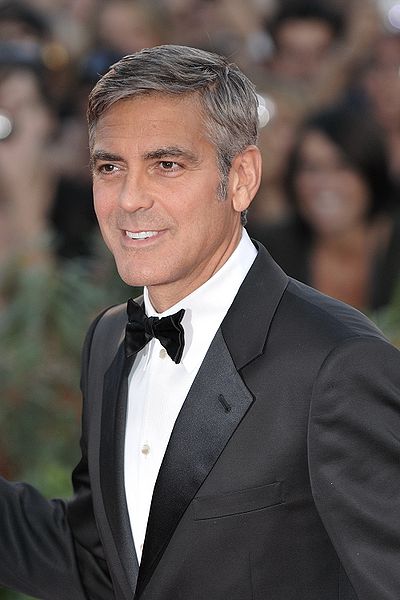
In the afternoon, Paul Bloom from Yale University took the stage. Among Paul´s manifold interest is the notion of human pleasure and basically, why we like things – and which attributes of an object increase or decrease our perceived utility. E.g., he will ask you what you would pay for a sweater that has been worn by George Clooney.
Turns out that the average American is willing to pay about 130-140$ for a sweater that has been worn by Gorgeous George and still contains his gorgeous sweat (meaning: it hasn´t been washed afterwards). When the thought experiment is extended to the notion that the sweater has been washed, the perceived price level drops considerably. Bloom argues that act of washing alters (in this case: spoils) the sweater´s perceived essence. Here, essence means the sum of the many intangible features of an object: the way it was produced, it´s history before getting to us etc. This also explains how a standard urinal suddenly can become a piece of very expensive art.
Probably doesn’t work with your sweat though – just in case…
* It seems especially unwise to undertake a change effort while dieting at the same time. Baumeister and colleagues also show that willpower may depend on a sufficient level of blood sugar – where low levels lead to ego depletion.
Today has been the third day of MAPP immersion week – another day packed with truly extraordinary experiences. Today´s lectures took place at Wharton Business School. For the morning, Martin Seligman invited a guest lecturer, Chandra Sripada, who introduced us to concept of the Default Mode Network of our brain – which basically represents the specific and recurring pattern of activation in the brain that can be seen in fMRI studies when the brain is supposed to be doing “nothing at all” (which obviously isn´t the case). Being in the default mode seems to be connected to the mental task of prospection which involves future-oriented problem-solving, creating mental simulations of the world and the minds of other people, and daydreaming (among other things). I´m pretty sure that I´ll write more about prospection in the near future (no pun intended) – but I am still “digesting” all of that input – so this will have to do for today,
Over lunchtime, we were invited over to the Positive Psychology Center at Penn to meet, greet and eat with Seligman´s research team.

For the afternoon, Marty invited Barbara Fredrickson, the world´s foremost researcher on positive emotions and their role in human flourishing. She developed the Broaden-and-Build theory of positive emotion which basically posits that the reason why we experience positive emotions is fundamentally different from the reason for the existence of negative emotions. While negative emotions such as anxiety provoke narrow(ing), immediate survival-oriented behaviors, positive emotions are supposed to broaden our awareness and inspire novel, exploratory, and creative thoughts and/or actions. In turn, this expanded behavioral repertoire builds our skills, resources, and resilience. All of that needs some further mental digestion as well. You can find one of Barbara´s books on the reference list.
The high point of the day was an invitation from Martin Seligman and his wife Mandy for food and drinks at their house in the outskirts of Philadelphia. I feel very honored since usually, he´s more likely to associate with top-tier researchers, political and military leaders – or the Dalai Lama. Thanks for that one, Marty…
Since the onset of psychology as an academic discipline at the end of the 19th century, it has been functioning on the premise of a disease model: most psychologists were mainly interested in what´s “wrong with people” – and then finding cures for all those wrongs. Which is fine, but … just not the only way looking at humankind. It took psychology about a hundred years to take on the opposite perspective: trying to find out what´s right with people. Together with a colleague, the late Christopher Peterson, Martin Seligman published the book Character Strengths and Virtues: A Handbook and Classification about ten years ago, which scientifically classifies and describes 24 human strengths based on six broad virtues.
In order to make their list, a character strength had to satisfy most of the following criteria. Character strengths should be:
The six virtues and 24 character strengths are:
(strengths that involve the acquisition and use of knowledge)
(strengths that allow one to accomplish goals in the face of opposition)
(strengths of tending and befriending others)
(strengths that build healthy community)
(strengths that protect against excess)
(strengths that forge connections to the larger universe and provide meaning)
Why should anybody be interested in his/her strengths? The rationale for finding out what our real strengths are is rather simple: Using our so-called signature strengths in daily life and work makes us happy – and most likely: successful. It makes us feel good about ourselves. It invigorates and energizes us. It´s the real deal…
You can find out what your signature strength are by taking a comprehensive scientific test on Martin Seligman´s website: the Signature Strengths Questionnaire. I´ve taken the test about a year ago – my main character strengths are:
You are curious about everything. You are always asking questions, and you find all subjects and topics fascinating. You like exploration and discovery.
You love learning new things, whether in a class or on your own. You have always loved school, reading, and museums-anywhere and everywhere there is an opportunity to learn.
Regardless of what you do, you approach it with excitement and energy. You never do anything halfway or halfheartedly. For you, life is an adventure.
You like to laugh and tease. Bringing smiles to other people is important to you. You try to see the light side of all situations.
You value close relations with others, in particular those in which sharing and caring are reciprocated. The people to whom you feel most close are the same people who feel most close to you.
A couple of days ago, James Pawelski, the MAPP´s director, sent us a comprehensive reading list. It also contains Authentic Happiness, one of Martin Seligman´s earlier popular science books on Positive Psychology. Right at the beginning, Seligman describes an experiment that was carried out by Nobel Laureate Daniel Kahneman and colleagues.
Before I go into detail: Since you can read this text, I assume you went to school for a couple of years. Consequently, you´ve experienced being taught by a lot of different teachers – with their teaching skills representing a kind of bell curve: most were more or less o.k., a few were superduper, and some were the proverbial pain in the ass. Basically, it´s the same with (keynote) speakers. I attend a lot of conferences and conventions. Once again, most speakers are okish, a few rock, and some, unfortunately, just waste your time.
Now obviously, not everybody can be a master of rhetoric like, e.g., Barack Obama. But even if – for whatever reason – you suck big time by objective criteria, you can still manage to make a lasting, somewhat positive impression on your audience by adhering to a simple rule:
Save the best for last!
Try to give a first-class conclusion! Thanks to the so called recency effect, most people will tend to forget your overall performance. Instead, their evaluation will be by and large based on the final minutes of your performance.
For scientific proof, let´s go back to Kahneman – and a real pain in the ass. For a study, he and his colleagues surveyed several hundred people that had to undergo a colonoscopy. By random assignment, half the patients had a minute added to the end of their procedure during which the tip of the colonoscope remained in the rectum – but without moving, which is considerably less painful than any movement. The results in a nutshell: even though they experienced more pain all in all, patients who underwent the prolonged procedure rated the entire experience as significantly less unpleasant. Additionally, rates of returning for a repeat colonoscopy were slightly higher.
Thank God, speaking skills can be improved easily – beyond just giving a nice conclusion. For inspiration, you might want check out this blog post listing 15 TED Talks on happiness, motivation, and more.
 Mappalicious