On Positive Psychology, Bullshit, and why you need a Chief Philosophy Officer (CPO)

At our recent onsite at Penn, we had a stimulating discussion on bullshit with James Pawelski – who wears the hat of MAPP´s academic director and at the same time that of Chief Philosophy Officer (CPO). Now the job of a philosopher is to sit in his/her armchair, ask you unnerving questions – and thereby shake the grounds of everything you ever believed in. Or at least something like that … which … probably … is a good thing. I don´t know.

By the way, that´s by far the easiest way to be philosophic: Just say “I don´t know” a lot. But you have to say it in a smirk philosophic kind of tone – or else, you´re just a dumbass who, well, doesn´t know stuff. Which brings me to the question: Do our schools teach us to be anti-philosophers? After all, saying “I don´t know” a lot in class will surely get you in trouble – while a decent capability in the fine art bullshitting can get you at least half-way through your Ph.D. program – and sometimes, published in first-tier journals.

So, I just wanted to write something along the lines of “But I digress…” to lead over to next section. Yet, curiously – I´m already there. Philosophy moves in mysterious ways…

When an honest man speaks, he says only what he believes to be true; and for the liar, it is correspondingly indispensable that he considers his statements to be false. For the bullshitter, however, all these bets are off.
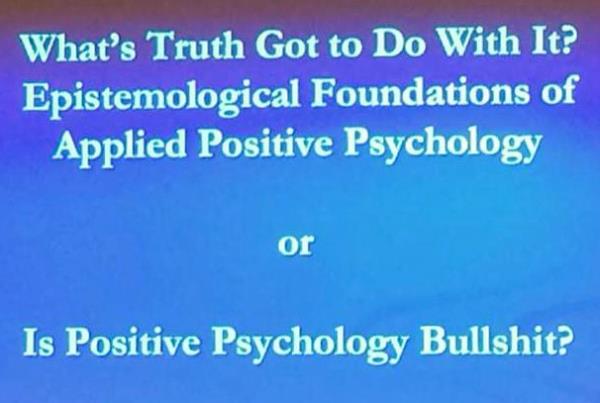
Positive Psychology = BullshitWhat is that thing: Bullshit? Well, what I like about philosophers so much is the fact that there are so many of them – and that they´ve started doing what they do (“philosophizing”…) more than 2,500 years ago. So there´s a really good chance that – whenever you have a question or a problem – some philosopher will already have thought about it. Most certainly, this is true for the subject of bullshit. Harry G. Frankfurt, professor emeritus of Princeton, has written a witty (and for a philosophical piece) pleasantly short and graspable essay on that overdue topic.

The essay starts with the skillfully crafted sentence “One of the most salient features of our culture is that there is so much bullshit.” and then moves on to explain why that could be the case; to finally define the nature of bullshit – especially in its relationship to adjacent concepts such as “truth” and “lie”. The following section represents a good synopsis of Frankfurt´s argument:

It is impossible for someone to lie unless he thinks he knows the truth. Producing bullshit requires no such conviction. A person who lies is thereby responding to the truth, and he is to that extent respectful of it. When an honest man speaks, he says only what he believes to be true; and for the liar, it is correspondingly indispensable that he considers his statements to be false. For the bullshitter, however, all these bets are off: he is neither on the side of the true nor on the side of the false. His eye is not on the facts at all, as the eyes of the honest man and of the liar are, except insofar as they may be pertinent to his interest in getting away with what he says. He does not care whether the things he says describe reality correctly. He just picks them out, or makes them up, to suit his purpose.

So where does Positive Psychology fit in here? And why is it really a good thing (I´m being honest to Flying Spaghetti Monster here!) to have a CPO somewhere at your side?

The truth is: a lot of the subjects in Positive Psychology sound like pure bullshit on the face of it. We´re all about well-being, happiness, virtues, meaning, and other fuzzy wishy-washy touchy-feely stuff. It is quite easy to get carried away in those diffuse realms of the conditio humana.* What separates Positive Psychology as a science from all that self-help literature out there is … well, that it´s a science. We give our best to approach that touchy-feely stuff with double-blind experiments, large-scale, and longitudinal research designs. We like to sell our pudding, point well-taken, but want to make sure first that there is enough scientific proof to it.

Our CPO James Pawelski really helps us to stay “grounded” while wrestling with all those new and exciting Positive Psychology concepts. He supports us in sharpening our minds while moving forward on our learning journey. He never gets tired of reminding us to be careful about what we say, how we say it, and to be aware of the assumptions our newfound knowledge is based upon.

And: he can talk for three hours nonstop just about the different meanings of the word “positive” in Positive Psychology. It´s a beautiful thing to behold.

What he does is absolutely essential. Already, there are prominent people out there that seem not to be able (or willing…) to grasp the difference between ordinary self-help lingo and the science of Positive Psychology. All the more we have to be careful. We have to know where our very own “red line” is – the one that crosses that grey area where talking about something we sufficiently know and understand turns into bullshitting. In Frankfurt´s words:

Bullshit is unavoidable whenever circumstances require someone to talk without knowing what he is talking about. Thus the production of bullshit is stimulated whenever a person’s obligations or opportunities to speak about some topic are more excessive than his knowledge of the facts that are relevant to that topic.

Thus, I stop at this point. My knowledge of bullshit is exhausted.


*Throwing in some Latin or Greek in your writing makes you sound very philosophical. Especially, when you say “I don´t know” in Latin or Greek…

PowerPoint slide © James Pawelski; photographed by Katrina Calihan
Zen Mind, Beginner´s Mind: Rain – for the very first time…

If you read my blog regularly, you´ll know by now that I blog about my son once in a while. I just love to watch him while he explores this world – and he is very good teacher. In (Zen) Buddhism, they put a lot of emphasis on cultivation a “beginner´s mind”, meaning one should let go of all preconceptions, rigid thinking, and dualistic distinctions. The goal is to see things as they really are – nothing more, and nothing less. For grown-ups, this is an almost impossible thing to do. Once a concept has entered our mind, it is incredibly hard to shake off. You can experience this effect via looking at pictures like this. Once you know what you´re looking at, it´s practically impossible to not see it any more.

All the more, it is an incredible thing to watch a beautiful child experience something for the very first time – as in this video. Enjoy!

Kayden + Rain from Nicole Byon on Vimeo.

Adam Grant on the “#1 Feature of a Meaningless Job”

Yesterday I wrote a blog post about Yale professor Amy Wrzesniewski who is a highly decorated researcher in the area of meaning and purpose on the job. I was delighted to see that Adam Grant, the youngest tenured professor at Wharton Business School (and who´ll teach in MAPP in April) and author of Give and Take has recently written a blog post on a similar subject on LinkedIn. Enjoy!

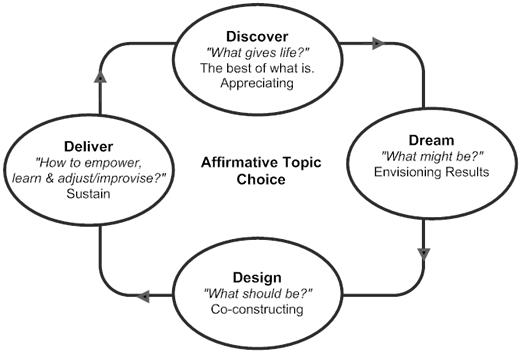
What “gives Life” to your Organization? Appreciative Inquiry and the Quest for the “Positive Core”

AI_4_DAt the January MAPP onsite, one of our guest speakers was David Cooperrider. He has (co-)developed Appreciative Inquiry (AI), a method of organizational development that is rooted in Positive Organizational Scholarship (POS). It´s a bit hard to explain it in a few words; therefore, I´ll let other people do the talking. The first video below is a short interview with David Cooperrider on the foundations and underlying assumption of AI. The second one is a bit longer and explains the whole AI process in a very graspable way.

Let me just say this much: the word “appreciate” is typically understood in the sense of “highly valued” – but can also mean “increasing something in value”. Therefore, things we appreciate grow in their value precisely because of our appreciation. To make use of a little oversimplification:

Whatever we put most energy into – grows. So if we focus a lot of energy on problems and problem-fixing – there´s a good chance there will be more problems. But if we instead put emphasis on strengths and what is already good – those aspects tend to grow. That´s exactly what AI tries to do – by asking the right questions (that´s where the “inquiry” in AI comes from). Enjoy!

What is AI?

Following your Bliss vs. following your Blisters

I´m sitting at “Vino Volo”, Philly airport right now. The 7th onsite of MAPP 2013/14 is over. It was another incredible, intensive, incomparable experience – not only thanks to the program itself, but due to the other participants. A big shout-out especially goes to Ann Brafford and Patricia De La Torre.

The hardest part always seems to choose what to write about afterwards. There´s so much good stuff out there – and I only have time to write about a few things. Yesterday afternoon, our guest lecturer was Yale´s Amy Wrzesniewski. Wrzesniewski is one of the world´s most renowned researchers on meaning and purpose on the job, (career) callings, and turning the job you have into the job you want (job crafting).

Towards the end of her lecture, she touched upon the topic that is displayed in the title of this post: Should we follow our bliss – or our blisters in order to have a fulfilling and successful (work) life? Both phrases were coined by mythologist and writer Joseph Campbell who, based on his literary studies, developed the theory of the Monomyth. The idea in short is that basically all great stories (from Homer´s Iliad to Harry Potter) are based on the same universal storytelling structure: the Hero´s Journey.

The following quote can be found in his book “The Power of Myth”:

If you follow your bliss, you put yourself on a kind of track that has been there all the while, waiting for you, and the life that you ought to be living is the one you are living. Wherever you are—if you are following your bliss, you are enjoying that refreshment, that life within you, all the time.

A lot of Campbell´s students obviously misinterpreted his quote as an advice to embrace hedonism as the path to happiness, to pursue “feeling good no matter what”. Late in his life and frustrated with this development, Campbell purportedly made the remark “I should have said, ‘Follow your blisters’.”

Had those students paid more attention to the structure of the Monomyth they would have grasped that the bliss in “follow your bliss” cannot be about pleasure alone. The Hero´s Journey is a path that entails great struggle, pain, and even losing (parts of) oneself: Luke Skywalker and Frodo Baggins both lose a part of their body before defeating evil for good.

This notion can be made clearer when replacing the term “bliss” with “passion”. Passion is based on the Latin word “passio” which means “suffering” or “enduring” (as in “The Passion of Christ”). Only much later did it acquire its meaning of “enthusiasm” and “strong liking”. Consider this image (source):

What success looks like

The drawing mirrors sayings such as “No Cross, no Crown” or “No Pain, no Gain”. Despite thousands of books offering us a shortcuts to “success and everything we ever wanted”, intuitively most of us know that the picture on the right is the real deal – and the one on the left (in 99,9% of all cases) is Bullshit (as defined by Harry G. Frankfurt).

Every melody would be played in C major. Every painting would depict beautiful water lilies. Every story would begin with “and they lived happily ever after”.

And how lackluster our lives would be if the left side were an effigy of truth: Every melody would be played in C major. Every painting would depict lovely water lilies. Every story would begin with “and they lived happily ever after”. Such a life would not be worth living.

Dear shortcut vendors, here´s what Yoda (picture source) has to say to you:

Yoda - Up the shut fuck you must

Field of Dreams: Positive Psychology at the Movies

As we´ve entered the second semester of the MAPP program, the subjects have changed. To put it black & white: while the first semester was (mostly) focused on the theory of Positive Psychology, the second semester zooms in on the application in different domains (e.g. healthcare, coaching, consulting with organizations). One of the courses explicitly focuses on the value of the “humanities” (music, art, philosophy, history, etc.) for enhancing “the good life”. That´s why I´ve been writing so much about my love for heavy metal in recent posts.

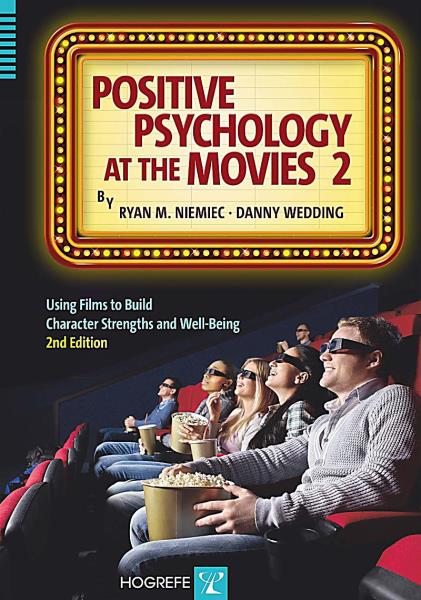
Positive Psychology at the MoviesNow, a lot of people may not like to go the theater, opera, or museums that much. But there are hardly any people that do not like to go the movies. As such, I am thrilled that some researchers explicitly focus on cultivating psychological well-being, meaning in life, and similar “positive constructs” via watching the “right kind” of movies. One of those people is Ryan Niemiec who also was a guest lecturer at our January onsite period. He´s the author of Positive Psychology at the Movies – and also happens to be the director of the VIA Institute on Character.

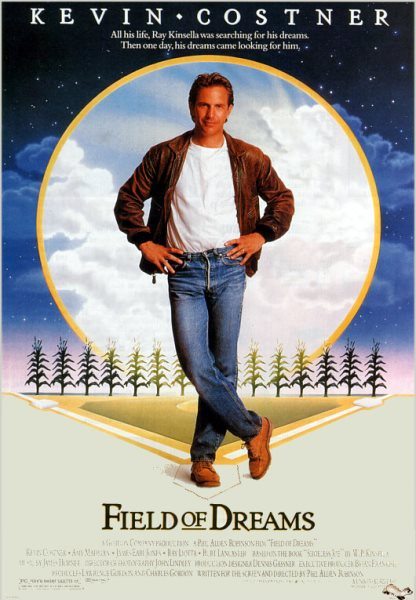
Field of DreamsDrawing on the insights of this branch of Positive Psychology, from now on, we´re going to have a movie night once every onsite. Last night, lead by Marty Seligman, we watched Field of Dreams (1989) starring Kevin Costner. Now this film is not that well-known in my home country Germany because baseball is just not a big thing in our culture.* Even though, I tremendously enjoyed watching that film since – at the end of the day – baseball is just used an analogy for conveying ideas about callings, purpose, meaning in life, reconciliation, and finding peace of mind (and heart).

Actually, the whole plot very much reminded me of a psychotherapeutic method by the name of Family Constellations that has become a sort of “movement” in Germany, but is really not well-known anywhere else. I do not wish to expand on this here – but if you´re interested to know more about this: here you´ll find a concise scientific paper in English on the underpinnings and application of this method.

So, it´s Saturday. If you go to the movies tonight, why not put on those “positive psychology glasses” and e.g., look for the expression of character strengths in the protagonists?

* The only baseball player that I really knew about before watching the movie is Yogi Berra – who is quite famous for his brainy quotes (Yogiisms) such as: “Always go to other people’s funerals, otherwise they won’t go to yours.”

P.S.

Another valuable resource is the film index at cinematherapy.com.

Positive Psychology Speaking Tour: Martin Seligman is coming to Europe

If you are interested in Positive Psychology and happen to live in (central) Europe, you might be interested to hear that Martin Seligman is coming to Germany in the summer of 2014 together with some other big names in the field, such as Mihály Csíkszentmihályi, and Barbara Fredrickson for several conferences. This is a great way to get updated on the latest developments in Positive Psychology. The presentation will be in English and translated into German. For more information, please refer to this (German) Flyer.

PP_Speaking_2014

Do what you love, and do it often: The Holstee Manifesto

Today, I´d like to share with you the Hostee Manifesto, a clear proof for the fact that you do not have to be a positive psychologist to have a deep knowledge of positive psychology. It has been created by a group of young people, e.g., Fabian Pfortmüller,  who happens to be co-founder of Sandbox, a truly exceptional group of young global change-makers that I had the pleasure to spend an incredible weekend with in Lisbon in 2012.

I´ll let the words speak for themselves.

The Holstee Manifesto

On the Intersection of Cat Content and Positive Psychology…

Samu & NellySometimes, the world seems to be divided into two different kinds of human species: by way of example, those who love cats – and those who love to hate them. I mean, I rarely meet people who say something like “You know…I mean…cats are…Ok”. Either we are totally infatuated with our feline friends – or we´ve come to believe they´re the devil´s brood – for whatever reason.

Now, I happen to be a cat lover. Therefore, I´d like to introduce you to Nelly (brown) and Samu (blotched), two British Shorthair kitten that live in our home since January 17. The reasons: first, I know that cat content is the most important type of internet content right after porn, so my secret hope is that you´re going to share this post like crazy. But I´d never admit that of course…

Second and more important, I´d like to convince you of the notion that there is a substantial correlation between Positive Psychology and having a cat (or several, for that matter). The argument goes as follows:

1) Cats do really cute things. I mean, they sleep about 90% of the day. And another 9% are reserved for eating. But in the 15 minutes that remain, they really do very cute things – like licking themselves, falling off the couch, or trying to fit in holes that are far too small.

2) Watching really cute things makes us happy. And being happy is one element of PERMA, Martin Seligman´s concept of flourishing. Quod erat demonstrandum.

But joking aside: there is some scientific research on why it could be healthy to have a pet (at least one that can be petted…): 

First, there the Biophilia hypothesis. Basically, this means there is considerable empirical evidence that humans profit from getting in touch with nature, be it a green forest – or animals.

And second, we need to touch and to be touched (warmly). A caress (be it on the giving or receiving end) is as good as medicine (without the side effects). It can lower our blood pressure and reduce stress hormones like cortisol – among other things.

So, if you still believe that cats are evil creatures, please watch this video:

A huge Meow! to that.