Emma, if you had to describe your book in a short analogy (“We’re the Uber for x…” or something like that): What would it be?
The hack for success without stress.
I’m a manager and reaaaaally busy. If I had time to read only one chapter: Which one would you recommend – and why?
Read the second chapter on how to build your resilience. We believe we need high levels of adrenaline to get things done – so we over-caffeinate, over-schedule ourselves, and wait until the last minute to get things done. The result is not productivity, it’s burnout which is why we’re seeing 50% burnout across industries, 80% of doctor’s visits due to stress, and 75% of the American workforce disengaged. You can’t talk yourself out of stress but there is something you can do at the physiological way that will help you manage your energy, be more productive and emotionally intelligent, and be resilient in the face of the pressure and demands coming your way – cultivating physiological resilience.
In all these years of studying Positive Psychology: What is the one scientific finding that intrigued you the most?
The finding that has intrigued – and inspired – me the most is that the best kept secret to happiness is to give it away. By uplifting others, supporting them, helping them and living a more compassionate life, not only will you be making everyone else happier, you will be happier, healthier and live a longer life too. It’s win-win!
Thank you very much and best of luck with The Happiness Track!
Last year, I shared with you information on UK-based non-for-profit organization Action for Happiness. Now fellow MAPP alum and AFH board member Vanessa King has authored a book which draws on AFH’s GREAT DREAM acronym: 10 Keys to Happier Living. Congrats, Vanessa!
From the book cover:
In this book, Vanessa King of Action for Happiness has drawn on the latest scientific studies to create a set of evidence-based practical actions that have been shown to increase happiness and wellbeing – at home, at work and in the world around you.
It will help you connect with people, nurture your relationships and find purpose. You’ll get ideas for taking care of your body, making the most of what’s good and finding new ways to stimulate your mind.
If you have children and are keen to discover their character strengths, you can find a free test adapted for children on Seligman´s website at the University of Pennsylvania. But how do you talk to your children about the results – or the value and use of character strengths in general?
One fantastic (but not completely free…) opportunity is offered by my fellow MAPP alum Renee Jain. Meet the Dynamos – via an amazing workbook! In the words of their creators:
Dynamos are tiny and powerful beings from the planet Dynamis. Each Dynamo comes into the universe possessing a unique Dynamic or character strength as well as a Supertool to amplify their strength. Children will enjoy learning about character strengths by getting to know the Dynamos and their Supertools.
Kids can read each story in this workbook and then decide which Dynamo (representing a character strength) could be used to effectively solve the problem presented. This workbook is ideal if you’re teaching character education at school or at home.
Find and out about and purchase the workbook via GoZen!
I’m well aware that this is off-topic. And I´m also aware of the fact that some people will think or even say “Shut up! Being German, this none of your business…” But living in a globalized world, and seeing crisis situations such as in Syria or the South China Sea, I definitely do care who will be the Commander-In-Chief of the most powerful army in the world – even when our nations are on friendly terms.
I´m pretty sure Donald Trump (if he gets to be the GOP nominee) will lose against Hillary Clinton, Bernie Sanders, or even Michael Bloomberg, for that matter. But then, you never know…
Here´s the thing that scares me the most. The following is an excerpt from an article on politico.com – where a scientist analyzed the demographics and attitudes of Trump´s supporters:
If I asked you what most defines Donald Trump supporters, what would you say? They’re white? They’re poor? They’re uneducated? You’d be wrong. In fact, I’ve found a single statistically significant variable predicts whether a voter supports Trump—and it’s not race, income or education levels: It’s authoritarianism.
Here´s how the author explains the concept of authoritarianism:
While its causes are still debated, the political behavior of authoritarians is not. Authoritarians obey.They rally to and follow strong leaders. And they respond aggressively to outsiders, especially when they feel threatened. From pledging to “make America great again” by building a wall on the border to promising to close mosques and ban Muslims from visiting the United States, Trump is playing directly to authoritarian inclinations.
With my German heritage, I’m especially wary when I read stuff like that.
I readily admit that The Donald can be entertaining and funny at times. I´d probably even tune in once in a while – if we were the host of a talk show or something like that. But he´s not trying to become that. He´s trying to become the POTUS.
A lot of people have wondered and written about the following question:
How does he do it?
How does he pull off the stunt of gathering all those supporters behind him – while being a blatant liar (frequently), ignorant (very frequently ) and outright mean and ostracizing (practically at all times)? One intriguing answer – that also fits with the analysis of his supporters´ attitudes stated above – is given in this Forbes article. The author links Trump´s ongoing success to his skillful use of dominant behavior, especially body language:
What Trump does prove is the observation of evolutionary psychologists that humans worship the projection of authority in much the way that animals do.
Personally, I always wonder how somebody can portray such a high level of confidence while making bogus arguments (if you want to call it arguments at all) nearly 100% of the time. Then, I remembered philosopher Harry Frankfurt´s fabulous essay On Bullshit. Here´s the important part:
It is impossible for someone to lie unless he thinks he knows the truth. Producing bullshit requires no such conviction. A person who lies is thereby responding to the truth, and he is to that extent respectful of it. When an honest man speaks, he says only what he believes to be true; and for the liar, it is correspondingly indispensable that he considers his statements to be false. For the bullshitter, however, all these bets are off: he is neither on the side of the true nor on the side of the false. His eye is not on the facts at all, as the eyes of the honest man and of the liar are, except insofar as they may be pertinent to his interest in getting away with what he says. He does not care whether the things he says describe reality correctly. He just picks them out, or makes them up, to suit his purpose.
In light of this, I probably have to correct myself: Trump is not a liar, but rather the biggest (and unfortunately: best) bullshit artist currently living on this planet. Literally, my only hope is that, on the day when he is elected to be the nominee for the GOP, he walks up to the lectern, shows one of his awkward smiles, and says something like: “Sorry folks, this was meant to be a joke. It´s all bullshit. Actually, I just wanted to show the world what a pathetic bunch of bigots most of you are.”
In the meantime, if you´re unsure who to vote for, you might want to watch this hilarious excerpt from Last Week Tonight with John Oliver. Let´s make Donald Drumpf again!
I´ve initiated a study that seeks to better understand the perception of certain leadership behaviors. If you currently work somewhere and report to someone (= have a boss) you are eligible to participate.
Participation takes just 7-8 minutes. Please click here:
I guess there ´s a heck of a lot of people out there who haven’t even heard about the first wave of Positive Psychology – and now, there´s supposed to be a second one? Yes, sir!
For quite some time now, Positive Psychology has been criticized for focusing way too much on the positive side(s) of life, while (by and large) ignoring negative phenomena – which, after all, is why Positive Psychology was founded in the first place. I feel this criticism is unwarranted pertaining to the academic/research side of things. E.g., research on Post-Traumatic Growth has always been readily embraced. But I guess in terms of marketing PP to the public, there´s more than a bit truth to this allegation.
Second Wave Positive Psychology is underpinned by four dialectical principles: appraisal; co-valence; complementarity; and evolution.
Appraisal means that we cannot appraise something as either positive or negative without taking context into account.
Co-valence reflects the idea that many situations and experiences comprise positive and negative elements.
Complementarity is about the idea of Ying and Yang, that positive and negative are co-creating sides of the same coin.
Evolution draws on Hegel’s notion of thesis-antithesis-synthesis.
In this case, traditional psychology can be seen as the thesis, Positive Psychology is the anti-thesis, and SWPP could evolve into a synthesis, where the truths of both thesis and antithesis are preserved, while their flaws are overcome.
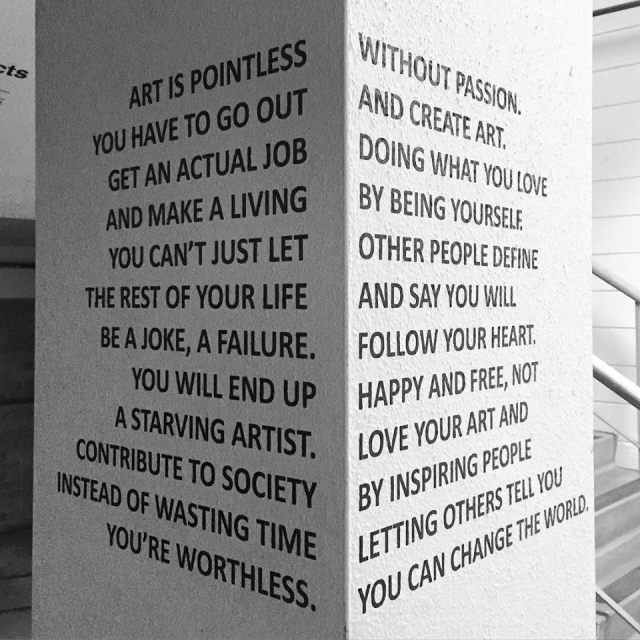
Now, here’s a little inspirational post. Slightly off-topic, but not all that much. What you can see below is a piece of art created by University of Texas art student Jasmine Kay Uy. Sometimes, you just need to look around another corner to get the full picture. Beautiful – and very clever. Reminded me of the Holstee Manifesto that I posted quite a while ago. Share and enjoy!
Some nations are happier than others, that’s a fact. In most year’s rankings, Switzerland or one of the Scandivian countries (quite frequently: Denmark) take the No. 1 spot in the carefully researched list. Quite obviously, this does not mean each and every person over there is happier than your fellow countrymen – but on average, they are. Why is that the case? The solution can be found in the answers to these high-level questions:
Do people earn enough money – and how well does the economy do in general? Additionally: Is the distribution of wealth (perceived as) fair?
Do people form strong social bonds in your society? Do they value highly their family and friends?
Do people have access to (enough) healthy food, clean water, and decent doctors/hospitals?
Do people live in a (stable) democracy granting a high amount of individual freedom and safety?
Can people afford to be generous and compassionate vis-a-vis your countrymen (and generally, those in need)?
Can your citizens trust their political and economic leaders?
Or, in the words of University of British Columbia economics professor John Helliwell, co-editor of the World Happiness Report (as quoted on ThinkAdvisor.com):
Six factors explain about three-quarters of the difference in country rankings […]: GDP per capita, social support (based on the question, “Do you have a friend or relative to call on in times of trouble?”), life expectancy, freedom to make life choices, generosity (having donated to charity within the past month) and trust (perceptions of business or governmental corruption).
In order to make make the top ranks of the “happiest nations list”, a country needs to do pretty well on each of those factors. But they also explain why some countries that don’t do so well economically might be far ahead of some richer counterparts:
(Some of) the best things in life are free – e.g., your family and friends.
 Emma Seppälä, Ph.D is Science Director of Stanford University’s Center for Compassion and Altruism Research and Education and author of the recently published book The Happiness Track. She is a frequent contributor to Harvard Business Review, Psychology Today, Huffington Post, and Scientific American Mind.
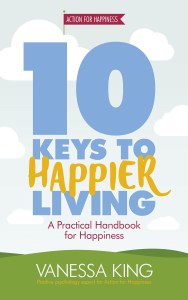 Last year, I shared with you information on UK-based non-for-profit organization Action for Happiness. Now fellow MAPP alum and AFH board member Vanessa King has authored a book which draws on AFH’s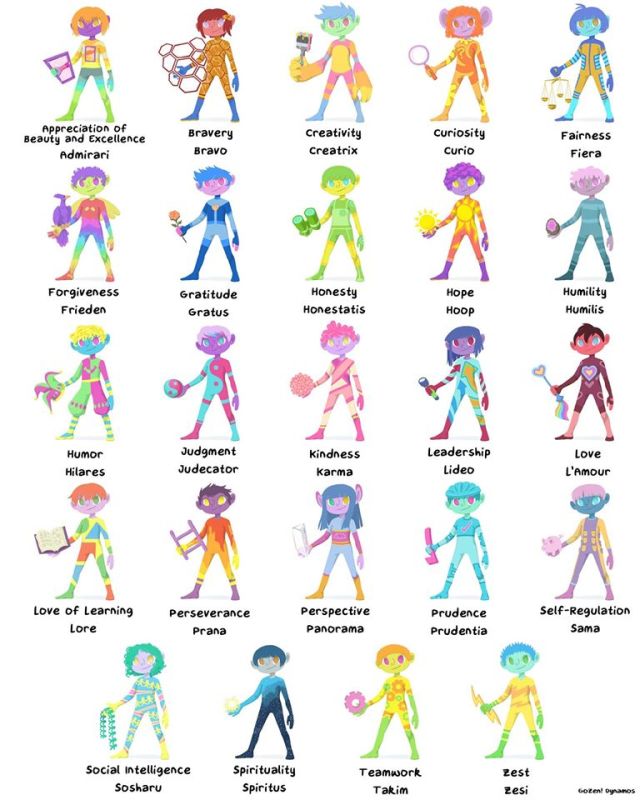
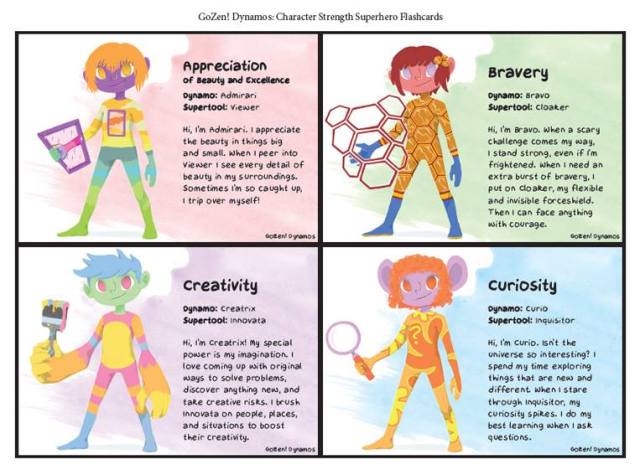 Find and out about and purchase the workbook via

 Personally, I always wonder how somebody can portray such a high level of confidence while making bogus arguments (if you want to call it arguments at all) nearly 100% of the time. Then, I remembered philosopher Harry Frankfurt´s fabulous essay
 Some nations are happier than others, that’s a fact. In most year’s rankings, Switzerland or one of the Scandivian countries (quite frequently: Denmark) take the No. 1 spot in the carefully researched list. Quite obviously, this does not mean each and every person over there is happier than your fellow countrymen – but on average, they are. Why is that the case? The solution can be found in the answers to these high-level questions:
 Mappalicious