Thank you! Danke schön! Kiitos! ¡Muchas gracias!

I’ll fly back to Germany shortly after having spent the last three days in Ann Arbor, Michigan, taking part in the Positive Business Conference 2016 (see here and here for a recap).

During these days, Mappalicious has surpassed the total number of page views for 2015 – and it’s only May. So, I just want to express my heartfelt gratitude to you for joining me on my ride across the world of Positive Psychology, for helping this baby grow, writing comments, and sharing my stuff with your friends and communities!

Nico

wlkaszbetjt8s

Thriving not Surviving: Positive Business Conference (Day 2)

While the first day of the Positive Business Conference 2016 has been stimulating and inspiring, the second day was truly transformative for me – and mind you, I don’t use words like this lightly. But I will eloborate on this at a later point in time. The impressions are too fresh to put them in intelligible phrases.

For today, I’d like to recap the day in the same day I did yesterday: by sharing some of my and other participants’ tweets.

First, I discovered my next job title:

https://twitter.com/drnicorose/status/731110612755984385

Then I learned about how to infuse a company with purpose.

I was impressed to learn how Ross School of Business strives to develop leaders that make a positive difference.

https://twitter.com/drnicorose/status/731132498495848450

https://twitter.com/drnicorose/status/731138133211942912

The early afternoon was reserved for a workshop on compassion in business led by Jane Dutton and Monica Worline. Somehow, this one made the difference that makes a difference. But as said, I’m going to talk about that in a separate post.

https://twitter.com/drnicorose/status/731155288657670144

https://twitter.com/drnicorose/status/731163965095436288

https://twitter.com/drnicorose/status/731153403464798209

Fellow Penn Mappster Jessica Amortegui was awarded with the 1. price of the Positive Business Project competition for her work with Logitech.

https://twitter.com/drnicorose/status/731187208837861379

Just like Alex Edmans explained yesterday: It pays off financially to invest in ethical companies.

https://twitter.com/drnicorose/status/731194938302582786

Coffee makes the world go round – but only if it’s fair-trade.

https://twitter.com/drnicorose/status/731204017611804672

Michigan Ross: Thanks a million for hosting that is brilliant conference. I’ll be back…!

https://twitter.com/drnicorose/status/731212530249519104

positive business conference 

Passion. Purpose. Performance. Positive Business Conference (Day 1)

I’m absolutely thrilled to be at the University of Michigan, attending this year’s Positive Business Conference at Ross School of Business.This post is my personal summary of the conference’s first day, brought to you via some of the tweets I’ve put out there…

https://twitter.com/drnicorose/status/730755747395604480

Prof. Vic Strecher shared some really intriguing upsides of having a strong purpose in life. More importantly, you should check out his fabulous app JOOL.

https://twitter.com/drnicorose/status/730761605944905728

Prof. Jane Dutton had me change my mind on using the term rockstar only in contexts that involve electric guitars. She shared with us her Flourishing Triangle framework of organizational effectiveness.

https://twitter.com/drnicorose/status/730773900506894336

I was equally thrilled to be able to learn directly from Prof. Alex Edmans, whose work on the financial impact of treating employees exceptionally well has been covered extensively on Mappalicious.

https://twitter.com/drnicorose/status/730778590313320448

Prof. Joe Arvai shared some incredible research on how to help consumers make more ethical buying decisions. E.g., why is that we can consciously choose from what part of the world our coffee comes from (and how it was cultivated) – but not with regard to our gasoline? And what if we could

https://twitter.com/drnicorose/status/730786157596954626

After lunch, I was thrilled to have the opportunity of attending a workshop led by Prof. Robert Quinn whose blog posts I share frequently via my Positive Psychology News Digests.

https://twitter.com/drnicorose/status/730822508534988800

Once more it became clear to me that we do not really understand “a thing” (even if we’ve heard about it a lot of times) until somebody explains it to us in the exactly right words at the right time.

https://twitter.com/drnicorose/status/730823755203813377

When you’re in the right space, the smartest “person” in the room is the room itself.

https://twitter.com/drnicorose/status/730870737234481152

Jim Miller, VP at Google, shared insights on the special culture that drives the incredible success of the company.

https://twitter.com/drnicorose/status/730877115038609409

https://twitter.com/drnicorose/status/730876211254202369

Of course, there were more sessions, and more speakers, and an abundance of inspiring conversations while having delicious food – but I cannot cover it all here.

Yet, one last thing I found out is this:

https://twitter.com/drnicorose/status/730843363457568768

Share and enjoy!

Positive Business Conference

What drives Workplace Happiness? A Survey of 200,000 People

BCG_Decoding_TalentOne of the central tenets in Positive Psychology is “Other People Matter!” – coined by the late Prof. Chris Peterson. This is also true for the workplace. Hell may be other people, as Sartre famously said. But they are also heaven if companies manage to create asshole-free offices.

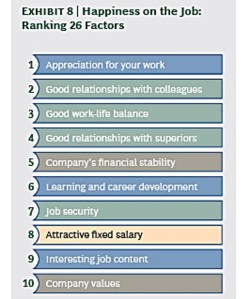
I recently stumbled upon a study carried out by consulting firm Boston Consulting Group (BCG). They surveyed more than 200,000 people globally from all walks of life on the drivers of workplace happiness (among other things). At the end of the day, they came up with a list of 26 different factors. In the graphic, the top 10 attributes that influence workplace happiness are displayed.

Now, if you ask me, the top 4 factors are all about (positive) relationships:

BCG_Decoding_Talent_RankNo. 1 is “appreciation for your work”. Yet, appreciation doesn’t come out of nowhere. It´s provided by bosses, co-workers, and subordinates. It´s other people.

No. 2 is “good relationships with colleagues”. Clearly, that´s other people.

No. 3 is “good work-life-balance”. For me, that translates to “My job enables me to have good relationships with people apart from the workplace”.

No. 4 is “good relationships with superiors”. That’s probably very close to No. 1.

I rest my case.

Your first and foremost Job as a Leader is… Peter Drucker​ on Positive Organizations

I guess it must be really hard to be a management guru these days. No matter what you say, no matter how brilliant you are – there’s a very high probability that somebody will already have laid out what your core message is. And with “somebody”, I don’t refer to a lot of people, I’m just talking about one person: Peter Drucker.

If you visit, e.g., his notable quotes on GoodReads, you’ll find that he was an incredibly smart thinker – and the he basically laid out all the principles of modern (and in some instances: post-modern) management (in the best sense of the word…). And he did all of that mostly during the 1950s and 60s!

Last week, I stumbled upon a quote that gives rise to the assumption Peter Drucker was also able to foresee some of the developments in Positive Organizational Scholarship (POS), e.g.,  Jane Dutton’s concept of High-Quality Connections, or Kim Cameron’s idea of leading by managing Organizational Energy.

Here are some additional quotes alluding to the rise of Positive Organizations:

Peter Drucker on Positive Deviance and High-Quality Connections

Leadership is lifting a person’s vision to higher sights, the raising of a person’s performance to a higher standard, the building of a personality beyond its normal limitations.

—–

The work relationship has to be based on mutual respect. Psychological despotism is basically contemptuous—far more contemptuous than the traditional Theory X. It does not assume that people are lazy and resist work, but it assumes that the manager is healthy while everybody else is sick. It assumes that the manager is strong while everybody else is weak. It assumes that the manager knows while everybody else is ignorant. It assumes that the manager is right, whereas everybody else is stupid. These are the assumptions of foolish arrogance.

—–

The leaders who work most effectively, it seems to me, never say “I.” And that’s not because they have trained themselves not to say “I.” They don’t think “I.” They think “we”; they think “team.” They understand their job to be to make the team function. They accept responsibility and don’t sidestep it, but “we” gets the credit. This is what creates trust, what enables you to get the task done.

Peter Drucker on Strength Orientation

A person can perform only from strength. One cannot build performance on weakness, let alone on something one cannot do at all.

—–

We all have a vast number of areas in which we have no talent or skill and little chance of becoming even mediocre. In those areas a knowledge workers should not take on work, jobs and assignments. It takes far more energy to improve from incompetence to mediocrity than it takes to improve from first-rate performance to excellence.

—–

A man should never be appointed to a managerial position if his vision focuses on people’s weaknesses rather than on their strengths. The man who always knows exactly what people cannot do, but never sees anything they can do, will undermine the spirit of his organization.

Peter Drucker on Purpose

An organization is not, like an animal, an end in itself, and successful by the mere act of perpetuating the species. An organization is an organ of society and fulfills itself by the contribution it makes to the outside environment.

—–

Only a clear, focused, and common mission can hold the organization together and enable it to produce results.

Peter Drucker on Self-Knowledge and the Growth Mindset

Success in the knowledge economy comes to those who know themselves – their strengths, their values, and how they best perform.

—–

People in general, and knowledge workers in particular, grow according to the demands they make on themselves. They grow according to what they consider to be achievement and attainment. If they demand little of themselves, they will remain stunted. If they demand a good deal of themselves, they will grow to giant stature—without any more effort than is expended by the nonachievers.

A Positive Approach to Organizational Tensions

Pos_Org_QuinnI know I probably should be talking about Adam Grant´s Originals (I did…) or Angela Duckworth´s Grit (I will…) these days, but instead, today, I´d like to point you towards another superb book: The Positive Organization by Robert Quinn.

Robert is professor at the University of Michigan and serves on the faculty of Organization and Management at the Ross Business School. He is one of the co-founders and of the Center for Positive Organizations and author several bestsellers on management.

Description of the book (taken from the book´s wrapper):

The problem is that leaders are following a negative and constraining “mental map” that insists organizations must be rigid, top-down hierarchies and that the people in them are driven mainly by self-interest and fear. But leaders can adopt a different mental map, one where organizations are networks of fluid, evolving relationships and where people are motivated by a desire to grow, learn, and serve a larger goal. Using dozens of memorable stories, Quinn describes specific actions leaders can take to facilitate the emergence of this organizational culture—helping people gain a sense of purpose, engage in authentic conversations, see new possibilities, and sacrifice for the common good.

The book includes the Positive Organization Generator, a tool that provides 100 real-life practices from positive organizations and helps you reinvent them to fit your specific needs. With the POG you can identify and implement the practices that will have the greatest impact on your organization.

For me, the most intriguing part of the book is Quinn´s proposition to see organizations not as more or less static entities, but rather as a systems of tensions. This figure provides a nice overview:

Quinn_Org_Tensions.png

The remainder of the book is equally valuable. If you´re looking for management book that is based on solid science (Positive Organizational Scholarship) and yet offers jargon-free language and actionable ideas, “The Positive Organization” is for you.

The Ten Keys to Happier Living | Vanessa King

What are the active ingredients for a happier and fulfilling life? Positive psychology, happiness and resilience expert, Vanessa King of Action for Happiness, unlocks the Ten Keys to Happier Living. The areas science shows we can most easily take action – for ourselves and to contribute to a happier world.

Vanessa King is a leading expert on the practical application of the science of happiness, resilience and wellbeing in our everyday lives, communities and in organisations. She’s a Board Member and Lead Positive Psychology and Workplace Expert for Action for Happiness.