Explaining Character Strengths to Children: Meet the Dynamos

One of the cornerstones of Positive Psychology is a scientifically validated set of 24 character strengths, first published in the tome Character Strengths and Virtues: A Handbook and Classification by the late Christopher Peterson and Martin Seligman himself. If you want to know what your top strengths are, you can take a free test offered by the VIA Institute on Character.

If you have children and are keen to discover their character strengths, you can find a free test adapted for children on Seligman´s website at the University of Pennsylvania. But how do you talk to your children about the results – or the value and use of character strengths in general?

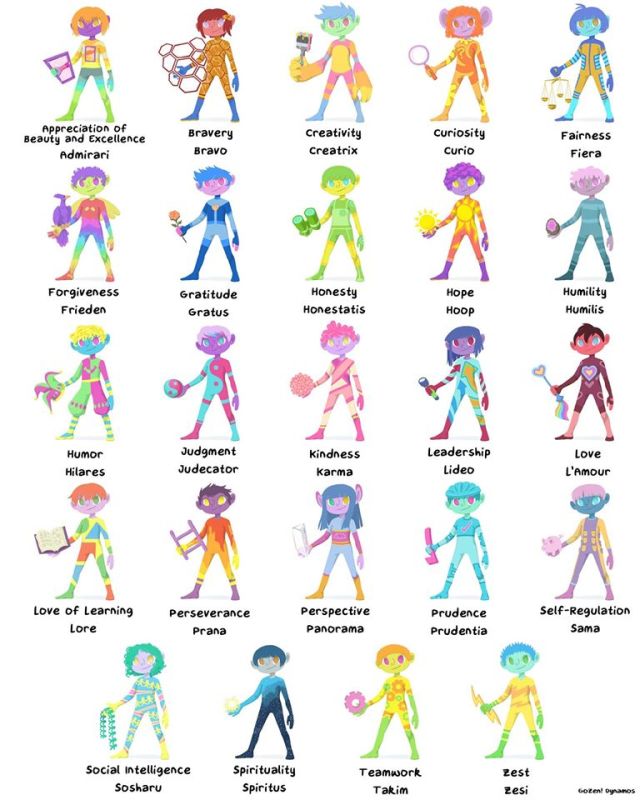
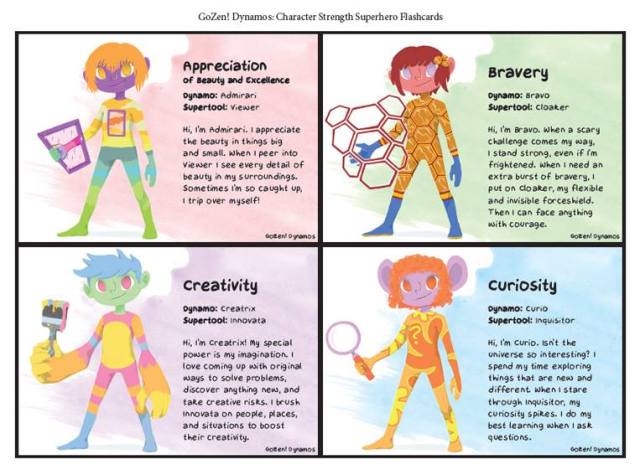
One fantastic (but not completely free…) opportunity is offered by my fellow MAPP alum Renee Jain. Meet the Dynamos – via an amazing workbook! In the words of their creators:

Dynamos are tiny and powerful beings from the planet Dynamis. Each Dynamo comes into the universe possessing a unique Dynamic or character strength as well as a Supertool to amplify their strength. Children will enjoy learning about character strengths by getting to know the Dynamos and their Supertools.

Kids can read each story in this workbook and then decide which Dynamo (representing a character strength) could be used to effectively solve the problem presented. This workbook is ideal if you’re teaching character education at school or at home.
12239387_10153619125167752_7416382057681496865_o

12227661_10153619125437752_7503175795841036175_nFind and out about and purchase the workbook via GoZen!

Are you ready for the 2. Wave of Positive Psychology?

I guess there ´s a heck of a lot of people out there who haven’t even heard about the first wave of Positive Psychology – and now, there´s supposed to be a second one? Yes, sir!

For quite some time now, Positive Psychology has been criticized for focusing way too much on the positive side(s) of life, while (by and large) ignoring negative phenomena – which, after all, is why Positive Psychology was founded in the first place. I feel this criticism is unwarranted pertaining to the academic/research side of things. E.g., research on Post-Traumatic Growth has always been readily embraced. But I guess in terms of marketing PP to the public, there´s more than a bit truth to this allegation.

Last year, Todd Kashdan and Robert Biswas-Diener published their book The Upside of Your Dark Side, others are following suit now. There´s a very recent article on Psychology Today by Tim Lomas: Second Wave Positive Psychology: An Introduction. Here´s the central part:

Second Wave Positive Psychology is underpinned by four dialectical principles: appraisal; co-valence; complementarity; and evolution.

Appraisal means that we cannot appraise something as either positive or negative without taking context into account.

Co-valence reflects the idea that many situations and experiences comprise positive and negative elements.

Complementarity is about the idea of Ying and Yang, that positive and negative are co-creating sides of the same coin.

Evolution draws on Hegel’s notion of thesis-antithesis-synthesis.

In this case, traditional psychology can be seen as the thesis, Positive Psychology is the anti-thesis, and SWPP could evolve into a synthesis, where the truths of both thesis and antithesis are preserved, while their flaws are overcome.

Just in case you´ll find that article stimulating: it is based on an academic paper which can be found on Research Gate: Second Wave Positive Psychology: Exploring the Positive–Negative Dialectics of Wellbeing.

Another synopsis of SWPP is proposed by Paul T. P. Wong in this article: What Is Second Wave Positive Psychology and Why is it necessary?

Mann_lachend_weinend

Art: Contribute to Society by Inspiring People

Now, here’s a little inspirational post. Slightly off-topic, but not all that much. What you can see below is a piece of art created by University of Texas art student Jasmine Kay Uy. Sometimes, you just need to look around another corner to get the full picture. Beautiful – and very clever. Reminded me of the Holstee Manifesto that I posted quite a while ago. Share and enjoy!

Pointless_Art.jpg

Why that Swiss Friend of yours is probably Happier than You are

Frau_BartSome nations are happier than others, that’s a fact. In most year’s rankings, Switzerland or one of the Scandivian countries (quite frequently: Denmark) take the No. 1 spot in the carefully researched list. Quite obviously, this does not mean each and every person over there is happier than your fellow countrymen – but on average, they are. Why is that the case? The solution can be found in the answers to these high-level questions:

  • Do people earn enough money – and how well does the economy do in general? Additionally: Is the distribution of wealth (perceived as) fair?
  • Do people form strong social bonds in your society? Do they value highly their family and friends?
  • Do people have access to (enough) healthy food, clean water, and decent doctors/hospitals?
  • Do people live in a (stable) democracy granting a high amount of individual freedom and safety?
  • Can people afford to be generous and compassionate vis-a-vis your countrymen (and generally, those in need)?
  • Can your citizens trust their political and economic leaders?

Or, in the words of University of British Columbia economics professor John Helliwell, co-editor of the World Happiness Report (as quoted on ThinkAdvisor.com):

Six factors explain about three-quarters of the difference in country rankings […]: GDP per capita, social support (based on the question, “Do you have a friend or relative to call on in times of trouble?”), life expectancy, freedom to make life choices, generosity (having donated to charity within the past month) and trust (perceptions of business or governmental corruption). 

In order to make make the top ranks of the “happiest nations list”, a country needs to do pretty well on each of those factors. But they also explain why some countries that don’t do so well economically might be far ahead of some richer counterparts:

(Some of) the best things in life are free – e.g., your family and friends.

Planting Seeds Of Happiness The Danish Way [TEDx]

Our northermost neighbors, the Danes, frequently take the number one spot when researchers try to find the happiest country on earth. While this finding has to be treated with some caution (please see What people around the world mean when they say they’re happy) they probably one or two things about the good life. 

Here’s what former corporate executive and nowadays writer Malene Rydahl has to say on the topic.  

10 Propositions regarding (Positive) Emotions, especially Happiness

Good_AdviceBy now, I have written +400 blog posts on Positive Psychology and given +30 talks and presentations for different audiences, mostly in the realm of business. While I receive a lot of positive feedback (referring to the PP content; I´m not talking about my presentation style here), quite obviously, I also get some pushback once in a while. Over time, I´ve come to notice that most of the counterarguments I hear are based on a rather small set of “shared (mis-)conceptions”. I guess, a lot of these arise over time due to the fact that – for the sake of brevity – speeches and news articles on Positive Psychology have to simplify and overgeneralize their messages in order to get their points across. In order to structure my own thoughts vis-à-vis this situation – but also for discussion – in the following, you´ll find…

10 Propositions regarding (Positive) Emotions, especially Happiness

1) I feel, therefore I am. Emotions are among the very few constants in life. Where´s the consciousness, there´s emotion. They may not always be strong, and we may not always be aware – but they are there.

2) All emotions are valid and adaptive, depending on context and dose.

3) In excess, every emotion can and probably will have detrimental side effects.

4) Different emotions will have different consequences (e.g., for our overall health or the perception of “meaning in life”), especially in high doses and in the long-term.

5) Feelings are contagious and therefore, (almost) always “social”: What we do unto ourselves, we do unto others (to some degree). With that, there comes a responsibility.

6) Happiness is mostly used as an umbrella term, it comes in many different forms and sizes (e.g. serenity, exhilaration, relaxation).

7) Feeling happy is not a (or the) goal in life itself, it’s a “positive side effect” of certain behavior patterns and thinking styles.

8) Feeling happy is not shallow. At least, it´s not shallower than experiencing sadness, anger, or any other kind of emotion.

9) Feeling mostly happy requires effort, at least more work than feeling mostly unhappy (especially with regard to people displaying certain unfavorable genetic predispositions).

10) We seldom feel pure emotions. In most situations, we have several feelings at the same time. Quite often, they display a somewhat antagonistic structure (e.g., experiencing a bittersweet moment; or feeling proud of having been humble).


Picture via Gratisography

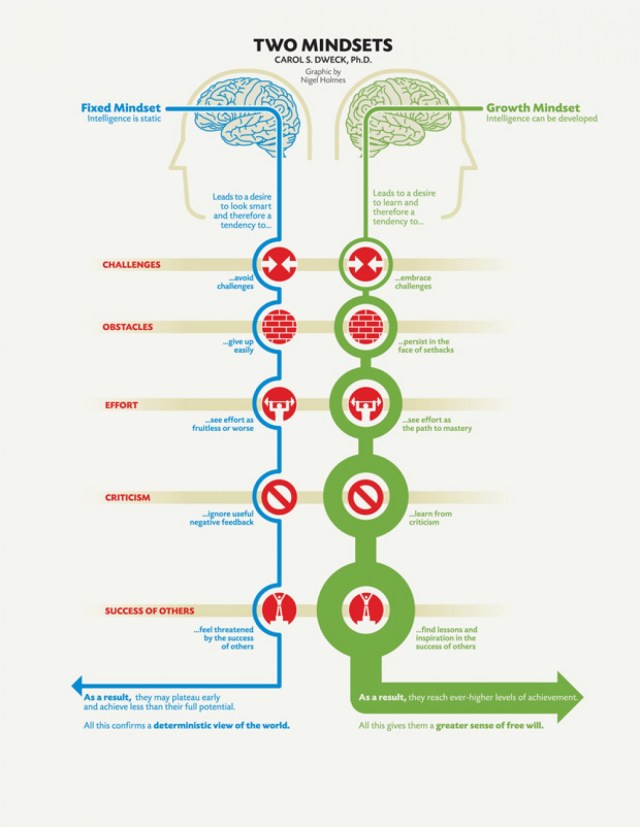
Infographic: Carol Dweck and the Growth Mindset

Now, I´m aware that this infographic (created by Nigel Holmes) has been around for a while – but then, there´s probably some 6,999,000,000 people on this planet who have not seen it as of yet – so I´m doing an important job here. 😉

The Growth Mindset – based on Carol Dweck

Growth Mindset

U.S. Researchers are lucky – as the top-tier Universities are very strong Brands

This is a little off-topic – but over the last days, I came to realize how much easier it appears to be for top (psychology) researchers in the U.S. to “create buzz” around their research and/or book publications compared to their German colleagues.

Over the last weeks, a couple of researchers in the field of Positive Psychology and adjacent whom I am loosely acquainted with (e.g., Adam Grant, Scott Barry Kaufman, and Emma Seppälä) or whom I would like to be loosely acquainted with (e.g., Amy Cuddy – we´re following each other on Twitter; I guess that doesn´t count…) have published new books (Congratulations to all of you!):

Because a) these are all fabulous books; b) they all probably have more than decent PR agents; and c) I follow a heck of a lot of Positive Psychology people on Twitter, Facebook, and LinkedIn my timelines are bursting with posts about their books (reviews, excerpts, and interviews). Now here´s the interesting thing – look at these headlines:

This is a random sample. Even though – from my perspective – Adam Grant has become a sort of personal brand, and Amy Cuddy is well on her way to becoming one (there´s not too many social psychologists who get air time on the Late Show with Stephen Colbert), very often the research is marketed via the university they are affiliated with.

So, it´s clear that these institutions over time have managed to become strong brands. Their names validate and even amplify the messages publicized by their faculties. That’s a really cool thing!

Now, if you are from the U.S. you might say: Duh, tell me something new. But seen from a German perspective, this is really remarkable – because (currently) this would never work over here. You just won’t see a headline along the lines of “A Humboldt University of Berlin Researcher says X” – because the names of the universities do not really add any credibility to the message (at least not in the realm of psychology; with, e.g., engineering, it might be a slightly different story).

As a side note: I have not seen that many headlines featuring my MAPP alma mater, UPenn (with Wharton Business School being the exception). Maybe, it’s time for some more brand-building here?

Stanford_Psych

10 more Blogs on Positive Psychology and adjacent You Need to Know

IMG_2317A while ago, I posted a list of 10 blogs on Positive Psychology and adjacent I frequently visit. Back then, I already said it was hard to limit the selection to only 10 sites. Therefore, here´s another curated list of cool Positive Psychology blogs. Share and enjoy!

Eric Barker writes Barking Up The Wrong Tree. He brings you science-based answers and expert insight on how to be awesome at life. His content has been featured in the New York Times, the Wall Street Journal, Wired Magazine and Time Magazine.

The Greater Good Science Center at Berkeley (co-founded by Professor Dacher Keltner) “studies the psychology, sociology, and neuroscience of well-being, and teaches skills that foster a thriving, resilient, and compassionate society”. They frequently publish articles by their own staff as well as guest articles by eminent researchers.

In their own words, The Creativity Post (co-founded by Scott Barry Kaufman) is “a non-profit web platform committed to sharing the very best content on creativity, in all of its forms: from scientific discovery to philosophical debate, from entrepreneurial ventures to educational reform, from artistic expression to technological innovation – in short, to all the varieties of the human experience that creativity brings to life.”

The Center for Positive Organizations (staff includes Professors Jane Dutton, Kim Cameron, Robert Quinn, and Gretchen Spreitzer) based at the Ross School of Business (University of Michigan) seeks to “inspire and enable leaders to build high-performing organizations that bring out the best in people. We are a catalyst for the creation and growth of positive organizations.” They regularly publish articles by the aforementioned researchers and scholars in Positive Organizational Scholarship.

Paula Davis-Laack is a fellow Penn MAPP alum and writes a regular column called Pressure Proof about “strategies and stories for busy, complicated lives” on Psychology Today.

In their own words, The Pursuit of Happiness is a “group of psychologists, philosophers, educators, and web professionals dedicated to the advancement of scientific knowledge about happiness and depression prevention. We provide science-based information on life skills and habits needed to enhance well-being, build resilience against depression and anxiety, and pursue a meaningful life.” Professor Todd Kashdan is one of the contributors.

Happiness by Design is a column on Psychology Today by London School of Economics´ Professor Paul Dolan. It doesn’t update very often by the posts are cool to read.

Action for Happiness is a movement of people committed to building a happier and more caring society. We want to see a fundamentally different way of life – where people care less about what they can get just for themselves and more about the happiness of others. Sir Richard Layard is among the founders. They publish compelling pieces by top-tier Positive Psychology researchers and experts in their news section.

To my mind, Michael Tomoff is one of the few people who write stuff worth reading on Positive Psychology in German. His blog is called Was wäre wenn? (What if?).

The last one is a sort of honorable mention. The late Professor Christopher Peterson published an immensely insightful and oftentimes very funny Positive Psychology blog via Psychology Today called The Good Life. Even though it has not been updated ever since 2012 (for obvious reasons), I revisit it frequently for inspiration.