What drives Workplace Happiness? A Survey of 200,000 People

BCG_Decoding_TalentOne of the central tenets in Positive Psychology is “Other People Matter!” – coined by the late Prof. Chris Peterson. This is also true for the workplace. Hell may be other people, as Sartre famously said. But they are also heaven if companies manage to create asshole-free offices.

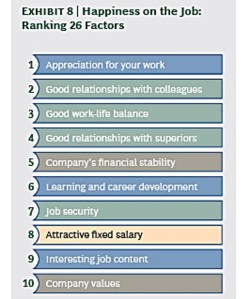
I recently stumbled upon a study carried out by consulting firm Boston Consulting Group (BCG). They surveyed more than 200,000 people globally from all walks of life on the drivers of workplace happiness (among other things). At the end of the day, they came up with a list of 26 different factors. In the graphic, the top 10 attributes that influence workplace happiness are displayed.

Now, if you ask me, the top 4 factors are all about (positive) relationships:

BCG_Decoding_Talent_RankNo. 1 is “appreciation for your work”. Yet, appreciation doesn’t come out of nowhere. It´s provided by bosses, co-workers, and subordinates. It´s other people.

No. 2 is “good relationships with colleagues”. Clearly, that´s other people.

No. 3 is “good work-life-balance”. For me, that translates to “My job enables me to have good relationships with people apart from the workplace”.

No. 4 is “good relationships with superiors”. That’s probably very close to No. 1.

I rest my case.

Your first and foremost Job as a Leader is… Peter Drucker​ on Positive Organizations

I guess it must be really hard to be a management guru these days. No matter what you say, no matter how brilliant you are – there’s a very high probability that somebody will already have laid out what your core message is. And with “somebody”, I don’t refer to a lot of people, I’m just talking about one person: Peter Drucker.

If you visit, e.g., his notable quotes on GoodReads, you’ll find that he was an incredibly smart thinker – and the he basically laid out all the principles of modern (and in some instances: post-modern) management (in the best sense of the word…). And he did all of that mostly during the 1950s and 60s!

Last week, I stumbled upon a quote that gives rise to the assumption Peter Drucker was also able to foresee some of the developments in Positive Organizational Scholarship (POS), e.g.,  Jane Dutton’s concept of High-Quality Connections, or Kim Cameron’s idea of leading by managing Organizational Energy.

Here are some additional quotes alluding to the rise of Positive Organizations:

Peter Drucker on Positive Deviance and High-Quality Connections

Leadership is lifting a person’s vision to higher sights, the raising of a person’s performance to a higher standard, the building of a personality beyond its normal limitations.

—–

The work relationship has to be based on mutual respect. Psychological despotism is basically contemptuous—far more contemptuous than the traditional Theory X. It does not assume that people are lazy and resist work, but it assumes that the manager is healthy while everybody else is sick. It assumes that the manager is strong while everybody else is weak. It assumes that the manager knows while everybody else is ignorant. It assumes that the manager is right, whereas everybody else is stupid. These are the assumptions of foolish arrogance.

—–

The leaders who work most effectively, it seems to me, never say “I.” And that’s not because they have trained themselves not to say “I.” They don’t think “I.” They think “we”; they think “team.” They understand their job to be to make the team function. They accept responsibility and don’t sidestep it, but “we” gets the credit. This is what creates trust, what enables you to get the task done.

Peter Drucker on Strength Orientation

A person can perform only from strength. One cannot build performance on weakness, let alone on something one cannot do at all.

—–

We all have a vast number of areas in which we have no talent or skill and little chance of becoming even mediocre. In those areas a knowledge workers should not take on work, jobs and assignments. It takes far more energy to improve from incompetence to mediocrity than it takes to improve from first-rate performance to excellence.

—–

A man should never be appointed to a managerial position if his vision focuses on people’s weaknesses rather than on their strengths. The man who always knows exactly what people cannot do, but never sees anything they can do, will undermine the spirit of his organization.

Peter Drucker on Purpose

An organization is not, like an animal, an end in itself, and successful by the mere act of perpetuating the species. An organization is an organ of society and fulfills itself by the contribution it makes to the outside environment.

—–

Only a clear, focused, and common mission can hold the organization together and enable it to produce results.

Peter Drucker on Self-Knowledge and the Growth Mindset

Success in the knowledge economy comes to those who know themselves – their strengths, their values, and how they best perform.

—–

People in general, and knowledge workers in particular, grow according to the demands they make on themselves. They grow according to what they consider to be achievement and attainment. If they demand little of themselves, they will remain stunted. If they demand a good deal of themselves, they will grow to giant stature—without any more effort than is expended by the nonachievers.
A Positive Approach to Organizational Tensions

Pos_Org_QuinnI know I probably should be talking about Adam Grant´s Originals (I did…) or Angela Duckworth´s Grit (I will…) these days, but instead, today, I´d like to point you towards another superb book: The Positive Organization by Robert Quinn.

Robert is professor at the University of Michigan and serves on the faculty of Organization and Management at the Ross Business School. He is one of the co-founders and of the Center for Positive Organizations and author several bestsellers on management.

Description of the book (taken from the book´s wrapper):

The problem is that leaders are following a negative and constraining “mental map” that insists organizations must be rigid, top-down hierarchies and that the people in them are driven mainly by self-interest and fear. But leaders can adopt a different mental map, one where organizations are networks of fluid, evolving relationships and where people are motivated by a desire to grow, learn, and serve a larger goal. Using dozens of memorable stories, Quinn describes specific actions leaders can take to facilitate the emergence of this organizational culture—helping people gain a sense of purpose, engage in authentic conversations, see new possibilities, and sacrifice for the common good.

The book includes the Positive Organization Generator, a tool that provides 100 real-life practices from positive organizations and helps you reinvent them to fit your specific needs. With the POG you can identify and implement the practices that will have the greatest impact on your organization.

For me, the most intriguing part of the book is Quinn´s proposition to see organizations not as more or less static entities, but rather as a systems of tensions. This figure provides a nice overview:

Quinn_Org_Tensions.png

The remainder of the book is equally valuable. If you´re looking for management book that is based on solid science (Positive Organizational Scholarship) and yet offers jargon-free language and actionable ideas, “The Positive Organization” is for you.

The 3 Layers of Meaningful Work

A while ago, I shared a summary of a fantastic article on the sources of meaning in work co-authored by Amy Wrzesniewski. This year, while trying to understand how to create infographics, I wrote an article about Michael Steger’s (University of Colorado) CARMA framework on how leaders can help their employees to perceive meaning in their work.

Today, I’d like to share more of Michael’s insightful work. With several co-workers, he created a new scale that aims at measuring how much meaning somebody perceives in his or her current working role. It’s called Work and Meaning Inventory (WAMI, here’s the original article).

Steger et al. find that it might be useful to conceptualize meaningful work as having three different layers (please also see the infographic at the bottom): The meaning of the work itself, the meaning it helps to generate in the wider context of the person’s life, and the meaning that is generated when a job helps to achieve some greater good. In their own words:

Positive meaning in work. This facet is a straightforward reflection of the idea of psychological meaningfulness that has been part of work psychology since the job characteristics model. […] Meaningful work is often a subjective experience that what one is doing has personal significance. 

Meaning making through work. Empirical research has shown that work frequently is an important source of meaning in life as a whole. There seems to be a common overlap between one’s work and one’s life work. Indeed, the idea that work could be meaningful without also leading people to build meaning in their lives as a whole makes little sense.

Greater good (GG) motivations. The desire to make a positive impact on the greater good is consistently related to the experience of meaningful work as well as the related construct of calling. […] This facet reflects commonly held ideas that work is most meaningful if it has a broader impact on others. 

As the saying goes:

All good comes in threes.

Three_Level_Meaning_Steger

Finally, it´s here: Adam Grant´s TED talk on Creativity and Innovation

How do creative people come up with great ideas? Organizational psychologist Adam Grant (here´s an interview he recently gave for Mappalicious…) studies “originals”: thinkers who dream up new ideas and take action to put them into the world. In this talk, learn three unexpected habits of originals — including embracing failure. “The greatest originals are the ones who fail the most, because they’re the ones who try the most,” Grant says. “You need a lot of bad ideas in order to get a few good ones.”

While this is Adam´s first TED talk, he´s given two TEDx talks in the past:

Share and enjoy!

3 “Original” Questions for Wharton´s Adam Grant

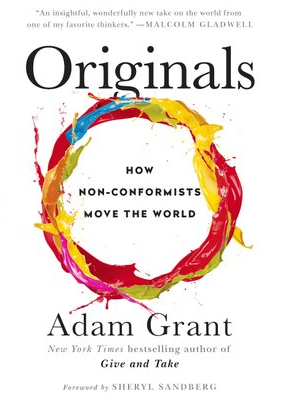
Adam Grant is a professor at Wharton Business School and also teaches in the Master of Positive Psychology program at Penn. His new book Originals: How Non-Conformists Move the World has recently been published. It´s about creativity and how we all can bring daring ideas to life.


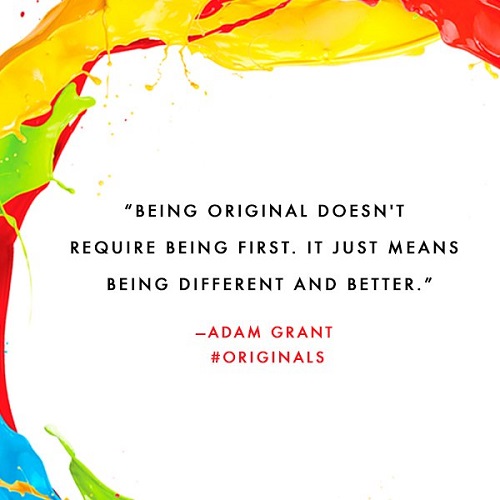
Adam_Grant_Quote_1Adam, you’re a scientist. According to philosopher Thomas Kuhn’s theory of paradigm shifts it’s particularly tough to be original in this domain because your own community might be incentivized to hold bold ideas down. What’s your (give and) take on this?

When I first read Kuhn as a freshman in college, I was stunned by his argument that major scientific advances don’t take hold until a generation of old scientists clinging to old theories literally dies out. At the time, I believed him, but now I think he was only partially right. In many scientific fields, it’s extremely difficult to publish work that doesn’t challenge the status quo. We want to discover new knowledge, not replicate existing knowledge. There may be a small group of gatekeepers who are invested in their pet theories, but the larger scientific community favors fresh insights. Why, then, do so many scientists face opposition to their oppositional ideas? Building on what I wrote in chapter 2 of Originals, my bet is that it’s less about incentives and more about cognitive entrenchment: scientists become so convinced of prevailing theories that they literally have a hard time seeing alternative possibilities. Look at Einstein: after ushering in his revolutionary ideas about relativity, he resisted the quantum revolution in physics. “To punish me for my contempt for authority,” Einstein reflected, “fate made me an authority myself.”

Adam Grant - OriginalsCultures may vary significantly as to the extent they value non-conformism and standing out. I´m German – we´re a decidedly Western society but still, I feel, the general public adheres to “being sensible and staying with the flock”. What´s your advice here for the “dreamers and the doers”?

The more a culture values conformity, the more important it becomes to master the art of tempered radicalism.

First, make your unfamiliar ideas more familiar by connecting them to things that people already understand – like pitching The Lion King as “Hamlet with lions” or Warby Parker as “We’re going to do for glasses what Zappos did for shoes.”
Second, instead of trying to convince other people to change their values, show them how your idea appeals to values they already hold.
Third, reframe following you as an act of conformity by leveraging the power of social proof: show them that other people like them are already on board with your idea.
And fourth, don’t forget that there’s often more variance within cultures as between them. Find the bright spots, as Chip and Dan Heath say in Switch.  Then, to borrow a term from Jane Dutton, build a micro-community of people who embrace originality.

Adam Grant - QuoteFrom the author´s perspective: What´s the most original chapter in “Originals” – and why?

In form, I think chapter 3 is the most original. I had great fun building in a surprise that I will not spoil here. In content, I’d say the most contrarian ideas are in chapter 5, where I argue that common goals drive groups apart instead of binding them together (this helps to explain why vegans hate vegetarians even more than they dislike meat eaters) and revealing your purpose can make you less persuasive (this is why Elon Musk didn’t start SpaceX by telling people he wanted to go to Mars).


Thanks a lot, Adam – and best of luck with your new book!

Article about Positive Organizational Scholarship on Zeit Online

For my German readers (or those that like to use Google Translator):

I´m really proud and happy right now. I´ve published an article on ZON, the online presence of Die Zeit, Germany´s most-read weekly newspaper (and one of the most prestigious in general). It covers a short overview of Positive Psychology and then takes a deep-dive into Alex Edmans´ research on the relationship of employer centricity and capital markets performance.

Nico_Rose_Zeit_Feelgood


Invitation: Study on Leadership Behavior

For my German-speaking readers:

I´ve initiated a study that seeks to better understand the perception of certain leadership behaviors. If you currently work somewhere and report to someone (= have a boss) you are eligible to participate.

Participation takes just 7-8 minutes. Please click here:

https://de.surveymonkey.com/r/fuehrungsstudie

You can also forward this link via e-mail or share it on social media etc.

Thank you very much!

Nico

Mann_lachend_weinend.jpg

Picture via gratisography.com

Infographic: How to be Wise – as an Entrepreneur (and in Life)

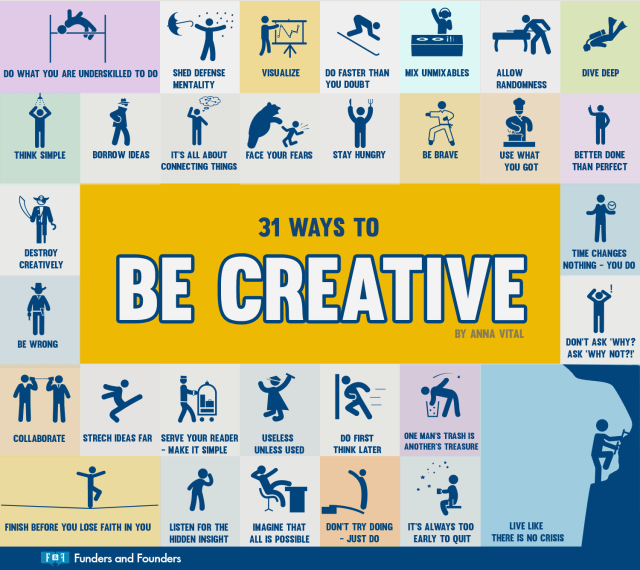
This is another really cool infographic by Anna Vital of Funders and Founders. And I think the quotes she gathered do not only apply to the realm of entrepreneurship but getting sh.t done in general. When I look at that graphic (which means through the lens of Positive Psychology), I see insights on self-efficacy, self-concordance, grit and perseverance, and hope (theory).

Share and enjoy!

Wise_Vital