
Actually, now it´s hanging right on my coaching office´s wall. How do you like it? I see lots of Positive Psychology in it…
Actually, now it´s hanging right on my coaching office´s wall. How do you like it? I see lots of Positive Psychology in it…
A couple of times, I´ve written about how German mainstream culture and Positive Psychology may just not be a perfect match. In spite of this, German mainstream media outlets start to discover the topic, especially reporting on the connection of being happy/satisfied and positive work outcomes. Heré, I´ve compiled a list of pieces that were published in 2013 and 2014.
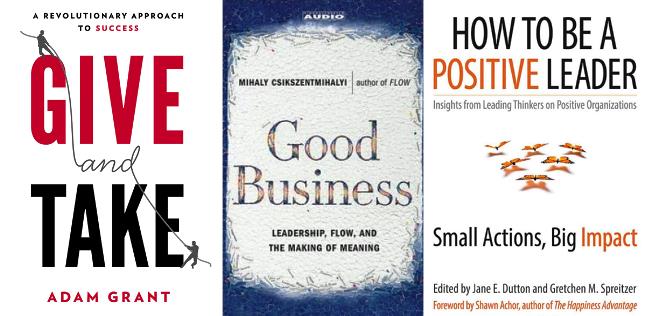
Here, I´ve compiled a list of books that apply Positive Psychology to the realm of “the organization”, leadership, management etc. As always, I see the list as work in progress and will be happy to include your suggestions. When making suggestions, please stick to books that have a clear link to Positive Psychology and are (by and large) backed by research.
Yeah! It´s finally online. Over the last couple of weeks (and including reading and preliminary research, over the last 8 months) I´ve been working on my MAPP Capstone thesis. Now, it has been published in the Scholarly Commons section of Penn´s homepage. You can download the PDF for free here.
The title of my paper is: Introducing Self-Permission: Theoretical Framework and Proposed Assessment. Here´s the abstract:
The term self-permission refers to a belief about the self that a person can hold to a stronger or weaker extent. Self-permission, in short, is the answer an individual gives oneself when asking about their perceived allowance to reach overarching long-term objectives, such as having a fulfilling career or enjoying a lasting and gratifying relationship. At a broader level, the question is whether a person allows him or herself to lead a happy and rewarding life. This paper describes the concept of self-permission, explores its nomological network and possible antecedents and consequences, proposes a corresponding self-permission scale (SPS), and suggests a study for assessing 1) the psychometric properties of that scale, 2) its relationship with conjectured adjacent constructs, and 3) its relationship with psychological functioning. Considering how important it seems to be to most individuals to make the best out of their lives and to live up to a deeply felt sense of purpose, a better understanding of self-permission could significantly benefit the psychological well-being of many people who do not allow themselves to thrive.
If you are an expert in (Positive) Psychology research and theory, I´d love to have your feedback. I propose a new construct and a scale to measure it. I´ve tried to list all adjacent constructs and concepts I could find to “build” the nomological net (please see appendix in addition to the relevant section in the paper) – but I´m sure there´s lots of interesting stuff out there that I´ve missed and that could serve to deepen my understanding. So if there´s something I should definitely have a look at, please do tell me…
To laugh often and much: To win the respect of intelligent people and the affection of children, to earn the appreciation of honest critics and endure the betrayal of false friends; to appreciate beauty, to find the best in others, to leave the world a bit better whether by a healthy child, a garden patch, or a redeemed social condition; to know even one life has breathed easier because you lived. This is to have succeeded.
 Sorry, Positive Psychologists. It´s all been said and done before… 😉
“There is no way to happiness. Happiness is the way.” is a quote by the Buddha. I have not spoken to him in person (at least not to his 2,500 B.C. incarnation…) but what he probably meant is that happiness is not a goal that can be attained (for good). Rather, happiness is a consequence (or rather: byproduct) of doing certain things – and refraining from doing certain other things. This view opposes modern materialistic notions of life where we are repeatedly told something along the lines of “If you achieve X/if you manage to get Y – then you´ll be happy.”
Buddha´s quote is in line with other great thinkers of his time: Aristotle thought that eudaimonia (the “good life”, flourishing) was a byproduct of leading a virtuous life, where a virtue can be found right in the middle between two vices (e.g., courage lies between cowardice and imprudence). Confucius equally propagated leading a life guided by certain virtues. For instance, he formulated an early version of the Golden Rule that was made famous in the West by my compatriot Immanuel Kant.
The Science of Positive Psychology takes these sages at their word – and has gathered some empirical evidence on the issues. By way of example, happiness is a consequence of…
But if happiness is a way instead of a destination – I assume it´s also reasonable to ask: the way to what or where?
Typically, we ask ourselves what we have to do in order to be happy. But what if happiness is not the goal?
What if happiness were the input variable – not the outcome?
By now, we do know a lot about this way of looking at psychological well-being. For instance, happiness leads to …
In order to start being happy right now, I suggest you (re-)visit this video…
I´m sitting at “Vino Volo”, Philly airport right now. The 7th onsite of MAPP 2013/14 is over. It was another incredible, intensive, incomparable experience – not only thanks to the program itself, but due to the other participants. A big shout-out especially goes to Ann Brafford and Patricia De La Torre.
The hardest part always seems to choose what to write about afterwards. There´s so much good stuff out there – and I only have time to write about a few things. Yesterday afternoon, our guest lecturer was Yale´s Amy Wrzesniewski. Wrzesniewski is one of the world´s most renowned researchers on meaning and purpose on the job, (career) callings, and turning the job you have into the job you want (job crafting).
Towards the end of her lecture, she touched upon the topic that is displayed in the title of this post: Should we follow our bliss – or our blisters in order to have a fulfilling and successful (work) life? Both phrases were coined by mythologist and writer Joseph Campbell who, based on his literary studies, developed the theory of the Monomyth. The idea in short is that basically all great stories (from Homer´s Iliad to Harry Potter) are based on the same universal storytelling structure: the Hero´s Journey.
The following quote can be found in his book “The Power of Myth”:
If you follow your bliss, you put yourself on a kind of track that has been there all the while, waiting for you, and the life that you ought to be living is the one you are living. Wherever you are—if you are following your bliss, you are enjoying that refreshment, that life within you, all the time.
A lot of Campbell´s students obviously misinterpreted his quote as an advice to embrace hedonism as the path to happiness, to pursue “feeling good no matter what”. Late in his life and frustrated with this development, Campbell purportedly made the remark “I should have said, ‘Follow your blisters’.”
Had those students paid more attention to the structure of the Monomyth they would have grasped that the bliss in “follow your bliss” cannot be about pleasure alone. The Hero´s Journey is a path that entails great struggle, pain, and even losing (parts of) oneself: Luke Skywalker and Frodo Baggins both lose a part of their body before defeating evil for good.
This notion can be made clearer when replacing the term “bliss” with “passion”. Passion is based on the Latin word “passio” which means “suffering” or “enduring” (as in “The Passion of Christ”). Only much later did it acquire its meaning of “enthusiasm” and “strong liking”. Consider this image (source):

The drawing mirrors sayings such as “No Cross, no Crown” or “No Pain, no Gain”. Despite thousands of books offering us a shortcuts to “success and everything we ever wanted”, intuitively most of us know that the picture on the right is the real deal – and the one on the left (in 99,9% of all cases) is Bullshit (as defined by Harry G. Frankfurt).
Every melody would be played in C major. Every painting would depict beautiful water lilies. Every story would begin with “and they lived happily ever after”.
And how lackluster our lives would be if the left side were an effigy of truth: Every melody would be played in C major. Every painting would depict lovely water lilies. Every story would begin with “and they lived happily ever after”. Such a life would not be worth living.
Dear shortcut vendors, here´s what Yoda (picture source) has to say to you:

The MAPP program is a fulltime program – but combines onsite classes with long-distance learning periods. Part of the distance learning comprises a lot of reading (Who would have thought of that…) and writing essays about a wide array of positive psychology topics. I´ve decided to post some of those essays here on Mappalicious. Surely, they´re not the be-all and end-all of academic writing. But then again, it would also be a pity to bury them in the depths of my laptop. So here we go…
Seligman (2011) posits that engagement, for instance, by regularly entering into a state of Flow (Csikszentmihalyi & LeFevre, 1989), and seeking and realizing achievement (Wiegand & Geller, 2005) on and off the job are two constitutive elements of well-being. These concepts are represented by the letters E and A in the acronym PERMA, Seligman´s current outline of positive psychology. Csikszentmihalyi (1990) characterizes Flow as a state of optimal experience. The most important features of Flow are effortless attention, absence of time awareness, and absence of emotion. Seemingly contradictory, Duckworth, Peterson, Matthews, and Kelly (2007) posit that Grit, characterized as a passion and persistence for long-term goals and the associated exercise of self-control (Duckworth & Seligman, 2005), are key predictors of sustainable achievement. In this paper, I will argue that experiencing Flow and exerting Grit may be alternating stages on the same road to accomplishment – much in the same way that in- and exhaling are interchanging phases of the process of breathing.
At first glance, even though both concepts are perceived as pathways to achievement, Flow and Grit do have characteristics that seem to be somewhat incompatible. Grit is theorized as a stable character trait that does not require an immediate positive feedback loop. Individuals high in Grit are capable of sustaining determination and motivation over long periods despite experiences with failure and adversity (Duckworth et al., 2007). Their passion for long-term objectives is the principal factor that provides the energy required to keep on track amidst challenges and set-backs. Using one´s Grit may be gratifying in the end because it helps us to reach long-term goals – but is doesn´t necessarily have to feel good while still being “on the way”. Often, using Grit is the opposite of the characteristic of effortlessness. In fact, it can lead people to “torture” themselves for the “greater good”.
On the other hand, Flow is a state that is “easy” (Csikszentmihalyi, 1990). While it is important to have feelings of potential control and mastery in order to experience Flow, it does not feel like it is necessary to exert control – things seem to take care of themselves. In fact, most people report that feeling nothing at all is a typical characteristic of being “in the Flow”. Positive feelings only come after the task at hand is done. In addition, experiencing Flow is dependent on regular task-related feedback. It is attained most easily when a person´s skills and the challenge at hand are of equal magnitude.
I propose that the relationship of skill level and the difficulty of the task at hand may be the connection between both concepts. Flow is typically depicted as the optimal level between boredom and anxiety:
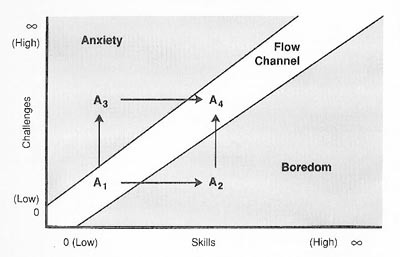
It seems likely that gritty persons are typically capable of overcoming the anxiety of facing challenges that seem too difficult at first. They perceive obstacles as challenges, and by conquering these challenges, the continuously expand their skill level. This, in turn, will enable them to potentially experience Flow in more difficult situations in the future. Thereby, the gratifying experience of Flow may be the reward for having pushed one´s boundaries just a little further.
To close this essay with an analogy: in my opinion, the relationship between Grit and Flow resembles the interplay of Yin and Yang in Taoism. Yin is the female, soft, or yielding principle. It can be likened to being in Flow. It´s letting go without losing control, it´s doing without doing. On the other hand, exerting Grit can be likened to Yang: it´s the male, hard, or penetrating principle. It´s holding on to preserve control, it´s doing by taking action. These principles seem to be contradictory – but in fact, they are complementary.
Csikszentmihalyi, M., & LeFevre, J. (1989). Optimal experience in work and leisure. Journal of Personality and Social Psychology, 56(5), 815-822.
Csikszentmihalyi, M. (1990). Flow: The psychology of optimal experience. New York: Harper-Perennial.
Duckworth, A. L., Peterson, C., Matthews, M. D., & Kelly, D. R. (2007). Grit: perseverance and passion for long-term goals. Journal of Personality and Social Psychology, 92(6), 1087-1101.
Duckworth, A. L., & Seligman, M. E. (2005). Self-discipline outdoes IQ in predicting academic performance of adolescents. Psychological Science, 16(12), 939-944.
Seligman, M. E. (2011). Flourish: A visionary new understanding of happiness and well-being. New York: Free Press.
Wiegand, D. M., & Geller, E. S. (2005). Connecting positive psychology and organizational behavior management: Achievement motivation and the power of positive reinforcement. Journal of Organizational Behavior Management, 24(1-2), 3-25.
Just found out that I wasn´t the first person on planet Earth to have the brilliant abovementioned thoughts (What was I thinking anyway…). Here´s a very instructive blog post along similar lines by the name of Grand Unified Theory of Mastery.
By Johannes Jansson (GFDL or CC-BY-SA-3.0) via Wikimedia Commons.
Sorry for this mediocre headline…
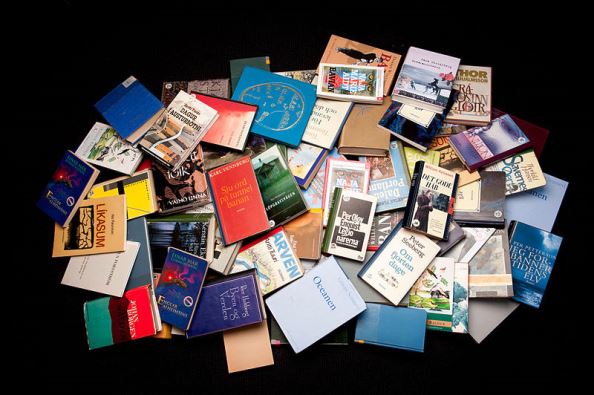
I don´t know what your home looks like – but mine is crammed with books. I have several book shelves that are way to small to harbor them all. So I just put them everywhere. There are books in my study, in the living room, in the bedroom, in the kitchen, … , you get the picture. That´s why I really enjoyed reading about this study I came across a couple days ago:
A team of researchers investigated the connection of availability of books in a household and education of the inhabitants. They collected data from representative samples in 27 countries and basically looked at the educational attainment of the children, comparing those that come from families with a lot of books (>500) versus not so many books. What they found:
Children that grow up with many books stay in school three years longer on average – which obviously has something to say on their success in later life. This finding applies across all the countries investigated. What I find most interesting: the finding is independent of parental occupation, education, and social class.
Now go and buy a book. Or ten. Or a hundred. Do it. Now!
Books are not made for furniture, but there is nothing else that so beautifully furnishes a house.
(Henry Ward Beecher)
 Mappalicious