Breathing Happiness: New TEDx Talk by Emma Seppälä

Emma Seppälä believes we already possess the tools we need to control our own happiness. She explores the science behind harnessing your state of mind and how it can ultimately lead to success.

Turns out, happiness is not as elusive as it once seemed. Using findings from cognitive psychology and neuroscience, Seppälä simplifies happiness so that anyone can enjoy it. She’s a frequent contributor to Harvard Business Review, Psychology Today and Scientific American Mind. She’s the founder and editor-in-chief of Fulfillment Daily, a news site dedicated to the science of happiness.

10 fantastic Quotes by William James that preview Positive Psychology

Philosopher William James is often portrayed as being the founding father of modern (American) psychology. Here, I collected ten of his quotes that show he’s also been an influence for many theories and practices that are among the cornerstones of Positive Psychology.

On self-efficacy and solution-focused thinking

Action may not always bring happiness, but there is no happiness without action.

On creating habits

To change one’s life:
1. Start immediately.
2. Do it flamboyantly.
3. No exceptions.

On optimism, pessimism, and rumination

If you believe that feeling bad or worrying long enough will change a past or future event, then you are residing on another planet with a different reality system.

On the value of attention and mindfulness

Each of us literally chooses, by his way of attending to things, what sort of universe he shall appear to himself to inhabit.

On belief systems and disputation of negative thoughts

To perceive the world differently, we must be willing to change our belief system, let the past slip away, expand our sense of now, and dissolve the fear in our minds.

On perseverance, grit, and sisu

In exceptional cases we may find, beyond the very extremity of fatigue distress, amounts of ease and power that we never dreamed ourselves to own, sources of strength habitually not taxed at all, because habitually we never push through the obstruction, never pass those early critical points.

On finding purpose and vitality

Seek out that particular mental attribute which makes you feel most deeply and vitally alive, along with which comes the inner voice which says, ‘This is the real me,’ and when you have found that attitude, follow it.

On meaning, altruism, and the greater good

The great use of life is to spend it for something that will outlast it.

On the value of positive relationships

Wherever you are, it is your friends who make your world.

On hope, best future selves, and callings

Your hopes, dreams and aspirations are legitimate. They are trying to take you airborne, above the clouds, above the storms, if you only let them.
 William  James 

3 Questions for Emma Seppälä, Author of “The Happiness Track”

Emma_SeppäläEmma Seppälä, Ph.D is Science Director of Stanford University’s Center for Compassion and Altruism Research and Education and author of the recently published book The Happiness Track. She is a frequent contributor to Harvard Business ReviewPsychology TodayHuffington Post, and Scientific American Mind.

Emma, if you had to describe your book in a short analogy (“We’re the Uber for x…” or something like that): What would it be?

The hack for success without stress.

I’m a manager and reaaaaally busy. If I had time to read only one chapter: Which one would you recommend – and why?

Read the second chapter on how to build your resilience. We believe we need high levels of adrenaline to get things done – so we over-caffeinate, over-schedule ourselves, and wait until the last minute to get things done. The result is not productivity, it’s burnout which is why we’re seeing 50% burnout across industries, 80% of doctor’s visits due to stress, and 75% of the American workforce disengaged. You can’t talk yourself out of stress but there is something you can do at the physiological way that will help you manage your energy, be more productive and emotionally intelligent, and be resilient in the face of the pressure and demands coming your way – cultivating physiological resilience. 

In all these years of studying Positive Psychology: What is the one scientific finding that intrigued you the most?

The finding that has intrigued – and inspired – me the most is that the best kept secret to happiness is to give it away. By uplifting others, supporting them, helping them and living a more compassionate life, not only will you be making everyone else happier, you will be happier, healthier and live a longer life too. It’s win-win!

Thank you very much and best of luck with The Happiness Track!

Infographic: Building Blocks of the Good Life (PERMA-V)

This is the second artwork (well…) in my self-imposed learning journey on the way to producing decent infographics. This time, I chose Martin Seligman´s PERMA framework, which, by many people, is considered to be the most comprehensive framework of “the good life”, the foundation of Positive Psychology in science and practice.

Since PERMA is not exactly hot from the presses, I added a little twist: For a couple of years now, Marty challenges his students in the Penn Master of Positive Psychology program to propose meaningful additions to the original PERMA outline (Positive Emotions | Engagement | Relationships | Meaning | Achievement). Over time, it became clear that the original framework may be somewhat “neck-up”, thereby omitting aspects such as sports, sex, sustenance, and sleep.

PERMA-V: Positive Psychology, neck-up and neck-down

Therefore, students kept asking for the letter “S” to be added – which ultimately would result in the acronym PERMAS (doesn´t sound too funky…) or SPERMA (uh-uh, not a proper name for a scientific term…). Meanwhile, there seems to be a growing mutual consent to choose the letter “V” for Vitality – and to put it at the end with a hyphen. To my knowledge, this was first proposed by a fellow Mapp graduate, Emiliya Zhivotovskaya.

What do you think?

PERMA_V_Good_Life

Share and enjoy!

Life is amazing. And then it’s awful. And then…

Nico_Mika_ParkWord.

Life is amazing. And then it’s awful. And then it’s amazing again. And in between the amazing and awful it’s ordinary and mundane and routine. Breathe in the amazing, hold on through the awful, and relax and exhale during the ordinary. That’s just living heartbreaking, soul-healing, amazing, awful, ordinary life. And it’s breathtakingly beautiful.

(L.R. Knost)

Almost everything will work again if you unplug it for a few minutes…

I’m sitting in my favorite café in the beautiful city of Wiesbaden where I lived from 2005 to 2010. They make the best cappuccino in the whole wide world. 

Appropriately enough, I’ve just stumbled upon this witty quote by Anne Lamott:

Almost everything will work again if you unplug it for a few minutes, including you.


12 + 1 Articles on Positive Education (including links to PDFs)

Positive EducationI´m very happy to announce that recently, I have become an IPEN Global Representative. IPEN (International Positive Education Network) is an initiative to “bring together teachers, parents, academics, students, schools, colleges, universities, charities, companies and governments to promote positive education.” The group of Global Representatives volunteers to help IPEN to “spread the word” on Positive Education (in their respective countries of origin).

To start, I´ve compiled a list of 12 eminent research articles on Positive Education, the links will lead to the respective PDFs. Enjoy!

Bonus:

Mindful Farting: 5 Easy Tips To Get Started

First things first: in case you´ve been reading my blog in the past, you will know that I´m a big fan of mindfulness and mindfulness exercises. If you´re here for the first time, let me tell you: I love mindfulness. There, I´ve said it. Just in case…

What I don´t like at all is the fact that there´s a developing “industry” around this truly valuable topic, taking it, and turning it into just another of those (marketing) fads that are all to common in the multi-billion dollar self-help business. I was inspired to write the post you´ll find below after reading the piece “The Muddied Meaning of Mindfulness” in the New York Times. The author tracks the aforementioned (d)evolution and concludes that by now, “mindfulness seems perilously close to the doggerel from the same playbook that brought us corny affirmations, inner children, and vision boards“.

To “prove” the point that a lot of what is written on mindfulness these days may actually be fluff talk, I typed “mindful eating” into the Google search bar, took the first “listicle” type article I could find, and basically just erased two or three sentences. Then, I exchanged all those words relating to the realm of food with expressions from the realm of digestion, most notably flatulence. Result: the meaning of the piece basically stayed the same – more or less. But do judge for yourself… 🙂

Please note: I do not intend to offend any directly with this post. Neither the Huffington Post, nor the writer who crafted the original piece. In this case, they are just a victim of the superior Google rank. And most certainly, I´m not opposed to mindful and healthy eating habits.

Instead, please take this article as a reminder to be mindful about mindfulness. Or just a bad case of German humor…

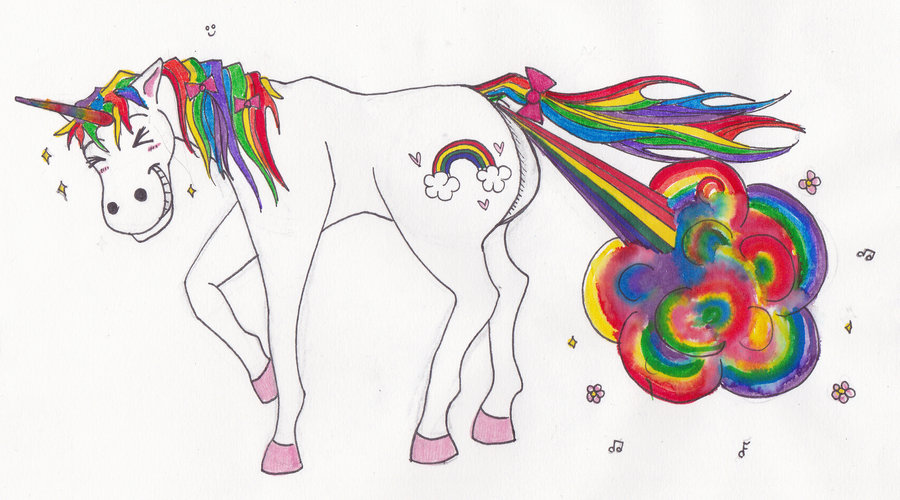
rainbow_farting_unicorn_by_ahiruluver602-d4rdxgxMindful Farting: 5 Easy Tips To Get Started

From how not to fart when you are pregnant, to the endless lists of the latest must-have superfoods, discussion about healthy farting tends to focus on what we fart. 

Much less attention is paid to the question of how we fart. 

Yet a growing body of research suggests that changing our attitudes and practices around farts and farting rituals may be every bit as important as obsessing over what it is we actually squeeze out of our bowels. Mindful farting (also known as intuitive farting), a concept with its roots in Buddhist teachings, aims to reconnect us more deeply with the experience of farting — and enjoying — our gasses. Sometimes referred to as “the opposite of diets,” mindful farting is based on the idea that there is no right or wrong way to fart, but rather varying degrees of consciousness about how we are farting and why. The goal of mindful farting, then, is to base our farts on physical cues, such as our bodies’ signals, not emotional ones — like farting for comfort. 

The idea was featured in a New York Times article last year, in which journalist Jeff Gordinier visited a Buddhist monastery where practitioners were encouraged to fart in silence, and sniff every bit of gas as they explored its tastes, textures and smells in minute detail. The article inspired a somewhat skeptical response from our own Robin Shreeves, who noted that in her household full of young boys, the notion of farting in silence seemed like mission impossible, and might even be detrimental, given that mealtimes are often when the family gets a chance to actually converse.

But mindful farting doesn’t have to be an all-or-nothing affair.

In fact, as the New York Times article stated, there are plenty of ways to work mindfulness into your daily flatulence habits without the need to become a fully robed monk, or grind on a tiny fart for three days straight.

As a registered dietitian, I am a firm believer that finding ways to slow down and fart intentionally is all a part of developing a truly healthy flatulence culture. And some early research into mindful farting would seem to back this up. One study, for example, tracked more than 1,400 mindful farters and showed them to have lower body weights, a greater sense of well-being, and fewer symptoms of farting disorders.

But mindful farting will only work for you can make it compatible with your lifestyle. 

Here are some of my favorite tips to introduce mindfulness to fart-times in an easy, accessible fashion.

Fart slower. Farting slowly doesn’t have to mean taking it to extremes. Still, it’s a good idea to remind yourself, and your family, that farting is not a race. Taking the time to savor and enjoy your gasses is one of the healthiest things you can do and you’ll probably find yourself noticing flavors you might otherwise have missed. If you have young children, why not try making a game of it — who can fart their farts the longest?

Savor the silence. Yes, farting in complete silence may be impossible for a family with children, but you might still encourage some quiet time and reflection. Again, try introducing the idea as a game — “let’s see if we can fart for two minutes without talking”.

Silence the phone. Shut off the TV. Our daily lives are full of distractions, and it’s not uncommon for families to fart with the TV blaring or one family member or other fiddling with their iPhone. Consider creating family fart-time, which should, of course, an electronics-free zone. I’m not saying you should never fart in front of the TV, but that too should be a conscious choice that marks the exception, not the norm. 

Pay attention to flavor. The tanginess of a lemon, the spiciness of arugula, and the crunch of a pizza crust— paying attention to the details of our farts can be a great way to start farting mindfully. After all, when you fart on the go, it can be hard to notice what you are even sniffing, let alone truly savor all the different sensations. If you are trying to introduce mindful farting to your family, consider talking more about the flavors and textures of the gasses. Ask your kids what the avocado smells like, or how the hummus feels. And be sure to share your own observations and opinions too. (Yes, this goes against the farting in silence piece, but you don’t have to do everything at once.)

Know your gasses. Mindfulness is really about rekindling a relationship with our farts. Even when you have no idea where the gasses you are blowing have come from, try asking yourself some questions about the possibilities: Who grew this? How? Where did it come from? How did it get here? Chances are, you’ll not only gain a deeper appreciation for your farts, but you’ll find your digestion habits changing in the process, too. 

Like I say, mindful farting does not have to be an exercise in super-human concentration, but rather a simple commitment to appreciating, respecting and, above all, enjoying the farts you blow every day. It can be practiced with salad or ice cream, donuts or tofu, and you can introduce it at home, at work, or even as you fart on the go (though you may find yourself doing this less often).

And while the focus becomes how you fart, not what you fart, you may find your notions of what you want to digest shifting dramatically for the better, too.

Picture Source