The 3 Layers of Meaningful Work

A while ago, I shared a summary of a fantastic article on the sources of meaning in work co-authored by Amy Wrzesniewski. This year, while trying to understand how to create infographics, I wrote an article about Michael Steger’s (University of Colorado) CARMA framework on how leaders can help their employees to perceive meaning in their work.

Today, I’d like to share more of Michael’s insightful work. With several co-workers, he created a new scale that aims at measuring how much meaning somebody perceives in his or her current working role. It’s called Work and Meaning Inventory (WAMI, here’s the original article).

Steger et al. find that it might be useful to conceptualize meaningful work as having three different layers (please also see the infographic at the bottom): The meaning of the work itself, the meaning it helps to generate in the wider context of the person’s life, and the meaning that is generated when a job helps to achieve some greater good. In their own words:

Positive meaning in work. This facet is a straightforward reflection of the idea of psychological meaningfulness that has been part of work psychology since the job characteristics model. […] Meaningful work is often a subjective experience that what one is doing has personal significance. 

Meaning making through work. Empirical research has shown that work frequently is an important source of meaning in life as a whole. There seems to be a common overlap between one’s work and one’s life work. Indeed, the idea that work could be meaningful without also leading people to build meaning in their lives as a whole makes little sense.

Greater good (GG) motivations. The desire to make a positive impact on the greater good is consistently related to the experience of meaningful work as well as the related construct of calling. […] This facet reflects commonly held ideas that work is most meaningful if it has a broader impact on others. 

As the saying goes:

All good comes in threes.

Three_Level_Meaning_Steger

Invitation: Study on Leadership Behavior

For my German-speaking readers:

I´ve initiated a study that seeks to better understand the perception of certain leadership behaviors. If you currently work somewhere and report to someone (= have a boss) you are eligible to participate.

Participation takes just 7-8 minutes. Please click here:

https://de.surveymonkey.com/r/fuehrungsstudie

You can also forward this link via e-mail or share it on social media etc.

Thank you very much!

Nico

Mann_lachend_weinend.jpg

Picture via gratisography.com

Infographic: Building Blocks of the Good Life (PERMA-V)

This is the second artwork (well…) in my self-imposed learning journey on the way to producing decent infographics. This time, I chose Martin Seligman´s PERMA framework, which, by many people, is considered to be the most comprehensive framework of “the good life”, the foundation of Positive Psychology in science and practice.

Since PERMA is not exactly hot from the presses, I added a little twist: For a couple of years now, Marty challenges his students in the Penn Master of Positive Psychology program to propose meaningful additions to the original PERMA outline (Positive Emotions | Engagement | Relationships | Meaning | Achievement). Over time, it became clear that the original framework may be somewhat “neck-up”, thereby omitting aspects such as sports, sex, sustenance, and sleep.

PERMA-V: Positive Psychology, neck-up and neck-down

Therefore, students kept asking for the letter “S” to be added – which ultimately would result in the acronym PERMAS (doesn´t sound too funky…) or SPERMA (uh-uh, not a proper name for a scientific term…). Meanwhile, there seems to be a growing mutual consent to choose the letter “V” for Vitality – and to put it at the end with a hyphen. To my knowledge, this was first proposed by a fellow Mapp graduate, Emiliya Zhivotovskaya.

What do you think?

PERMA_V_Good_Life

Share and enjoy!

How Leaders Enable Meaningful Work [Infographic]

Thanks to the stunning infographics of Anna Vital (see them here, here, and here), I’ve decided to learn how to better think and communicate in a visual way. I’m not a designer, so I don’t know how to work with Software packages like Illustrator. Therefore, for the time being I have to use what’s already out there, e.g., the Webdings that come with Microsoft’s fonts.

To start, I´ve chosen a topic that´s very close to my heart: Meaningful work. Prof. Michael F. Steger is one of the world´s foremost authorities on this topic. He created the acronym CARMA to outline a set of leadership behaviors that help employees to perceive their work as being valuable and meaningful.

What do you think?

CARMA_Work

Share and enjoy!

The Meaning of Life according to different Philosophers [Infographic)

This is another brilliant infographic by information designer extraordinaire Anna Vital (see her simply beautiful work on self-compassion here) – where the content is highly relevant to Positive Psychology. Please check out her website to see more of her amazing work.   

10 brilliant Quotes, Adages, and short Poems related to Positive Psychology

Over the last years, I´ve collected countless quotes, sayings, short poems and similar inspirational stuff that (to my mind) is related to Positive Psychology. Here are my top-10 for the time being. Enjoy!

It is easier to build strong children than to repair broken men.
(Frederick Douglass)

Be yourself. No one can say you´re doing it wrong.
(Charles M. Schulz)

Discipline is choosing between what you want now and what you want most.
(Abraham Lincoln, among others)

Your brain is not designed to make you happy. That´s your job.
(Tony Robbins)

People were created to be loved. Things were created to be used. The reason why the world is in chaos is because things are being loved and people are being used.
(Unknown)

Be you! The world will adjust.
(Unknown)

We either make ourselves miserable, or we make ourselves strong. The amount of work is the same.
(Carlos Castaneda)

A positive attitude may not solve all your problems, but it will annoy enough people to make it worth the effort.
(Herm Albright)

To laugh often and much: To win the respect of intelligent people and the affection of children, to earn the appreciation of honest critics and endure the betrayal of false friends; to appreciate beauty, to find the best in others, to leave the world a bit better whether by a healthy child, a garden patch, or a redeemed social condition; to know even one life has breathed easier because you lived. This is to have succeeded.
(Ralph Waldo Emerson)

I will not die an unlived life. I will not live in fear of falling or catching fire. I choose to inhabit my days, to allow my living to open me, to make me less afraid, more accessible, to loosen my heart until it becomes a wing, a torch, a promise. I choose to risk my significance; to live so that which came to me as seed goes to the next as blossom and that which came to me as blossom, goes on as fruit.
(Dawna Markova)

Be Yourself - Schulz

Boosting Meaning in Life by visiting Golden Gate Bridge

I’m writing this while sitting in a whirlpool in Stanford Park Hotel, Palo Alto. I’m on an extended business trip to the U.S. which has taken me from Philadelphia (where I got to attend the 10 year anniversary of the MAPP program at Penn) to Boston, then New York, and now the San Francisco area.

Today is a day off and I took the time to do some classic SF sightseeing – since this is my first time ever on the West Coast: I visited the Twin Peaks, Fishermen’s Wharf, and Lombard Street. But first and foremost, I was eager to see the Golden Gate Bridge.

Nico Rose - Golden Gate

Ever since doing that, I have a warm feeling in my heart and my guts – and after looking at some research, I’m pretty sure I know why this is the case.

Growing up in Germany in the early 80s, I used to watch all those classic TV series like “Hart to Hart”, “The Fall Guy”, or “The A-Team”. Ever since, just being in the U.S., walking around and looking at the skyscrapers, yellow cabs, and the ambulances just is a cool thing to do for me (as it probably is for most Germans).

But at the end of the day, I guess there is no other sight that is able to carry the same quality of “longing to be in the USA” as Golden Gate – probably, because it is also the longest way to go from my home. For me, it’s a classic case of reveling in nostalgia, it conveys a sense of excitement, insouciance, and spending time with my beloved grandparents (who all have passed away long ago).

As stated before, I found a piece of research that is able to show reveling in nostalgia may be a viable pathway for boosting the presence of meaning in life. Here is what the researchers have to say:

The present research tested the proposition that nostalgia serves an existential function by bolstering a sense of meaning in life. Study 1 found that nostalgia was positively associated with a sense of meaning in life. Study 2 experimentally demonstrated that nostalgia increases a sense of meaning in life. In both studies, the link between nostalgia and increased meaning in life was mediated by feelings of social connectedness.

So thank you Empire State Building, thank you yellow cabs, thank you Golden Gate Bridge, for bringing back colt Colt Seavers, Hannibal Smith – and first and foremost, grandma and grandpa! Love you…

Research: Linking “Positive Practices” to Organizational Effectiveness

Stones - GrowthThere are tons of books out there explaining how to use Positive Psychology for boosting the performance of organizations. But the truth is: from a scientific point of view, we really do not know very much about this link. There’s abundant research on the connection of positivity and individual performance – but it remains by and large unclear if this influence on the micro-level yields any outcomes on the macro-level. Of course, it seems to make a lot of sense to infer this relationship – but where’s the research?

A very worthwhile attempt is offered via an article named Effects of positive practices on organizational effectiveness by Kim Cameron and his colleagues. Based on prior research, they developed an inventory of what they call “positives practices”. According to the authors, these can be described as

behaviors, techniques, routines […] that represent positively deviant (i.e., unusual) practices, practices with an affirmative bias, and practices that connote virtuousness and eudemonism in organizations.

In order to do so, they administered a large number of questionnaire items to diverse groups of people. Afterwards, they clustered the answers in order to find common themes and pattern in the data. They found that all positives practices could be categorized into six distinct subgroups:

Caring

People care for, are interested in, and maintain responsibility for one another as friends.

Compassionate Support

People provide support for one another including kindness and compassion when others are struggling.

Forgiveness

People avoid blame and forgive mistakes.

Inspiration

People inspire one another at work.

Meaning

The meaningfulness of the work is emphasized, and people are elevated and renewed by the work.

Respect, Integrity, and Gratitude

People treat one another with respect and express appreciation for one another. They trust one another and maintain integrity.

Having found that structure, they gathered data from several divisions of a financial services company and one operating in the healthcare industry. They asked employees to assess their respective business unit (= the organization as a whole, not individuals) with regard to being a place that possesses the aforementioned attributes. Additionally, they obtained data on several objective and subjective key performance indicators of those business units – and finally looked at the connection of the presence of positive practices and organizational effectiveness measures. Here´s what they´ve Cameron and his colleagues found (in their own words):

In Study 1, positive practices in financial service business units were significantly associated with financial performance, work climate, turnover, and senior executive evaluations of effectiveness. In an industry in which positive practices might be assumed to carry little importance, organizational performance was substantially affected by the implementation of positive practices.

In Study 2, improvement in positive practices over a two year period in health care units predicted improvements in turnover, patient satisfaction, organizational climate, employee participation in the organization, quality of care, managerial support, and resource adequacy.

 In the course of arguing why positive practices should have a performance-boosting effect, the authors conclude that

cognitively, emotionally, behaviorally, physiologically, and socially, evidence suggests that human systems naturally prefer exposure to the positive, so it is expected that organizational performance would be enhanced by positive practices.

Of course, Cameron et al. urge us to be careful not to make strong inferences from their results:

The results of these two investigations, of course, are suggestive and not conclusive.

Still, their work is one of the first and still very rare pieces of research that links positive organizational behavior to organizational effectiveness. I am very much looking forward to scholars who pick up on these findings and expand our knowledge on the positivity-performance link.

The 4 Types of Fun – Infographic

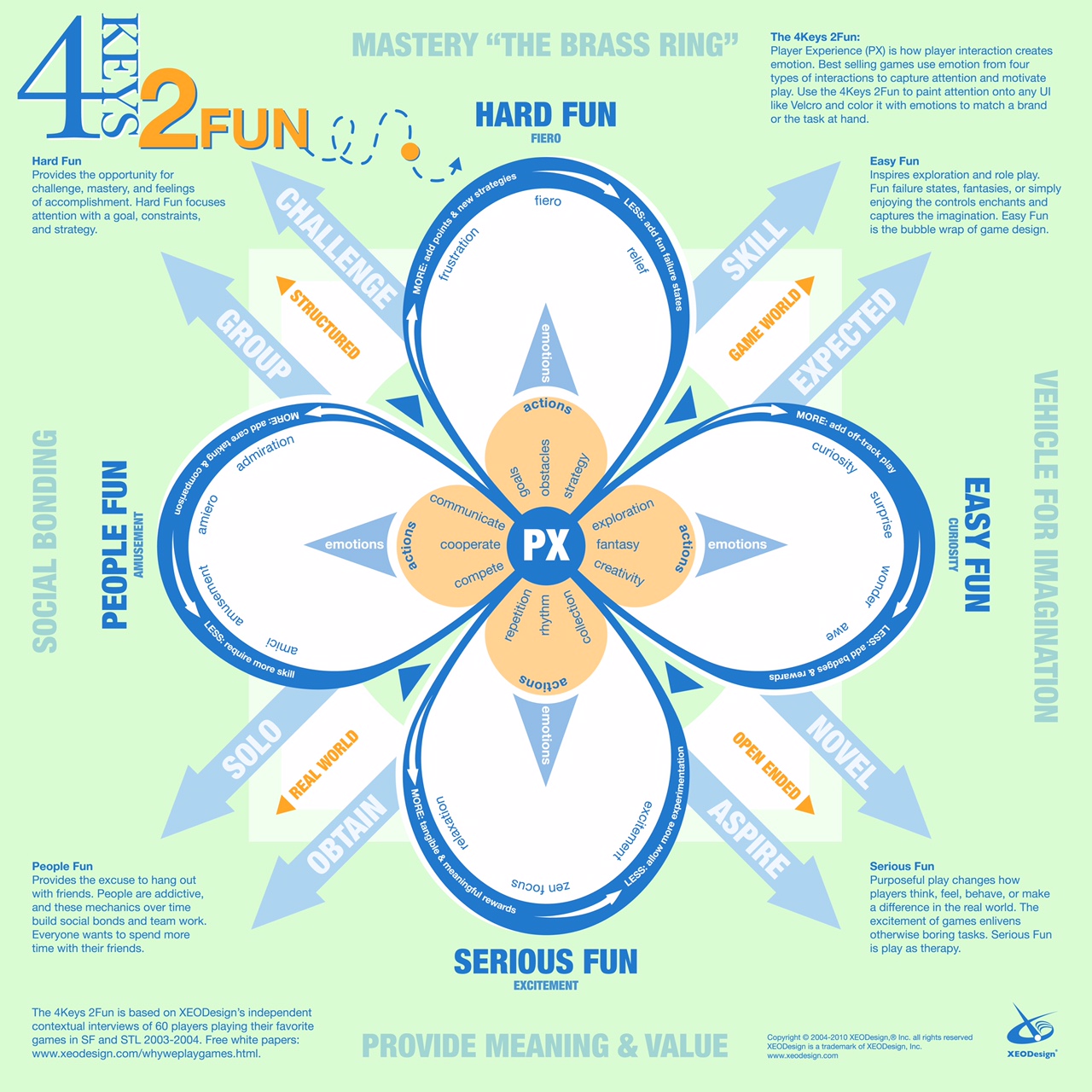
Yesterday, I stumbled upon this fascinating info graphic (click to enlarge):

Four Keys to Fun

It was created by game experience designer Nicole Lazzaro and shows the different kinds of positive emotions that gamers can experience while playing a well-crafted game. The underlying data was obtained from in-depth interviews and thorough observations of 60 gamers.

I am not a gamer myself (or rather, I stopped being one at age 14…) but I like the chart and the underlying concept for its striking similarity to some frameworks from Positive Psychology. It seems pretty easy to map the four types of fun to Seligman´s PERMA framework:

  • “Easy Fun” and Imagination can be found in Positive Emotions.
  • “Hard Fun” and Mastery can be found in Engagement and Achievement.
  • “People Fun” and Bonding can be found in Relationships.
  • “Serious Fun” and Value can be found in Meaning and also Achievement.

I´m always fascinated when different thinkers come to similar conclusions starting at totally different angles of a certain subject. Lazzaro has a presentation on Slideshare where she explores her framework in more depth. Have (maybe four types…) of fun with it!