Probably the most important message ever – but hard to grasp for some of us

So I found this yesterday on one of my friend´s Facebook page. I copied the pictured and forgot to write down who it was. Please notify me if you see this to get proper credit.

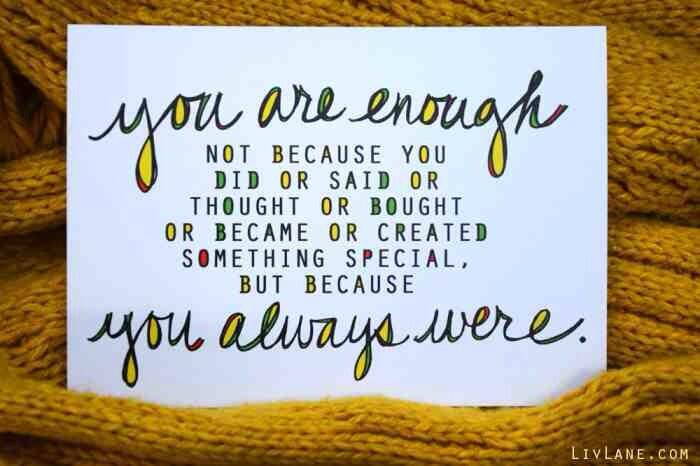
But anyway, the original source for this postcard is the artist and motivational speaker Liv Lane. I´ve never heard of her before (living in Germany might be a good excuse for that…) – but below, you can see one of the very fundamental truths about our nature as human beings. It took me about 30 years to reach that insight – and sadly, a lot of people never get to that point of intuitive wisdom.

But once you understand, everything is different…

You are enough

Micro-Changes: What´s in a (first) Kiss?

Just a filler for today – but a truly beautiful one. It´s a video that´s just going viral right. What you´ll see: 10 couples that have just met and are asked to kiss. It´s a beautiful thing just in itself – but perceived through Esa Saarinen´s Positive Psychology lens it´s also a great story about micro-change and not holding back. Enjoy!


Edit

By now it is clear that those first meetings may have been not be that spontaneous. A lot of the protagonists seem to be models, actors, or musicians – so they are used to performing in front of a camera. But still: it´s a beautiful thing to behold…

On Friendship, Love, and the Benefits of Aging

Aging WellFor whatever reason, I am confronted with the issues of aging (and death…) a lot over the recent weeks. My mom had to go to the hospital, and in my circle of friends, parents got sick as well – or even died. And while that is distressing and painful emotionally, I know rationally that getting old(er) is nothing to be afraid of. Because getting older (for most of us) means getting happier. We get less anxious, more satisfied, and get to a deeper understanding of the meaning of (our) life.

While being on the plane that brought me to Philly for the MAPP onsite, I watched the movie Last Vegas starring Robert De Niro, Michael Douglas, Morgan Freeman, and Kevin Kline. It´s a fun-loving, pleasantly over-the-top “geriatric” version of Hangover. Most of all, it´s a story of aging well – and the power of (life-long) friendship.

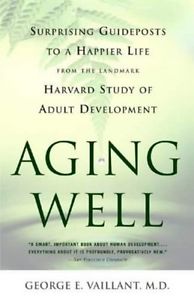
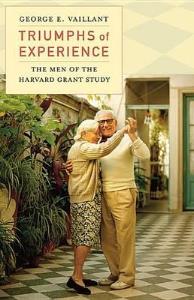
Triumphs of ExperienceCoincidently, one of the guest lecturers of this month´s MAPP onsite has been (some 80 years old) George Vaillant, who´s been the director of the world-famous (Harvard) Grant Study – which for 75 years followed the lives of 268 physically and mentally healthy Harvard college sophomores from the classes of 1939-1944, and a second cohort of 456 disadvantaged non-delinquent inner-city youths who grew up in Boston neighborhoods between 1940 and 1945. Vaillant writes about the results of this study in his books Aging Well (2003) and Triumphs of Experience (2012). There´s lots of interviews available with Vaillant – here, I´ll point you to one for the Huffington Post. Two main points that came out of the study:

Love is really all that matters.

Connection is crucial.

There you have it. The Beatles were right: All you need is love. My parents will both turn 70 next year. And by March 2014, they will be married for 46 years. I hope that my wife and I one day will achieve the same…

If you´d like to have more input, please watch this TED talk on the benefits of aging by Laura Carstensen who is Director of Stanford´s Center on Longevity.

Why I buy Flowers for my Wife (almost) every Week – not only on Valentine´s Day

element5-digital-538883

unsplash.com/@element5digital

First thing to say: Because she deserves it, obviously! Second: the headline includes “almost”. Let´s be honest here. I travel a lot, but on a lot of Saturdays, she gets ´em.

Now, there is reason and a story behind this. I buy flowers for my wife because of my grandpa. He served in World War II, got wounded several times, and was a prisoner of war for about a year towards the end of the story. When I was a boy, he used to tell me stories of that time over and over again: Mostly horrible stories of him seeing his comrades being torn to pieces by grenades – but there was one story that I particularly liked. He used to recount:

You know, I am not a very religious guy. But when I was a prisoner, I prayed to God. And I told him: Please God, if you let me return home to my wife, I promise you I will buy her roses every weekend until the end of my life.

And as far as I know, he kept his promise. Later, when I was a young man and my grandpa could hardly walk any more due to long-term sequelae of his battlefield injuries, I used to do the grocery shopping for my grandparents on Saturday mornings. Grandpa would always give me an extra 20 Deutsche Mark so I could buy roses for grandma at his favorite flower shop. And I would bring home the roses – and he would give them to her. We did this right to the end.

So that´s why I buy roses for my wife (almost) every week. I´ve learned from the best. Here´s to you, Opa…

Do what you love, and do it often: The Holstee Manifesto

Today, I´d like to share with you the Hostee Manifesto, a clear proof for the fact that you do not have to be a positive psychologist to have a deep knowledge of positive psychology. It has been created by a group of young people, e.g., Fabian Pfortmüller,  who happens to be co-founder of Sandbox, a truly exceptional group of young global change-makers that I had the pleasure to spend an incredible weekend with in Lisbon in 2012.

I´ll let the words speak for themselves.

The Holstee Manifesto

Micro-Moments of Love: A short Story on Meaning in Life

The MAPP program is a fulltime program – but combines onsite classes with long-distance learning periods. Part of the distance learning comprises a lot of reading (Who would have thought of that…) and writing essays about a wide array of positive psychology topics. I´ve decided to post some of those essays here on Mappalicious. Surely, they´re not the be-all and end-all of academic writing. But then again, it would also be a pity to bury them in the depths of my laptop…

Introduction

Positive psychology stresses the importance of close relationships, be it friendship, romantic love, family, or the support of a larger social entity (Reis & Gable, 2003). When asked to give a definition of positive psychology, the late Christopher Peterson used to say: “Other people matter.” (2006, p. 249). Fredrickson (2013) complements this remark by asserting that love (and its benefits) cannot be a matter of one person, but can only exist in pairs or groups of people. For authors like Vaillant (2008) and Seligman (2011), relationships are of uttermost importance as well. They are embodied by the letter “R” in the acronym PERMA, which represents Seligman´s framework of human flourishing. Additionally, it is hypothesized that close relationships can serve as a major source of meaning in life (Steger, 2009). This should hold true especially if one of the person´s top character strengths (Peterson & Seligman, 2004) is the “capacity to love and to be loved” – which for me is the case. Therefore, this story focuses on love between father and son as an “active ingredient” in the creation of meaning.

Micro-Moments of Love: A short Story on Meaning in Life

On 30th October 2013, my son Mika turned one year old. This year as a young father has been the most transformative experience of my life. It is said that having a child turns the “M” in “Me” upside down, converting it into “We”. By now I know this is absolutely true.

Having a child turns the M in Me upside down.
It is transformed into a We.

When I had to leave Germany for the U.S.A. on 3rd September 2013 to attend the so-called immersion week of the 2013/14 Master of Applied Positive Psychology program at University of Pennsylvania, I was deeply worried. My job as a manager at Bertelsmann, Europe´s largest media company, requires me to travel a lot. But until that day, I had never been away from my boy for more than two nights in a row – and even that could be heartbreaking. Yet, back then I had to leave for a whole week. For whatever reason, one of my greatest fears was that Mika would forget me and “turn cold” in the meantime. Happily, I can say this notion was utter foolishness on my part.

Nico - Mika - FunMika is a wild boy. We have this little ritual: When I return home from work on weekdays, my wife will wait at the door, holding him in her arms. When he spots me, you can see in his eyes that it takes him a little while to realize that his daddy is home. He will look at me with a blank expression. In my head, I start counting the seconds: twenty-one … twenty-two … twenty- … and then his whole face will transmute into the acme of joy. He will squeak with glee and hold up his arms, meaning: Daddy, grab and hug me! He will be really wild in his excitement, hit me on the cheek, kick my belly, and bite my nose. After seven seconds or so, he will beckon me to let him down on the floor again – and he will turn his attention to whatever toy is in reach at that moment.

But when I came home from Philadelphia in the early afternoon of 9th September, it was different. Really different. Mika had just woken up from his afternoon nap. He was standing upright, holding on to the guardrail of his crib, the lights still turned down low. I slowly entered his room and walked to the window, opening up the roller blind just a little bit so the afternoon sun could sneak into the room. Then, I stepped to the side of his bed and looked at him. And Mika looked back with that blank expression on his face. And in my head, I started to count the seconds again: twenty-one … twenty-two … twenty-three … twenty-four … twenty-five – and then I felt he really had forgotten about me.

But at last, he lifted up his arms. Calm. Not smiling. And I picked him up and he hugged me. And he laid down his head on my chest and for the eternity of about thirty seconds it stayed there. He then looked up, gazing at my face. Calm. Not smiling. After about five seconds, he rested his head again for another fleeting eon. Finally, he looked up again. And his whole face transformed into the acme of joy. And he squeaked with glee, and he hit me on the cheek, and he kicked my belly, and bit my nose. And after seven seconds or so, he made me let him down on the floor and went to play. And I cried.

References

Fredrickson, B. L. (2013). Love 2.0: How our supreme emotion affects everything we feel, think, do, and become. New York: Hudson Street Press.
Peterson, C. (2006). A primer in positive psychology. New York: Oxford University Press.
Peterson, C., & Seligman, M. E. P. (2004). Character strengths and virtues: A handbook and classification. Washington, D.C.: American Psychological Association.
Reis, H. T., & Gable, S. L. (2003). Toward a positive psychology of relationships. In C. L. Keyes & J. Haidt (Eds.), Flourishing: The positive person and the good life (pp. 129-159). Washington, DC: American Psychological Association.
Seligman, M. E. (2011). Flourish: A visionary new understanding of happiness and well-being. New York: Free Press.
Steger, M. F. (2009). Meaning in life. In S. J. Lopez (Ed.), Oxford handbook of positive psychology (pp. 679-687). Oxford, UK: Oxford University Press.
Vaillant, G. (2008). Spiritual evolution: How we are wired for faith, hope, and love. New York: Broadway Books.
I have a new Guru!

Little Guru - Unconditional LoveHe is approximately 73 cm tall and weighs roughly 8 kg. His superhuman abilities: breathing, sleeping, crying, farting – and most of all: smiling…

I am talking about our son Mika of course. I´m sure I will have to teach him a lot over the next twenty years (or so). But in return, he has already taught me something which I had heard of a lot of times over the last ten years, during an estimated 2,500 hours of courses in coaching and therapy, from secular and spiritual teachers; and read about in innumerable books. But I have never felt it fully until now: Unconditional Love.

During the workweek, I typically only have half an hour with him in the evening to read a bedtime story and put him to bed. When he falls asleep in my arms eventually, his head halfway hidden under my chest, one hand on my side, the other one straight on my heart, with infinite trust, a feeling of profound peace and stillness comes over me.*

I always knew I wanted to have kids. Not wanting to have children somehow appears “unnatural” to me. In this spirit, to all the people out there who (willingly) do not want to have offspring: I´m positively sure you´ll be missing out on all the best…

*I hope that I will be able to preserve this attitude, even if he – just like his father – will flunk his first math test in 8th grade; or if he – in spite of my deep love for Heavy Metal – perhaps will dig ridiculous German Ghetto Rap (Yes, that does exist!) instead…

Strong. Stronger. Signature Strengths. What are yours?

Since the onset of psychology as an academic discipline at the end of the 19th century, it has been functioning on the premise of a disease model: most psychologists were mainly interested in what´s “wrong with people” – and then finding cures for all those wrongs. Which is fine, but … just not the only way looking at humankind. It took psychology about a hundred years to take on the opposite perspective: trying to find out what´s right with people. Together with a colleague, the late Christopher Peterson, Martin Seligman published the book Character Strengths and Virtues: A Handbook and Classification about ten years ago, which scientifically classifies and describes 24 human strengths based on six broad virtues.

In order to make their list, a character strength had to satisfy most of the following criteria. Character strengths should be:

  1. fulfilling;
  2. intrinsically valuable;
  3. non-rivalrous;
  4. not the opposite of a desirable trait;
  5. trait-like (stable over time);
  6. not a combination of the other character strengths;
  7. personified by people made famous through story, song, etc.;
  8. observable in child prodigies;
  9. absent in some individuals;
  10. and nurtured by societal norms and institutions.

The six virtues and 24 character strengths are:

Wisdom and Knowledge

(strengths that involve the acquisition and use of knowledge)

  • creativity
  • curiosity
  • open-mindedness
  • love of learning
  • perspective and wisdom

Courage

(strengths that allow one to accomplish goals in the face of opposition)

  • bravery
  • persistence
  • integrity
  • vitality

Humanity

(strengths of tending and befriending others)

  • love
  • kindness
  • social intelligence

Justice

(strengths that build healthy community)

  • active citizenship
  • fairness
  • leadership

Temperance

(strengths that protect against excess)

  • forgiveness
  • humility
  • prudence
  • self-regulation

Transcendence

(strengths that forge connections to the larger universe and provide meaning)

  • appreciation of beauty
  • gratitude
  • hope
  • humor and playfulness
  • spirituality

What are my signature strengths?

Why should anybody be interested in his/her strengths? The rationale for finding out what our real strengths are is rather simple: Using our so-called signature strengths in daily life and work makes us happy – and most likely: successful. It makes us feel good about ourselves. It invigorates and energizes us. It´s the real deal…

You can find out what your signature strength are by taking a comprehensive scientific test on Martin Seligman´s website: the Signature Strengths Questionnaire. I´ve taken the test about a year ago – my main character strengths are:

Curiosity and interest in the world

You are curious about everything. You are always asking questions, and you find all subjects and topics fascinating. You like exploration and discovery.

Love of learning

You love learning new things, whether in a class or on your own. You have always loved school, reading, and museums-anywhere and everywhere there is an opportunity to learn.

Zest, enthusiasm, and energy

Regardless of what you do, you approach it with excitement and energy. You never do anything halfway or halfheartedly. For you, life is an adventure.

Humor and playfulness

You like to laugh and tease. Bringing smiles to other people is important to you. You try to see the light side of all situations.

Capacity to love and be loved

You value close relations with others, in particular those in which sharing and caring are reciprocated. The people to whom you feel most close are the same people who feel most close to you.