Want to learn from a certified Genius? Come to MAPP…

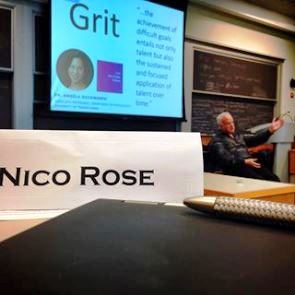
Duckworth - GritIf you´re like most people, you´re not going to be particular fond of statistics. But: Lo and behold – it can be fun! You just need the right teacher. In the case of the MAPP program, it is Angela Duckworth who was just awarded with a McArthur Fellowship – a prize that is informally also called “Genius Grant”. Angela received this award for her research on the concept of Grit which has shown to be a predictor of (academic) success above and beyond the predictive power of intelligence. In the picture, you can see Marty Seligman in the classroom the moment he told us about Angela´s achievement.

Now it might put a little extra pressure on us being taught by a genius – but who cares? When I compare this experience to learning statistics during my undergrad studies – it´s light years apart. You just need a teacher who loves to teach. So my mantra for today is:

Statistics can be fun

If you can´t dream it, you can´t do it!

In a lot of self-help books (of the shallow kind…), you’ll get to read the sentence “If you can dream it, you can do it” – which supposedly has been coined by Walt Disney. I acknowledge that this saying is well-intentioned – yet well intentioned and well done are oftentimes light years apart. There are simply a lot of things which sometimes all of us, and often most of us, cannot do – no matter how strong we believe. However how hard you exercise, you will never run as fast as Usain Bolt. No matter how hard you study, you will never be as smart as Steven Hawking. No matter how hard you work, you´ll never create the next Apple, Google, or Microsoft. Of course, there are always exceptions to the rule. There is a Usain Bolt, there is a Stephen Hawking, and there are Jobs, Brin/Page, and Gates – but they are “singularities”. And no matter how many books sporting titles such as “The 10 Secrets to being like Steve Jobs” you´ll read – there´s a 99.999% likelihood of failure.

But I do not want to be a messenger of pessimism here. In fact, I do believe in the power of belief. It´s just that we have to turn things around in order to make it work. If you´d like to have science on your side, the saying should go like this:

If you can´t dream it, you can´t do it!

No man in this world can run a mile (1,609m) in less than four minutes. This has been an unwritten law during the first half of the 20th century. Innumerable athletes had tried to conquer the so-called miracle mile; some came close, but no one was able to beat that time. There even were physicians who claimed the human body per se is not capable of performing that feat.

However, impossibility did not know that somebody didn´t give a sh.t about impossibility: Roger Bannister, a young British athlete, just didn´t believe in the widespread doctrine. In a series of preparatory runs, he came closer and closer to reaching the impossible. Finally, at Oxford’s Iffley Road arena, on 6th May 1954, under rather bad external conditions, he finished the mile in 3:59.4 minutes – new world record.* You can watch a race between Bannister and his closest rival at that time, John Landy, a couple of weeks later here.

While this is very impressive in itself, it is not the point of the matter. The really fascinating fact is: Suddenly, by the end of 1954, a total of 36 athletes worldwide were able to beat that time. Now what has happened here? Was there a sudden advance in the training methods? Or the doping substances? I don´t believe that. Rather, I believe Roger Bannister has overthrown a collective self-fulfilling prophecy. He broke “the spell”, he crushed the mental blockade that had bedeviled his generation of fellow athletes.

Bannister had what psychologist like to call high self-efficacy, the specific belief in one’s ability to succeed in specific situations. High self-efficacy is associated with a wide array of positive outcomes, while a lack of self-efficacy is a good predictor for failure – irrespective of actual capabilities. Low self-efficacy is the psychological equivalent of “If you can´t dream it, you can´t do it”.

But no amount of self-efficacy will help us do what´s not doable.

* The current world record is held by Hicham El Guerrouj (3:43.13).

Dream_it

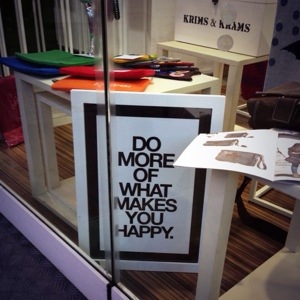
Do more of what makes you happy!

I came home to Germany from the third MAPP onsite this morning. In the afternoon, I went for a walk with my wife and the Little Guru. This is what I found in a local shop window. Wonder, for how long it has been there…

20131028-223511.jpg

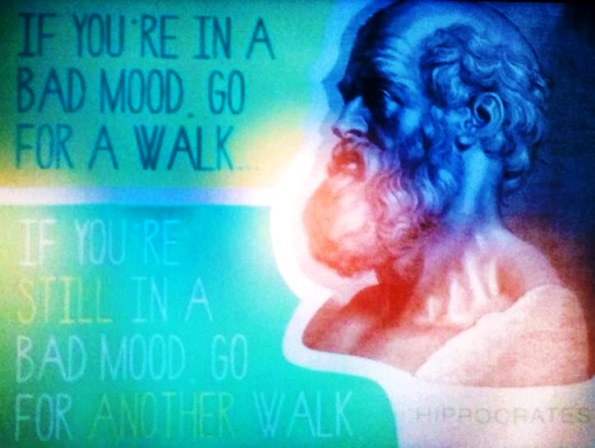
Hippocrates: If you´re in a bad Mood, go for a Walk

I´m at the third onsite of the 2013/14 MAPP program. This onsite is special because it´s the MAPP Summit: were being joined by some 60 MAPP alumni from the first eight editions of the program. Also, we´re welcoming some very interesting guest speakers. We will be joined by Art Carey from the Philadelphia Enquirer, Charlie Scudamore, who is Vice Principal at Geelong Grammar School, Ellen Langer from Harvard – and John Ratey, also from Harvard.

Right now, John Ratey is giving a presentation on the beneficial effects of physical exercise on overall well-being. He had this really nice slide that draws on Hippocrates – and I just want to share it with you…

Hippocrates

Not the same! On being (un-)happy in the Past, Present, and Future

Are you happy? That´s a rather easy question to answer, don´t you think? Well, turns out it´s not that easy. Because it really makes a difference what you are thinking about while trying to answer this question. What are the standards you use while evaluating your ‘human condition’?

????????????????????????????????

In Positive Psychology, there are (at least) three different perspectives on this issue and they center on the timeframe that is used for evaluating one´s happiness. It is literally possible to be (un-)happy in the past, present, and future – and there´s considerable evidence that these perspectives are separate from each other (albeit closely related).

When talking about ‘happiness in the past’, we usually refer to the construct of satisfaction with life which is a global cognitive evaluation of one´s life (so far). To date, it is the most widely used measure of psychological well-being.*

When talking about ‘happiness in the present’, we usually refer to what you do when actually ask somebody “How do you feel (right now)?” How much positive or negative affect do you feel in this moment? In terms of measurement, the most widely used instrument is the so-called PANAS (Positive and Negative Affect Schedule).

And finally, there´s ‘happiness in the future’ which is concerned with our optimism. How happy do you expect to be at time X in the future?

Now the interesting thing is: all three aspects will to a certain extent determine how happy you are today. And they can be tackled and improved separately (but that´s not today´s story…)

For today: if you would like to find out how you´re doing in the past, present, and future, you can take tests at Martin Seligman´s homepage. They can be found (among others) in the menu questionnaires.


*I´ve also used that one in the study that my book is based on.

Foto credit: Pamela Moore – www.istockfoto.com

Positive Psychology: Is it about Pleasure? Or Meaning? Or both?

The silence on Mappalicious is officially over. I´ve been travelling over the last 14 days and obviously have been too busy actually living my life in order to write about it in addition. And while doing this, I´ve made an interesting discovery: you can spend your days in New York (arguably the most exciting place on Earth) with a bunch of really nice people and a great program (Broadway musical, boat tour on the Hudson, party at one of the best rooftop bars in town etc.) – and still end up crying your eyes out in the hotel room. Just because you miss baby boy so much. True story…

Mika_Nico

Which raises a question on the nature of Positive Psychology:

Is Positive Psychology about leading a happy, pleasurable life? Or is it about leading a virtuous, meaningful life?

The answer is: both aspects are important – but if you would ask Marty Seligman, he´d say the emphasis clearly should be on cultivating strengths, virtues, and meaning. While experiencing lots of positive emotion definitley is a goal in Positive Psychology (because it just feels good to feel good; but more important: because positive emotions produce lots of beneficial ‘side effects’) they are only one element (P) of PERMA, Seligman’s theory of human flourishing.

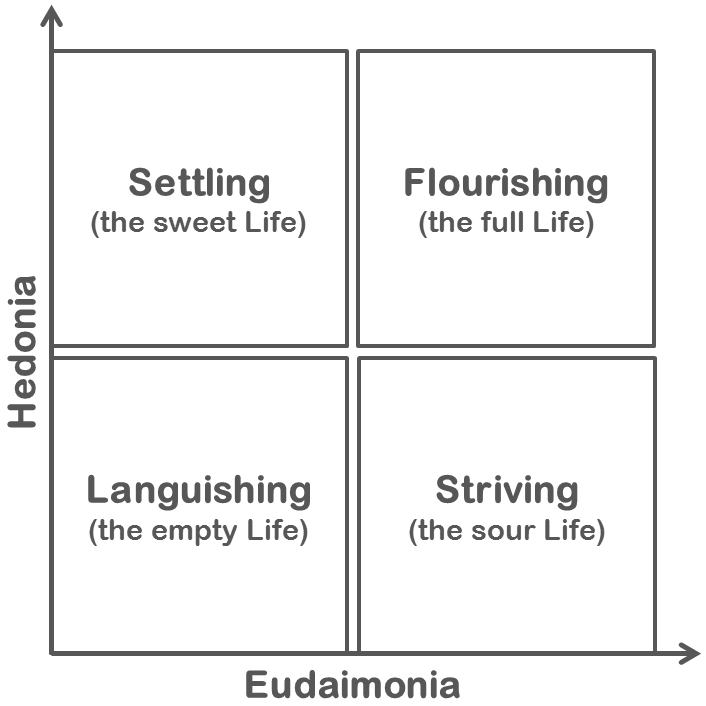
On the overarching level, it is possible to distinguish between the quest for hedonic (pleasurable) and eudaimonic (virtuous) experiences. Both clearly are important for leading a ‘full’ life, but Eudaimonia may just be a little more sustainable in the long run. When creating a 2×2 matrix with Eudaimonia on the one axis and Hedonia on the other, it will look like this:

Hedonia_Eudaimonia

  • When a human being experiences high levels of positive emotion and the presence of meaning, worthwhile goals, connection to other human beings etc., this can be characterized as ‘the full life’ or ‘Flourishing’ in the official diction.
  • The absence of both dimensions is called ‘the empty Life’ or ‘Languishing’ – a condition that is closely tied with depression.
  • If someone is high on the hedonic dimension but relatively low on Eudaimonia, I like to call it ‘the sweet life’ (‘Settling’ in the official lingo). By way of example, imagine the prototypical billionaire heir that squanders his family´s money on the French Riviera. It´ll surely be pleasurable but may also seem somewhat shallow.
  • On the other hand, when there´s a considerable lack of Hedonia, this condition can be termed ‘the sour life’ or ‘Striving’ in official Positive Psychology speak. You might want to imagine the epitome of an old unmarried lady that spends all of her time and money on ‘good causes’ but forgets herself on the way. It is admirable but may also seem a little ‘anemic’.

If you´d like to learn more: I´ve written an article in a coaching magazine on that topic about a year ago. It´s in German unfortunately – but I know that many German-speaking people are reading this blog, too…

Social Media and Wellbeing – or: Can your iPhone tell if you´re depressed?

For a moment, please imagine that you have had an episode of depression at an earlier point in your life. Obviously, you would not want anything of that to return anytime soon. Unfortunately, that´s just not an easy thing to do. Relapse rates for depression are rather high – thus, there is a considerable probability of experiencing at least one other episode once who been there for the first time.

Now imagine there´s someone that could give you an early warning. Someone that would be able to detect and interpret all those little behavioral signals that typically occur when a person slips in into depression. This someone would also automatically notify your doctor so she can catch up with you. Sounds like a dream of the future? Well, maybe not. What if your smartphone could understand what you are saying all day long – and then infer from your words that you are currently talking like somebody who is depressed?

Enter several researchers from the University of Pennsylvania, of whom one is Johannes Eichstaedt (who was in the MAPP program three years ago). They analyzed 700 million words and phrases collected from Facebook messages of 75,000 volunteers, who also took standard personality tests. What they´ve found is pretty amazing: the usage of certain (groups of) words on Facebook can be highly predictive of certain aspects of our personality, but also other variables like gender or age. So while there are a lot words that basically everybody uses to the same extent, there are specific words or sentences that on average tend to occur more often when, e.g., you´re a woman (as opposed to a man), or 35 years old (as opposed to 15), or extroverted (as opposed to introverted), or displaying high levels of Neuroticism (as opposed to Emotional Stability).

journal.pone.0073791.g006

Have a look at the image (click to enlarge), especially at the grey, blue, and red wordles at the center of the word clouds (those that are surrounded by the greenish ones). They can tell us something on the language(s) of a) extroversion, b) introversion, c) neuroticism, and d) emotional stability. The size of each word will tell you something on the predictive power pertaining to the variable in question.* By way of example, the use of the word ‘internet’ is a better predictor of being introverted than the use of ‘comic’. Additionally, the color will tell you how often that word is used (relatively; grey = not that often; blue: often; red = very often).

Now isn´t that cool?  But…you might ask: So what?

The ‘So what?’ leads us back to beginning of this post: if there is a typical ‘language of neuroticism’, there might also be a typical ‘language of depression’ – since displaying, e.g., a high level of neuroticism is correlated with the prevalence of depression. Or there might be a typical ‘language of mania’, or a ‘language of schizophrenia’ etc.

Now suppose there were an app on your smartphone that – at certain intervals over the day – switched on and took sound files of whatever you´re doing at a specific moment. It would surely pick up a lot of your conversations. By way of speech recognition (and prior, being fed with the algorithms that the abovementioned research is based on), your smartphone could detect if, over the course of time, your use of language changes from a ‘language of (relative) mental health’ to a ‘language of relative mental illness (perhaps, the app could also analyze whatever you´ve written on Facebook, Twitter and e-mails on a specific day). And if that were the case, the app would report this change back to you (or your doctor) as a means of early recognition. Wouldn’t that be really, really beneficial to a lot of people?

Now to date, this is a dream of future. But all the ingredients are there!

If you would like to learn more on this research, please click here for the original research paper. Also, there is a lot of cool stuff coming up in the near future – so you might want to check out the website of the World Well-Being Project.


*Please note that this is correlational research – so it is not appropriate to make any causal inferences. For instance, frequently using the word ‘party’ will not make you more extroverted. Rather, it can be likened to a ‘side effect’ of already being extroverted.
I went to MAPP and all I got was this…

Schwartz…deck of cards! No, that´s not true obviously.

Today has been the first day of MAPP´s second onsite learning period – and actually, every student did in fact get a deck of cards as a gift from Barry Schwartz, who is this weekend´s guest lecturer. It was created by Brooke Allen and is supposed to help us to create a “robust Philosophy of Life” by answering 54 questions on life, meaning, and sense of purpose. I have yet to try them out – but I will let you know how it all worked out.

Card Game

As before, I do feel I´m not yet ready to write on what we´ve learned today. I´m still in the process of digesting everything that has been said. Instead, I´m going to build on a recent article that summarizes the most important ideas from Schwartz´s book ‘The Paradox of Choice’. In that post, I described why Schwartz believes that having too many choices can make us miserable.

The question is: is that really true? After all, we live in a free market economy and that´s supposed to make us happier than experiencing lots of constraints, e.g., like it used to be in most (former) communist countries. A powerful piece of evidence comes from the Amish people, a religious community with German heritage of about 250.000 people that pursue a simple, non-materialistic lifestyle – basically they ignore all kinds of modern comforts like cars, telephones, and electricity in general. While this may sound not too inviting there may be some interesting upsides this kind of lifestyle. Notably, the depression rate of the Amish is only a fraction of the overall U.S.  population. One explanation for this might be the very close social ties that the Amish are embedded in. But yet another hypothesis can be drawn from the work of Schwartz: the Amish only have to make a fraction of the choices that we have to make in our lives. They do not have to worry about which clothes to wear because basically there is a rule. The do not have to worry about which car to buy because it is simply not allowed to own a car. In most orders, it´s not allowed to maintain a website – and so on.

At the end of the day, that may not seem very attractive to most ‘modern’ people. Good news is: we do not have to copy them. But we should be aware of the principle behind those actions: choosing not choose can be a potent way of improving our lives. Setting rules, standards, and default modes is be a powerful trajectory towards increased mental health.

How does this relate to your life?

TV, Flow, and the Waste of Human Consciousness

A couple of days ago, I finished The Paradox of Choice by Barry Schwartz and wrote a short article on the idea that unlimited choice can make us miserable. In the meantime, I picked up a true classic of Positive Psychology: Flow by Mihály Csíkszentmihályi* (actually, it was written about 10 years before Seligman and Csíkszentmihályi coined the term Positive Psychology). Now there are some interesting parallels in those two texts, namely on setting boundaries for oneself to enjoy more freedom and thus to experience order in consciousness (which is one definition of Flow).

By Oliver Kurmis via Wikimedia Commons

By Oliver Kurmis via Wikimedia Commons

I have a full-time job as a manager, I work as a coach on the side, teach at a business school, study in the MAPP, run several blogs and publish articles in practitioner journals very regularly – and I am a husband and a father. Therefore, people often ask me about my time management. The truth is: I may be somewhat of a workaholic (in a positive sense) and I do not regularly get those eight hours of sleep that my body craves for. But the other side of the coin is: I do not waste any of my time! There simply are a lot of things that I choose not to do – even though I know I would immensely enjoy them.

Let´s see what Csíkszentmihályi has to say on what could be called ‘fake flow’:

“[I]nstead of using our physical and mental resources to experience flow, most of us spend many hours each week watching celebrated athletes playing in enormous stadiums. Instead of making music, we listen to platinum records cut by millionaire musicians. Instead of making art, we go to admire paintings that brought in the highest bids at the latest auction. We do not run risks acting on our beliefs, but occupy hours each day watching actors who pretend to have adventures, engaged in mock-meaningful action.”

Enter Barry Schwartz:

“But if unrestricted freedom can impede the individual’s pursuit of what he or she values most, then it may be that some restrictions make everyone better off. And if “constraint” sometimes affords a kind of liberation while “freedom” affords a kind of enslavement, then people would be wise to seek out some measure of appropriate constraint.”

I intuitively threw out my game console at age 14. Back then, I spent day after night after day playing strategy games like ‘Sim City’ or ‘Civilization’, which is totally fine – for a teenager. The thing is: I´m pretty sure I´d still do it today. Those games fulfill the requirements for a flow experience to a very high extent (goal clarity and immediate feedback, high level of concentration, balance between skills and challenge, feeling of control, effortlessness, altered perception of time, melting together of action and consciousness, autotelic quality).

But it is not the real McCoy. It does not get things going in the real world. And while I would never argue that playing is not for grown-ups, as always, it’s the dose that makes the poison. Same thing with watching TV: I know there are a lot of absolutely great TV series out there. I´m positively sure I would immensely enjoy ‘Mad Men’, ‘Breaking Bad’, ‘Boardwalk Empire’, and all the other Emmy-winning masterpieces out there. That´s why I have never watched a single episode. I choose not to be immersed in those artificial worlds. I feel my life is fascinating enough.

Let´s hear Csíkszentmihályi once more:

“The flow experience that results from the use of skills leads to growth; passive entertainment leads nowhere. Collectively we are wasting each year the equivalent of millions of years of human consciousness. The energy that could be used to focus on complex goals, to provide for enjoyable growth, is squandered on patterns of stimulation that only mimic reality.”

I take my hat off to the producers of those series. It takes a lot of effort and human consciousness to create them. But how much consciousness is lost by consuming them? I don´t like to squander mine. Maybe we can all learn a lesson from Odysseus: sometimes, we need to be tied up in order to hear the music…

*If you´ve ever wondered how to pronounce his name in English: it´s something along the lines of ‘Me-High Chicks-Sent-Me-High’. 🙂