Positive Psychology News Digest on Mappalicious | No. 2/16

My favorite pieces covering Positive Psychology and adjacent from (roughly) the last seven days:

New York Times: Having Friends Is Good for You, Starting in Your Teens by Nicholas Bakalar


Quartz: In our pursuit of happiness, Americans are losing sight of what actually makes us happy by Geoff Chang


Forbes: How To Bring Presence To Your Biggest Challenges by Paula Davis-Laack


Harvard Business Review: Income Inequality Makes Whole Countries Less Happy by Jan-Emmanuel De Neve &  Powdthavee Nattavudh


BPS Research Digest: Follow your heart – Having an unanswered calling in life is worse than having no calling at all by Alex Fradera


New York Magazine: How Expressing Gratitude Might Change Your Brain by Christian Jarrett


Washington Post: Your relationships are just as important to your health as diet and exercise by Elahe Izadi


Huffington Post: The science of happiness: Everything you need to know about the feeling we all crave by Jason March et al.


New York Times: ‘Design Thinking’ for a Better You by Tara Parker-Pope


Fast Company: Countries Do Get Happier When They Get Richer–But Only If They Share The Wealth by Ben Schiller


Wall Street Journal: Latest Game Theory: Mixing Work and Play by Rachel Emma Silverman


Greater Good Science Center: How Humility Will Make You the Greatest Person Ever by Vicki Zakrzewski


Science Daily: Brain can be trained to regulate negative emotions, study shows, no author

Positive Psychology | News Digest | Mappalicious

You are allowed to be both a Masterpiece and a Work in Progress, simultaneously.

This quote brilliantly summarizes a mindset that I´ve been struggling with all the way up to my 30s. I´m definitely the “achiever type” person and into self-optimization, I want to be increasingly productive, get better at what I do, expand my outreach, and so on. I guess that is what drew me towards Positive Psychology in the first place. But this can be a pretty tough and unforgiving lifestyle – until it is balanced with a fair amount of self-compassion, and the ability to accept, appreciate, and enjoy what´s already there. I´m on my way…

Masterpiece - Progress

Hopes and Dreams: What the top-tier Positive Psychology Researchers wish for 2016

One day before New Year’s Eve, I sent an e-mail to some of the foremost researchers and experts in Positive Psychology and adjacent. I asked them to answer one of the following questions.

  • What do you hope for Positive Psychology in 2016?

  • What are your expectations of Positive Psychology in 2016?

  • What would be a breakthrough for Positive Psychology in 2016?

Positive Psychology Researchers - Mappalicious

While there obviously is a lot of variation in their answers, one common topic is the notion that Positive Psychology needs to shift its attention from individual wellbeing to a broader perspective: systemic or holistic wellbeing, so to say. The answers are displayed below in alphabetical order.

Shawn Achor, CEO of GoodThink Inc. and author of The Happiness Advantage:

I hope positive psychology continues to attract top talent inside and outside of academia, while re-embracing concepts like “happiness” which appeal to the non-academic population rather than going for jargon. I expect that positive psychology will take firmer hold inside of companies as more research comes out. We need a top company or celebrity to credit “positive psychology” (rather than individual interventions) for their success. I’d like to see a celebrity say positive psychology is so important they are donating money to spark the movement.

Robert Biswas-Diener, “Indiana Jones of Positive Psychology” and co-author of Upside of Your Dark Side:

What trends do I expect? 1) An increasing push to brand “positive” with different specialties (positive education, positive real estate, positive boxing, etc.). I think positive education has the greatest momentum so we will see more and more of this. 2) An increasingly “life hack” approach to disseminating positive psychology. For example, many bloggers, etc. will harp on single published studies or offer simplistic advice as a sort of low-cost cheat with big payoffs. I see this as akin to promoting effective communication by saying “use 3 hand gestures every minute.” Artificial, simplistic, dubious. I think this is a by-product of market forces on positive psychology. I think the real action– the important action– will happen in research (see below).

What I hope for: 1) This will take time but there are at least two labs that are undertaking very sophisticated intervention studies. Using careful methods, longitudinal sampling, careful controls, and consulting with academics such as clinical trial researchers to improve the quality of this research. 2) I think we will see an expansion in topics covered. Grit, resilience and happiness, to name three, have been popular, but I think we will start seeing more topics integrated: interest, friendship, hospitality, intelligence, attention, etc. 

Kim Cameron, professor at University of Michigan and co-founder of the Center for Positive Organizations:

My expectation is that the international membership* will double, and that in 18 months we will have as many non-USA members as we do members from The United States.

* This reply somewhat confused me. I conjecture that Professor Cameron is referring to the International Positive Psychology Association (IPPA).

Angela Duckworth, professor at University of Pennsylvania and author of Grit:

My hope for Positive Psychology in 2016 is that there continues to be the scientific rigor that elevates this endeavor to something other than feel-good self-help!

Jane Dutton, professor at University of Michigan and co-author of How to be a Positive Leader:

I have one big wish: I hope for more serious research and consideration of how work and organizational contexts matter in limiting or facilitating human flourishing. My expectation (and deep hope) is that there will be an explosion of research in positive organizational psychology and that it will be used to foster humility and carefulness in how to apply positive psychology in work settings.  

Adam Grant, Wharton professor and author of Originals:

I hope for a shift in focus from the mind to behavior. Positive psychologists have paid a great deal of attention to cognitions and emotions, strengths and virtues, but far less to the actions that make our lives better.

Tim Kasser, professor at Knox College and author of The High Price of Materialism:

I hope that Positive Psychology will become less focused on trying to increase peoples’ personal happiness and instead recognize that a good life also includes living one’s life in ways that promote the well-being of other people and the ecological sustainability of the planet.

Scott Barry Kaufman, scientific director of the Imagination Institute, researcher and lecturer at Penn, and author of Wired to Create:

I’d like to see more research on Positive Communities, and deepen our understanding of their development and benefits. There’s so much of a focus on individual flourishing measured through self-report questionnaires. I’d like to see much more research on meaning as measured by the functioning of larger systems of people and community structures.

Dacher Keltner, professor at Berkeley and co-director of the Greater Good Science Center:

I hope that positive psychology will use its wisdom to tackle the costs of inequality and poverty.

Sonja Lyubomirsky, professor at University of California, Riverside and author of The How of Happiness:

I hope for the label “positive psychology” to be retired. We don’t need it anymore!

Ryan Niemiec, Education Director of the VIA Institute on Character and author of Positive Psychology at the Movies:

I expect there to be an array of important published and forthcoming studies on positive psychology interventions with problems (e.g., conflicts, disorders, stressors, dark side).

Martin Seligman, co-founder and spiritus rector of Positive Psychology:

I hope that more exoplanets suitable to life will be discovered* and that David Mitchell will publish another novel.

* I guess Marty has answered my question in a more comprehensive way. Always dreaming big, I daresay.

Amy Wrzesniewski, professor at Yale and one of the world´s foremost experts on meaning at/in work:

I hope that we see more top tier peer-reviewed research that sheds helpful light on the antecedents and outcomes of people finding a sense of meaning in their lives! Am doing my best to help!

Farewell to Competitiveness – Why Companies need a New Operating System

This post is just a little off-topic, but really just a little. Marc Stoffel is the CEO of Haufe-umantis, a Swiss software company. What make him special is the fact that he´s an elected CEO.

Haufe-umantis is special in many ways. Among the peculiarities is the fact that all leaders within the company are chosen by a democratic election – up to the position of CEO. I´ve had the chance to meet Marc on a couple of occasions. He´s a great guy and holds very intriguing conceptions of leadership, organization design, and engagement. One of his quotes still rings in my ears very clearly:

Employees choose their leaders each and every day – whether they are allowed to or not.

On TED: How to let Altruism be your Guide

What is altruism? According to Matthieu Ricard, happiness researcher, Buddhist monk and right-hand man of the Dalai Lama, it’s the wish that other people may be happy. And he believes altruism is also a great lens for making decisions, both for the short and long term, in work and in life.


Matthieu Ricard´s talk will also be posted as No. 49 on my topical list of Positive Psychology-infused TED talks, Michael Norton´s is already there.


Life is amazing. And then it’s awful. And then…

Nico_Mika_ParkWord.

Life is amazing. And then it’s awful. And then it’s amazing again. And in between the amazing and awful it’s ordinary and mundane and routine. Breathe in the amazing, hold on through the awful, and relax and exhale during the ordinary. That’s just living heartbreaking, soul-healing, amazing, awful, ordinary life. And it’s breathtakingly beautiful.

(L.R. Knost)

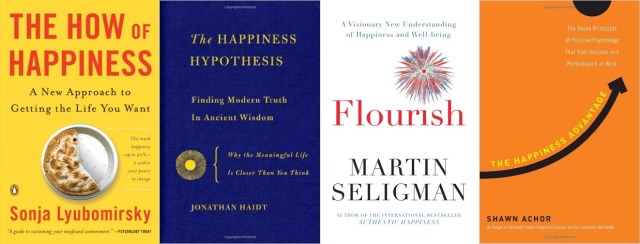
What´s your Favorite Positive Psychology Book? (Poll)

Today, I´d like to know which Positive Psychology Book you like best. I´ve provided a list with 10 of the most popular books (from my point of view). You can pick up to 3 books – or list other books that you prefer. Thanks a lot for your participation. Please share this post so others will vote, too!

Positive_Psychology_Books

Why Companies with Happy Employees outperform their Competition on the Stock Market

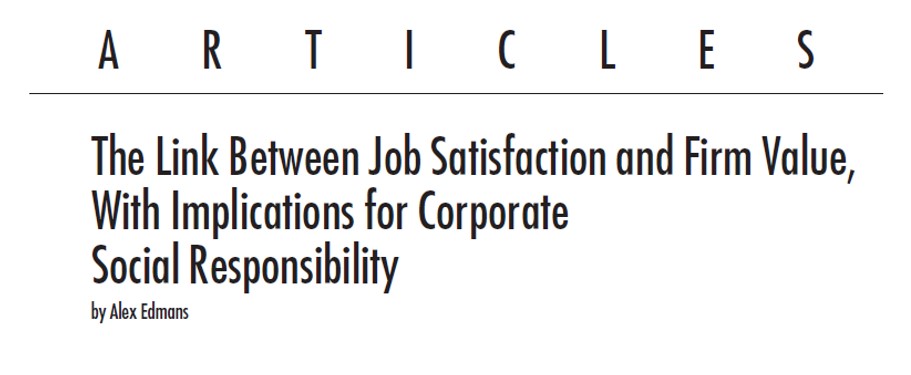
Edmans_SatisfactionDo happy employees affect a company´s bottom line (in a positive way)? What seems like no-brainer is actually quite hard to detect in real life. Studies in Positive Organizational Scholarship have been able to show that happy workers tend to be more productive, but this relation has been mostly detected for individuals, not on the “systems level”.

Alex Edmans, finance professor at London Business School, has been busy trying to change that. He created a hypothetic stock portfolio comprised of the “100 Best Companies to Work For in America” (as a proxy for organizations that treat their employees exceptionally well) and tracked this for more than 20 years. His conclusion: after controlling for confounding variables such as company size and industry, employee-centric companies significantly outperform their competitors year after year.

What more, he also seems to able to detect a causal relationship. Over the years, some firms drop out of the “Best Companies” ranking, while others obviously make it for the first time. Edmans finds that corporations begin to outperform their competition – several years after they´ve managed to be listed on that index.

Here are Edmans´ original research papers on this fascinating topic:

Alternatively, you can read a summary in this piece on The Atlantic: Happy Workers, Richer Companies?

Or, you can have him explain it to you personally via his TEDx talk. Share and enjoy!


Alex Edmans´s talk will also be posted as No. 48 on my topical list of Positive Psychology-infused TED talks, Michael Norton´s is already there.

Positive Psychology News Digest on Mappalicious | No. 1/16

I´ve decided to start a new category of blog articles on Mappalicious. Once a week, I´m going to post a news digest listing the most interesting articles on Positive Psychology and adjacent from the past week. That’s it, clean and simple. So here we go…


Positive Psychology | News Digest | Mappalicious

33 ½ Science-backed Methods to Boost Your Mood and Be Happier | Part II

Want to lead a happier life in 2016 (and beyond)?

This list includes valuable tips, exercises and “hacks” to be happier and lead a more meaningful life. All of these recommendations are backed by psychological science. In case you are interested to learn more, I´ve included links to some research articles that have examined the corresponding topic. No. 12 – 22 are listed here, No. 23 – 33 ½ will be published soon. The pieces of advice are ordered (roughly) by difficulty/level of effort etc. Share and enjoy!

12) Sing when you´re winning

Just like dancing, singing seems to be a natural anti-depressant. Singing is enjoyable and a very healthy kind of physical activity. It doesn´t matter if you sing in the shower, the car, or for an audience. And it surely doesn’t matter if your singing is good or bad. An especially beneficial way seems to be joining a choir. In doing so, people additional profit from the social support such an environment entails.

13) Remember the good Times

Good things that have happened in the past can be a powerful mood (and meaning) booster for the present. It could be our fondest childhood memories, our wedding day, or that beautiful sunset from our last vacation: Actively remembering these events can turn today into a brighter day. Accordingly, it´s helpful to create what positive psychologists like to call a positive portfolio. This is a box or a folder (these days, probably a digital one) where you keep especially uplifting memories, such as the wedding video, the first photo of your kid, your favorite piece of music etc.

14) Buy that Concert Ticket, not the Dress

Conventional wisdom holds that money cannot buy happiness. And while the best things in life are really (more or less free), most things do cost some money. Now, a sizeable body of research shows that investing our money in experiences such as concerts and vacations will be more beneficial for our long-term happiness than buying “stuff”. First, those events are typically shared experiences, second they can be re-lived in memory (see No.13), and third, especially memorable experiences seem to become parts of our selves, an integral part of “our story” – whereas the “stuff” will mostly be gone at some point in the future.

15) Spend Money on thy Neighbor

If you´re neither into concerts nor vacations (see No. 14), and you don´t like to buy stuff, it could be a great idea to spend your dough on other people. There´s abundant empirical evidence for the notion that giving money to others (e.g., via charity) can be a veritable happiness booster. Some studies find that spending your bucks on others is much more beneficial for our emotional wellbeing than keeping it for ourselves. If you don´t know where to start: Mashable provides a great overview of online funding sites.

16) Practice realistic Optimism

Truth is: the world is a much better place than we think it is. Our senses and our brains are gauged to pay attention to and process negative information much more thoroughly than positive stimuli (see this post for more info). News editors are well aware of this fact and select their stories accordingly. When these two mechanisms join forces, our perspective on the state of the world can become pretty gloomy and depressive. At this point, it could be helpful to practice what Positive Psychologists like to call realistic optimism. It´s not based on seeing everything through rose-colored glasses, but rather on thorough investigation of facts and probabilities. A good way to start this is to learn how to fight off unwarranted negative thoughts. For information on how to do this, please visit this post on Positive Psychology News Daily.

17) Go with the Flow

Flow (as described by eminent Positive Psychologist Mihály Csíkszentmihályi) is a state in which a person is fully immersed in a feeling of focus, full involvement, and enjoyment in the process of pursuing a specific activity. It´s a surefire way to satisfaction and personal growth. The experience of Flow is dependent on a set of internal and external conditions, among them, focusing on a single goal and shutting of any distractions (see Wikipedia for an overview). There´s a great article on Fast Company about companies that try to enable better conditions for Flow at work.

Nico - Fun18) Strong. Stronger. Signature Strengths

One of the hallmarks of Positive Psychology is a taxonomy of 24 character strengths. You can find out what your top attributes are (so-called signature strengths) for free when visiting the website of the VIA Institute on Character (mine are: curiosity, zest, and love of leaning). There, you´ll also find tons of information on how to use that knowledge in order to lead a more satisfying life. Generally speaking, the more we use our most pronounced strengths (e.g., in our occupation), the happier we are.

19) Be a Do-Gooder

Recommendation No. 15 already touched the beneficial effects of pro-social spending for our own happiness. The same can be said pertaining to pro-social behavior, e.g., volunteering and committing random acts of kindness. There seem to be positive short-term consequences for our mood (so-called helpers high) but also long-term effects. When we help others, our life becomes more meaningful – and that´s a source of happiness in its own right.

20) The Pen is mightier than your bad Moods

Writing is one of the most potent methods for “getting a grip” on life. It can help us to focus our attention on the goods things (see No. 11) or, alternatively, to come to terms with bad events, especially as a way of creating mental and emotional distance. If you´re not sure how to start, you’ll find advice in this article on Psychology Today.

Mika Samu21) Get a furry Companion

It has been shown that humans have lived together with domesticated animals for at least 500.000 years. Pets can be a valuable source of comfort, amusement, and distraction. As such, research shows that living with pets has several beneficial long-term effects for our psychological and physiological health, especially for children. Just a word of advice: Before you bring Lassie home, please make sure that you and your family are prepared and willing to take on the responsibility of owning a pet (hint: cats are much more low-maintenance than dogs).

22) Friends with Happiness Benefits

Typically, our social network (the non-virtual one, a.k.a. family and friends) is one of the most important sources of comfort and satisfaction in our lives. Now, the interesting thing is: almost everything can spread through these networks by means of social contagion. E.g., if of most of your friends are fitness freaks, your risk for obesity is considerably lower than when most of them are a little on the chubby side. The same goes for things like smoking, and even activities such as getting married. And this mechanism also holds true for emotions such as happiness (as well as depression). Bottom line: if your posse is a really cheerful bunch of people, this will positively influence your own emotional wellbeing in the long run (at least statistically). Conversely, this also means it could be beneficial to rid yourself of some “forms of energy” in your life.

Epictetus_Good_Company

Please note

Science shows that you do not have to practice all of these things (at once) to be happier. Rather, you should find out which of these activities best fit your personality and current way of life – so you´ll find it easy to sustain them. Please refer to: To each his own well-being boosting intervention: using preference to guide selection.