A couple of weeks ago, I posted an article from the Huffington Post on the habits of supremely happy people.
Last week, the German edition of Huffpo was launched. The translated this article into German. It is available here.
A couple of weeks ago, I posted an article from the Huffington Post on the habits of supremely happy people.
Last week, the German edition of Huffpo was launched. The translated this article into German. It is available here.
The silence on Mappalicious is officially over. I´ve been travelling over the last 14 days and obviously have been too busy actually living my life in order to write about it in addition. And while doing this, I´ve made an interesting discovery: you can spend your days in New York (arguably the most exciting place on Earth) with a bunch of really nice people and a great program (Broadway musical, boat tour on the Hudson, party at one of the best rooftop bars in town etc.) – and still end up crying your eyes out in the hotel room. Just because you miss baby boy so much. True story…

Which raises a question on the nature of Positive Psychology:
Is Positive Psychology about leading a happy, pleasurable life? Or is it about leading a virtuous, meaningful life?
The answer is: both aspects are important – but if you would ask Marty Seligman, he´d say the emphasis clearly should be on cultivating strengths, virtues, and meaning. While experiencing lots of positive emotion definitley is a goal in Positive Psychology (because it just feels good to feel good; but more important: because positive emotions produce lots of beneficial ‘side effects’) they are only one element (P) of PERMA, Seligman’s theory of human flourishing.
On the overarching level, it is possible to distinguish between the quest for hedonic (pleasurable) and eudaimonic (virtuous) experiences. Both clearly are important for leading a ‘full’ life, but Eudaimonia may just be a little more sustainable in the long run. When creating a 2×2 matrix with Eudaimonia on the one axis and Hedonia on the other, it will look like this:
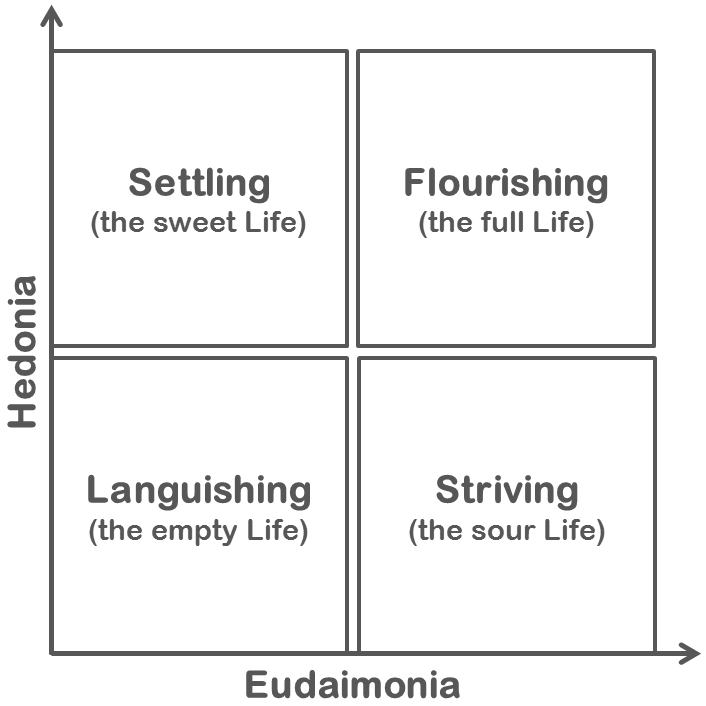
If you´d like to learn more: I´ve written an article in a coaching magazine on that topic about a year ago. It´s in German unfortunately – but I know that many German-speaking people are reading this blog, too…
I´m in London for a couple of days. No time to blog. Still, you might want to check out this comprehensive article on Positive Psychology from the Huffington Post:
Please have a look at this great blog post from a 2012/2013 Mappster:
Today has been the third day of MAPP immersion week – another day packed with truly extraordinary experiences. Today´s lectures took place at Wharton Business School. For the morning, Martin Seligman invited a guest lecturer, Chandra Sripada, who introduced us to concept of the Default Mode Network of our brain – which basically represents the specific and recurring pattern of activation in the brain that can be seen in fMRI studies when the brain is supposed to be doing “nothing at all” (which obviously isn´t the case). Being in the default mode seems to be connected to the mental task of prospection which involves future-oriented problem-solving, creating mental simulations of the world and the minds of other people, and daydreaming (among other things). I´m pretty sure that I´ll write more about prospection in the near future (no pun intended) – but I am still “digesting” all of that input – so this will have to do for today,
Over lunchtime, we were invited over to the Positive Psychology Center at Penn to meet, greet and eat with Seligman´s research team.

For the afternoon, Marty invited Barbara Fredrickson, the world´s foremost researcher on positive emotions and their role in human flourishing. She developed the Broaden-and-Build theory of positive emotion which basically posits that the reason why we experience positive emotions is fundamentally different from the reason for the existence of negative emotions. While negative emotions such as anxiety provoke narrow(ing), immediate survival-oriented behaviors, positive emotions are supposed to broaden our awareness and inspire novel, exploratory, and creative thoughts and/or actions. In turn, this expanded behavioral repertoire builds our skills, resources, and resilience. All of that needs some further mental digestion as well. You can find one of Barbara´s books on the reference list.
The high point of the day was an invitation from Martin Seligman and his wife Mandy for food and drinks at their house in the outskirts of Philadelphia. I feel very honored since usually, he´s more likely to associate with top-tier researchers, political and military leaders – or the Dalai Lama. Thanks for that one, Marty…
When scientist look for the difference between (largely) successful versus not so successful people (across a multitude of different situations), the most important predictor so far has been overall intelligence. But there are – potentially – more important things than being the brightest kid in the room.

In 2007, Angela Duckworth and her colleagues first described a non-cognitive character trait by the name of “Grit”. Grit is described as perseverance and passion for long-term goals. It is supposed to have an orthogonal relationship to general intelligence – meaning they are by and large independent aspects of our personality. One can be intelligent but not gritty, gritty but not intelligent, both at the same time – or neither intelligent nor gritty.
Grit is hypothesized as a stable characteristic. A person high in Grit does not seek immediate (positive) feedback. He/she is able to maintain his/her enthusiasm for a specific goal over very long periods of time despite experiencing adversity. In this context, long-term typically means “many years”, e.g. the time it takes to finish a doctoral thesis, become a grandmaster of chess or the like. The person´s commitment towards long-term objectives is the principal element that provides the determination essential to overcome challenges and set-backs.
Abraham Lincoln may be a good example of a gritty personality. He lost his first job at the age of 23 as well as his first election campaign. At 27, he lost his second election campaign and had a nervous breakdown. Two of his sons died while still in their infancy. He lost at a race for Congress at 34, and once more in his 39th year. At 47, he failed to become the Vice President of the USA. Then, at the age of 52, he finally managed to become one of the most popular Presidents of all time.
If you want to find out how gritty you are – you´ll find short test here.
Since the onset of psychology as an academic discipline at the end of the 19th century, it has been functioning on the premise of a disease model: most psychologists were mainly interested in what´s “wrong with people” – and then finding cures for all those wrongs. Which is fine, but … just not the only way looking at humankind. It took psychology about a hundred years to take on the opposite perspective: trying to find out what´s right with people. Together with a colleague, the late Christopher Peterson, Martin Seligman published the book Character Strengths and Virtues: A Handbook and Classification about ten years ago, which scientifically classifies and describes 24 human strengths based on six broad virtues.
In order to make their list, a character strength had to satisfy most of the following criteria. Character strengths should be:
The six virtues and 24 character strengths are:
(strengths that involve the acquisition and use of knowledge)
(strengths that allow one to accomplish goals in the face of opposition)
(strengths of tending and befriending others)
(strengths that build healthy community)
(strengths that protect against excess)
(strengths that forge connections to the larger universe and provide meaning)
Why should anybody be interested in his/her strengths? The rationale for finding out what our real strengths are is rather simple: Using our so-called signature strengths in daily life and work makes us happy – and most likely: successful. It makes us feel good about ourselves. It invigorates and energizes us. It´s the real deal…
You can find out what your signature strength are by taking a comprehensive scientific test on Martin Seligman´s website: the Signature Strengths Questionnaire. I´ve taken the test about a year ago – my main character strengths are:
You are curious about everything. You are always asking questions, and you find all subjects and topics fascinating. You like exploration and discovery.
You love learning new things, whether in a class or on your own. You have always loved school, reading, and museums-anywhere and everywhere there is an opportunity to learn.
Regardless of what you do, you approach it with excitement and energy. You never do anything halfway or halfheartedly. For you, life is an adventure.
You like to laugh and tease. Bringing smiles to other people is important to you. You try to see the light side of all situations.
You value close relations with others, in particular those in which sharing and caring are reciprocated. The people to whom you feel most close are the same people who feel most close to you.
A couple of days ago, James Pawelski, the MAPP´s director, sent us a comprehensive reading list. It also contains Authentic Happiness, one of Martin Seligman´s earlier popular science books on Positive Psychology. Right at the beginning, Seligman describes an experiment that was carried out by Nobel Laureate Daniel Kahneman and colleagues.
Before I go into detail: Since you can read this text, I assume you went to school for a couple of years. Consequently, you´ve experienced being taught by a lot of different teachers – with their teaching skills representing a kind of bell curve: most were more or less o.k., a few were superduper, and some were the proverbial pain in the ass. Basically, it´s the same with (keynote) speakers. I attend a lot of conferences and conventions. Once again, most speakers are okish, a few rock, and some, unfortunately, just waste your time.
Now obviously, not everybody can be a master of rhetoric like, e.g., Barack Obama. But even if – for whatever reason – you suck big time by objective criteria, you can still manage to make a lasting, somewhat positive impression on your audience by adhering to a simple rule:
Save the best for last!
Try to give a first-class conclusion! Thanks to the so called recency effect, most people will tend to forget your overall performance. Instead, their evaluation will be by and large based on the final minutes of your performance.
For scientific proof, let´s go back to Kahneman – and a real pain in the ass. For a study, he and his colleagues surveyed several hundred people that had to undergo a colonoscopy. By random assignment, half the patients had a minute added to the end of their procedure during which the tip of the colonoscope remained in the rectum – but without moving, which is considerably less painful than any movement. The results in a nutshell: even though they experienced more pain all in all, patients who underwent the prolonged procedure rated the entire experience as significantly less unpleasant. Additionally, rates of returning for a repeat colonoscopy were slightly higher.
Thank God, speaking skills can be improved easily – beyond just giving a nice conclusion. For inspiration, you might want check out this blog post listing 15 TED Talks on happiness, motivation, and more.
The final potential stumbling block has been removed. Today, I have obtained my student visa for the U.S. Even though Germany is typically not considered to be a member of some axis of evil, getting my doctoral degree was a piece of cake compared to this procedure – at least subjectively.
So now I´m all set to board an airplane which will take me to Philadelphia on September 3, The next morning, it´ll be the first day of “immersion week” for the Master of Applied Positive Psychology (MAPP) program 2013/201 at University of Pennsylvania. I´m really grateful I have been chosen as one of only 30 individuals who, for ten months, will take a deep dive into Positive Psychology in all of its wonderful facets – guided by some of the most exceptional scholars in the field.

Even though I oppose to new age thinking as conveyed by “phenomena” like The Secret etc., sometimes it really does feel like magic when a supposedly unreachable goal suddenly becomes attainable. I learned about the MAPP about a year ago when I read Martin Seligman´s newest book Flourish, where he describes the program and its goals in one of the chapters. I was momentarily intrigued – because back then I was close to finalizing the writing process for my own book “Lizenz zur Zufriedenheit” (License for Satisfaction), which is also by and large based on Positive Psychology. The book contains some 300 references to research papers and popular science books. When I visited the MAPP homepage, I discovered that several of the scholars that I´ve cited most often are actually teaching in that program. I thought to myself: “If I ever go back to university to get another degree, it will have to this one!”

Yet, the University of Pennsylvania belongs to the Ivy League – meaning the graduate programs are not exactly a bargain buy. Having several jobs and a family in Germany also meant I would have to fly to Philadelphia at least ten times and stay in a hotel for a minimum of 40 nights – all in all adding up to a considerable amount money, which, frankly speaking, I could not find anywhere on my savings account back then. But, without going into detail, at the end of 2012, I made an arrangement with my boss at Bertelsmann, Dr. Hays Steilberg, making it all possible. Thank you very much, Hays! I won´t forget.
And just in case the “Law of Attraction” – against all odds – really does work, I would also like to express my gratitude for the inscrutable mechanics of the universe.
California Pennsylvania, here I come…
P.S.
If you would like to get a short introduction to Positive Psychology, you might want to watch this humorous and insightful TED Talk by “Mr. Positive Psychology” himself, Martin Seligman.
 Mappalicious