I´ve decided to start a new category of blog articles on Mappalicious. Once a week, I´m going to post a news digest listing the most interesting articles on Positive Psychology and adjacent from the past week. That’s it, clean and simple. So here we go…
This is off-topic, but then, it might not be that off at the end of the day…
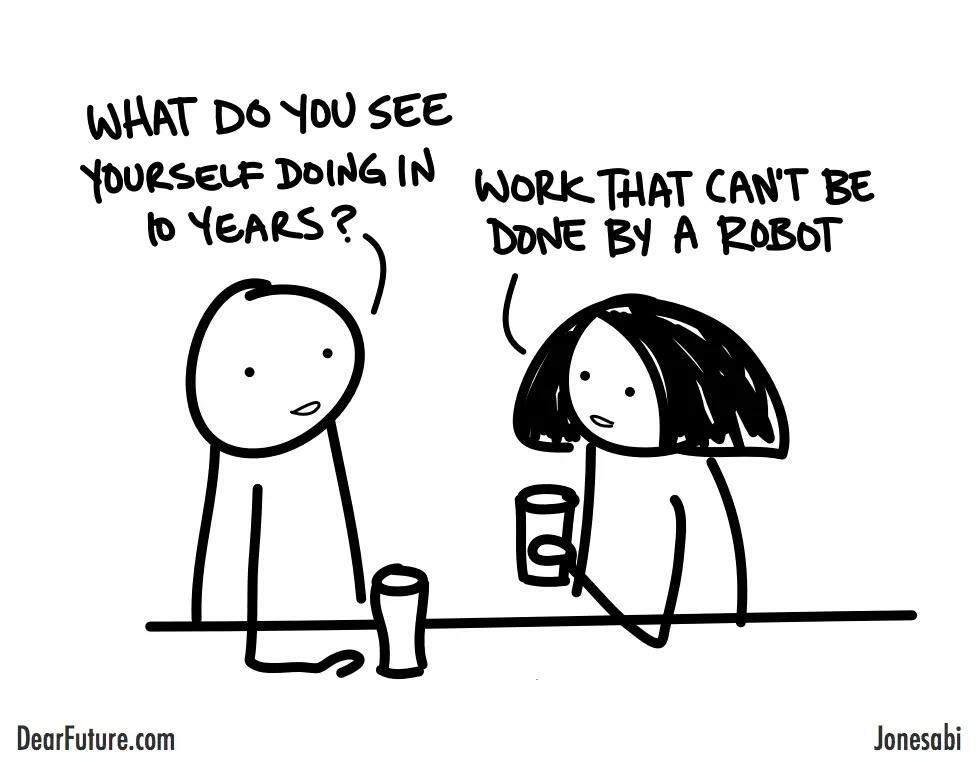
In June, I attended INSEAD, France’s premier MBA School, for a week of executive education. Basically, we were taught change management, strategy, and finance. At one point, we were discussing the consequences of artificial intelligence and advanced robotics. Over the last couple of years, a lot of articles and books have been published on this subject. Quite a lot of those take on a distinctly pessimistic perspective, claiming that squillions of jobs will be lost in the process. And indeed, a Chinese firm has announced that it plans to build the first robot-only factory site. Additionally, if you want to know the likelihood of being replaced by a computer in the medium run, please check this article on Fortune.com.
Now the fascinating question is: Is this a good or a bad development? The answer may, in fact, depend on the timeframe we´re looking at – and on the scope we´re considering. Have a look at this “arithmetic” problem that was given to us by INSEAD profesor Kevin Kaiser:
If a farmer with a tractor can do the work of 100 farmers without a tractor in the same amount of time: What´s the value of the tractor? The answer is: 99 farmers that are able to do something else.
This is basically what has happened over the last 1000 years or so. In the middle-ages, only a tiny fraction of the population was not working in farming. Even though, mankind could barely produce enough food to sustain itself. Today, only one percent of the U.S. population is working in that profession. The output per farmer has multiplied twelvefold – and that only covers the timeframe between 1950 and today. Just try to imagine the magnitude of the difference between a medieval and a modern farmer.
Now what has happened to those several hundred millions of people that aren’t farmers any more? Did they all become “unemployed farmers” and starved to death? The answer is no, of course. Over time, lots of them became craftsmen or merchants, later on, factory workers, service agents, psychologists, game designers, bloggers …, [fill in whatever you like]. In short: they did something else – at least in the long run!
The idea that technological advancements will lead to large-scale unemployment is known as luddite fallacy, named after early 19th century textile workers in England, who protested against the implementation of mechanical stocking frames, culminating in riots and the destruction of factory equipment. It´s called “fallacy” because the machine breakers turned out to be wrong. They (mostly) did not starve: they did something else instead.
The fallacy is based on the assumption that there´s a limited amount of work in this world – so when a part of that whole is automated, it is “lost” to humans. This assumption is most likely wrong. We´re constantly developing new jobs (mostly services) that fulfill certain needs arising with the arrival of new technologies. By example, this article lists ten jobs that did not exist ten years ago. My question is: Why should this development suddenly come to an end?
Yes, it is true. Millions of people will lose their job to a computer or robot over the next 20 to 30 years. And from the vantage point of the individual, there will be tragedies. Some people clearly will not be able to cope. But: In the long run, people will do something else. They will not sit around and wait until they starve. They will do something else.
And again, it is true. For a lot of us, it is not clear as of now what this “something else” might be like. But I am a die-hard optimist. I am firmly convinced that whatever remains (or arises) will be more fulfilling than those jobs that are going extinct. Let´s be honest: Those jobs in that robot factory in China: how satisfying would they have been for human workers? And even if, somewhere in the near future, algorithms will be able to write news articles that are comparable in quality to those of human journalists, those journalists will find more creative work that cannot be matched by a computer program.
Recently, the German “new work guru” and former IBM executive Prof. Gunther Dueck said in a keynote:
“The simple part of work will disappear – for all of us. What remains is the challenging (or: sophisticated) part – for all of us.
Let´s all find out what the sophisticated part of our work is – the one that is truly creative and fulfilling: the one that cannot be matched by a silicone chip.
P.S.
If you want to know more, please read this article by Forbes contributor and new work expert Steve Denning: The ‘Jobless Future’ Is A Myth. Another angle on that story is provided by Pulitzer Prize-winning journalist John Markoff. In an intriguing long-read for Edge.org titled The Next Wave, he makes the point that we´re probably overestimating what artificial intelligence will be able to achieve in the near future. By way of example, he showcases results from a recent robotics contest, where most machines weren’t even able to properly used a door handle (“If you’re worried about the Terminator, just keep your door closed”).
Dan Bowling also was an assistant instructor in my Penn MAPP class. In his former life, he was the SVP of Human Resources at Coca-Cola. He frequently publishes pieces on talent management seen through the lens of Positive Psychology.
CNN runs a series of articles by the name of Project Happy.
If you know any other interesting writers that regularly publish Positive Psychology stuff on big news outlets (not their own blogs), please leave a comment below this article.
A couple of times in the past, I´ve written about how immersing yourself in Positive Psychology is somewhat hard when you´re German – because it seems to be a slightly “Un-German” topic. Today, I´d like to explore this topic from a slightly different angle – that of language. Oscar Wilde supposedly said “Life is too short to learn German.” And he may have been right. It´s pretty complicated and therefore awfully hard to learn as a foreign tongue. Yet, it is the language of Goethe, Schiller, and Rammstein – that´s something to explore.
Speaking of the metal band Rammstein: there´s this thing about German pronunciation that makes just about everything sound like a declaration of war – even if you say something like “I love you”. There´s a funny video about this on Youtube. The guys overdo it a little, but then, this may just be what it feels like to a non-German ear:
But I digress. What I really want to talk about: I feel there´s a lack of positive words in the German language. Positive Psychology was (sort of…) invented in the U.S. – and most research papers and books are written in English. When I came to Penn, obviously I had to study the subject in English, too. But now that I´m back in Germany, I try to “sell” the topic over here, which has to be done in German of course. And that´s where the problems begin.
There´s this myth that the Inuit have an unusually high number of words to describe snow. We have “50 Shades of Grey”, they supposedly have 50 shades of snow. Actually, this is not true. But the idea behind the myth seems highly intriguing to me. In short it says: when something is valued very highly in a specific culture this tends to influence the use of language. Specifically, people pay more attention to the subject because of its importance, thereby learning to make more subtle distinctions, that ultimately are reflected in the amount of different words that can be used to talk about the subject.
To a certain degree, this idea mirrors one of Wittgenstein´s most famous dictums:
The limits of my language means the limits of my world.
When I do not have a word for something, that makes it hard to think about that subject, because it cannot be “grasped”. And it makes it even harder to speak about “that something” to other people. That idea is (probably) embodied in another Wittgenstein quote: “Whereof one cannot speak, thereof one must be silent.”
Which brings us back to my problem of “selling” Positive Psychology in German:
Where there are no words, you can´t “spread the word”.
When I first tried to talk and write about Positive Psychology in German, oftentimes I felt a lack of the “right” words. For example, the German language has the same word (ergo: a lack of distinction…) for the subjects of “Happiness” and “Luck”. Both are signified by the noun “Glück”. So whenever I talk about happiness and positive emotions in the context Positive Psychology, I have to use an awful lot of extra words to get across the intended meaning.
But it´s not only a lack of distinction. Sometimes, I even feel there are no words. For instance, the brilliant Jonathan Haidt gave a lecture on the subject of “awe” in one of our MAPP classes. This moved me very much and I wanted to talk about my experience with friends back in Germany. The problem is: obviously, there is no adequate translation for “awe”. If you type “awe” into a translation machine, you’ll get the German equivalents of “veneration” or “reverence”, “rapture” or “entrancement”. All the suggestions entail a very religious or, at least, old-fashioned connotation. They are not part of a modern, non-religious German “language game”. Therefore, talking about “awe” in German in a scientific (or just everyday) context seems awfully hard.
This bears some interesting implications. Whenever I fill in a questionnaire on happiness or life satisfaction (e.g., here on Marty Seligman´s website), there´s an interesting phenomenon when I look at the results. These will be displayed in the context of different normed groups. E.g., your scores will be compared to other people of your age, your educational background, but also your ZIP code (when provided). Now here´s the thing: Comparing my results to other people from my ZIP code (ergo: other Germans) will always put me in a higher percentile. This means: based on the same raw scores, the algorithm will display that I´m quite happy when comparing myself to other men in general, or other Ph.Ds, but that I´m extremely(!) happy when comparing myself to other Germans.
Now, there´s a couple of different explanations for this phenomenon. The easiest one would be: on average, the German respondents in that data base are not all that happy – and that´s why I score (relatively) higher vis-à-vis that group. But it may also be a phenomenon of language. What if Germans were just as happy on average as, let´s say, U.S. citizens, but were reluctant to use positive self-descriptions in an extreme specification – just because it´s not part of our “happiness language game”? Maybe, via studying Positive Psychology in English in the U.S., I became a little less German, thereby being able to mitigate the dissonance of describing my life in a very positive light?
I guess Positive Psychology has to integrate cultural perspectives more and more in order to be equally “useful” for all the people on this planet. Recently, the Scientific American published a piece by the name of “Not Everyone Wants to Be Happy” citing different studies that were able to show that the concept and meaning of happiness can vary significantly between different cultures (notably, between more Western and more Eastern cultures) – but has also evolved over time. Very though-provoking.
Which brings me to the final question for today:
Could Germany be a better place if somebody invented new positive words?
“The German” per se (as a stereotype”) is depicted as a sober-minded person. We´re perceived as being diligent, orderly, industrious, and a lot of other helpful attributes. But we´re also depicted as being rather anxious, risk-averse, and just not that open-minded (think “German Angst”). This is not just an academic discussion. The German economy has been doing comparably well over the last couple of years – but how long will this last? We´re really not that good at building and financially supporting start-ups. Forbes regularly updates a large list of all those startups that are valued at more than one billion $ in terms of private equity funding. Only one of those is based in Germany.
What if all this were (at least to some extent) a consequence of a lack of the right positive words? Would we become more optimistic, less risk-averse, and more open-minded if we were able to enhance our language, if we were able to broaden the (far) positive side of our verbal aptitude? I think it´d be worth a try. In 1999, a German publisher of dictionaries (together with ice-tea brand Lipton) hosted a contest for the invention of a new word. We have a German word for the state of being “full” (= not hungry any more) – but there´s no positively framed expression for being “not thirsty any more”. As far as I know, the winning word has not made it into our regular language use, but I guess it was worth the effort.
So why shouldn’t we – for starters – find a more awesome translation for “awe”? I´m eager to hear your suggestions…
You know, sometimes life is just plain good. This morning, Lisa Sansom, a MAPP alumna, posted a link to the Facebook group on Positive Psychology that she runs. It´s a piece on the Forbes website that discusses the impact of Positive Psychology on psychotherapeutic work and mentions the websites of some other MAPP alumni, e.g., Emilia Lahti and Samantha Boardman.
So I put a link to that article on Twitter:
And a couple of hours later, I found this reply by Giovanni Rodriguez, the author of that article:
That´s how it goes! I guess Adam Grant would be very proud of us… 🙂

 Brett Steenbarger regularly writes


 Mappalicious