In 1938 Harvard University began following 268 male undergraduate students and kicked off the longest-running longitudinal studies of human development in history. The study’s goal was to determine as best as possible what factors contribute most strongly to human flourishing. For the 30 years, George Vaillant, who also teaches in MAPP, has taken care of this study. A little while ago, he published a fascinating book on this: Triumphs of Experience: The Men of the Harvard Grant Study. It´s a fascinating into the principles of positive psychology.
If you don´t have time to read the whole book, you might want to read this article on Feelguide instead.
Now, I know this is a little off-topic, but as you may know, research methods and statistics is a really important part of the MAPP program. If you´ve ever had classes in statistics, you´ll surely have heard of the Normal/Gaussian distribution. It was named after German mathematician Carl-Friedrich Gauss. You can see the guy and the distribution on the ’10 Deutsche Mark Schein’ – which unfortunately is not in use any more since the advent of the EURO.
The nice thing about the normal distribution is: it displays what´s normal. That´s how it has gotten its name. Basically, it shows that most things and people are ‘somewhere in the middle’ pertaining to most properties. That´s why the cusp of the curve in the middle. So most people are of average height, intelligence, beauty… you name it. The Brad Pitts and Stephen Hawkings of this world are the outliers. They do exist, but they are much scarcer than the John and Jane Does. Isn´t that reassuring? 🙂
If you would like to see the Gaussian function (and the underlying probability theory) in action, just have a look at this amazing Youtube video:
Edit:
Maybe this post isn´t that off-topic after all. Below, you can see a chart taken from a presentation by Charlie Scudamore. It explains the overarching goal of Positive Psychology in terms of the Gaussian distribution. Basically, we´d like to give the whole human population a little nudge. We´d like everybody to be move a little bit into the direction of flourishing, shifting the mean of the distribution just a little to the right. Now who says statistics is just a waste of time…?!
If you are a regular reader of Mappalicious you know that I´m currently a student at University of Pennsylvania. Today, I need your help! For our statistics class, it is our duty to recreate an already existing study – so we need to gather some data.
Therefore, you could do me a really, really big favor: Pleaseclick on this link to fill out a short questionnaire. It´ll take you only about 5 – 10 minutes. This questionnaire is on meaning in life and life satisfaction.
Afterwards, you might want to read the original study. But please do this after you´ve filled in the questionnaire. Otherwise, your result may be biased.
If you look at all the surveys out there, it seems most people want to spent less time at work. Especially Millennials put a lot of emphasis on having a great work-life-balance – which, at the end of the day, means putting in less hours at the office. Sounds nice, huh? But is this really advisable? From the Positive Psychology point of view, I´d have my doubts.
One very important concept in Positive Psychology is Flow – which is a state of being deeply immersed in an ongoing activity, forgetting about the time and surroundings, completely being at one with what we do. Experiencing flow on a regular basis is a sure sign of being on the path of mental health and personal growth. Now here´s the nub of the matter:
Mihály Csíkszentmihályi, the ‘discoverer’ of Flow, used a method called Experience Sampling when first studying this phenomenon. Basically, this means giving a beeper to people and contacting them a couple of times per day over a certain period of time. When being contacted, participants are to write down in a journal what they just did, and how they felt while doing it. What Csíkszentmihályi found: people reported being ‘in the Flow’ about four times as often while at work compared to their free time. How can that be?
Let´s look at the elements of Flow:
Focus: Concentration on a limited Field
Clarity: Explicit Goals and immediate Feedback
Balance: Match between Skills and Challenge
No Problemo: Feeling of (potential) Control
No Sweat: Ease and Effortlessness
Time Warp: Altered Perception of Being
Self-Forgetfulness: Merging of Action and Consciousness
Autotelic Quality: The Journey is the Destination
The problem with leisure time is: a lot of the things we like to do lack some of the critical elements for generating Flow. Except for being asleep, watching TV is the one activity that the average person spends most time on. Watching TV does not require any skills, yet putting one´s skills to work is crucial for experiencing Flow. What´s more, you don´t have any goals while watching TV, and you don´t get any feedback (besides from: now it´s over). Csíkszentmihályi actually found that when watching TV (even a sitcom) we´re in a state that can be likened to a minor depression. Of course there are leisure activities that can generate flow, e.g., most sports, dancing, reading, and painting – among others.
But how much time do we actually spend on these activities (percental)? The moral of the story is: We should be careful what we wish for. I don´t mean to say that work is inherently good.* There´s an ever-increasing prevalence of burnout in western societies. But that´s another story. Burnout is typically not a consequence of working too many hours. It´s a consequence of working too many hours on the wrong things. Now we shouldn´t make the same mistakes in our spare time…
* If you´re interested in what Positive Psychology has to say about ‘good work’, you might want to check out the thesis of Dan Bowling, on of my antecessors in the MAPP program.
One of the speakers at this year´s MAPP Summit has been Charlie Scudamore. He´s Vice Principal of Geelong Grammar School (GGS) in Australia. For several years now, this school has implemented the principles of Positive Psychology in its curriculum, or, for that matter, in the way the school managed on the general level. Therefore, Martin Seligman awarded Charlie with the ‘Pioneer Award’ for the application of Positive Psychology – he is now considered as one of the founding fathers of Positive Education. If you are interested in the way that Positive Psychology is implemented at GGS please click here.
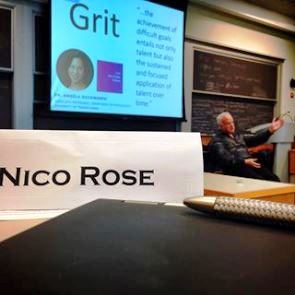
If you´re like most people, you´re not going to be particular fond of statistics. But: Lo and behold – it can be fun! You just need the right teacher. In the case of the MAPP program, it is Angela Duckworth who was just awarded with a McArthur Fellowship – a prize that is informally also called “Genius Grant”. Angela received this award for her research on the concept of Grit which has shown to be a predictor of (academic) success above and beyond the predictive power of intelligence. In the picture, you can see Marty Seligman in the classroom the moment he told us about Angela´s achievement.
Now it might put a little extra pressure on us being taught by a genius – but who cares? When I compare this experience to learning statistics during my undergrad studies – it´s light years apart. You just need a teacher who loves to teach. So my mantra for today is:
When you´re attending a seminar on coaching, training, positive psychology, or ‘self-help’ in general, there´s this 90% likelihood that at a certain point, the facilitator will talk about learning. In order to ‘open up’ the minds of the participants, most workshop hosts will use the (in-)famous ‘baby analogy’. They will give a talk on how babies learn to walk: by getting up, falling down, getting up again, falling down again, getting up again, …., you get the picture.
The message is: babies are not afraid to fail. The ‘just do it’. Thing is: I´ve had at least 2.500 hours of different courses in the abovementioned areas over the last years – so I tend to get a little tired of hearing the same story all over again. But:
Now I kind of received this live demonstration. Below you´ll find a video* of the Little Guru that my wife sent to me while I was at work. It (presumably) shows the first time ever that the Little Guru has managed to sit up all by himself. He tries once, falls down, tries again – and then he succeeds. Even more important: Little Guru not only shows persistence. He also takes his time to savor the victory…
This is a fast-paced life. We rush from task to task, meeting to meeting, job to job. Most of the time, there´s a lot of things that will go well along the way. Do we really take enough time to cherish what went well?
In a lot of self-help books (of the shallow kind…), you’ll get to read the sentence “If you can dream it, you can do it” – which supposedly has been coined by Walt Disney. I acknowledge that this saying is well-intentioned – yet well intentioned and well done are oftentimes light years apart. There are simply a lot of things which sometimes all of us, and often most of us, cannot do – no matter how strong we believe. However how hard you exercise, you will never run as fast as Usain Bolt. No matter how hard you study, you will never be as smart as Steven Hawking. No matter how hard you work, you´ll never create the next Apple, Google, or Microsoft. Of course, there are always exceptions to the rule. There is a Usain Bolt, there is a Stephen Hawking, and there are Jobs, Brin/Page, and Gates – but they are “singularities”. And no matter how many books sporting titles such as “The 10 Secrets to being like Steve Jobs” you´ll read – there´s a 99.999% likelihood of failure.
But I do not want to be a messenger of pessimism here. In fact, I do believe in the power of belief. It´s just that we have to turn things around in order to make it work. If you´d like to have science on your side, the saying should go like this:
If you can´t dream it, you can´t do it!
No man in this world can run a mile (1,609m) in less than four minutes. This has been an unwritten law during the first half of the 20th century. Innumerable athletes had tried to conquer the so-called miracle mile; some came close, but no one was able to beat that time. There even were physicians who claimed the human body per se is not capable of performing that feat.
However, impossibility did not know that somebody didn´t give a sh.t about impossibility: Roger Bannister, a young British athlete, just didn´t believe in the widespread doctrine. In a series of preparatory runs, he came closer and closer to reaching the impossible. Finally, at Oxford’s Iffley Road arena, on 6th May 1954, under rather bad external conditions, he finished the mile in 3:59.4 minutes – new world record.* You can watch a race between Bannister and his closest rival at that time, John Landy, a couple of weeks later here.
While this is very impressive in itself, it is not the point of the matter. The really fascinating fact is: Suddenly, by the end of 1954, a total of 36 athletes worldwide were able to beat that time. Now what has happened here? Was there a sudden advance in the training methods? Or the doping substances? I don´t believe that. Rather, I believe Roger Bannister has overthrown a collectiveself-fulfilling prophecy. He broke “the spell”, he crushed the mental blockade that had bedeviled his generation of fellow athletes.
Bannister had what psychologist like to call high self-efficacy, the specific belief in one’s ability to succeed in specific situations. High self-efficacy is associated with a wide array of positive outcomes, while a lack of self-efficacy is a good predictor for failure – irrespective of actual capabilities. Low self-efficacy is the psychological equivalent of “If you can´t dream it, you can´t do it”.
But no amount of self-efficacy will help us do what´s not doable.
* The current world record is held by Hicham El Guerrouj (3:43.13).
 In 1938 Harvard University began following 268 male undergraduate students and kicked off the longest-running longitudinal studies of human development in history. The study’s goal was to determine as best as possible what factors contribute most strongly to human flourishing. For the 30 years, George Vaillant, who also teaches in MAPP, has taken care of this study. A little while ago, he published a fascinating book on this: Triumphs of Experience: The Men of the Harvard Grant Study. It´s a fascinating into the principles of positive psychology.








 Mappalicious