7 common Misconceptions about Positive Psychology

P.E.R.M.A.Positive Psychology is not Happyology

Ok. So there´s some truth in this. Positive psychology indeed tries to understand the role of positive emotions in the good life. But they are only one of the five key elements in Martin Seligman´s PERMA concept. I guess most positive psychologists would agree that – at the end of the day – concepts like meaning in life and positive relationships are more important for a life well-lived. Additionally, it is important to acknowledge that positivity is not (only) and end in itself. It may be a powerful way to attain other important things in life (e.g., success at work).

Positive Psychology is not Kitchen Sink Psychology

While there´s nothing wrong with kitchen sink psychology per se, it has to be noted that laypersons get things wrong a lot of times. Even though we should be all experts at living (because that´s what we do all day long…), many people bear serious misconceptions on what makes for a good and happy life. This is where positive psychology as a data-driven science steps in – and often comes up with counterintuitive findings. For instance, if you´re into social media, you´ll know all this TGIF (Thank God it´s Friday) stuff people put on Facebook and Twitter on Friday afternoon. But scientific inquiry time and again is able to show that most people are happier while at work compared to their leisure time.

Positive Psychology is not Self-Help/Positive Thinking

Now this one is so important that I may have to write it down three times. Here we go…

For sure, there are similarities in the subject matters of positive psychology and positive thinking. By way of example, both are concerned with cultivating optimism in individuals, since being optimistic (most of the time) is associated with an array of beneficial outcome variables. The difference is: positive psychology is a science. It´s grounded in thorough academic research. Of course it´s possible to arrive at correct conclusions without conducting large-scale studies – but personally, I feel a lot better when what I recommend to my clients is based on coherent theories and scientific evidence.

Positive Psychology is not headed by some dubious Guru Elite

This point is closely connected to the aforementioned one. Positive psychology is spear-headed by some of the most widely acclaimed psychologists of our time. Among them are Martin Seligman, former president of the American Psychological Association, Mihaly Csíkszentmihályi, and Barbara Fredrickson. And: Daniel Kahneman, Nobel Laureate of 2002, also is among the major contributors to the literature on psychological well-being. Among other things, he´s a co-editor of the seminal book Well-Being: The Foundations of Hedonic Psychology. Yet, the crucial difference between these people and the common self-help guru is not the length of their Wikipedia articles – it´s something else that can be found in this post.

Positive Psychology is not about ignoring negative Emotions

Once again: positive psychology is not about being happy-smiley all day long. It is not trying to eradicate “the Negative”. It´s just that psychology as an academic discipline has very much focused on negative phenomena (such as fear and depression) for the first hundred years. Positive psychology wants to point the spotlight to the positive side of our emotional and behavioral continuum in order to create a more balanced view of human functioning. Actually, negative events and emotions play a crucial role in studying so-called post-traumatic growth which basically is concerned with the question: How can we profit in the long run from going through really hard times in our lives?

Positive Psychology is not only for rich white People

This concern was issued in a recent article by James (Jim) Coyne, PhD, a Clinical Psychologist and Professor in the Department of Psychiatry, University of Pennsylvania – the same university that Martin Seligman is teaching at. Again, there´s a grain of truth here. Positive psychology was coined at several high-end private universities in the U.S. As with virtually all psychological theories, they are first tested empirically using samples of undergraduate students at those universities the researchers teach at. And since these tend to be predominantly affluent white people, there´s is some truth to that criticism. But once again: that´s true for almost any piece of research in any branch of psychology out there. Positive psychologists do acknowledge this caveat and continually try to broaden their (research) perspective, reaching out to international samples and other diverse target groups.

Positive Psychology is not ignoring its Roots, e.g. Humanistic Psychology

Positive psychologists readily do acknowledge the theories and findings that came out of Humanistic Psychology, thereby standing (partly) on the shoulder of giants like Abraham Maslow and Carl Rogers. Additionally, positive psychology draws heavily on the ancient wisdom of some of the great philosophers. A lot of positive psychologists seem to be very fond of William James, and especially Aristotle and his conception of Eudaimonia. The crucial difference once again is positive psychology´s strong foundation in (experimental) research.

P.S.
I´d really like to have your feedback on this one. Do you agree? Do you disagree? What did I forget?

Savoring the Positive Moments in our Lives…

In my non-MAPP-student life, I´m (also) an HR guy. Specifically, I work in employer branding and recruiting. HR somehow has got a bad rep – a lot of people will say it´s (one of) the most boring functions in management. Well … I definitely do not agree. And here´s one of the reasons why…

Generation Y: Why we don´t want to lead … like you lead!

I know that about half of my pageviews come from Germany – so I´d like to share with you a presentation I just uploaded on Slideshare. It´s about Generation Y and the future of leadership – but there´s a strong link to positive psychology, especially on the subject of meaning in life.*

* To all English readers: I apologize – maybe I´ll put up a translated version someday…

Awe without Shock: The Nature of Awesome!

Little Guru - AweWhile psychology for the first hundred years of its existence as an academic discipline has very much focused on the negative spectrum of human emotions (fear, guilt, anger etc.), positive psychology looks mostly to the favorable end of that range. On the very far side of the positive sphere lies an emotion which hasn´t really gotten a lot of attention – until one of our MAPP lecturers, Jonathan Haidt, came along. This is emotion is awe. You can see what awe looks like on the face of the Little Guru. It´s a picture I took while he was watching his first display of fireworks ever. You can sense the unique blend of joy, fascination – and fear.

The element of fear marks the crucial difference compared to my wife´s facial expression: she´s seen a lot of fireworks in her life, so she´s just delighted; the angst is missing. Here´s what Haidt has to say on awe in an academic paper on that subject:

Two appraisals are present in all clear cases of awe: perceived vastness and a need for accommodation, defined as an inability to assimilate an experience into current mental structures.

Furthermore: “Awe is felt about diverse events and objects, from waterfalls to childbirth to scenes of devastation. Awe is central to the experience of religion, politics, nature, and art. Fleeting and rare, experiences of awe can change the course of a life in profound and permanent ways”. In addition, Haidt lists five appraisals that account for the “hedonic tone” of the awe experience:

  • threat
  • beauty
  • exceptional ability
  • virtue
  • supernatural

So obviously we can experience awe e.g., via beholding forces of nature, a beautiful piece of artRoger Federer playing tennis, by experiences such as might have happened to Paul (a.k.a. Saul), and also by witnessing acts of great virtue – as in this video of Team Hoyt (get a Kleenex first if you´ve never seen this before…).

If you´d like to learn more: Jonathan was featured on Oprah a while ago – and he also gave a TED talk touching these issues by the name of “Religion, evolution, and the ecstasy of self-transcendence”:

The Edge of Moral Reasons: Why Liberals and Conservatives can´t get along

Why is it that liberals and conservatives cannot get along? We´re all human after all, aren´t we? Well…yes. But as you know, there are people who speak different languages which might lead to not being able to understand each other. Turns out, (far) right and left wing supporters may have the same problem – even if they all speak plain English.

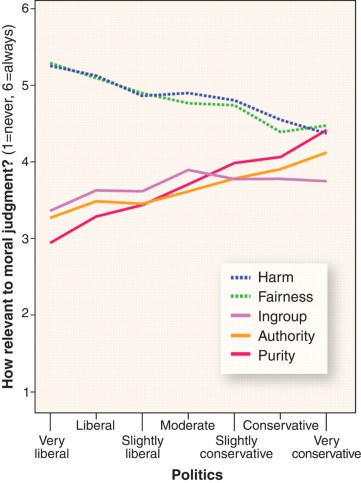
One guest lecturer of MAPP´s fourth onsite was Stern School of Business´ Jonathan Haidt. Among other most interesting topics, he conducts research on moral reasoning. What he found has a lot to say on the state of current U.S. politics: Haidt has identified a kind of moral taxonomy, a set of five dimensions that all our moral judgments are based on (see diagram below). The problem is: conservatives tend to use all five dimensions to just about the same amount when making moral judgments. Liberals tend to use only two of them – the other are seen as not relevant. The result: liberals perceive conservatives as being uptight, while the latter perceive the aforementioned to be ‘morally loose’.

Both sides are literally ‘worlds apart’ – and building bridges is a tough task when the differences are engraved deep into your mind…

If you´d like to know more about your personal moral reasoning, please vitit Jonathan Haidt´s site www.yourmorals.org.

Haidt - Moral Judgment

Source for diagram

Mappalicious: The first 100 Days

100 DaysWhen a new CEO or political leader assumes an office, typically there is this special 100 day time window to deliver some first results. Today, Mappalicious is 100 days old. So I thought: why not create a first retrospective. So here´s what happened so far:

A big thank you to all my readers!

Clip art source

The crucial Difference between ‘Positive Psychology’ and ‘Positive Thinking’

Here´s a dialogue I´ve gone through a lot of times lately – it goes a long the lines of this:

  • Friend: “Hey Nico, I´ve seen (on Facebook…) that you´re a student again. You´re at Penn, right?”
  • Nico: “Yep.”
  • Friend: “So what are doing?”
  • Nico: “I study positive psychology.”
  • Friend: “Oh yes, positive thinking. I really like that. You know, I´ve read … (substitute all kinds of self-help books by Joseph Murphy, Dale Carnegie, Napoleon Hill, Rhonda Byrne, … , Tony Robbins).
  • Nico: “Duh…”

So, I´m not going to deny that there are a lot of similarities in the subject matters of positive psychology and positive thinking. By way of example, both are concerned with cultivating optimism in individuals, since being optimistic (most of the time) is associated with an array of beneficial outcome variables. So where´s the difference, then?

Here I am, sitting in Jon Huntsman Hall at University of Pennsylvania, listening to some of the most widely-acclaimed psychologists of our time. And there are some sentences which I really hear a lot of the time. Here there are:

  • I was wrong.
  • I changed my mind.
  • I made a mistake.
  • I don´t know.
  • I´m not sure about…
  • We don´t know enough about…
  • We should really be careful to say…

I rest my case.

A book a Day (or at least: a Month or so…) keeps mental Enfeeblement away

Books

By Johannes Jansson (GFDL or CC-BY-SA-3.0) via Wikimedia Commons.

Sorry for this mediocre headline…

I don´t know what your home looks like – but mine is crammed with books. I have several book shelves that are way to small to harbor them all. So I just put them everywhere. There are books in my study, in the living room, in the bedroom, in the kitchen, … , you get the picture. That´s why I really enjoyed reading about this study I came across a couple days ago:

A team of researchers investigated the connection of availability of books in a household and education of the inhabitants. They collected data from representative samples in 27 countries and basically looked at the educational attainment of the children, comparing those that come from families with a lot of books (>500) versus not so many books. What they found:

Children that grow up with many books stay in school three years longer on average – which obviously has something to say on their success in later life. This finding applies across all the countries investigated. What I find most interesting: the finding is independent of parental occupation, education, and social class.

Now go and buy a book. Or ten. Or a hundred. Do it. Now!

Books are not made for furniture, but there is nothing else that so beautifully furnishes a house.

(Henry Ward Beecher)

Getting older? Do not fear! For Age brings you Happiness…

A lot of people out there are afraid of getting old. But probably they shouldn´t be. Time and time again, research shows that getting older means getting happier for most people. A couple of days ago, I posted a link to a survey that is meant to replicate an already existing study on meaning and satisfaction with life across different age groups. 100 people participated in less than three days. Thank you very much for help your help!
Now here are some of the results:

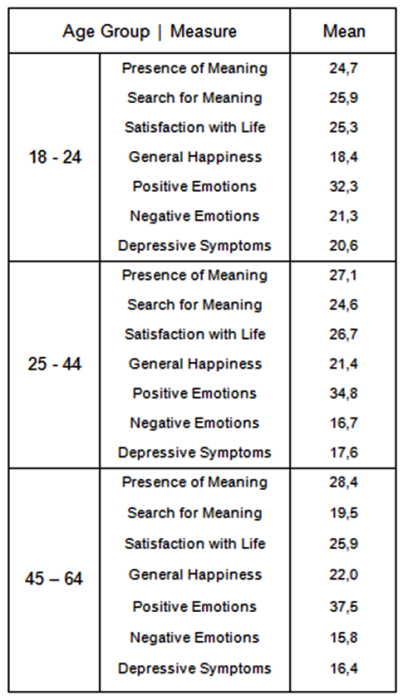
The table shows the means for different measures of our study. As you can see, the oldest group shows higher values in practically all of the positive measures (such as ‘General Happiness’ or the presence of ‘Positive Emotions’ – and lower values for negative measures (such as the presence of ‘Negative Emotions’ or ‘Depressive Symptoms’).

Meaning and Life Satisfaction

Wrinkles should merely indicate where the smiles have been.

(Mark Twain)