Feel-Good vs. Feel-Purpose: Hedonia and Eudaimonia as separate but connected Pathways to Happiness

Ever since graduating from the Penn MAPP program, I give a handful of presentations and keynotes on Positive Psychology each quarter. Since I´m an executive in a multinational corporation, I mostly get invited to talk to fellow businessmen, and the greater part of my talks addresses human resources, leadership, and organization culture topics. One of the charts I show early on in each and every presentation is this one:

Fifteen_Seconds_Graz_Rose.png

I deliberately show it early in the game in order to convey that Positive Psychology is not a sort of Happyology, that it´s not about wearing rose-colored glasses all the time. Yet, it also serves to clarify the consequences of different human resources and leadership behaviors and programs. One of the most important takeaways:

Hedonic and eudaimonic pathways both play a crucial role in order to keep employees fully engaged and productive – but most measures that foster hedonic experiences are rather short-lived and, perhaps even more important, easy to copy by competitors – whereas conditions that foster meaning an purpose are rather hard to replicate.

Yesterday, I stumbled upon an exquisite book chapter by University of Ottawa researcher Veronika Huta which explains in detail the differences between hedonic and eudaimonic orientations in life (and work). She analyzed a multitude of definitions and conceptions on the differences of hedonia and eudaimonia from previous research and boiled them down to a comprehensible set of attributes. These are the most important takeaways.

Hedonia, in short, is about:

  • pleasure, enjoyment, and satisfaction;
  • and the absence of distress.

Eudaimonia is more complex in it´s nature, it´s about:

  • authenticity: clarifying one’s true self and deep values, staying connected with them, and acting in accord with them;
  • meaning: understanding a bigger picture, relating to it, and contributing to it. This may include broader aspects of one´s life or identity, a purpose, the long term, the community, society, even the entire ecosystem;
  • excellence: striving for higher quality and higher standards in one’s behavior, performance, accomplishments, and ethics;
  • personal growth: self-actualization, fulfilling one’s potential and pursuing personal goals; growth, seeking challenges; and maturing as a human being.

Other important attributes and distinctions:

Hedonia is associated with:

  • physical and emotional needs;
  • desire;
  • what feels good;
  • taking, for me, now;
  • ease;
  • rights;
  • pleasure;
  • self-nourishing and self-care; taking care of one’s own needs and desires, typically in the present or near future; reaching personal release and peace, replenishment; energy and joy.

Eudaimonia is associated with:

  • cognitive values and ideals
  • care;
  • what feels right;
  • giving, building, something broader, the long-term;
  • effort;
  • responsibilities;
  • elevation;
  • cultivating; giving of oneself, investing in a larger aspect of the self, a long-term project, or the surrounding word; quality, rightness, context, the welfare of others.

To close, it is important to say that both pathways to happiness are not mutually exclusive (in the strict sense). Meaningful experiences can certainly bring about pleasure – and taking care of ourselves can certainly add meaning to our lives. As such, we must also refrain from equating the pursuit of hedonia with shallowness. As the graphic at the top of the article illustrates, we need to grow on both dimensions in order to live a truly fulfilling life.

Share and enjoy!

On the Meaning of Meaning at Work: A Collection of Infographics

Over the last weeks, I invested a lot of hours in trying to better understand the antecedents of meaning and purpose at/in work. While doing so, I created a couple of info graphics that serve to explain different theories and outlines. I thought it would make sense to collect them all in one place to show point of convergence and divergence. Here you go…

CARMA_Work

Anatomy_Meaning_Work

IMG_9786

Three_Level_Meaning_StegerThe final graphic is not my creation – the picture is taken directly from the article listed in the respective headline.

Meaning at Work Grid

Share and enjoy!

On Grit and Perseverance: How many Times will you try?

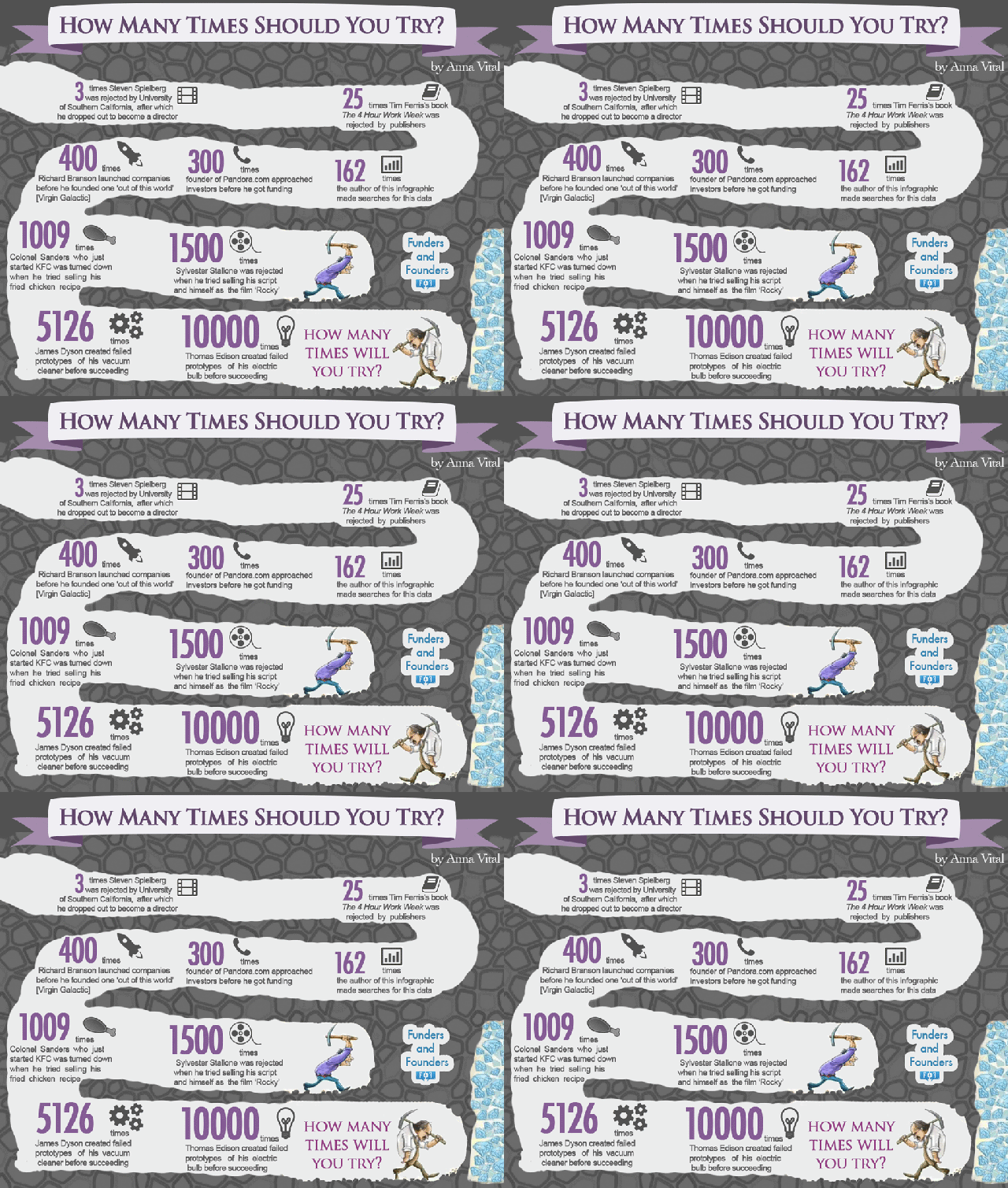
This is yet another fantastic infographic by Anna Vital from Funders and Founders. Now, I don´t know if each and everyone of those numbers on the chart is absolutely correct – but then, this is not the point anyway.

The crucial message is: Live will try to screw you, and then try to screw you all over again. In most domains, it´s not the smartest or most talented people that will succeed at the end of the day. It´s the ones that are willing to walk the proverbial extra mile (which sometimes is a thousand extra miles to be more precise…).

how-many-times-should-your-try.gif

I very much know this from my own life. You´re working hard on a project, you´re almost finished – and suddenly something happens: Your computer kills a full day´s work, an important stakeholder withdraws, or you just get really, really sick. I firmly believe this is a sort of test. In these moments, “life” wants to know what we´re made of. “It” wants us to say “I won´t back down, come hell or high water!”

And actually, all of us do have this quality to some extent. It´s the way we learned to walk on our own two feet…

How to Replenish Your Energy at Work? Hint: It´s Not the Caffeine

Man_Cookie_kleinMost of us know these days: You´re rushing from one meeting to another, squeezing in those important calls with the tax consultant and your child´s class teacher – while desperately trying to finish that presentation for your boss which is due at 06:00 pm. This is what days at the office look like for a lot of who earn their money as so-called knowledge workers.

To make it through days like this (and perform well!), maintaining a high level of subjective energy is paramount. In the words of Jane Dutton (Center for Positive Organizations at Ross School of Business), human energy is the “fuel” that helps organizations run successfully. Here, an interesting question arises: How do people manage – and in the case of depletion – replenish their energy while still at the office?

This issue was addressed in a paper by researchers Charlotte Fritz, Chak Fu Lam, and Gretchen Spreitzer via an article in “Academy of Management Perspectives” from 2011. In order to do so, they surveyed 214 knowledge workers across all hierarchical levels on their subjective levels of energy (separate for presence and depletion of vitality) throughout their work days – and additionally assessed what kind of (micro-)strategies these people employ to maintain their energetic balance – and how often they use certain strategies compared to others.  Here´s the key takeaway:

When trying to recharge at work, most people get it wrong most of the time!

Among the most frequently used micro-strategies to recharge were:

  • drinking water or coffee, or having a snack;
  • checking e-mails, switching to another task, or making a to-do list;
  • surfing the net or talking to a colleague about non-work issues (e.g., sports).

In the study, none of these behaviors was associated with a heightened energy level, and some were actually connected to further depletion. Instinctively, many people seem to resort to strategies that shift their attention away from the current task. Yet, the scholars show this may be a severe case of looking in the wrong direction. Those energy management strategies found to be most positively related to vitality are:

  1. learning something new;
  2. focusing on what provides joy in work;
  3. setting a new goal;
  4. doing something that will make a colleague happy;
  5. make time to show gratitude to a colleague;
  6. seeking feedback;
  7. reflecting on how to make a difference at work;
  8. reflecting on the meaning of one´s work.

It´s a mental, or sometimes, emotional shift that breeds success.

In a nutshell, all of these strategies are work-related and reflect notions of learning, relationships, and meaning at work. Accordingly, the key to fill your batteries while at work may be to see your job with different eyes without taking your mind off the tasks at hand. It´s a mental, or sometimes, emotional shift that breeds success.

By the way: The only functional non-job-related strategy in the study was taking time to meditate. What about micro-strategies like taking a short nap or going for a walk? Fritz et al. found that these activities were related neither to the presence nor the depletion of energy – they just didn´t matter all that much. The researchers conclude that these strategies may have more potent effects as sources of recovery while being away from work, e.g., during evenings or weekends.

Meaninglessness at Work: The 7 Deadly Sins [Infographic]

Yesterday, I shared some insights from a fantastic article on the antecedents of meaning in work that has recently been published in the MIT Sloan Management Review

One of the central insights of that piece is the notion that managers can only “prepare the soil” , but they cannot create or grow meaning at work for their employees.

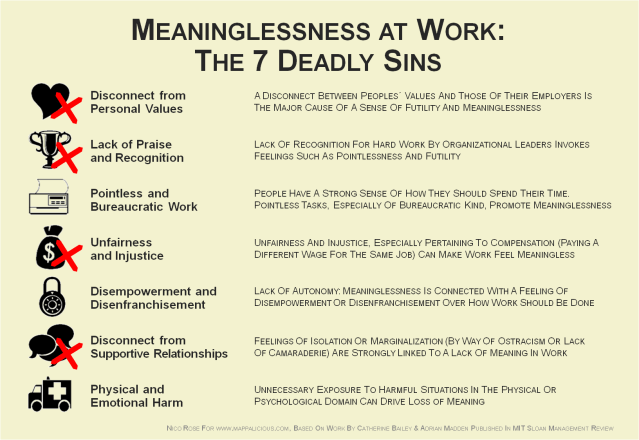
Yet, researchers Catherine Bailey and Adrian Madden found that bosses do play a big part in destroying the experience of meaningfulness at work. 

They interviewed 135 people from very different walks of life. From that material they distilled “seven deadly sins” that bosses frequently commit – and thereby diminish or outright devastate their peoples’ sense of meaning at work.

Here are the key takeaways by way of an infographic. Share and enjoy!

Meaning at Work - Seven Sins

The Anatomy of Meaningful Work [Infographic]

This week, I stumbled upon a fascinating article in the MIT Sloan Management Review written by Catherine Bailey and Adrian Madden. They interviewed 135 people from 10 different walks of life in order to find out what makes their work especially meaningful – and also, what destroys their job-related sense of meaningfulness. While I´ve read other articles that provide valuable syntheses of meaning in work in the past (see here, here, and here), this one is especially rich in context, providing in-depth personal accounts of peoples´ experiences. This makes the findings especially palpable.

Here are some takeaways:

  • Meaningfulness is not dependent on the type of work. A garbage collector can experience the same amount of meaning in work as a nurse or a doctor.
  • Bosses (and specific leadership behaviors) are typically not perceived as a source of meaningfulness. Yet, they can easily destroy the perception of meaning in work.
  • More generalized, the creation of meaning in work is an individual endeavor, while its dismantling is caused by others, or the organizational system as a whole.

Moreover, the researchers describe several crucial components of meaningful work. They´ve inspired me to create this infographic based on their findings. Share and enjoy!

Anatomy_Meaning_Work.png

Additionally, Bailey and Madden describe the “seven deadly sins” leaders can commit to destroy meaningfulness. I´ll share those in the upcoming post.

Beautiful Overview of Positive Psychology [Infographic]

Today, I´d like to share with you this charming mind map of some of the central concepts in Positive Psychology. It was created by Dr. Ilona Boniwell who heads the International MSc in Applied Positive Psychology (I-MAPP) at Anglia Ruskin University and teaches Positive Management at l’Ecole Centrale Paris and HEC Business School.

Positive_Psychology_Boniwell

If you´d like to see more, here´s her recent TEDx talk:

Organizational Energy: A Whole-System Approach

A couple of days ago, I wrote about the concept of relational energy, the idea that energy is generated via positive interactions between an organization´s members – resulting in a fully charged system.

Org_Energy_BruchToday, I´d like to introduce two other approaches that aim at assessing organizational energy. In both, St. Gallen-based (Switzerland) Prof. Heike Bruch plays a major role.

In an article Bruch co-authored with Sumantra Ghoshal in the Sloan Management Review from 2003 based on several case-studies, she introduced the idea that an organization as a whole system can be described via a grid that describes the intensity and the quality of the present energy. In doing so, she also promoted the concept of “organizational burnout”, a state that may arise when an organization spends to much time in the upper left quadrant of the energy grid. I highly recommend reading the original article – as it also provides valuable ideas on how to shift an organization from one energetic state to an another (“Slaying the Dragon” and “Winning the Princess”)

In 2011, she followed up with this article: Energy at work: A measurement validation and linkage to unit effectiveness. This further explores the idea of “whole system energy” but tackles it from a more quantified point of view. The authors define

collective energy (henceforth productive energy) as affect, cognitive arousal, and agentic behavior among unit members in their joint pursuit of organizationally salient objectives.

One important notion is that the researchers view productive energy as having affective, cognitive, and behavioral components – so it´s not only about “feeling energized”:

Affective energy refers to members’ shared experience of positive feelings and emotional arousal due to their enthusiastic assessments of work‐related issues.

Cognitive energy refers to the shared intellectual processes that propel members to think constructively and persist in search of solutions to work‐related problems, including the mental faculties to focus attention, shut out distractions, and have a desire to make “good things” happen.

Behavioral energy reflects members’ joint efforts designed to benefit the organization; it encompasses the pace, intensity, and volume with which members purposefully invest physical resources.

 The other important distinction is the facet of emergence:

We take a multilevel position on energy, conceptualizing it as both an individual‐level and a collective‐level phenomenon. We, therefore, recognize the need to discuss the nature of its emergence or how the lower‐level parent construct (i.e., individual‐level energy) materializes to form a collective construct (i.e., productive energy).

Accordingly, the authored have used a questionnaire to assess individual energy, but used that data to additionally compute a collective energy level, e.g., that of the whole business unit, by aggregating the individual energy levels. Here are some of the items they used:

  • Affective dimension: People in my work group feel enthusiastic in their job.
  • Cognitive dimension: In my work group, there is a collective desire to make something happen.

  • Behavioral dimension: People in my work group often work extremely long hours without complaining.

After statistical analyses, the authors conclude that

productive energy appears to be an emergent phenomenon. That is, energy referenced at the unit level considers the context or social environment in which individuals work and is distinct from the attributes of those individuals.

In a separate study, they also find that

the productive energy of firms is positively associated with firm performance.

I´m really eager to see how this stream of literature will develop in the future – and how it might inform practical interventions, e.g., in the field of human resources development.

Angela Duckworth and Adam Grant in the New York Times

Nico Rose - Angela Duckworth - Adam GrantTwo of my academic heroes have published pieces in the New York Times recently.
Angela Duckworth writes about cultivating, rather than discovering our passion and the corresponding career paths. The key takeaways:

Move toward what interests you

Don’t panic if you can’t think of a career path that’s a perfect fit. A good-enough fit is a more reasonable aim than a perfect one.

Seek purpose

People are hard-wired not only to gratify their personal desires but also to care for others. So ask, “In what way do I wish the world were different? What problem can I help solve?” 

Finish strong

When considering a career change…

Work as hard on your last day as on your first. No matter where you go next, you have an opportunity to make the most of where you are now.

Adam Grant writes about how the concept of authenticity might be misleading in the world of business. He proposes to strive for sincerity instead. The key takeaway:

Instead of searching for our inner selves and then making a concerted effort to express them, start with your outer self. Pay attention to how you present ourselves to others, and then strive to be the person you claim to be.

Top 10: Quite a lot of the World´s Eminent Scholars contribute to Positive Psychology

Positive Psychology is concerned with wellbeing and optimal human functioning, in all of its different domains and contexts. Compared to subjects such as, e.g., depression and anxiety, these may seem like “fluffy” topics to explore (Even though I would not agree – what could be more important than wellbeing?)

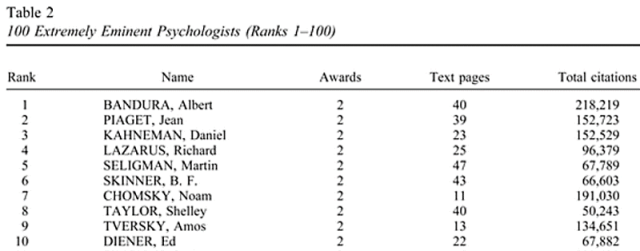
Yet, even if one were inclined to call this a superficial topic this doesn’t automatically mean it’s superficial science. Here’s the thing: I’ve recently stumbled upon a paper listing 200 eminent scholars in psychology, concentrating on people that are still active today or have been publishing in the second half of the 20th century (thereby excluding “forefathers” such as Sigmund Freud). The ranking was determined by aggregating several indicators, such as number of citations, coverage in introductory psychology textbooks, and prestigious awards received. Here’s a screenshot of the top 10:

Eminent_Psychologists

At No. 1, we see Albert Bandura who is most renowned for this research on self-efficacy, the scientific equivalent of the popular notion “If you believe you can do it, you can do it”. Now, Bandura created most of his work before the onset of modern Positive Psychology, but he clearly has a big influence on the field.

At No. 3, we have Daniel Kahnemann, Nobel Laureate of 2002 who, together with his late partner Amos Tversky (No. 9), has developed prospect theory. I´ve been told that Kahneman does not like being called a Positive Psychologist. Nevertheless, he´s the lead editor of the seminal book Well-Being: Foundations of Hedonic Psychology which, by all means, makes him an important contributor to the field.

At No. 5, we have Martin Seligman himself – no explanation necessary.

At No. 8, we find Shelley Taylor, who most likely would not be characterized as a Positive Psychologist. Still, she has made some influential contributions on the subject of optimism and its relation to psychological well-being.

And at No. 10, we see Ed Diener, co-creator of the prominent Satisfaction With Life Scale and major contributor to the fields of subjective wellbeing and public health.

I guess this pretty much settles the score. 🙂