
I´d really love to read your reaction to this one.
P.S.
Thanks to David Nevill for this inspiration.
I´d really love to read your reaction to this one.
P.S.
Thanks to David Nevill for this inspiration.
One of the guest lecturers at MAPP 13/14 onsite No. 8 was Jane Dutton, who is best-known for her research on what she calls High-Quality Connections (in the workplace).
As part of her lecture, she showed us this video by the Cleveland Clinic. I´ll let it speak for itself…
 Does a heart surgeon need to have suffered from a heart attack in order to be a top-notch heart surgeon? Probably not. Does a psychotherapist need to have suffered from depression in order to be a top-notch psychotherapist? Probably not. But in the latter case, it might still help a lot. The difference: whereas in the first case, the patient lies in the operating room, in the second case, a hell of a lot of empathy is needed.
In Greek mythology, there´s the character of the centaur Chiron. Among other attributes, Chiron is the epitome of the Wounded Healer. He is frequently depicted as one of the greatest healers of his time – but was accidently hit by Hercules with a poisoned arrow, resulting in the only wound that he could not heal. And that might have turned him an even better healer.
By now, there´s a lot of evidence that prior personal experience with psychological distress (broadly speaking) is a strong driver for people to seek a career in coaching, counseling, and psychotherapy. Very recently, a study was published that additionally suggests that such a personal wound might also make them better a what they do compared to their unharmed colleagues.
In a paper by the name of Survivor mission: Do those who survive have a drive to thrive at work? the researchers (including Penn´s Angela Duckworth) investigate this issue using samples of police detectives (with and without a history of violent victimization) and mental health workers (with and without a history of mental illness). Their results indicate that police detectives who have experienced violent victimization and mental health professionals who have experienced the same mental illness as their clients do indeed exhibit greater work engagement than their colleagues who lack these parallel life experiences. The link between firsthand experience of client’s hardships and work engagement appears to be explained by higher levels of grit among police detectives and by a greater sense of life-narrative continuity among mental health professionals. In a nutshell:
Wounded Healers seem to try harder and experience a stronger sense of meaning in what they do.
These findings strongly resonate with a broader strand of research (in Positive Psychology) that investigates the phenomenon of Posttraumatic Growth (PTG). It is true that suffering a psychological trauma leaves a lot of people shattered. But that is by far not the only possible trajectory. Many people manage to reach a markedly higher level of psychological functioning some time after the trauma then they were at before. Specifically, successfully coping with a trauma can lead to:
As Nietzsche said: “What does not destroy me, makes me stronger.” That´s part of the the sheer beauty of the human soul.
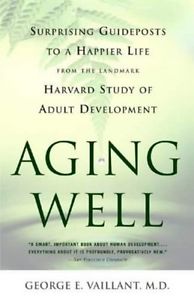 For whatever reason, I am confronted with the issues of aging (and death…) a lot over the recent weeks. My mom had to go to the hospital, and in my circle of friends, parents got sick as well – or even died. And while that is distressing and painful emotionally, I know rationally that getting old(er) is nothing to be afraid of. Because getting older (for most of us) means getting happier. We get less anxious, more satisfied, and get to a deeper understanding of the meaning of (our) life.
While being on the plane that brought me to Philly for the MAPP onsite, I watched the movie Last Vegas starring Robert De Niro, Michael Douglas, Morgan Freeman, and Kevin Kline. It´s a fun-loving, pleasantly over-the-top “geriatric” version of Hangover. Most of all, it´s a story of aging well – and the power of (life-long) friendship.
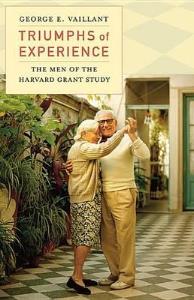 Coincidently, one of the guest lecturers of this month´s MAPP onsite has been (some 80 years old) George Vaillant, who´s been the director of the world-famous (Harvard) Grant Study – which for 75 years followed the lives of 268 physically and mentally healthy Harvard college sophomores from the classes of 1939-1944, and a second cohort of 456 disadvantaged non-delinquent inner-city youths who grew up in Boston neighborhoods between 1940 and 1945. Vaillant writes about the results of this study in his books Aging Well (2003) and Triumphs of Experience (2012). There´s lots of interviews available with Vaillant – here, I´ll point you to one for the Huffington Post. Two main points that came out of the study:
Love is really all that matters.
Connection is crucial.
There you have it. The Beatles were right: All you need is love. My parents will both turn 70 next year. And by March 2014, they will be married for 46 years. I hope that my wife and I one day will achieve the same…
If you´d like to have more input, please watch this TED talk on the benefits of aging by Laura Carstensen who is Director of Stanford´s Center on Longevity.
To laugh often and much: To win the respect of intelligent people and the affection of children, to earn the appreciation of honest critics and endure the betrayal of false friends; to appreciate beauty, to find the best in others, to leave the world a bit better whether by a healthy child, a garden patch, or a redeemed social condition; to know even one life has breathed easier because you lived. This is to have succeeded.
 Sorry, Positive Psychologists. It´s all been said and done before… 😉
 If you are like most people, willpower and self-regulation may not exactly be among your top strengths. E.g., for most of us, self-regulation is located pretty close to the bottom of the list when filling in the VIA questionnaire on 24 character strengths – which is based on Seligman´s and Peterson´s book Character Strengths and Virtues.
But then, breaking or making habits is one of the most important tasks when trying to succeed at a personal change project. So lo and behold! There´s help on the way. In earlier days, people would tie a knot in their handkerchiefs to help them remember things. These days, people don´t use handkerchiefs that much – but most of us do have a smartphone (or two…). And of course, there´s lots of apps around that strive on the fact that our spirit is willing but the flesh is weak.
 Here, I´d like to introduce you to three app that I´ve started using at the onset of the year:
On New Year´s Eve, I´ve decided I´d like to become a “nicer” person this year. It´s not that I´m an asshole right now – I just thought I could put a little extra effort in it. Probably a “side effect” of being in the MAPP program…
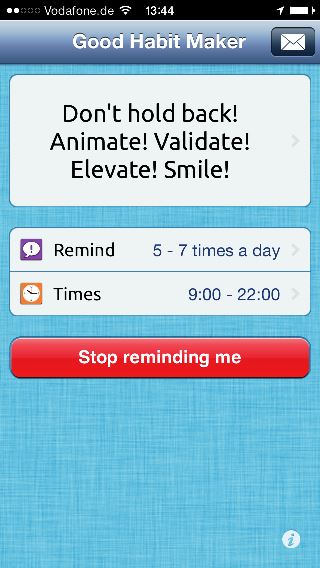
OK. The Good Habit Maker is a nice little (free) app that does only one thing: at pre-selected intervals over the day, it’ll push one sentence to your smartphone´s screen, e.g. your personal change mantra. Helps a lot to bring your mind back to what you want to achieve during busy schedules.
 The app Balanced is a little more refined, it´s a sort of task manager. You can enter specific tasks that you want to accomplish, and the quantities/intervals you intend to fulfill (e.g., “watch a TED talk once a week”). The app will then continuously remind you to complete those tasks until they are done. It also keeps track of you levels of completion and timeliness. There´s a demo version that is limited to a small number of tasks – the full version comes at $ 2.99.
And finally, the Grid Diary: as the name suggests, it´s a nice and clean diary app. The useful twist: you can pre-select (or enter your own…) specific questions. So instead of having to think about what to write each and every evening, the app will make you respond to the prompts that you specifically chose to be given. By way of example, I use it as a gratitude journal, which is one of the pre-eminent interventions in Positive Psychology. It´s free but offers some in-app purchases.
Enjoy! Keep it going! And for some extra energy, power up your Sisu!

One of the letters in Martin Seligman´s PERMA outline of Positive Psychology is M for Meaning (in life). In this post, I would like to point you to three outstanding resources on that topic:
First, check out Maria Popova´s fabulous Brain Pickings site – in this case her essay on Viktor Frankl´s Logotherapy and his conception of meaning in life.
Ultimately, man should not ask what the meaning of his life is, but rather he must recognize that it is he who is asked. In a word, each man is questioned by life; and he can only answer to life by answering for his own life; to life he can only respond by being responsible.
Second, you might want to have a look at Michael Steger´s TEDx talk – where he explains why and how meaning in life can be a matter of life an death; and what role relationships play in that piece.
And third, here´s a link to a website I discovered recently which contains a psychological test that can help you to find your personal “purpose pattern” (at work). It was created by a team around Aaron Hurst, author of The Purpose Economy. I found that some familiar MAPP faces are also associated with that project, namely “Chief Giving Officer” Adam Grant, and Job Crafting Authority Amy Wrzesniewski.
Enjoy!
The MAPP program is a fulltime program – but combines onsite classes with long-distance learning periods. Part of the distance learning comprises a lot of reading (Who would have thought of that…) and writing essays about a wide array of positive psychology topics. I´ve decided to post some of those essays here on Mappalicious. Surely, they´re not the be-all and end-all of academic writing. But then again, it would also be a pity to bury them in the depths of my laptop…

Sir Winston Churchill, British prime minister during World War II, is often cited with the quote “First of all: No sports.”* At the same time, it is well-known that he experienced recurring bouts of severe depression all through his life. Churchill is publicly perceived as one of the greatest political leaders of the 20th century – but he may have erred severely pertaining to the issue of physical activity. I will argue that building people´s self-efficacy and perception of agency should be a goal of all positive interventions, and that “neck-down” interventions, such as regular physical activity, are an easily accessible instrument to build up these resources.
In his review article that covers 30 years of research on goal-setting, Locke (1996) points out the importance of conscious goal-setting for motivational processes. To support this notion, he elaborates on different conditions and processes that foster the relationship between goals, motivation, and performance. For instance, he states that goal difficulty, goal clarity, and commitment to one´s goals are enablers of high performance across a wide array of tasks. In addition, he explicates how frequent goal-directed feedback and beliefs about the attainability of one´s objectives are beneficial to high levels of achievement. Ideally, these beliefs can initiate an upward spiral: Self-efficacy is conducive to attaining goals, which in turn builds up more self-efficacy, which in turn helps to attain more difficult goals in the future. Furthermore, Locke argues that the process of effective goal-setting can be taught and learned – which is important because reaching goals, especially difficult ones, is beneficial to build and sustain personal satisfaction with life.
Somewhat similar to Locke´s findings, hope theory (Lopez, Snyder, Magyar-Moe, Edwards, Pedrotti, Janowski, et al., 2004) stresses the human capacity for setting goals, envisioning approaches that enable us to reach those goals, and thus for summoning the necessary motivation to follow through. Hope is delineated as the expectancy that a change for the better is possible, thereby being a meta-resource for all kinds of change processes. Without hope, they would probably be no impulse to act at all. People can be hopeful about goals in general, broad aspects of life, and also very specific goals. The authors posit – again somewhat similar to goal-setting theory – that hope can initiate an upward spiral: Initial hope increases the probability for early progress which than acts as a resource for building further hope.
As expressed in the first paragraph, there is considerable support for the idea that physical activity such as regular jogging or working out at a gym can be a way to build up self-efficacy and optimism. Most interestingly, this increase in self-efficacy may not be confined to that specific domain of activity. There is some evidence that there may be a (positive) spillover effect to other areas of life. In this spirit, Richard Shusterman (2006) makes the case for a new research agenda called Somaesthetics. He claims that the branch of sciences labeled as “the Humanities” has neglected the role of the body over the last 2,500 years. Arguing that the body is the “tool” for each and every human performance, Shusterman posits that coming to a better understanding of the interplay between the body and human cognition and emotion could improve our understanding of (positive) developmental processes in general. In his flow of arguments, Shusterman suggests the body is a major source of agency and autonomy since physical movement is the perfect embodiment of exerting free will. Later in his article, he also elaborates on how performers of any every kind can profit from an enhanced bodily awareness since it will help them to practice (and subsequently, perform) more stress-free and therefore, longer. Yet, in his opinion, a fully functioning body is not just a means to an end, but can be an end in itself – since feeling healthy and fully-functional brings about a pleasure of its own kind.
Much in the same vein, Mutrie and Faulkner (2004) state that the body plays an essential role in human cognition and emotion. They summarize their article by stating there is convincing evidence that supports the link between physical activity and well-being, first by preventing mental health problems, second by functioning as a direct treatment of mental disorders, and third by improving the quality of life of people with mental health problems as well as the non-clinical population. Similar to Shusterman (2006), Mutrie and Faulkner believe this to be a result of the specific way physical activity is capable of strengthening self-efficacy and perceived autonomy, the feeling of being in control, and optimism. They conclude by saying that, in their opinion, regular physical exercise embodies the principles of positive psychology to a great extent and should therefore complement the extant canon of positive interventions.
To summarize: Building up self-efficacy, a feeling of agency, and optimism, is an underlying principle of positive interventions. “Neck-down” interventions can be instrumental in building up these general resources. To a varying extent, physical activity is accessible to (almost) every person on this planet, can be initiated at will, and comes at virtually no cost (in the case of jogging etc.). Yet, it is not only a means to end – but rather a pathway to well-being itself.
The MAPP program is a fulltime program – but combines onsite classes with long-distance learning periods. Part of the distance learning comprises a lot of reading (Who would have thought of that…) and writing essays about a wide array of positive psychology topics. I´ve decided to post some of those essays here on Mappalicious. Surely, they´re not the be-all and end-all of academic writing. But then again, it would also be a pity to bury them in the depths of my laptop…

There is an abundance of proverbs that are suggestive of the positive upshots of close relationships. By way of example, we say “no man is an island” and therefore “a sorrow shared is a sorrow halved”. Or vice versa: “A joy shared is a joy doubled.”
Positive psychology and adjacent disciplines underscore this importance of close relationships, be it friendship, love, or the support of a larger social entity (Reis & Gable, 2003). When asked to give a short definition of positive psychology, the late Christopher Peterson used to say: “Other people matter.” (2006, p. 249). Fredrickson (2013) complements this observation by stating that love (and its benefits) cannot be a matter of one person, but resides in pairs or groups of people. For Seligman (2011), close relationships are of uttermost importance as well. They are embodied by the letter R in the acronym PERMA which represents his framework of human flourishing.
There is ample evidence that experiencing a sense of relatedness is a fundamental need of humans (Baumeister & Leary, 1995) – and other mammals (Harlow, 1958). Accordingly, feeling close to others has several positive consequences. For instance, married couples on average are happier than singles or divorced women and men, and they also tend to live longer (Peterson, 2006; Fredrickson, 2013). Similar results have been found for long-lasting friendships (Myers, 2000; Demır & Weitekamp, 2007). Conversely, feeling lonely over longer periods of time has shown to be detrimental to our mood and, subsequently, health (de Jong Gierveld, 1998; Hawkley & Cacioppo, 2010). In addition, researchers have shown that happiness tends to spread in social networks. Being surrounded by happy people results in an increased likelihood of being happy oneself (Fowler & Christakis, 2008; Christakis & Fowler, 2009).
Yet, there is another perspective on close relationships. The existentialist philosopher Jean-Paul Sartre coined the famous quote “Hell is other people” (1944, p. 191) and he may have had a point in saying so. After all, relationships are the source of some of our greatest joys, but also the context for some of our greatest sorrows. Couples regularly hurt each other (Feeney, 2004) and being physically abused is much more likely in the context of one´s family than with total strangers (Emery & Laumann-Billings, 1998). Even the aforementioned concept of social contagion can work against us. While there is statistical evidence that happiness can be transferred from one person to another, the same holds true for unhappiness and even depression (Rosenquist, Fowler, & Christakis, 2010). So what is the solution here? Are other people heaven – or are they hell after all?
The truth is: even Sartre did not believe that being around other people is necessarily bad for us. He seemed to be rather unhappy when being narrowed down to this infamous quote. Some 20 years later he said:
“Hell is other people” has always been misunderstood. People thought that what I meant by it is that our relations with others are always rotten or illicit. But I mean something entirely different. I mean that if our relations with others are twisted or corrupted, then others have to be hell. Fundamentally, others are what is important in us for our understanding of ourselves. (Sartre, 1965; cited in Contat & Rybalka, 1974, p. 99)
Obviously, Sartre emphasizes the quality of our relationships when contemplating the outcomes of being with other people. Having close relationships can have all the above mentioned upshots – but as humans we also have the potential to spoil these positive consequences if we are not careful enough.
In this spirit, I will now try to make a point that at present I cannot really substantiate with scientific research – but which may hold some truth nonetheless. I believe that in order to be happy in a relationship (be it friendship, marriage, or being part of a larger community), one has to be happy with oneself already – at least to a certain extent. This may be a case of “mesearch”, but then again, it may also be true. It is not at all unlikely that there is a kind of threshold, a minimum level of self-liking or -love that is a precondition for entering into fulfilling relationships with other human beings. To make this point, let´s reconsider the research on married couples. While it is fairly unequivocal that married people are at least a little bit happier than non-married people on average, it is not at all clear if this is due to a causal relationship. Consequently, we do not know for sure that marrying produces happiness. It might just as well be true that people who are already happy before getting married stand a better chance of finding and keeping a life partner (Peterson, 2006). Looking at my own life, I find this to be true. Now that I am married man and have child, I am definitely happier than I was before having met my wife. But: I definitely needed to “come to terms with myself” first in order to be prepared to let myself in for this relationship. Once again: I could not find any convincing empirical evidence for this idea – but I am fairly sure that many people would agree based on their own experiences.
To conclude, I propose that well-being neither resides in the individual alone, nor that it is solely confined to instances where we are with other people. Happiness and well-being are certainly multiplied when shared with others – but we have to “bring something to the table” in the first place in order to make it work.
“There is no way to happiness. Happiness is the way.” is a quote by the Buddha. I have not spoken to him in person (at least not to his 2,500 B.C. incarnation…) but what he probably meant is that happiness is not a goal that can be attained (for good). Rather, happiness is a consequence (or rather: byproduct) of doing certain things – and refraining from doing certain other things. This view opposes modern materialistic notions of life where we are repeatedly told something along the lines of “If you achieve X/if you manage to get Y – then you´ll be happy.”
Buddha´s quote is in line with other great thinkers of his time: Aristotle thought that eudaimonia (the “good life”, flourishing) was a byproduct of leading a virtuous life, where a virtue can be found right in the middle between two vices (e.g., courage lies between cowardice and imprudence). Confucius equally propagated leading a life guided by certain virtues. For instance, he formulated an early version of the Golden Rule that was made famous in the West by my compatriot Immanuel Kant.
The Science of Positive Psychology takes these sages at their word – and has gathered some empirical evidence on the issues. By way of example, happiness is a consequence of…
But if happiness is a way instead of a destination – I assume it´s also reasonable to ask: the way to what or where?
Typically, we ask ourselves what we have to do in order to be happy. But what if happiness is not the goal?
What if happiness were the input variable – not the outcome?
By now, we do know a lot about this way of looking at psychological well-being. For instance, happiness leads to …
In order to start being happy right now, I suggest you (re-)visit this video…
 Mappalicious