The “Happy at Work Manifesto”: Do you have enough Arbejdsglaede?

Yesterday, I stumbled upon a guy named Alexander Kjerulf from Denmark (Germany´s northernmost neighboring country – just in case you were wondering…) who is leading a company by the wonderful name of Woohoo Inc. who are in the business of (what academics would call) Positive Organizational Scholarship – the science of happy and at the same time productive workplaces.

They have created a wonderful Happy at Work Manifesto which I´d like to share with you here:

HappyAtWorkManifestoEN-RGB

And if like this, you might also like Alexander´s TEDx talk:

That´s all for today. Enjoy!

P.S.

Remember, he´s Danish. Those guys know something about happiness. Denmark regularly pops up at the top of lists displaying the world´s happiest nations

“You´re doing just fine.” On the Power of Trust and day-to-day Positive Feedback

Blind SymbolAs I´ve already told you in this post on the significance of empathy, one guest lecturer at MAPP 13/14 onsite has been Jane Dutton who is known best for her research and teaching on high-quality connections (at work).

Jane stopped her lecture once in a while to lead us through some practical exercises on that topic. On one occasion, half of the group was blindfolded and then led through the hallways of Penn´s Huntsman Hall by the other people for several minutes. Now, I´ve done this sort of thing a couple of times before in coaching seminars – but I´ve never had such a powerful realization as I had this time:

I was feeling pretty save and comfortable in the beginning. My partner guided me with her hands and simple verbal cues, telling me to go left and right whenever needed. At one point, we were walking straight along a stretched-out hallway.* All I had to do was walk straight-on – so my partner stopped giving verbal feedback.

Somewhere half-way down that hallway, there was an ever so small bump in the floor, I guess a spot where a cable lay beneath it. But it was enough to catch me off-guard and lessen my trust considerably. Upon understanding that, my partner started to behave very differently. Instead od telling me only about necessary changes, she started to give me constant feedback, mostly along the lines of:

You´re doing just fine. The way is free. Just keep on going!

What a tremendous change that was! A genuine difference that makes a difference! And a powerful metaphor for everyday (business) life…

Because, on a closer look, we´re running around blindfolded all the time. We hear, see, and know so little compared to the sheer endless amount of information that is out there and could be of value for us. What a difference it makes to just hear “You´re on the right track” from somebody who just happens to know a little bit more than you do.

So if you´re a boss, a parent, or just somebody who happens to care about other people: How about telling them that they´re doing fine at least once every day? Not because they did something special. Just because they need and deserve it…


*I still wonder what all those suited-up Wharton MBAs thought of our crazy group of people playing children´s games in their sacred halls…

What “gives Life” to your Organization? Appreciative Inquiry and the Quest for the “Positive Core”

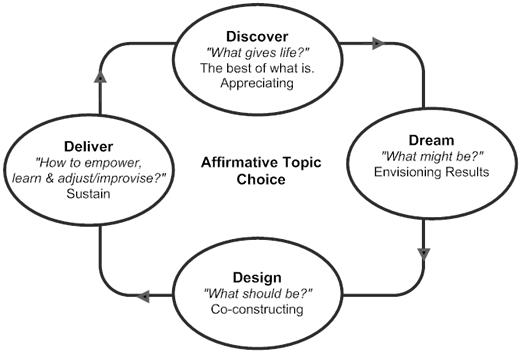
AI_4_DAt the January MAPP onsite, one of our guest speakers was David Cooperrider. He has (co-)developed Appreciative Inquiry (AI), a method of organizational development that is rooted in Positive Organizational Scholarship (POS). It´s a bit hard to explain it in a few words; therefore, I´ll let other people do the talking. The first video below is a short interview with David Cooperrider on the foundations and underlying assumption of AI. The second one is a bit longer and explains the whole AI process in a very graspable way.

Let me just say this much: the word “appreciate” is typically understood in the sense of “highly valued” – but can also mean “increasing something in value”. Therefore, things we appreciate grow in their value precisely because of our appreciation. To make use of a little oversimplification:

Whatever we put most energy into – grows. So if we focus a lot of energy on problems and problem-fixing – there´s a good chance there will be more problems. But if we instead put emphasis on strengths and what is already good – those aspects tend to grow. That´s exactly what AI tries to do – by asking the right questions (that´s where the “inquiry” in AI comes from). Enjoy!

What is AI?

Everybody wants more Work-Life-Balance – but should we want to want more free time?

If you look at all the surveys out there, it seems most people want to spent less time at work. Especially Millennials put a lot of emphasis on having a great work-life-balance – which, at the end of the day, means putting in less hours at the office. Sounds nice, huh? But is this really advisable? From the Positive Psychology point of view, I´d have my doubts.

One very important concept in Positive Psychology is Flow – which is a state of being deeply immersed in an ongoing activity, forgetting about the time and surroundings, completely being at one with what we do. Experiencing flow on a regular basis is a sure sign of being on the path of mental health and personal growth. Now here´s the nub of the matter:

Mihály Csíkszentmihályi, the ‘discoverer’ of Flow, used a method called Experience Sampling when first studying this phenomenon. Basically, this means giving a beeper to people and contacting them a couple of times per day over a certain period of time. When being contacted, participants are to write down in a journal what they just did, and how they felt while doing it. What Csíkszentmihályi found: people reported being ‘in the Flow’ about four times as often while at work compared to their free time. How can that be?

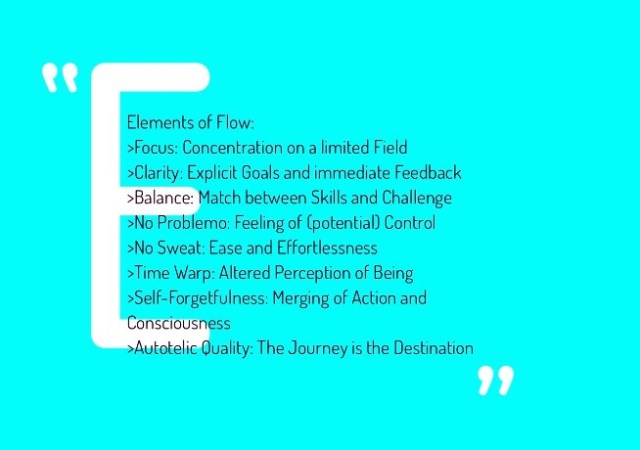
Let´s look at the elements of Flow:

  • Focus: Concentration on a limited Field
  • Clarity: Explicit Goals and immediate Feedback
  • Balance: Match between Skills and Challenge
  • No Problemo: Feeling of (potential) Control
  • No Sweat: Ease and Effortlessness
  • Time Warp: Altered Perception of Being
  • Self-Forgetfulness: Merging of Action and Consciousness
  • Autotelic Quality: The Journey is the Destination

The problem with leisure time is: a lot of the things we like to do lack some of the critical elements for generating Flow. Except for being asleep, watching TV is the one activity that the average person spends most time on. Watching TV does not require any skills, yet putting one´s skills to work is crucial for experiencing Flow. What´s more, you don´t have any goals while watching TV, and you don´t get any feedback (besides from: now it´s over). Csíkszentmihályi actually found that when watching TV (even a sitcom) we´re in a state that can be likened to a minor depression. Of course there are leisure activities that can generate flow, e.g., most sports, dancing, reading, and painting – among others.

But how much time do we actually spend on these activities (percental)? The moral of the story is: We should be careful what we wish for. I don´t mean to say that work is inherently good.* There´s an ever-increasing prevalence of burnout in western societies. But that´s another story. Burnout is typically not a consequence of working too many hours. It´s a consequence of working too many hours on the wrong things. Now we shouldn´t make the same mistakes in our spare time…
Elements of Flow

* If you´re interested in what Positive Psychology has to say about ‘good work’, you might want to check out the thesis of Dan Bowling, on of my antecessors in the MAPP program.