Honoring the Forefathers: Abraham Maslow and the Quest for Self-Actualization

Abraham_MaslowA couple of days ago, I shared some memorable quotes coined by Viktor Frankl whom most people consider to be the biggest influence on research related to meaning in life (and work).

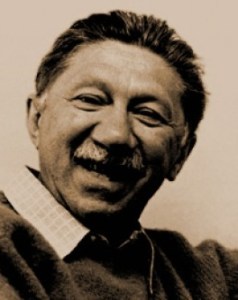
Today, I´d like to honor another luminary, the person who actually coined the term Positive Psychology in the 1950s: Abraham Maslow, probably best-known for his hierarchy of needs framework (mostly depicted as the “pyramid of needs” you´ll find in a lot self-help and management books).

Here are some of his most intriguing thoughts:

Abraham Maslow on Self-Actualization

It looks as if there were a single ultimate goal for mankind, a far goal toward which all persons strive. This is called variously by different authors self-actualization, self-realization, integration, psychological health, individuation, autonomy, creativity, productivity, but they all agree that this amounts to realizing the potentialities of the person, that is to say, becoming fully human, everything that person can be.

—–

We fear our highest possibilities. We are generally afraid to become that which we can glimpse in our most perfect moments, under conditions of great courage. We enjoy and even thrill to godlike possibilities we see in ourselves in such peak moments. And yet we simultaneously shiver with weakness, awe, and fear before these very same possibilities.

Abraham Maslow on Purpose in Life

A musician must make music, an artist must paint, a poet must write, if he is to be ultimately at peace with himself. What a man can be, he must be.

Abraham Maslow on Other-Orientation

The needs for safety, belonging, love relations and for respect can be satisfied only by other people, i.e., only from outside the person. This means considerable dependence on the environment. A person in this dependent position cannot really be said to be governing himself, or in control of his own fate. He must be beholden to the sources of supply of needed gratifications. […] He must be, to an extent, “other-directed,” and must be sensitive to other people’s approval, affection and good will.

—–

The great lesson is that the sacred is in the ordinary, that it is to be found in one’s daily life, in one’s neighbors, friends, and family, in one’s backyard.

Abraham Maslow on Perseverance and Post-Traumatic Growth

Not allowing people to go through their pain, and protecting them from it, may turn out to be a kind of over-protection, which in turn implies a certain lack of respect for the integrity and the intrinsic nature and the future development of the individual.

—–

One can choose to go back toward safety or forward toward growth. Growth must be chosen again and again; fear must be overcome again and again.

Abraham Maslow on Appreciation, Awe, and Gratitude

The most fortunate are those who have a wonderful capacity to appreciate again and again, freshly and naively, the basic goods of life, with awe, pleasure, wonder and even ecstasy.

Abraham Maslow on Mindfulness

I can feel guilty about the past, apprehensive about the future, but only in the present can I act. The ability to be in the present moment is a major component of mental wellness.

Honoring the Forefathers: Viktor Frankl and Men’s Quest for Meaning

Sometimes, I read or hear about criticism stating that Positive Psychology tends to ignore its forefathers (and mothers), all those, e.g., philosophers, sociologists, and psychologists from other traditions that have generated valuable insights on “the good life”. I’m tend not to agree here. If at all, I sense a bit of Americentrism – but that’s in the nature of the beast, I reckon.
Viktor FranklSo, today I like to honor Austrian psychiatrist Viktor Frankl, who founded Logotherapy (“meaning therapy”) and certainly is one of the biggest influences around the letter M (for Meaning) in Martin Seligman’s PERMA outline of Positive Psychology. Here are some of his most memorable quotes:

Viktor Frankl on Freedom and Dignity

Everything can be taken from a man but one thing: the last of the human freedoms—to choose one’s attitude in any given set of circumstances, to choose one’s own way.

Viktor Frankl on Success

Don’t aim at success. The more you aim at it and make it a target, the more you are going to miss it. For success, like happiness, cannot be pursued; it must ensue, and it only does so as the unintended side effect of one’s personal dedication to a cause greater than oneself or as the by-product of one’s surrender to a person other than oneself.

Viktor Frankl on Choice and Growth

Between stimulus and response, there is a space. In that space is our power to choose our response. In our response lies our growth and our freedom.

Viktor Frankl on Meaning and Responsibility

Ultimately, man should not ask what the meaning of his life is, but rather must recognize that it is he who is asked. In a word, each man is questioned by life; and he can only answer to life by answering for his own life; to life he can only respond by being responsible.

Viktor Frankl on Meaning and being Other-Focused

By declaring that man is responsible and must actualize the potential meaning of his life, I wish to stress that the true meaning of life is to be discovered in the world rather than within man or his own psyche, as though it were a closed system. I have termed this constitutive characteristic “the self-transcendence of human existence.” It denotes the fact that being human always points, and is directed, to something or someone, other than oneself–be it a meaning to fulfill or another human being to encounter. The more one forgets himself–by giving himself to a cause to serve or another person to love–the more human he is and the more he actualizes himself.

Viktor Frankl on Purpose in Life

Everyone has his own specific vocation or mission in life; everyone must carry out a concrete assignment that demands fulfillment. Therein he cannot be replaced, nor can his life be repeated. Thus, everyone’s task is unique as is his specific opportunity to implement it.

Lift! On Leading with Purpose

Most managers behave as if they were still in high school. The primary goal is not being laughed at.

This sentence resonates with/in me ever since I’ve heard it three days ago. Professor Robert Quinn, co-founder of the Center for Positive Organizations at the Ross School of Business (Michigan) coined it during a workshop on building positive cultures which was part of the Positive Business Conference 2016.

This is, of course, not the first time someone explained to me that most organizations create an atmosphere of (more or less) constant fear. But I have learned over the years that, in order to really grasp a “thing”, somebody has to present it to you at the right time in just the right words.

LiftI was so impressed after the workshop that I instantly bought his book Lift: The Fundamental State of Leadership (co-authored with his son Ryan) at the book table and devoured it on the plane back home from Detroit to Frankfurt, Germany. And what can I say? It´s one of the best books on leadership I´ve ever read.
Truth be told: I read a lot of management and psychology books (broadly speaking) and most authors on interpersonal leadership leave me rather unimpressed. I´m a senior human resources manager working in the headquarter of a multinational organization of 120,000 people, leading a team across two continents, additionally being responsible for groups of people that are part of our international trainee programs, and coordinating the efforts of multiple agencies that support us in recruiting and employer branding.

Against this backdrop, I can honestly say: Leadership is not easy. It doesn´t come down to checklists and simple recipes. Instead, it can be immensely taxing and challenging: It´s hard work. That´s why I enjoy leadership books that acknowledge and appreciate this basic condition.

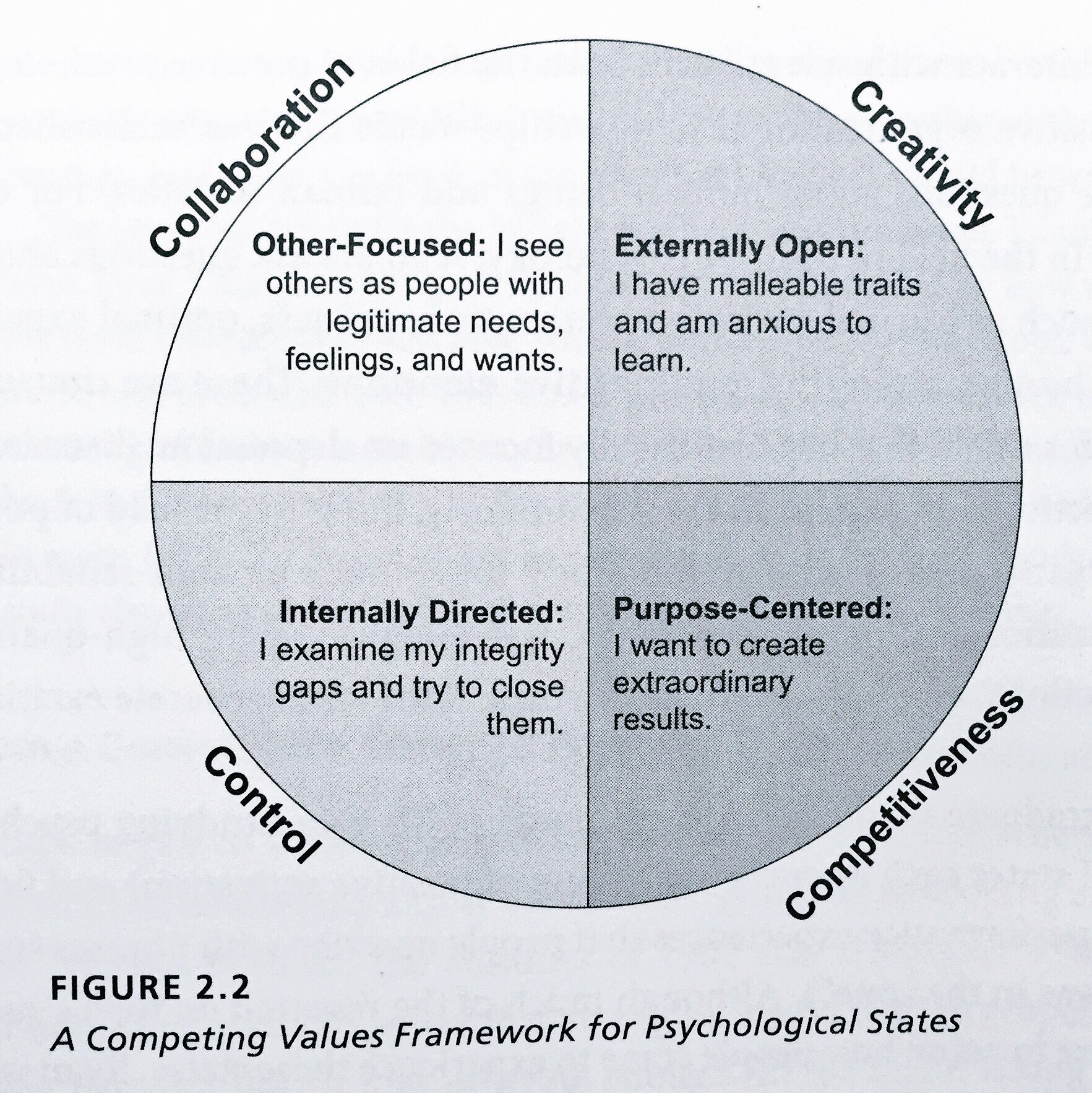
Lift - Psychological States - QuinnRobert Quinn´s “Lift” is such a book. It draws on a useful metaphor from aerodynamics (the dynamic that makes objects fly even though they are heavier than air) but more importantly, is grounded in decades of top-tier research. The framework that serves as the outline of the book is based on an influential article in the journal Management Science from 1983, A Spatial Model of Effectiveness Criteria: Towards a Competing Values Approach to Organizational Analysis that aims at describing the basic dimensions of organizational effectiveness.

Quinn takes this framework and uses it to outline four corresponding psychological states of leadership: Purpose-centered, internally directed, other-focused, and externally open. This is the crucial point that differentiates “Lift” from most other leaderships books: It doesn´t tell (aspiring) leaders what to do on a concrete level. Instead, it serves to cultivate a certain mindset, a stance, a leadership conduct – what the author terms the fundamental state of leadership.

The author proposes we can enter this special mindset when we (implicitly or explicitly) apply a set of questions to given leadership situations, especially those that bear potential for resistance and conflict. These questions correspond to the four quadrants of the effectiveness/psychological states model.

  1. What results do I want to create? (objective: becoming less comfort-centered and more purpose-centered).
  2. What would my story be if I were living the values I expect of others? (objective: becoming less externally directed and more internally directed).
  3. How do others feel about this situation? (objective: becoming less self-focused and more other-focused).
  4. What are three or more strategies I could try in learning how to accomplish my purpose? (objective: becoming less internally closed and more externally open).

If you want to hear a short summary in Quinn´s own word, here you go:

For me, an added value of the book is that it provides a very clear definition of an individual purpose. I´ve been struggling with that concept for quite a while now. I know I will have to sharpen mine in order to live up to my full potential – but most of what I´ve read so far has left me irresolute. Here´s what Quinn proposes:

When people are purposed-centered,

  1. they envision and pursue extraordinarily results that are not constrained by previous expectations or by expectations that they receive from others;
  2. the results they pursue are energizing because they are self-chosen, challenging, and constructive;
  3. they provide a clear definition of the situation, focusing people´s attention.

Most management books I read – whether I enjoyed them or not – don’t nudge me to do anything differently afterwards. I put them in a shelf and hope, at best, to remember one or two good ideas.

With “Lift”, it´s a different story. I have already printed out the four questions and I will stick them to the computer screen in my office next Monday. And I will use the aforementioned definition to further mold my individual purpose.

Share and enjoy!

P.S.
To learn more, you might want to watch Quinn´s 2013 TEDX talk.

Prof. Victor Strecher on Boiling Frogs, Public Health, and Purpose in Life

I´ve had the pleasure of listening twice to Prof. Vic(tor) Strecher, Professor of Health Behavior and Health Education at University of Michigan. First, at a book reading (he´s just published a new book by the name of Life on Purpose), and the day after when he presented at the Positive Business Conference.

Based on this experience, I highly encourage you to watch his 2014 TEDx talk. First, he has a beautiful voice (if you ask me…), he’s highly entertaining, but more importantly, he has a vital message for us on how to live healthier and more fulfilling lives – by finding an following our unique purpose.

Additionally, you need (no, you must…) have a look at his app JOOL which helps people to make better (health and happiness-related) decisions and live according to their purpose. I´ve seen a couple of similar products over time, but most left me rather unimpressed. JOOL seems to be the real deal. Designed well, easy to use, based on sophisticated models and algorithms that adapt to your specific needs over time. Check it out!

JOOL App - Vic Strecher

Thriving not Surviving: Positive Business Conference (Day 2)

While the first day of the Positive Business Conference 2016 has been stimulating and inspiring, the second day was truly transformative for me – and mind you, I don’t use words like this lightly. But I will eloborate on this at a later point in time. The impressions are too fresh to put them in intelligible phrases.

For today, I’d like to recap the day in the same day I did yesterday: by sharing some of my and other participants’ tweets.

First, I discovered my next job title:

https://twitter.com/drnicorose/status/731110612755984385

Then I learned about how to infuse a company with purpose.

I was impressed to learn how Ross School of Business strives to develop leaders that make a positive difference.

https://twitter.com/drnicorose/status/731132498495848450

https://twitter.com/drnicorose/status/731138133211942912

The early afternoon was reserved for a workshop on compassion in business led by Jane Dutton and Monica Worline. Somehow, this one made the difference that makes a difference. But as said, I’m going to talk about that in a separate post.

https://twitter.com/drnicorose/status/731155288657670144

https://twitter.com/drnicorose/status/731163965095436288

https://twitter.com/drnicorose/status/731153403464798209

Fellow Penn Mappster Jessica Amortegui was awarded with the 1. price of the Positive Business Project competition for her work with Logitech.

https://twitter.com/drnicorose/status/731187208837861379

Just like Alex Edmans explained yesterday: It pays off financially to invest in ethical companies.

https://twitter.com/drnicorose/status/731194938302582786

Coffee makes the world go round – but only if it’s fair-trade.

https://twitter.com/drnicorose/status/731204017611804672

Michigan Ross: Thanks a million for hosting that is brilliant conference. I’ll be back…!

https://twitter.com/drnicorose/status/731212530249519104

positive business conference 

Passion. Purpose. Performance. Positive Business Conference (Day 1)

I’m absolutely thrilled to be at the University of Michigan, attending this year’s Positive Business Conference at Ross School of Business.This post is my personal summary of the conference’s first day, brought to you via some of the tweets I’ve put out there…

https://twitter.com/drnicorose/status/730755747395604480

Prof. Vic Strecher shared some really intriguing upsides of having a strong purpose in life. More importantly, you should check out his fabulous app JOOL.

https://twitter.com/drnicorose/status/730761605944905728

Prof. Jane Dutton had me change my mind on using the term rockstar only in contexts that involve electric guitars. She shared with us her Flourishing Triangle framework of organizational effectiveness.

https://twitter.com/drnicorose/status/730773900506894336

I was equally thrilled to be able to learn directly from Prof. Alex Edmans, whose work on the financial impact of treating employees exceptionally well has been covered extensively on Mappalicious.

https://twitter.com/drnicorose/status/730778590313320448

Prof. Joe Arvai shared some incredible research on how to help consumers make more ethical buying decisions. E.g., why is that we can consciously choose from what part of the world our coffee comes from (and how it was cultivated) – but not with regard to our gasoline? And what if we could

https://twitter.com/drnicorose/status/730786157596954626

After lunch, I was thrilled to have the opportunity of attending a workshop led by Prof. Robert Quinn whose blog posts I share frequently via my Positive Psychology News Digests.

https://twitter.com/drnicorose/status/730822508534988800

Once more it became clear to me that we do not really understand “a thing” (even if we’ve heard about it a lot of times) until somebody explains it to us in the exactly right words at the right time.

https://twitter.com/drnicorose/status/730823755203813377

When you’re in the right space, the smartest “person” in the room is the room itself.

https://twitter.com/drnicorose/status/730870737234481152

Jim Miller, VP at Google, shared insights on the special culture that drives the incredible success of the company.

https://twitter.com/drnicorose/status/730877115038609409

https://twitter.com/drnicorose/status/730876211254202369

Of course, there were more sessions, and more speakers, and an abundance of inspiring conversations while having delicious food – but I cannot cover it all here.

Yet, one last thing I found out is this:

https://twitter.com/drnicorose/status/730843363457568768

Share and enjoy!

Positive Business Conference

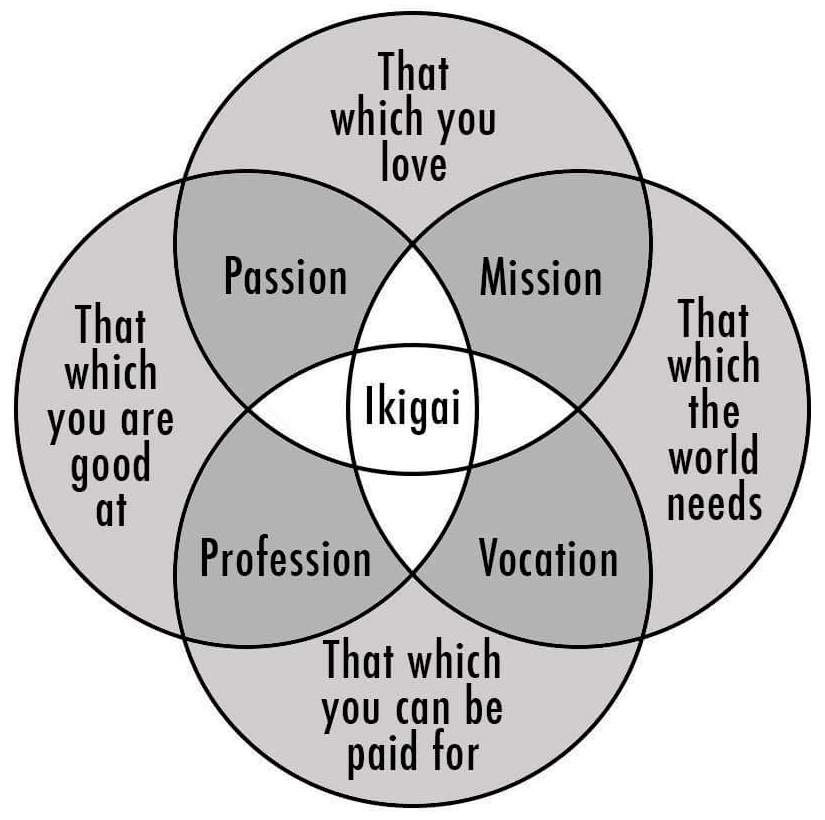
What’s your “Ikigai”? On Purpose, Meaning, and making a Living

There’s a very popular infographic on the net. It’s been around for a couple of years in several different versions.*

The graphic is supposed to help us find our life purpose by showing the different elements it consists of. It displays several overlapping Venn diagrams, thereby distinguishing the elements of mission, vocation, profession, and passion.

Ikigai - Purpose - Meaning
In later versions, at the center of those four circles, you’ll see the Japanese word Ikigai. Just in case you are wondering: Ikigai is composed of two separate Japanese terms: iki (life), and kai, which roughly means the realisation of what one expects and hopes for.

In more specific terms, ikigai is a) used to indicate the things that make one’s life worthwhile, and b) to refer to mental and spiritual circumstances under which individuals feel that their lives are valuable.

Having found (and living according to) one’s personal ikigai seems to be associated with greater health and longevity. At least this was a finding from a large-scale study among Japanese citizens. From the summary:

In this population-based prospective cohort study in Japan, those who did not find a sense of ikigai were significantly associated with an increased risk of all-cause mortality. The increase in mortality risk was attributed to an increase in the mortality from CVD (mainly stroke) and external causes […]. 

In our study subjects, those who did not find a sense of ikigai were likely to have a poorer socioeconomic status and poorer objective health status. However, the mortality risk in those who did not find a sense of ikigai was consistently increased, irrespective of socioeconomic factors, other psychological factors, physical function, lifestyle habits, and a history of illness.

*The infographic can be found in numerous versions on a ton of websites. In case you know who created it originally, please leave a comment so I can give proper credit.

The Structure of Psychological Well-Being — before PERMA

Torbogen_Kirche_kleinWhen talking about the “grand design” of psychological wellbeing these days, most people (at least implicitly) refer to Seligman’s PERMA framework, comprised of the building blocks: positive emotions, engagement, relationships, meaning, and achievement. You might also find people who add another letter for vitality, resulting in PERMA-V.

Of course, Seligman’s outline wasn’t the first attempt at developing a “theory of everything” with regard to psychological well-being.

Between 15 to 20 years before the introduction of the PERMA framework, researchers Carol Ryff and Corey Keyes presented a data-driven model that is comprised of 6 dimensions (here’s the link to one of the original papers: The structure of psychological well-being revisited): self-acceptance, positive relations with others, autonomy, environmental mastery, purpose in life, and personal growth.

Quite obviously, there’s a lot of overlap between the two frameworks, but also subtle differences.

To me, one very interesting feature of the Ryff/Keyes model is the idea that well-being is a higher-order entity. They were able to show statistically there’s a kind of “the whole is greater than the sum of its parts”-effect in the data. The idea is that psychological well-being exists as a single factor on the meta-level, where the whole has more meaning than the parts – kind of like looking at a house creates more meaning than looking at bricks, a door, and windows separately.

Here are the six factors of the Ryff/Keyes model in the original words of the researchers:

Self-Acceptance

High scorer: possesses a positive attitude toward the self; acknowledges and accepts multiple aspects ofself, including good and bad qualities; feels positive about past life.

Low scorer: feels dissatisfied with self, is disappointed with what has occurred in past life, is troubled about certain personal qualities, wishes to be different than what he or she is.

Positive Relations With Others

High scorer: has warm, satisfying, trusting relationships with others; is concerned about the welfare of others; capable of strong empathy, affection, and intimacy; understands give and take of human relationships.

Low scorer: has few close, trusting relationships with others; finds it difficult to be warm, open, and concerned about others; is isolated and frustrated in interpersonal relationships; not willing to make compromises to sustain important ties with others. 

Autonomy

High scorer: is self-determining and independent, able to resist social pressures to think and act in certain ways, regulates behavior from within, evaluates self by personal standards.

Low scorer: is concerned about the expectations and evaluations of others, relies on judgments of others to make important decisions, conforms to social pressures to think and act in certain ways.

Environmental Mastery

High scorer: has a sense of mastery and competence in managing the environment, controls complex array of external activities, makes effective use of surrounding opportunities, able to choose or create contexts suitable to personal needs and values.

Low scorer, has difficulty managing everyday affairs, feels unable to change or improve surrounding context, is unaware of surrounding opportunities, lacks sense of control over external world.

Purpose in Life

High scorer: has goals in life and a sense of directedness, feels there is meaning to present and past life, holds beliefs that give life purpose, has aims and objectives for living.

Low scorer: lacks a sense of meaning in life; has few goals or aims, lacks sense of direction; does not see purpose in past life; has no outlooks or beliefs that give life meaning.

Personal Growth

High scorer: has a feeling of continued development, sees self as growing and expanding, is open to new experiences, has sense of realizing his or her potential, sees improvement in self and behavior over time, is changing in ways that reflect more self-knowledge and effectiveness.

Low scorer: has a sense of personal stagnation, lacks sense of improvement or expansion over time, feels bored and uninterested with life, feels unable to develop new attitudes or behaviors.

10 fantastic Quotes by William James that preview Positive Psychology

Philosopher William James is often portrayed as being the founding father of modern (American) psychology. Here, I collected ten of his quotes that show he’s also been an influence for many theories and practices that are among the cornerstones of Positive Psychology.

On self-efficacy and solution-focused thinking

Action may not always bring happiness, but there is no happiness without action.

On creating habits

To change one’s life:
1. Start immediately.
2. Do it flamboyantly.
3. No exceptions.

On optimism, pessimism, and rumination

If you believe that feeling bad or worrying long enough will change a past or future event, then you are residing on another planet with a different reality system.

On the value of attention and mindfulness

Each of us literally chooses, by his way of attending to things, what sort of universe he shall appear to himself to inhabit.

On belief systems and disputation of negative thoughts

To perceive the world differently, we must be willing to change our belief system, let the past slip away, expand our sense of now, and dissolve the fear in our minds.

On perseverance, grit, and sisu

In exceptional cases we may find, beyond the very extremity of fatigue distress, amounts of ease and power that we never dreamed ourselves to own, sources of strength habitually not taxed at all, because habitually we never push through the obstruction, never pass those early critical points.

On finding purpose and vitality

Seek out that particular mental attribute which makes you feel most deeply and vitally alive, along with which comes the inner voice which says, ‘This is the real me,’ and when you have found that attitude, follow it.

On meaning, altruism, and the greater good

The great use of life is to spend it for something that will outlast it.

On the value of positive relationships

Wherever you are, it is your friends who make your world.

On hope, best future selves, and callings

Your hopes, dreams and aspirations are legitimate. They are trying to take you airborne, above the clouds, above the storms, if you only let them.
 William  James