On Meaning and Life Satisfaction

If you are a regular reader of Mappalicious you know that I´m currently a student at University of Pennsylvania. Today, I need your help! For our statistics class, it is our duty to recreate an already existing study – so we need to gather some data.

Therefore, you could do me a really, really big favor: Please click on this link to fill out a short questionnaire. It´ll take you only about 5 – 10 minutes. This questionnaire is on meaning in life and life satisfaction.

Afterwards, you might want to read the original study. But please do this after you´ve filled in the questionnaire. Otherwise, your result may be biased.

Thank you very much in advance!

Nico

My Direction

Positive Psychology: Is it about Pleasure? Or Meaning? Or both?

The silence on Mappalicious is officially over. I´ve been travelling over the last 14 days and obviously have been too busy actually living my life in order to write about it in addition. And while doing this, I´ve made an interesting discovery: you can spend your days in New York (arguably the most exciting place on Earth) with a bunch of really nice people and a great program (Broadway musical, boat tour on the Hudson, party at one of the best rooftop bars in town etc.) – and still end up crying your eyes out in the hotel room. Just because you miss baby boy so much. True story…

Mika_Nico

Which raises a question on the nature of Positive Psychology:

Is Positive Psychology about leading a happy, pleasurable life? Or is it about leading a virtuous, meaningful life?

The answer is: both aspects are important – but if you would ask Marty Seligman, he´d say the emphasis clearly should be on cultivating strengths, virtues, and meaning. While experiencing lots of positive emotion definitley is a goal in Positive Psychology (because it just feels good to feel good; but more important: because positive emotions produce lots of beneficial ‘side effects’) they are only one element (P) of PERMA, Seligman’s theory of human flourishing.

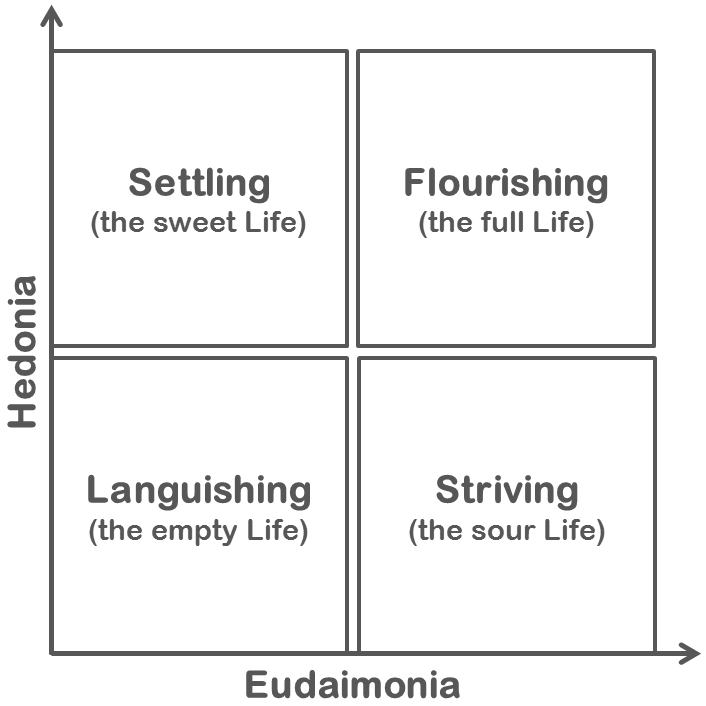
On the overarching level, it is possible to distinguish between the quest for hedonic (pleasurable) and eudaimonic (virtuous) experiences. Both clearly are important for leading a ‘full’ life, but Eudaimonia may just be a little more sustainable in the long run. When creating a 2×2 matrix with Eudaimonia on the one axis and Hedonia on the other, it will look like this:

Hedonia_Eudaimonia

  • When a human being experiences high levels of positive emotion and the presence of meaning, worthwhile goals, connection to other human beings etc., this can be characterized as ‘the full life’ or ‘Flourishing’ in the official diction.
  • The absence of both dimensions is called ‘the empty Life’ or ‘Languishing’ – a condition that is closely tied with depression.
  • If someone is high on the hedonic dimension but relatively low on Eudaimonia, I like to call it ‘the sweet life’ (‘Settling’ in the official lingo). By way of example, imagine the prototypical billionaire heir that squanders his family´s money on the French Riviera. It´ll surely be pleasurable but may also seem somewhat shallow.
  • On the other hand, when there´s a considerable lack of Hedonia, this condition can be termed ‘the sour life’ or ‘Striving’ in official Positive Psychology speak. You might want to imagine the epitome of an old unmarried lady that spends all of her time and money on ‘good causes’ but forgets herself on the way. It is admirable but may also seem a little ‘anemic’.

If you´d like to learn more: I´ve written an article in a coaching magazine on that topic about a year ago. It´s in German unfortunately – but I know that many German-speaking people are reading this blog, too…

I went to MAPP and all I got was this…

Schwartz…deck of cards! No, that´s not true obviously.

Today has been the first day of MAPP´s second onsite learning period – and actually, every student did in fact get a deck of cards as a gift from Barry Schwartz, who is this weekend´s guest lecturer. It was created by Brooke Allen and is supposed to help us to create a “robust Philosophy of Life” by answering 54 questions on life, meaning, and sense of purpose. I have yet to try them out – but I will let you know how it all worked out.

Card Game

As before, I do feel I´m not yet ready to write on what we´ve learned today. I´m still in the process of digesting everything that has been said. Instead, I´m going to build on a recent article that summarizes the most important ideas from Schwartz´s book ‘The Paradox of Choice’. In that post, I described why Schwartz believes that having too many choices can make us miserable.

The question is: is that really true? After all, we live in a free market economy and that´s supposed to make us happier than experiencing lots of constraints, e.g., like it used to be in most (former) communist countries. A powerful piece of evidence comes from the Amish people, a religious community with German heritage of about 250.000 people that pursue a simple, non-materialistic lifestyle – basically they ignore all kinds of modern comforts like cars, telephones, and electricity in general. While this may sound not too inviting there may be some interesting upsides this kind of lifestyle. Notably, the depression rate of the Amish is only a fraction of the overall U.S.  population. One explanation for this might be the very close social ties that the Amish are embedded in. But yet another hypothesis can be drawn from the work of Schwartz: the Amish only have to make a fraction of the choices that we have to make in our lives. They do not have to worry about which clothes to wear because basically there is a rule. The do not have to worry about which car to buy because it is simply not allowed to own a car. In most orders, it´s not allowed to maintain a website – and so on.

At the end of the day, that may not seem very attractive to most ‘modern’ people. Good news is: we do not have to copy them. But we should be aware of the principle behind those actions: choosing not choose can be a potent way of improving our lives. Setting rules, standards, and default modes is be a powerful trajectory towards increased mental health.

How does this relate to your life?

Was Socrates a happy Man? And if he lived today – would he be a Blogger?

Socrates - Louvre

By Eric Gaba (CC-BY-SA-2.0) via Wikimedia Commons

The topic for the afternoon of the last day of MAPP immersion week was the trial that eventually lead to the death sentence of Socrates, arguably one of the most important philosophers of all time. There are some hints in the Apology, Plato´s account of the trial, that allude to the idea that Socrates ‘chose’ to be sentenced to death – in the sense that he could have gotten away with a significantly milder punishment, if had chosen to display a different demeanor. Yet, he stayed true to his own self (being a philosopher, asking lots of probing questions, and thereby being the ‘pain in the ass’ of most of his fellow citizens), which provoked the judges and most his fellow Athenians (“Men of Athens, I honor and love you; but I shall obey God rather than you, and while I have life and strength I shall never cease from the practice and teaching of philosophy…”). Supposedly, there were some politically motivated reasons for his death sentence as well – but that is another story.

James Pawelski, Director of the MAPP program asked us an interesting question: was Socrates a ‘happy’ man? Obviously, it´s not possible to ask him any more – but the Apology contains some hints on that topic: when investigating the text for displays of PERMA, Martin Seligman´s definition of the elements of flourishing: Positive emotion, Engagement, Relationships, Meaning, and Achievement. While it is not clear if Socrates experienced a lot of positive affect (P), it is save to say that he displayed a high level pertaining to the remaining four elements: He obviously had something which he deeply cared about and regularly was immersed in, e.g., teaching his students (E). He also had a wife and three children, as well as his students and followers that admired and valued him (R). Socrates definitely experienced a sense of meaning in his life. He felt that it was his noble duty to be a philosopher and oftentimes spoke of his inner daimon that protected and/or guided him. And finally, we are still able to read about his deeds today – which obviously is not true for most of the other men of his time (A). Bottom line: While we cannot be sure about the ‘P’, there was definitely a lot of ‘ERMA’ in his life.

Let us rest the case here. But what about the other question? Would he be a blogger today? First, I assume, it is helpful to know how this rather strange question came into being. Unlike James, I am a psychologist and coach by training, not a philosopher. So I asked him about the psychological contract between Socrates and his fellow Athenians. While he had a lot of students that would actively seek him out, he supposedly also used his Socratic Method (basically: asking someone lots of questions until he finds the right answer by himself) on a lot people that really did not want to be bothered by him. James answered analogously, that Socrates probably would not want to be named a ‘patron of the coaching business’ – but that today, he might be a kind of (political) blogger. He would try to be the thorn in the side of the leading political class, exposing their flaws and misconceptions.

Once again, we cannot ask him anymore – but I kind of like that thought…

Why talking about the weather may make you unhappy – even on beautiful days

Today has been the second day of the MAPP´s so-called immersion week. Angela Duckworth is teaching research methods and statistics, which frankly speaking will never be my favorite subject – but that´s o.k. To learn more about the methodology of psychological research and to get an idea of how research papers are crafted, we skimmed through some articles in the classroom. I´d like to share one of those with you; it was published by Matthias Mehl and some colleagues.

Now the thing is: I am German and there is this stereotype of Germans as being rather uptight, not exactly unfriendly, but – you know – a little stiff, just not that easy to talk to. We´re the so-called “nation of poets and thinkers”, but just not very good at small-talk. Which…

…tadahhh – might explain why we´re also a rather happy nation on average!

What Matthias Mehl does as a researcher: he hooks up people with tiny recording devices that switch on automatically at certain intervals over the day. As a result, he gets these little samples of our everyday behavior, especially what we say to other people and what they say to us, respectively. Here´s what he´s found out: People that spend a lot of time in the company of other people are considerably happier on average than folks who mostly like to spend time on their own. There´s nothing new here. But: it also matters to a great extent what you talk about.

There is a considerable negative correlation between life satisfaction and small talk; and a considerable positive correlation between meaningful (“deep”) conversations and life satisfaction. Talking about shallow topics too often may be not all that beneficial to our psychological well-being. This, in turn, reminded me of that little story which is commonly attributed to Socrates – but presumably is a universal parable.

The three sieves of Socrates

Once upon a time, one of the acquaintances of Socrates came running and said: “Socrates, do you know what I just heard about one of your students?”
“Wait a minute”, Socrates stopped him, “Before you tell me, I would like to conduct the three sieves test.”
“Three sieves test?”
“Yes. Before you tell me anything, take a moment to consider carefully what you are going to say and pour your words through these sieves.”
“The first one is the sieve of truth. Are you absolutely sure that what you are about to tell me is true?”
“Well… no. Actually I heard it recently and…”
“Alright”, interrupted Socrates, “So you don’t really know if it is true or not!”
“Now, let us try the second one, it is the sieve of goodness. Are you about to tell me something good about my student?”
“Well…no. On the contrary…”
“So, you want to tell me something bad about him” roared Socrates, “even though you are not certain if it is true or not?”
The acquaintance shrugged, already feeling uncomfortable.
“You may still pass the test though” said the Socrates, “because there is a third sieve – the sieve of usefulness.”
“Is what you were to tell me about my student going to be useful?”
“No, not really…” said the man resignedly. 
Socrates continued his lesson, “Well, if what you want to tell me is neither true nor good nor useful, why tell me at all?”