What Thomas Edison knew about Grit…

What Thomas Edison knew about Grit…
 Yesterday, I told you that I would be going to give a TEDx talk at Bergen/Norway today. And that´s already history by now. I had a great time and would like to congratulate the TEDxBergen team for the great job that they´ve done (the event is entirely run by students!). Thanks for inviting me…
Since it´s probably going to take a couple of days until there´s a video available, let me give you a bit of advance information. My topic was: “How to be the architect of your own fortune”. I talked about how some People be seem to be luckier than others by sort of inviting luck into their lives.
In doing so, I cited some work by Richard Wiseman, Esa Saarinen, Steven Johnson/Stuart Kauffman, and Angela Duckworth. I also integrated some quotes by Louis Pasteur, Woody Allen, and Richard Branson, and talked about how God “manages”.
Here´s the summary, basically – which was also my punchline for the talk. If you want to bring more luck into your life, this is how it goes:

Watch out for my video in a couple of days…
Here´s my Top 20 for the time being. Any suggestions what to add?
Edit
I guess since I´ve given my first TEDx talk now, it´s fair enough to put it on the list. 🙂
Part of the requirements for the 2. semester of the MAPP program has been a 4-month service-learning project. To this effect, my beautiful “cohort” members Patricia De La Torre, Charles Cycon, Harold Hanul Lee, Guang Zeng, and my humble self had the great pleasure to work with Philly-based NFP Youth Mentoring Partnership (YMP) and their truly inspiring Director Chris Major.
YMP is committed to “helping kids overcome formidable challenges to be successful today and in the future”. YMP programs have five main components: mentoring, intense physical fitness, focused goal-setting and achievement, earned recognition, and positive feedback. The organization’s signature intervention is the Friend Fitness Program (FFP). Offered year-round in select locations, the FFP is free of charge to students in grades 6 – 12.
 The FFP aims to instill beneficial traits in its students by designing a challenging mix of intense strengths-training workouts, super-slow manual resistance routines, and cardio exercises. Upon entering the program, students are matched with a personal mentor that gives them undivided attention, guides them through strength training exercises, monitors their progress, helps set and track their goals, celebrates their achievements, acts as a positive role model, and becomes a supportive caring friend. Over the course of a year, students learn to take care of their bodies, set goals and achieve them, take responsibility for their actions, develop resiliency in the face of adversity, value effort and perseverance, and to ultimately develop Grit – which is defined “perseverance and passion for long-term goals” and has been shown to be associated with a variety of desirable outcomes such as a high GPA in college (beyond the explanatory power of general intelligence).
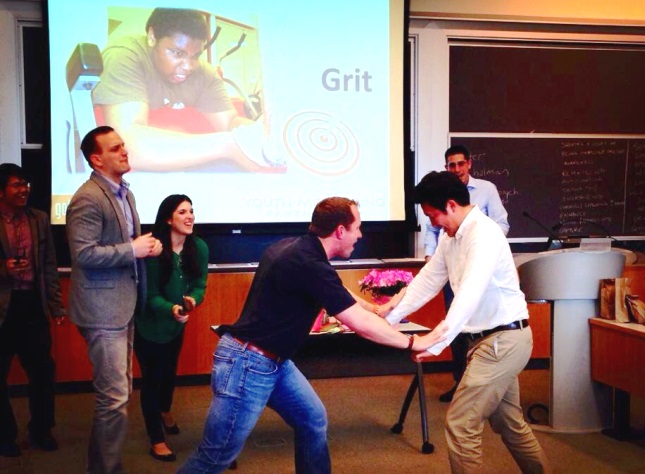
The “secret sauce” of FFP is creating regular “moments of choice” which basically means giving the kids a (physical) adversity to overcome and thereby the opportunity to grow by choosing to persevere in the face of that challenge – aided by the support from the personal mentor. The general idea is that those experiences of success via being gritty will then spill over to other domains of life, such as school work. Below, you’ll see a photo displaying Chris leading Harold through one of the super-slow resistance routines (and the rest cheering for them) as part of our final project presentation.
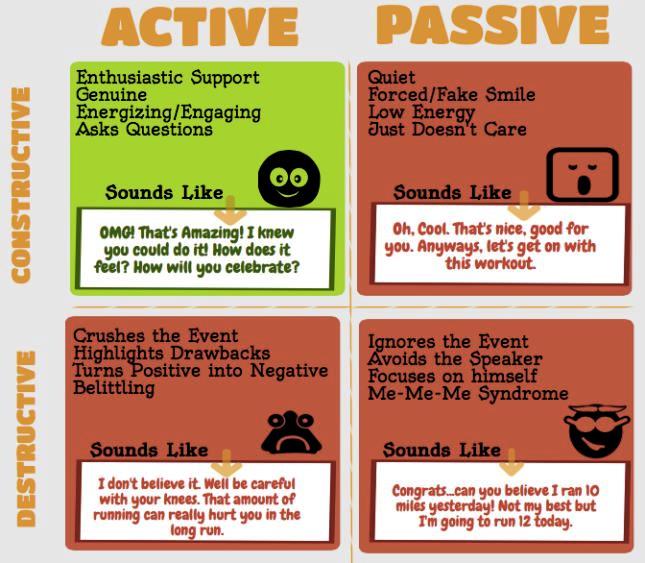
In short, we helped YMP by enhancing their onboarding process for new mentors. Among others things, we´ve created the outline and a demo for an online course and several infographics on relevant Positive Psychology concepts such as active-constructive responding.
And this is also where you, gentle reader, may come into play:
If you love kids, sports, and fun (plus: doing “good”), YMP might be the place for you (even outside of Philly – they´d really like to expand…). If your are thinking about volunteering, donating, or helping YMP in any way you see fit, please go to their website and contact Chris.
P.S.
Chris – you´re an awesome individual!
Any suggestions from your side? I´m not a Christian (any more) – so I could very well live with 17 or 333 commandments…
–> Research on the benefits of positive emotions.
–> Research on the benefits of experiencing flow.
–> Research on the benefits of positive relationships.
–> Research on the benefits of finding meaning and purpose in life.
–> Research on the benefits of grit and achievement.
–> Research on the benefits of physical exercise.
–> Research on the benefits of spending time in nature.
–> Research on the benefits of post-traumatic growth.
–> Research on the benefits of meditation and mindfulness.
–> Research on the benefits of altruism.
* I just couldn´t resist putting one of favorite metal bands in this list. Kiitos, Stratovarius!
** The last song is also a hint at what to do with this post… 🙂
The MAPP program is a fulltime program – but combines onsite classes with long-distance learning periods. Part of the distance learning comprises a lot of reading (Who would have thought of that…) and writing essays about a wide array of positive psychology topics. I´ve decided to post some of those essays here on Mappalicious. Surely, they´re not the be-all and end-all of academic writing. But then again, it would also be a pity to bury them in the depths of my laptop. So here we go…
Seligman (2011) posits that engagement, for instance, by regularly entering into a state of Flow (Csikszentmihalyi & LeFevre, 1989), and seeking and realizing achievement (Wiegand & Geller, 2005) on and off the job are two constitutive elements of well-being. These concepts are represented by the letters E and A in the acronym PERMA, Seligman´s current outline of positive psychology. Csikszentmihalyi (1990) characterizes Flow as a state of optimal experience. The most important features of Flow are effortless attention, absence of time awareness, and absence of emotion. Seemingly contradictory, Duckworth, Peterson, Matthews, and Kelly (2007) posit that Grit, characterized as a passion and persistence for long-term goals and the associated exercise of self-control (Duckworth & Seligman, 2005), are key predictors of sustainable achievement. In this paper, I will argue that experiencing Flow and exerting Grit may be alternating stages on the same road to accomplishment – much in the same way that in- and exhaling are interchanging phases of the process of breathing.
At first glance, even though both concepts are perceived as pathways to achievement, Flow and Grit do have characteristics that seem to be somewhat incompatible. Grit is theorized as a stable character trait that does not require an immediate positive feedback loop. Individuals high in Grit are capable of sustaining determination and motivation over long periods despite experiences with failure and adversity (Duckworth et al., 2007). Their passion for long-term objectives is the principal factor that provides the energy required to keep on track amidst challenges and set-backs. Using one´s Grit may be gratifying in the end because it helps us to reach long-term goals – but is doesn´t necessarily have to feel good while still being “on the way”. Often, using Grit is the opposite of the characteristic of effortlessness. In fact, it can lead people to “torture” themselves for the “greater good”.
On the other hand, Flow is a state that is “easy” (Csikszentmihalyi, 1990). While it is important to have feelings of potential control and mastery in order to experience Flow, it does not feel like it is necessary to exert control – things seem to take care of themselves. In fact, most people report that feeling nothing at all is a typical characteristic of being “in the Flow”. Positive feelings only come after the task at hand is done. In addition, experiencing Flow is dependent on regular task-related feedback. It is attained most easily when a person´s skills and the challenge at hand are of equal magnitude.
I propose that the relationship of skill level and the difficulty of the task at hand may be the connection between both concepts. Flow is typically depicted as the optimal level between boredom and anxiety:
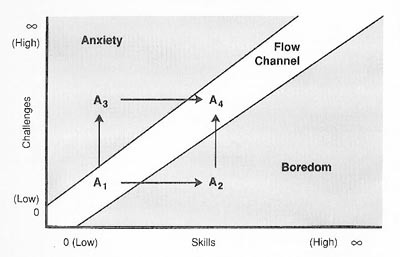
It seems likely that gritty persons are typically capable of overcoming the anxiety of facing challenges that seem too difficult at first. They perceive obstacles as challenges, and by conquering these challenges, the continuously expand their skill level. This, in turn, will enable them to potentially experience Flow in more difficult situations in the future. Thereby, the gratifying experience of Flow may be the reward for having pushed one´s boundaries just a little further.
To close this essay with an analogy: in my opinion, the relationship between Grit and Flow resembles the interplay of Yin and Yang in Taoism. Yin is the female, soft, or yielding principle. It can be likened to being in Flow. It´s letting go without losing control, it´s doing without doing. On the other hand, exerting Grit can be likened to Yang: it´s the male, hard, or penetrating principle. It´s holding on to preserve control, it´s doing by taking action. These principles seem to be contradictory – but in fact, they are complementary.
Csikszentmihalyi, M., & LeFevre, J. (1989). Optimal experience in work and leisure. Journal of Personality and Social Psychology, 56(5), 815-822.
Csikszentmihalyi, M. (1990). Flow: The psychology of optimal experience. New York: Harper-Perennial.
Duckworth, A. L., Peterson, C., Matthews, M. D., & Kelly, D. R. (2007). Grit: perseverance and passion for long-term goals. Journal of Personality and Social Psychology, 92(6), 1087-1101.
Duckworth, A. L., & Seligman, M. E. (2005). Self-discipline outdoes IQ in predicting academic performance of adolescents. Psychological Science, 16(12), 939-944.
Seligman, M. E. (2011). Flourish: A visionary new understanding of happiness and well-being. New York: Free Press.
Wiegand, D. M., & Geller, E. S. (2005). Connecting positive psychology and organizational behavior management: Achievement motivation and the power of positive reinforcement. Journal of Organizational Behavior Management, 24(1-2), 3-25.
Just found out that I wasn´t the first person on planet Earth to have the brilliant abovementioned thoughts (What was I thinking anyway…). Here´s a very instructive blog post along similar lines by the name of Grand Unified Theory of Mastery.
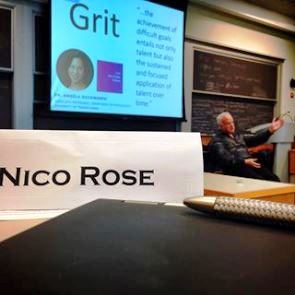 If you´re like most people, you´re not going to be particular fond of statistics. But: Lo and behold – it can be fun! You just need the right teacher. In the case of the MAPP program, it is Angela Duckworth who was just awarded with a McArthur Fellowship – a prize that is informally also called “Genius Grant”. Angela received this award for her research on the concept of Grit which has shown to be a predictor of (academic) success above and beyond the predictive power of intelligence. In the picture, you can see Marty Seligman in the classroom the moment he told us about Angela´s achievement.
Now it might put a little extra pressure on us being taught by a genius – but who cares? When I compare this experience to learning statistics during my undergrad studies – it´s light years apart. You just need a teacher who loves to teach. So my mantra for today is:

When scientist look for the difference between (largely) successful versus not so successful people (across a multitude of different situations), the most important predictor so far has been overall intelligence. But there are – potentially – more important things than being the brightest kid in the room.
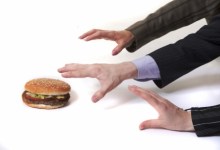
In 2007, Angela Duckworth and her colleagues first described a non-cognitive character trait by the name of “Grit”. Grit is described as perseverance and passion for long-term goals. It is supposed to have an orthogonal relationship to general intelligence – meaning they are by and large independent aspects of our personality. One can be intelligent but not gritty, gritty but not intelligent, both at the same time – or neither intelligent nor gritty.
Grit is hypothesized as a stable characteristic. A person high in Grit does not seek immediate (positive) feedback. He/she is able to maintain his/her enthusiasm for a specific goal over very long periods of time despite experiencing adversity. In this context, long-term typically means “many years”, e.g. the time it takes to finish a doctoral thesis, become a grandmaster of chess or the like. The person´s commitment towards long-term objectives is the principal element that provides the determination essential to overcome challenges and set-backs.
Abraham Lincoln may be a good example of a gritty personality. He lost his first job at the age of 23 as well as his first election campaign. At 27, he lost his second election campaign and had a nervous breakdown. Two of his sons died while still in their infancy. He lost at a race for Congress at 34, and once more in his 39th year. At 47, he failed to become the Vice President of the USA. Then, at the age of 52, he finally managed to become one of the most popular Presidents of all time.
If you want to find out how gritty you are – you´ll find short test here.
 Mappalicious